
Innovation in India is moving at a rapid pace. Start ups, research institutions, and established corporations are investing heavily in artificial intelligence, biotechnology, fintech, clean energy, and advanced manufacturing. This growth brings new commercial opportunities. It also raises complex patent challenges.
India’s patent framework has evolved to support innovation. Yet emerging technologies test the limits of traditional patent principles. Questions on patent eligibility, inventiveness, disclosure standards, and enforcement are becoming more nuanced. Businesses must understand these challenges early to protect their intellectual assets effectively.
This article explores how emerging technologies interact with Indian patent law and what innovators should consider while building a strong patent strategy.
The Rise of Emerging Technologies in India
India has become a global innovation hub. Government initiatives such as Digital India and Start-up India have created a supportive environment for research and commercialisation. Universities and private laboratories are filing more patent applications than ever before.
Key growth areas include:
- Artificial intelligence and machine learning
- Blockchain and fintech platforms
- Biotechnology and gene editing
- Pharmaceutical research and biosimilars
- Renewable energy technologies
- Semiconductor design and electronics
Each of these sectors presents unique patent concerns. The Indian Patents Act, 1970, as amended, must be interpreted carefully when applied to such technologies.
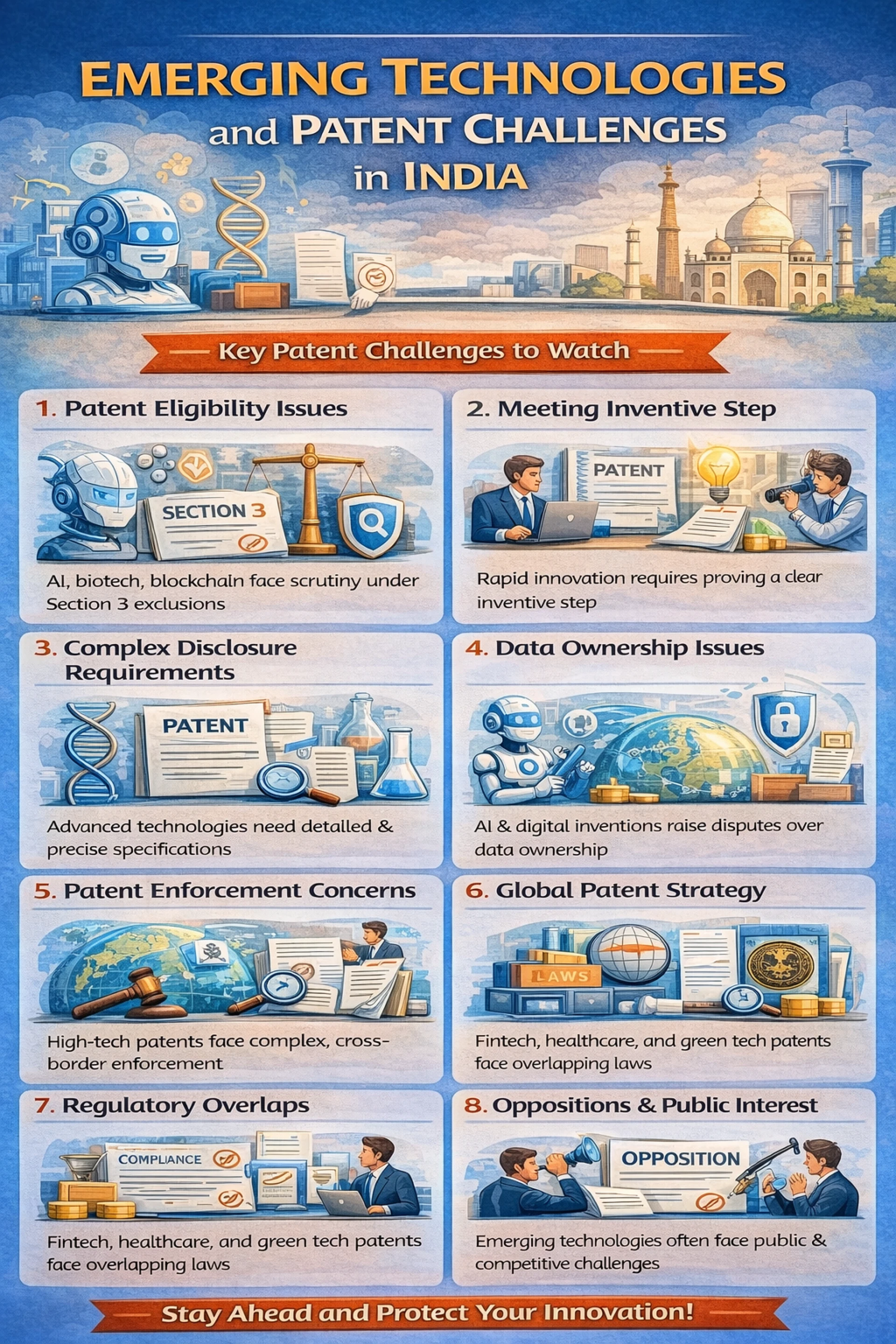
Patent Eligibility and Section 3 Challenges
One of the most debated issues in India relates to patentable subject matter. Section 3 of the Patents Act lists inventions which are not patentable. Emerging technologies often face scrutiny under these exclusions.
Artificial Intelligence and Software
Computer programmes per se are not patentable in India. This creates difficulty for AI driven inventions. If a claim focuses purely on an algorithm, it may be rejected. However, if the invention demonstrates a technical effect or technical contribution, patent protection may still be possible.
Applicants must draft claims carefully. Emphasis should be placed on technical advancement and practical application rather than abstract logic.
Biotechnology and Life Sciences
Biotechnology inventions must meet strict disclosure requirements. Biological materials may need to be deposited with recognised authorities. Ethical concerns also arise in gene based innovations.
India’s approach balances innovation with public interest. This is particularly visible in pharmaceutical patents, where Section 3(d) restricts patents for new forms of known substances without enhanced efficacy.
Inventive Step in Rapidly Evolving Fields
Emerging technologies develop quickly. What appears inventive today may become obvious within months. Patent examiners assess inventive step based on prior art available at the filing date.
In fields such as AI or blockchain, global research publications expand daily. Applicants must conduct thorough prior art searches before filing. Weakly drafted applications risk refusal or later invalidation.
A well prepared application should:
- Clearly identify the technical problem
- Explain how the invention solves this problem
- Distinguish the invention from existing solutions
- Provide experimental data where relevant
Strong technical documentation enhances credibility during examination.
Sufficiency of Disclosure and Complex Technologies
Indian patent law requires full and clear disclosure of the invention. The specification must enable a skilled person to perform the invention without undue experimentation.
This requirement becomes challenging for technologies such as:
- Deep learning models with evolving datasets
- Complex biotech processes
- Advanced semiconductor designs
Vague descriptions can result in objections. Overly broad claims without adequate support may also fail.
Drafting must strike a careful balance. The invention should be protected widely enough to deter competitors. Yet the description must remain precise and complete.
Data Driven Inventions and Ownership Issues
Modern technologies rely heavily on data. In AI systems, datasets play a critical role. Questions often arise regarding ownership and confidentiality.
While patents protect technical inventions, they do not protect raw data. Businesses must integrate patent strategy with data protection and trade secret frameworks.
Employment agreements, research collaborations, and joint ventures must clearly define ownership rights. Disputes in technology projects often arise due to poorly structured intellectual property clauses.
Patent Enforcement in High Tech Sectors
Securing a patent is only the first step. Enforcement remains equally important. High tech industries often involve cross border activities, digital platforms, and complex supply chains.
Indian courts have shown increasing willingness to grant injunctions in suitable cases. However, technical evidence plays a crucial role in patent litigation. Expert testimony and detailed technical analysis become essential.
Emerging sectors also face issues of standard essential patents, especially in telecommunications and electronics. Licensing disputes can be lengthy and complex.
Businesses should assess enforcement risks before entering competitive markets.
Global Protection and Cross Border Strategy
Emerging technologies often target global markets from inception. A purely domestic patent strategy may be insufficient.
Indian innovators must consider the international patent filing process at an early stage. Filing under the Patent Cooperation Treaty allows applicants to seek protection in multiple jurisdictions while preserving priority.
Global strategy requires:
- Timely filing within priority deadlines
- Understanding of foreign patent eligibility standards
- Budget planning for multi country prosecution
- Coordination with foreign associates
Failure to plan internationally can limit commercial expansion.
Regulatory Overlaps and Sector Specific Compliance
In sectors such as pharmaceuticals, medical devices, fintech, and renewable energy, patents interact with regulatory frameworks.
For example:
- Drug patents intersect with approvals under the Drugs and Cosmetics Act
- Fintech innovations may require compliance with Reserve Bank of India guidelines
- Renewable energy technologies must align with environmental regulations
Patent protection alone does not guarantee market entry. Innovators must adopt a holistic compliance approach.
The Role of Skilled Legal Guidance
Given the complexity of emerging technologies, professional advice becomes indispensable. Technical and legal expertise must work together.
Engaging an experienced patent attorney in India can help in drafting robust specifications, navigating objections, and managing opposition proceedings. Early legal consultation reduces risk of costly errors.
Strategic patent portfolios also enhance investor confidence. Venture capital firms often review intellectual property strength before funding technology ventures.
Opposition Proceedings and Public Interest
India allows both pre grant and post grant opposition. Competitors, industry bodies, or public interest groups may challenge a patent application.
Emerging technologies often attract scrutiny. Pharmaceutical patents, for instance, frequently face opposition on grounds of lack of inventive step or non compliance with Section 3(d).
Applicants must prepare for possible challenges. Strong documentation, transparent disclosures, and careful claim drafting improve survival chances.
Balancing Innovation and Access
India’s patent regime seeks to balance private rights with public welfare. This policy objective influences judicial interpretation.
In sectors such as healthcare and agriculture, courts remain sensitive to access concerns. Patent holders must exercise rights responsibly. Compulsory licensing provisions exist in specific circumstances.
Emerging technologies will continue to test this balance. Policymakers may introduce further clarifications as new industries mature.
Future Outlook
India stands at a pivotal moment. Artificial intelligence, biotechnology, green energy, and digital infrastructure will shape economic growth in the coming decade.
Patent law will evolve alongside these sectors. Greater clarity on software patents, data driven inventions, and biotech claims may emerge through judicial decisions and policy reforms.
Businesses must adopt proactive strategies. Early filing, precise drafting, international expansion planning, and vigilant enforcement form the foundation of sustainable innovation.
Emerging technologies create immense opportunity. Yet patent challenges in India require careful navigation. Companies which combine technical excellence with sound legal strategy will be best positioned to thrive in this dynamic landscape.
























Sign in to leave a comment.