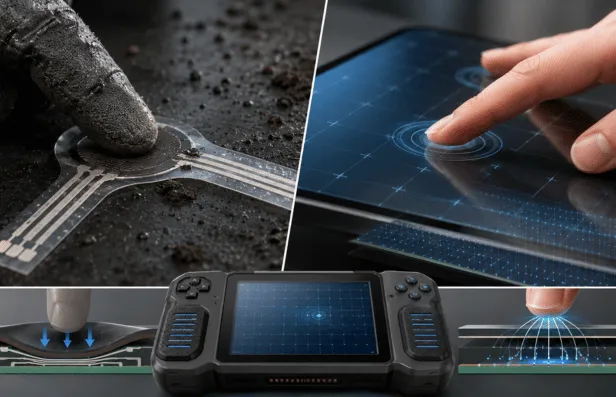

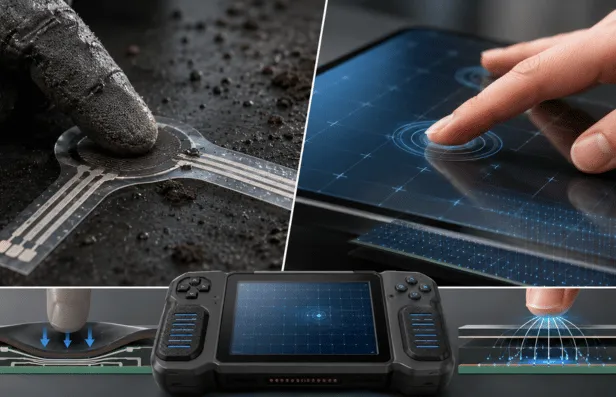
Two very different sensing technologies often get considered for the same job: force-sensing resistors and capacitive touch. They can both act as input for a device, but they sense completely different things, and choosing the wrong one leads to an interface that fights its environment.
The difference is simple to state and important to get right. Capacitive touch senses contact; a force sensing resistor senses pressure. Which one belongs in your device depends on what you actually need to measure and where the device has to work.
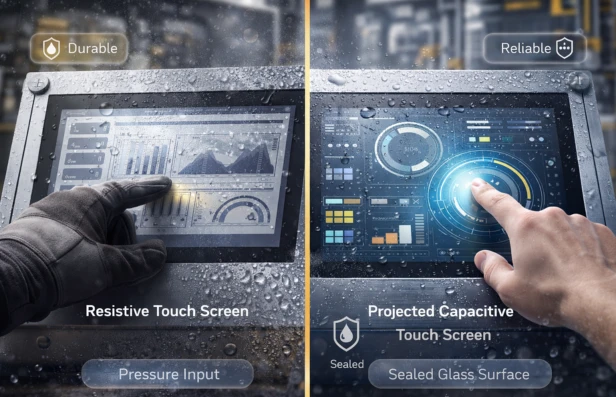
Quick answer: A force sensing resistor (FSR) measures how much pressure is applied and works through physical force, so it functions with gloves, in wet conditions, and without conductive contact. Capacitive touch senses the presence of a conductive touch, enabling gestures and sleek glass surfaces but struggling with gloves, liquids, and electrical noise. Choose FSR for force and rugged use; choose capacitive for gestures and clean environments.
How Each Technology Works
The technologies sense on entirely different principles, which is the root of every other difference.
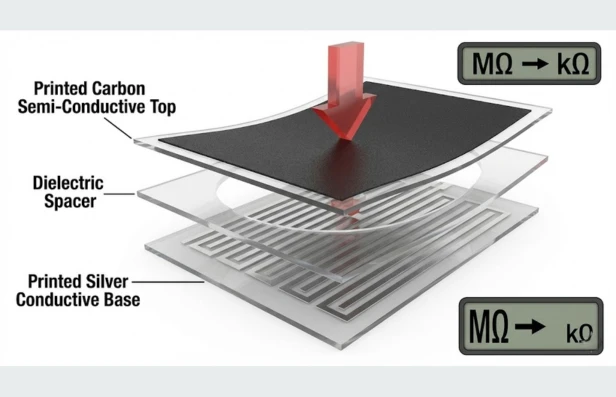
Force sensing resistors change electrical resistance as pressure is applied. Press harder, resistance drops. They respond to physical force, not conductivity, so anything that presses works.
Capacitive touch detects a change in an electrostatic field caused by a conductive object, usually a finger. It responds to contact and proximity, not pressure, which is what enables light-touch gestures.
Where Force Sensing Resistors Win
FSRs are the right choice when force matters or the environment is hostile to capacitive sensing.
- Gloved or tool-based operation, since they need pressure, not conductivity
- Wet, dirty, or contaminated environments where liquids do not cause false input
- Applications that need to know how hard, not just whether, something is pressed
- Thin, low-cost, single-point sensing built into a surface
Where Capacitive Touch Wins
Capacitive touch is the right choice when gestures, aesthetics, and a clean environment align.
- Multi-touch gestures like pinch, zoom, and swipe
- Sleek glass surfaces with no moving parts
- Clean, controlled environments without heavy contamination
- Consumer-style interfaces where look and feel dominate
The Practical Decision
The choice comes down to a few questions. Do you need to measure force, or just detect a touch? Will users wear gloves or use tools? Is the environment wet, dirty, or electrically noisy? Do you need gestures and a glass aesthetic? Force and rugged conditions point to FSR; gestures and clean environments point to capacitive.
In some devices, the answer is both: capacitive for the main display and FSRs for force-sensitive buttons or grips, each doing what it does best.
Where Manufacturing Precision Becomes Critical
Whichever technology you choose, consistency decides performance. An FSR’s force response and a capacitive sensor’s accuracy both depend on controlled printing, materials, and assembly, because small variations change how the sensor behaves.
Organizations that build both force sensing resistors and touch screens, such as Butler Technologies, Inc., can match the technology to the application rather than pushing every device toward one answer, and build it consistently in-house.
The Real Question to Ask
FSR versus capacitive is not about which is better. It is about which senses what your device actually needs, in the environment it actually faces. Answer that honestly and the right technology is usually obvious.
Key Takeaways
- FSRs sense pressure; capacitive touch senses conductive contact
- FSRs win for gloves, wet or dirty conditions, and force measurement
- Capacitive wins for gestures, glass aesthetics, and clean environments
- Some devices use both, each where it performs best
FAQs
What is the difference between an FSR and capacitive touch?
A force sensing resistor measures applied pressure and works through physical force, so it functions with gloves and in wet conditions. Capacitive touch senses conductive contact, enabling gestures and glass surfaces but struggling with gloves, liquids, and noise.
Can a force sensing resistor work with gloves?
Yes. An FSR responds to pressure, not conductivity, so it works reliably with gloves, tools, or any object that presses on it, which is a key advantage over capacitive touch.
When should I choose capacitive touch over an FSR?
Choose capacitive touch when you need multi-touch gestures, a sleek glass surface, and the device operates in a clean, controlled environment where liquids and heavy gloves are not a factor.
Can a device use both FSR and capacitive touch?
Yes. Many devices combine capacitive touch for the main display or gestures with force sensing resistors for pressure-sensitive buttons or grips, using each technology where it performs best.


























Sign in to leave a comment.