

In healthcare, the stakes are high and every decision counts. Whether it’s a smooth recovery or some complication, or early intervention versus crisis management. But with the overwhelming volume of patient data, medical histories, and scans to sift through, healthcare professionals are often left juggling with information overload under intense time pressure.
This is where Agentic AI is stepping in. It is empowering organizations and hospitals to make smarter, faster decisions by examining huge volumes of data (terabytes that are produced on a daily basis) from all medical touchpoints—medical imaging, patient records, and wearable devices. They pick on patterns and repetitive behaviors to recommend the best actions.
Let’s dig deeper into this ability and see how healthcare AI Agents are redefining care delivery.
How Agentic AI is Changing Healthcare?
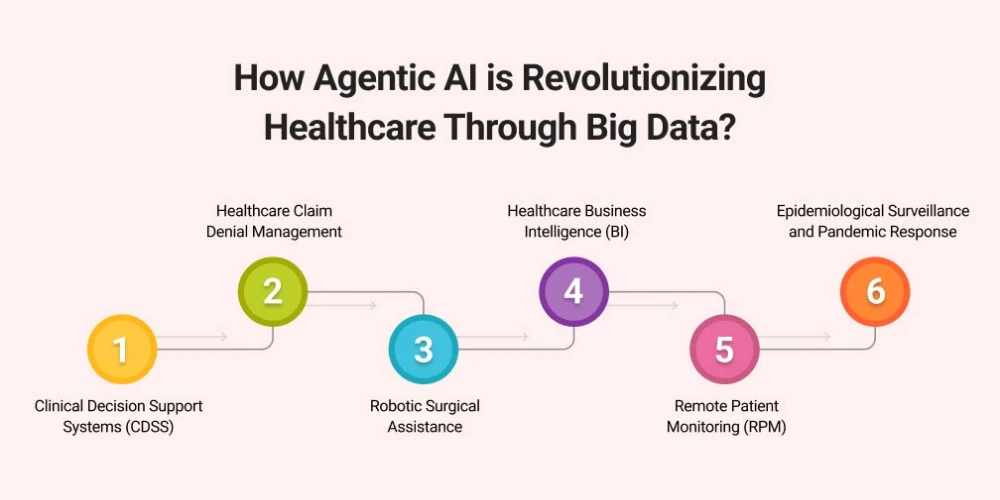
1. Clinical Decision Support (CDS)
By examining recent patient data against millions of historical similar cases, Agentic AI-integrated CDS systems have taken healthcare delivery beyond typical treatment guidelines and prescriptions. These systems combine real-time data from EHRs, medical imaging (X-Rays, CT Scans, etc), wearable devices, etc., and analyze it to learn patterns, compare them against previous benchmarks, and assist professionals in making decisions.
2. Healthcare Claim Denial Management
As per the American Medical Association (AMA), over 11% of healthcare claims were denied annually on average, pointing to an all-time high as of 2022. And this data only comes from 1700 hospitals that were a part of this survey; you can only imagine the global share.
AI Agents in healthcare have significantly helped organizations reduce this number by addressing gaps and inefficiencies in manual claim data processing, erroneous data entry, & inconsistent protocol adherence. These agents have automated scanning, analysis, and rectification of details by implementing context-aware databases.
3. Robotic Surgical Assistance
Healthcare AI Agents have also helped in devising tailored surgical plans and robotic execution frameworks. These systems combine individual patients’ data from different touchpoints—scans, medical histories, prognosis, etc., and create personalized patient profiles. Using this data in addition to real-time vitals, Agentic AI-integrated surgical systems can adapt during procedures, recalculate movements, and adjust robotic positions.
4. Healthcare Business Intelligence (BI)
AI Agents in healthcare have also enhanced BI, allowing hospitals and institutions to plan for varying patient demand, seasonal shifts, and inflow trends without much human involvement. For instance, many hospitals have integrated Agentic AI systems to track and predict flu outbreaks and automatically adjust staffing and restocking schedules.
5. Remote Patient Monitoring
In the US alone, over 70.6 million patients rely on remote monitoring systems, highlighting a massive (and increasing) adoption. Healthcare AI Agents streamline these workflows by compiling real-time sensor data, analyzing it, and providing alerts & scheduling appointments. For example, if someone’s sugar levels drop, healthcare AI Agents can adjust dosage, recommend actions, and schedule emergency consultations.
6. Epidemiological Surveillance and Pandemic Response
By combining outbreak data from multiple global locations, healthcare AI Agents have helped organizations identify hotspots, predict the spread of outbreaks, and automatically start advisories and interventions. CDC’s (Centers for Disease Control and Prevention) PulseNet is a prime example of this. It is a network of AI-integrated laboratories that track foodborne disease outbreaks.
The Integration Reality: Agentic AI within Existing Healthcare Systems
As can be seen above, hospitals and other institutions are incorporating healthcare AI Agents by 2025 in order to increase clinical decision-making, operational efficiency, and outbreak prediction, all of which improve patient outcomes overall. Despite this, deep integration of Agentic AI in healthcare is still complex for many organizations, though.
This is because:
→ AI integrations were not considered in the design of traditional EHRs or patient management systems.
→ The data is stored in disparate formats, making integration challenging.
→ Regulatory hurdles, with data privacy laws like HIPAA posing restrictions on the sharing and use of sensitive patient information.
→ Resistance to change from staff accustomed to traditional methods.
→ The cost of upgrading existing systems further complicates AI adoption in the healthcare industry.
How to Go About AI-Powered Healthcare Transformation?
- AI-Agnostic System Design: Put your bets in modular systems that are simple to integrate with AI/ML libraries, cloud services, and IoT networks.
- Store Data in Context-Aware Databases: Leverage databases that can intelligently match search intent to store and retrieve data, despite different formats. These databases can also unify patient information across various sources.
- Adherence to Regulatory Standards: Use Agentic AI-powered healthcare solutions that provide audit trails that automatically record all data access and modifications, automated data encryption, and access control features.
- Change Management and Staff Training: Help your staff through this transition. Agentic AI implementation, even in the healthcare industry, can create concerns around job displacement. Clarify and emphasize how AI Agent integration will enhance their efficiency and productivity, and not replace them.
Addressing Implementation Challenges on a Global Scale
Healthcare Agentic AI implementation also varies around the world, with more developed nations leading this frontier with advanced infrastructure and innovations. At the same time, developing countries with relatively fewer resources are trying to catch up with AI integration. The first category includes high-resource areas such as Western Europe and North America, where healthcare providers have access to large datasets, state-of-the-art tools, and interoperable systems that can readily integrate Agentic AI. Many South Asian and European nations are quickly adopting their innovations and sometimes even catching up to Western breakthroughs.
Challenges in Low-Resource Regions
→ Restricted access to high-speed internet or modern computing resources is required for AI systems.
→ Data integration and engineering workflows are still not standardized in many regions.
→ Some countries also exhibit cultural resistance, particularly in areas where trust in technology is low or where traditional healthcare practices dominate.
Agentic AI’s Impact on the Healthcare Workforce
By altering how medical professionals use technology and redefining their roles, the rise of Agentic AI is seriously upending the healthcare sector.
Concerns regarding job displacement have been raised by the potential for healthcare AI Agents to replace human workers, particularly in administrative roles. However, rather than replacing human knowledge, AI Agents are meant to supplement it.
Practically, only repetitive, time-consuming tasks are being replaced by these agents, speeding up analysis so that professionals and physicians can make decisions more quickly and accurately. For instance, doctors still have the last say, even though healthcare AI Agents evaluate medical data and make recommendations. In a similar vein, staff will have more time for more worthwhile interactions if administrative tasks are automated.
Future Vision - Human-in-the-Loop Agentic AI Adoption
Looking forward, the future of AI in healthcare envisions a Human-in-the-Loop (HITL) approach, where AI Agents provide insights, while humans offer oversight and judgment. This hybrid model ensures that AI augments healthcare workers’ roles, improving efficiency and care quality without replacing the human element.
Building Trust and Acceptance: Ethical Agentic AI Systems in Healthcare
As a healthcare organization planning to integrate an Agentic AI system, you can build trust and acceptance by doing the following:
→ Begin by fixing your data. For focused model training, make sure you have standardized, processed, and consolidated data because healthcare AI Agents thrive on high-quality data.
→ Make sure you handle all this data in a compliant manner, adhering to necessary regulations, such as HIPAA.
→ Give an extensive overview of the data that Agentic AI systems use, how they operate, and how they draw conclusions. Everyone will feel more at ease and secure in the knowledge that they are not being replaced due to this transparency.
→ To increase accuracy and reduce errors, evaluate your AI Agents in healthcare on a regular basis. Confidence in AI's dependability can also be improved by sharing these advancements with staff and patients.
→ Involve patients in the AI Agent adoption process by educating them about the benefits and encouraging feedback. Addressing concerns and demonstrating AI’s positive impact on patient outcomes builds trust and acceptance.
As trust and acceptance in these solutions will grow, the impact of AI in healthcare will not only transform clinical outcomes but also redefine the patient experience.




























Sign in to leave a comment.