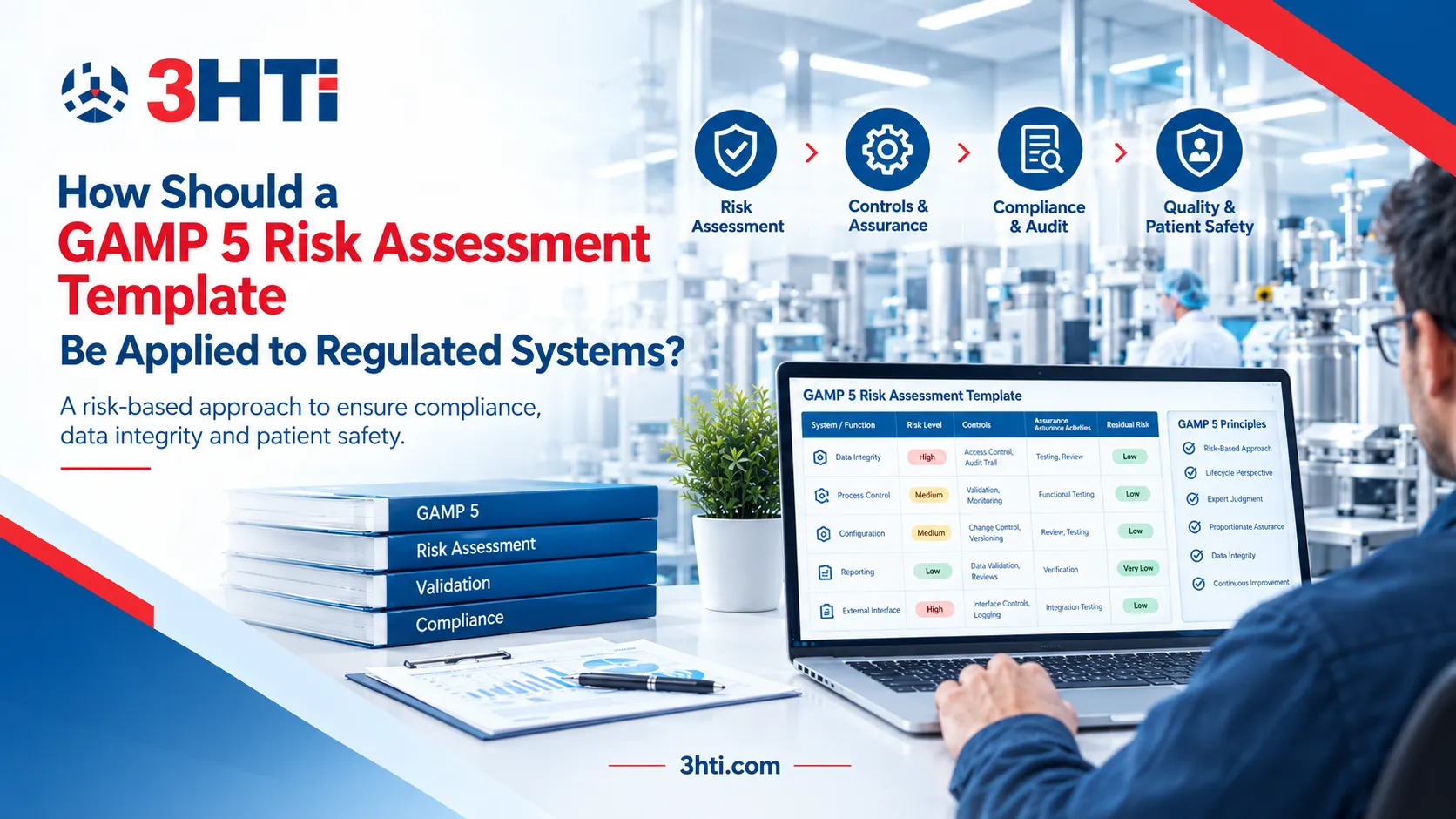

A GAMP 5 risk assessment template should be used as a structured decision-making aid—not as a checklist that automatically determines validation requirements. The objective is to understand a computerized system's intended use, GxP impact, risks to product quality, patient safety, and data integrity, and then select assurance activities proportionate to those risks.
The current GAMP 5 Second Edition maintains a risk-based lifecycle approach while placing greater emphasis on critical thinking, subject-matter expertise, service providers, software tools, automation, cloud technologies, and emerging technologies.
For organizations evaluating regulated digital systems, this makes risk assessment closely connected to the broader business process audit and operational governance framework: the focus should be on what the system does within a business process and what could happen if a critical function fails.
Key Takeaways
- A GAMP 5 risk assessment should begin with intended use and GxP impact.
- GAMP 5 provides guidance rather than a mandatory, prescriptive template.
- Risk should be assessed at the appropriate functional or component level rather than relying solely on whole-system categorization.
- Software categorization helps inform the approach but should not independently determine validation activities.
- FDA's current 2026 Computer Software Assurance guidance also emphasizes risk-based assurance based on intended use and process risk.
- A strong assessment should connect risks to controls, assurance activities, evidence, and lifecycle decisions.
What Is a GAMP 5 Risk Assessment?
A GAMP 5 risk assessment is a structured evaluation used to determine how a computerized system could affect regulated processes, product quality, patient safety, and data integrity.
GAMP guidance aims to help organizations achieve computerized systems that are fit for intended use while applying a patient-centric, risk-based approach. Importantly, ISPE states that GAMP is not a prescriptive standard; it provides practical guidance and tools that practitioners can adapt to their circumstances.
Therefore, a risk assessment template should provide consistency without replacing professional judgment.
What Should a GAMP 5 Risk Assessment Template Contain?
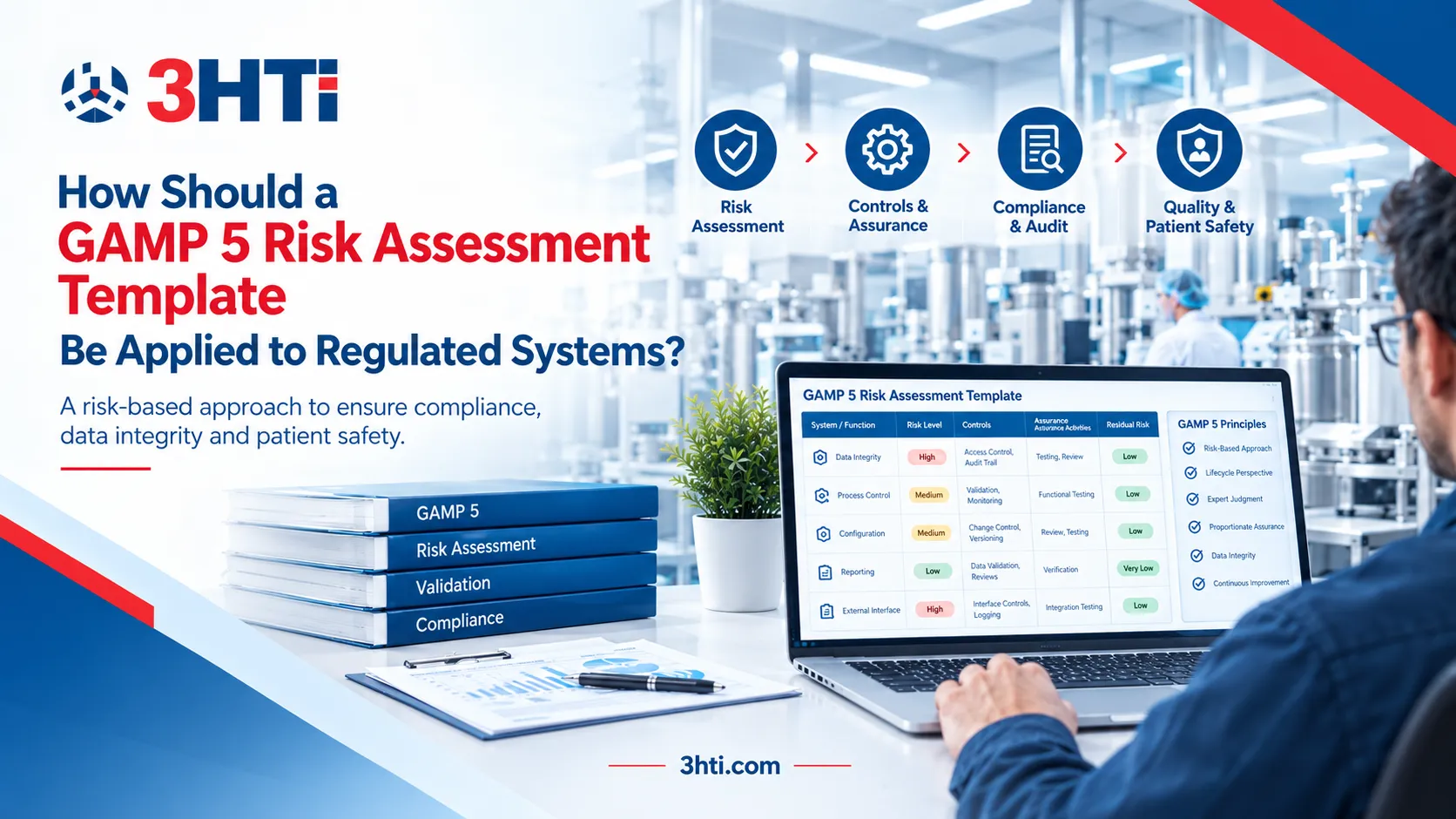
A practical GAMP 5 risk assessment should document the system name, version, owner, and supplier, followed by its intended use and GxP impact. It should identify the critical functions, the types of data created or processed, potential risks and their consequences, existing controls, the rationale for the assigned risk level, required assurance activities, residual risk, and approval by the appropriate system, process, and quality stakeholders.
The assessment should explain why a particular risk decision was made rather than simply assigning a numerical score. This makes the document more useful for validation, audits, change control, and ongoing lifecycle management.
Step 1: Define the Intended Use
The first question should be:
What exactly will the system or function be used for?
A commercial application may present very different risks depending on how an organization uses it.
For example, software used only to organize non-regulated administrative information may have limited GxP impact. The same software could require substantially more assurance if a configured calculation directly influences a regulated manufacturing or quality decision.
FDA's February 2026 Computer Software Assurance guidance similarly recommends examining the intended use of individual software features, functions, and operations when establishing a risk-based assurance strategy.
Step 2: Determine GxP Impact and Process Criticality
Next, identify whether the system supports a GxP process and what could happen if it fails.
Consider questions such as:
- Could an incorrect result affect product quality?
- Could inaccurate data affect a regulated decision?
- Could data loss compromise required records?
- Could an unauthorized change affect a critical process?
- Is the system used to generate, modify, or maintain regulated records?
This is where a business process audit perspective can add value. Instead of assessing software in isolation, auditors and validation teams can examine the relationship between the technology, business process, controls, and resulting outcomes.
Step 3: Identify Functional Risks
GAMP 5 Second Edition places greater emphasis on critical thinking and recognizes that computerized systems can contain components with different characteristics and risks. ISPE's current discussion of GAMP categorization specifically cautions against treating categorization as a checklist approach to validation.
For each critical function, consider:
Failure → Effect → Existing Control → Detectability → Required Assurance
For example, if an automated calculation produces an incorrect regulated result, the assessment should determine the potential impact, existing review controls, likelihood of detection, and appropriate assurance activity.
Step 4: Use Software Categories as Context, Not the Entire Decision
The Second Edition revised the treatment of software and hardware categories and emphasizes that systems can contain components with different characteristics. Category 2 from the previous framework was removed, while categories such as infrastructure software, standard components, configured components, and custom applications remain useful concepts.
The important point is that category assignment should support risk analysis rather than automatically dictate the complete validation package.
A configured commercial application, for example, may require attention to configuration, intended use, interfaces, data, and critical functions rather than treating every feature as equally important.
Step 5: Map Risks to Assurance Activities
Once risks are understood, determine what evidence is appropriate.
Depending on the system and risk, activities may include:
- Supplier assessment
- Requirements review
- Configuration verification
- Functional testing
- Performance testing
- Data integrity assessment
- Access-control verification
- Interface testing
- Backup and recovery testing
- Periodic review
- Change-control verification
FDA's 2026 guidance recommends selecting assurance activities based on intended use and process risk and documenting the rationale for those decisions.
This supports a more proportionate approach than applying identical testing requirements to every software function.
Step 6: Consider Data Integrity and Lifecycle Risk
A risk assessment should continue beyond initial implementation.
Organizations should consider risks associated with:
- Data creation
- Data modification
- Data transfer
- Access permissions
- Audit trails
- Retention
- Backup and recovery
- Interfaces
- System changes
- Decommissioning
This lifecycle perspective is particularly important when organizations use PLM managed services, cloud applications, integrated enterprise systems, or third-party service providers.
GAMP 5 Second Edition specifically expanded its guidance around service providers, cloud computing, automation, and other modern technology environments.
How Does This Fit Into an Operational Audit Process?
A mature operational audit process can use the risk assessment as evidence for evaluating whether technology controls support the intended business process.
For example, an audit may examine:
Business Process → System Function → Risk → Control → Evidence → Residual Risk
This creates a clearer connection between compliance activities and actual operational performance.
For organizations that need additional evaluation of process controls, business process audit services can be considered alongside technology and compliance assessments.
Similarly, companies operating complex engineering and product-development environments may need PLM services to evaluate how product data, workflows, integrations, and governance interact with regulated processes.
What Makes a GAMP 5 Assessment Defensible?
A defensible assessment is not necessarily the longest document. It should demonstrate that the organization understood:
- The intended use.
- The regulated process.
- The potential failure modes.
- The impact of those failures.
- Existing controls.
- The rationale for selected assurance activities.
- The evidence generated.
- How risks will be managed throughout the lifecycle.
This approach is consistent with GAMP's emphasis on critical thinking rather than mechanical application of predefined checklists.
Conclusion
A GAMP 5 risk assessment template works best when it structures expert judgment rather than replacing it. Start with intended use, establish GxP impact, identify critical functions and failure modes, assess controls, and then determine assurance activities proportionate to the resulting risk.
The same principle applies to a broader business process audit: technology should be evaluated in the context of the process it supports, the data it handles, and the consequences of failure.
For regulated organizations, this creates a more practical connection between compliance, operational controls, system implementation, and ongoing lifecycle management.
FAQs
Is there an official GAMP 5 risk assessment template?
GAMP 5 provides practical guidance, terminology, approaches, and tools rather than prescribing one mandatory template. Organizations should adapt their assessment structure to their systems, processes, risks, and applicable regulatory requirements.
Does GAMP 5 require every software function to receive the same level of validation?
No. GAMP 5 uses a risk-based approach, and the Second Edition emphasizes critical thinking. Assurance activities should be scaled according to the system's characteristics, intended use, and identified risks.
How does FDA's approach relate to GAMP 5?
FDA's current Computer Software Assurance guidance also uses a risk-based approach centered on intended use, process risk, and appropriate assurance activities. It can therefore complement risk-based computerized-system practices, although organizations must apply the requirements and guidance relevant to their specific jurisdiction and regulated environment.
Can a GAMP 5 risk assessment support a business process audit?
Yes. The assessment can provide structured evidence about intended use, process risks, controls, and assurance activities. An audit can then evaluate whether those controls operate effectively within the broader business process.
Should GAMP 5 software categorization determine the entire validation strategy?
No. ISPE's current guidance emphasizes that categorization should be used with critical thinking, risk assessment, and supplier assessment rather than as a standalone checklist for determining validation activities.































Sign in to leave a comment.