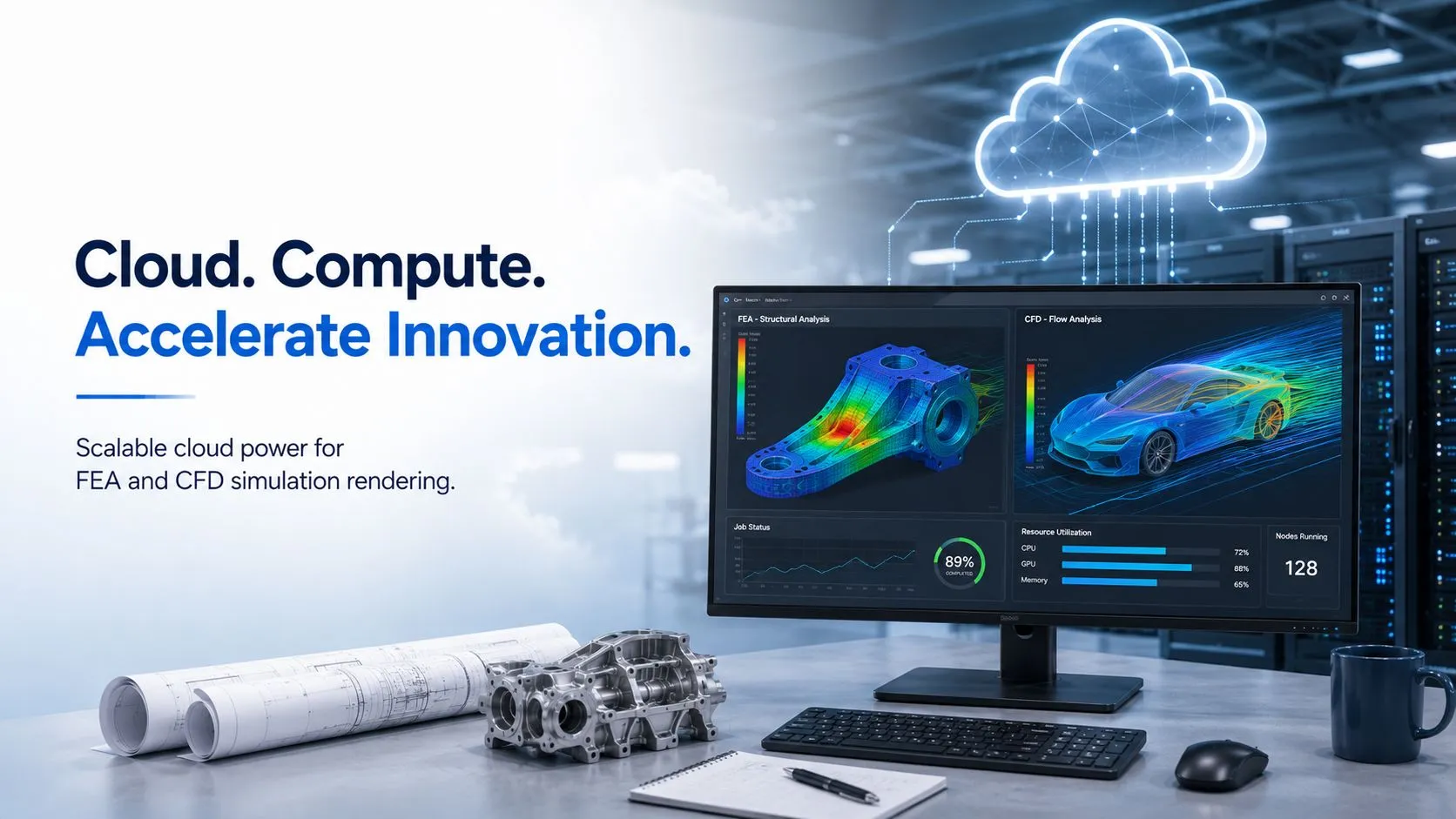

In high-consequence industries such as aerospace, defense, automotive, and medical devices, engineering excellence is bounded by computational throughput. Finite Element Analysis (FEA) and Computational Fluid Dynamics (CFD) are vital for validating structural integrity, thermal behavior, and aerodynamic efficiency, yet high-fidelity rendering and meshing frequently stall under local hardware constraints. Engineers face a tough choice: compromise on mesh density to hit tight development deadlines, or endure massive queues on over-allocated on-premise High-Performance Computing (HPC) clusters. This computational bottleneck directly slows down product velocity and increases time-to-market. To overcome these physical limits, forward-thinking enterprises are shifting heavy physics workloads off local servers and utilizing modern cloud-based environments to scale engineering workloads on demand.
Overcoming the Infrastructure Bottleneck in High-Fidelity Engineering Simulation
What is the primary operational blocker for modern FEA and CFD simulation teams? It is infrastructure rigidity specifically, the lack of immediate, scalable compute power to process multi-million cell meshes and transient fluid dynamics analyses simultaneously.
Traditional on-premise workstations or localized servers force development cycles into linear queues. When an engineering director needs a critical crash-test simulation or a complex thermal distribution render, the team cannot afford to wait days for internal server capacity to clear. Furthermore, as enterprises modernize their design infrastructure through comprehensive PLM implementation services, a major challenge appears: ensuring that heavy simulation data interacts fluidly with core product lifecycle records. Without scalable infrastructure, these data loops break down, causing disconnected data silos, mismatched versions, and outdated design tracking.
The True Cost of Local High-Performance Computing (HPC)
Maintaining physical HPC clusters requires significant capital expenditures, round-the-clock climate-controlled cooling, and dedicated IT maintenance teams. Worse, localized hardware depreciates rapidly, leaving engineering teams stuck with outdated processing architectures within three to four years. This hardware bottleneck restricts computational innovation just as product development teams require deeper, multi-physics fidelity to reduce prototyping costs.
Driving Computational Scale Through Cloud Managed Services
How do mid-sized to large manufacturing enterprises scale computational workloads seamlessly without expanding internal IT burdens? They achieve this by offloading infrastructure management, tuning, and orchestration to specialized cloud managed services.
By migrating intensive FEA and CFD simulation rendering pipelines to the cloud, organizations gain access to elastic, high-performance virtual architectures exactly when needed. This approach eliminates capital expenditures in favor of variable, project-based operational expenses. Engineers can provision hundreds of compute cores for a massive parallel processing run, complete the simulation in a fraction of the time, and immediately spin down the infrastructure to minimize idle hardware waste.
Optimizing the Digital Thread and Security Posture
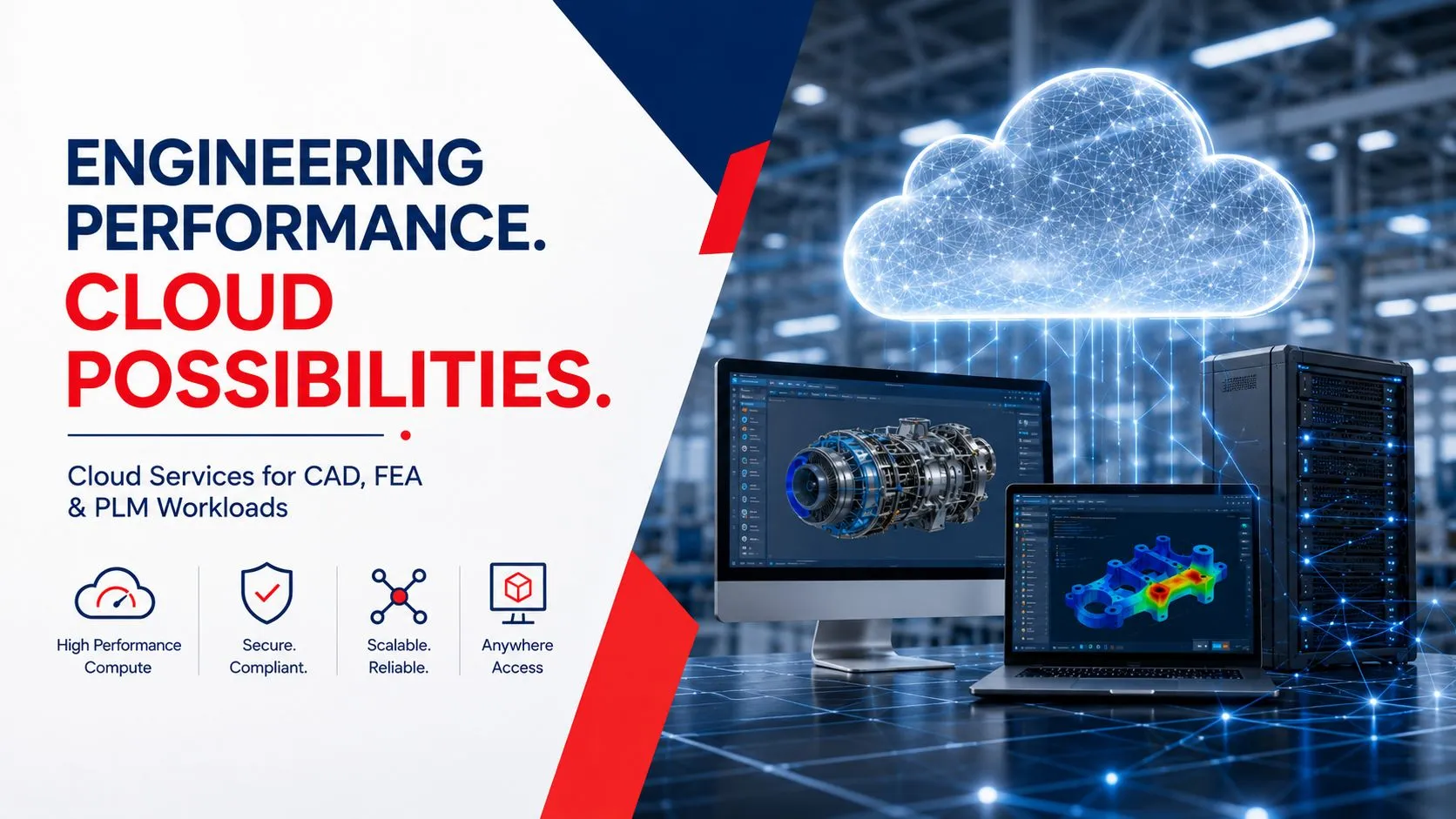
Moving sensitive simulation data to an external environment presents clear security and operational challenges, particularly in heavily regulated sectors like defense and life sciences. Enterprise-grade Cloud Managed Services from 3HTi solve this problem by providing secure, compliant cloud environments that feature advanced encryption, isolated networking, and automated lifecycle policies. This enables systems engineering leaders to maintain rigorous compliance standards such as ITAR, NIST, or ISO while unlocking massive processing capacity.
Seamless Toolchain Orchestration
Modern cloud architectures do not just host files; they fully optimize software environments. Expert management teams configure orchestration tools that automatically distribute rendering jobs across specialized GPU and CPU instances. This ensures maximum software licensing efficiency while preventing internal engineering teams from spending valuable time troubleshooting networking issues, software patches, or file-system incompatibilities.
Strategic Pitfalls to Avoid in Cloud Simulation Migrations
While shifting simulation workloads to the cloud delivers clear operational velocity, execution failures often happen when teams overlook systemic integration. Enterprise leaders should avoid these critical roadblocks:
- Treating Cloud Architecture as a Simple Data Repository: Simply moving files to cloud storage without configuring automated, distributed cluster compute nodes fails to accelerate execution speeds.
- Ignoring Data Ingestion and Egress Economics: Transferring massive, uncompressed simulation files back and forth without data minimization practices leads to significant network latency and unexpected egress fees.
- Isolating Simulation from Core Software Product Engineering Solutions: Separating rendering pipelines from broader software product engineering solutions creates version control issues, making it difficult to link simulation results directly back to specific product changes.
To mitigate these risks, organizations must adopt a data-first framework that prioritizes smart file caching, automated resource scheduling, and tight version integration across the engineering ecosystem.
Conclusion: Achieving Product Development Velocity
Embracing cloud managed services for complex FEA and CFD simulation workloads transforms compute capacity from an operational bottleneck into a distinct competitive advantage. By removing the boundaries of physical server limits, engineering organizations can iterate rapidly, perform high-fidelity analyses earlier, and secure compliance with absolute confidence. The future of manufacturing belongs to agile, cloud-enabled engineering teams and building an optimized cloud pipeline is the definitive path to achieving it.
Frequently Asked Questions (FAQs)
Q1: How do cloud managed services speed up complex FEA and CFD rendering?
They provide on-demand access to high-performance virtual clusters with specialized multi-core CPUs and GPUs. This eliminates local hardware queues, allowing massive, parallel simulation jobs to execute concurrently and complete in minutes rather than days.
Q2: What is the connection between PLM implementation services and cloud simulation?
Expert PLM implementation services embed cloud simulation checkpoints into the formal product lifecycle. This ensures that every high-fidelity rendering or analysis report is automatically version-controlled and tied directly to the master engineering assembly file.
Q3: Is cloud-based simulation secure enough for ITAR or aerospace defense projects?
Yes, provided the cloud environment is explicitly configured for regulatory compliance. Enterprise-grade managed environments use GovCloud infrastructure, strict access controls, end-to-end data encryption, and isolated virtual private networks to meet compliance requirements.
Q4: How do software product engineering solutions integrate with cloud simulation tools?
Modern software product engineering solutions bridge the gap by creating automated APIs. These pipelines extract CAD models, launch remote cloud-simulation instances, and push verification logs back into the central product dashboard with minimal manual steps.
Q5: What are egress fees, and how do we prevent them from inflating cloud costs?
Egress fees are charges applied by cloud providers when downloading data from the cloud. Managed services control these costs by running post-processing and visual rendering on cloud nodes, downloading only lightweight reports and summaries.
Q6: Can we run our existing desktop simulation licenses in a cloud environment?
Yes. Most major engineering software vendors offer cloud-ready or Bring Your Own License (BYOL) frameworks. Cloud providers assist in configuring licensing servers to distribute access flexibly across remote engineering networks.
Q7: What hardware configurations should we prioritize for CFD rendering in the cloud?
CFD rendering requires high memory bandwidth and fast inter-node connections. Prioritize cloud instances optimized for high-performance computing, featuring InfiniBand networking and high-RAM allocations per core to ensure seamless fluid dynamic scaling.




























Sign in to leave a comment.