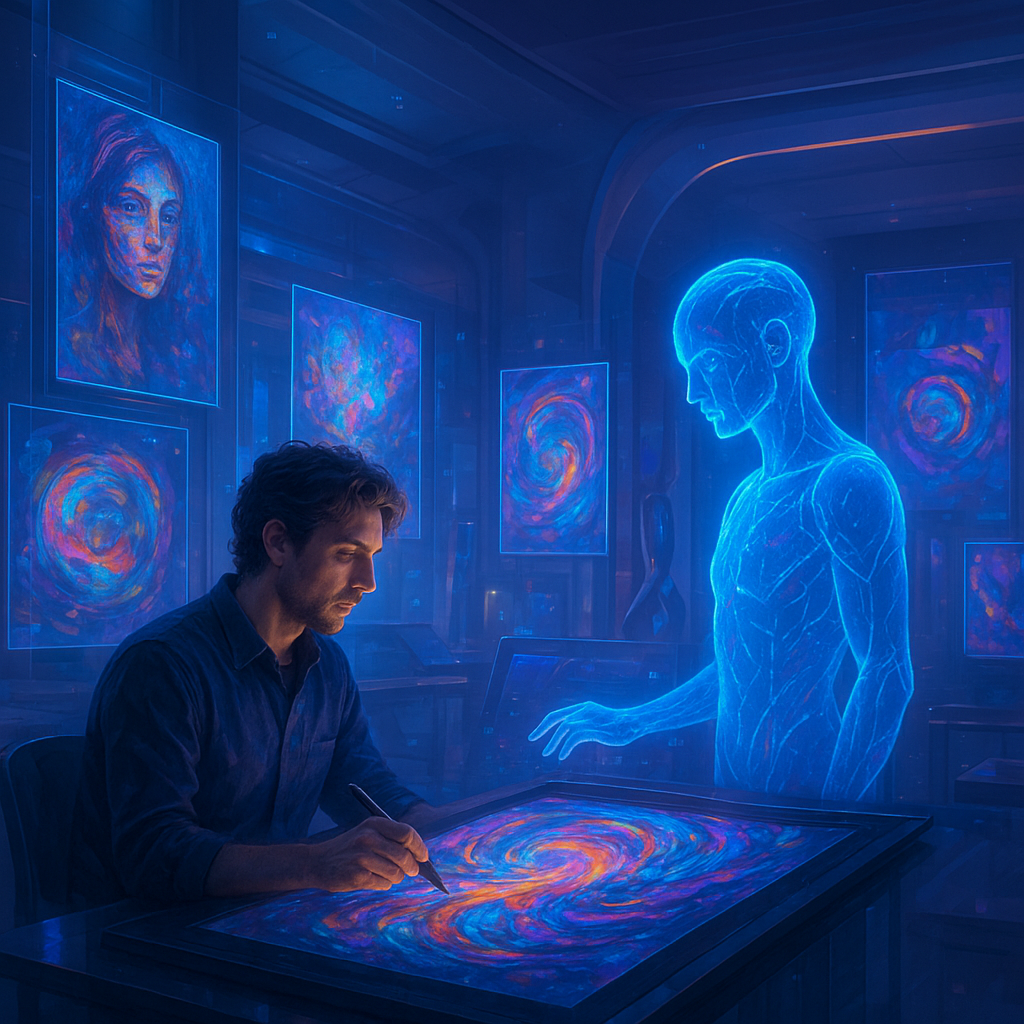

Opening Scene: A New Era of Creativity Unfolds
In early 2026, the Cannes Lions International Festival of Creativity witnessed a striking phenomenon: a record number of award-winning campaigns incorporated generative AI at their core. From AI-generated video scripts to bespoke musical scores and synthetic photography, creative outputs that once required entire teams now emerged from algorithmic collaborations between humans and machines. This shift is not just a novelty; it's a seismic transformation reshaping the creative industries worldwide.
Consider the case of a global advertising agency that launched a campaign for a major automotive brand. Using generative AI tools, the agency produced dozens of video variations targeting diverse demographics, each with customized narratives and visuals optimized for engagement. The entire process, which traditionally spanned months and involved costly reshoots, was completed in weeks with far less overhead.
Yet, this revolutionary progress has sparked intense debate. While some hail AI as a catalyst for unprecedented creative potential, others raise concerns about originality, job displacement, and ethical dilemmas. As Campaign Asia reports, a majority of creatives express apprehension about generative AI's influence on their craft and livelihoods.
"Generative AI is not just a tool; it’s altering the foundation of how creativity is conceived and executed," notes Dr. Amelia Chen, a leading AI ethicist and consultant for creative firms.
Historical Context: The Path to AI-Enhanced Creativity
The journey toward generative AI's integration in creative industries has accelerated over the past decade. Early AI applications focused on automation of routine tasks, such as photo editing and layout adjustments. However, breakthroughs in deep learning, natural language processing, and generative adversarial networks (GANs) have since enabled machines to produce original content—be it text, images, music, or video.
By 2024, platforms like OpenAI's GPT series and DALL·E had become mainstream tools for ideation and prototyping. These models demonstrated remarkable capabilities in mimicking human styles and generating novel concepts. Creatives initially treated AI as an assistant to augment productivity. But as the technology matured, its role expanded from support to co-creator, blurring traditional boundaries.
This evolution has roots in the broader digital transformation of media and advertising, which embraced data-driven personalization and cross-platform storytelling. Generative AI emerged as a natural extension, offering scalability and customization at an unprecedented level. The Covid-19 pandemic further accelerated adoption, as remote workflows demanded new forms of collaboration and rapid content generation.
However, this progress also exposed challenges regarding intellectual property rights and creative attribution. As detailed in the WriteUpCafe piece on Generative AI in Regulated Industries, legal frameworks have struggled to keep pace with AI's capacity to generate derivative works and remix copyrighted material.
Quantitative Analysis: Measuring Generative AI’s Creative Disruption
Recent industry data offers a quantitative lens on generative AI’s impact. According to a 2026 report by McKinsey, approximately 43% of creative tasks in advertising, design, and media production are now either fully or partially automated by AI tools—a sharp increase from 18% in 2022. This trend is reflected in the growing market valuation of AI-focused creative software, which is projected to surpass $15 billion globally by the end of 2026.
Key figures from various sectors illustrate this disruption:
- Advertising: Agencies utilizing generative AI report up to 50% reductions in production time and 30% cost savings per campaign, enabling faster iteration and deployment.
- Film and Animation: AI-assisted storyboarding and CGI generation have cut pre-production phases by nearly 40%, as per industry surveys.
- Music Industry: AI-generated compositions account for an estimated 12% of new music releases on streaming platforms, with some artists using AI collaborators to blend genres innovatively.
- Publishing and Journalism: Newsrooms increasingly rely on AI to draft articles, create summaries, and produce multimedia content, with AI-produced stories constituting roughly 25% of digital content in 2026.
However, these efficiencies come with complex trade-offs. The UK House of Lords recently issued a report cautioning that unchecked AI adoption may undermine human artistry and reduce employment opportunities in creative fields.
"The balance between embracing innovation and preserving cultural value is delicate. Policy interventions are essential to safeguard the creative workforce," argues Lord Timothy Wallace, member of the UK Lords AI Committee.
Current Developments in 2026: AI Tools Reshaping Creative Workflows
The past year has marked significant advancements in generative AI capabilities, with newer models boasting enhanced contextual understanding, emotional nuance, and multimodal synthesis. Tools like Synthesia for video generation, Amper Music for AI-composed soundtracks, and Jasper AI for copywriting have integrated seamlessly into mainstream creative pipelines.
Notably, agencies and content marketers are leveraging AI not just for production but for strategy and personalized audience engagement. The Herald-Times highlights how top-tier agencies utilize generative AI to produce hyper-targeted campaigns that adapt dynamically to user responses, driving deeper brand connections and conversion rates.
Furthermore, the democratization of AI creativity tools has empowered independent creators and small studios. Platforms offering user-friendly AI interfaces have reduced barriers to entry, fostering a surge in diverse and experimental content across social media and streaming services.
Yet, this expansion prompts ongoing debates around ethical AI use, transparency, and the preservation of human creative identity. Industry bodies and regulators are working on guidelines to ensure fair attribution and to prevent AI-generated misinformation or biased content.
This complex landscape is explored in WriteUpCafe's article on How Managers Can Unlock More Creative Power From Generative AI, which emphasizes strategic integration rather than replacement as the pathway to sustainable innovation.
Expert Perspectives: Balancing Innovation and Integrity
Leading voices in the creative and AI sectors offer nuanced views on generative AI’s role. Renowned creative director Maya Alvarez states, "AI has become an indispensable collaborator, expanding our imaginative horizons. However, it cannot replace the human experience and emotional depth that define authentic storytelling. Our job is to harness AI while maintaining artistic integrity."
Meanwhile, AI researchers caution against overreliance on automated creativity, highlighting risks such as homogenization of styles and loss of cultural uniqueness. Professor Liam O’Connor from MIT’s Media Lab emphasizes the need for diverse training data and human oversight to prevent algorithmic bias and ensure inclusive creative expression.
Industry forums like the 2026 India AI Impact Summit, as reported by Economic Times, underscore the importance of collaborative governance among creators, technologists, and policymakers to shape AI’s future in creativity responsibly.
Case Studies: Real-World Applications Illustrating AI's Creative Utility
One standout example is the partnership between the luxury fashion house Savoir and AI developer Lumen Labs. Together, they launched a virtual fashion show in 2026 featuring AI-generated models and digitally crafted garments. The event attracted millions of viewers globally and redefined traditional runway formats, merging technology with haute couture.
Similarly, the independent film "Neon Dreams" used generative AI to co-write its screenplay and create visual effects on a modest budget, receiving critical acclaim for its innovative narrative style. The director credited AI as a "creative partner that amplified our vision while preserving the human touch."
In advertising, a leading beverage brand employed generative AI to craft localized marketing content for over 50 countries simultaneously, boosting campaign reach while respecting cultural nuances—an approach lauded for both efficiency and sensitivity.
- Efficiency Gains: Reduced production timelines by 35-50% across sectors.
- Cost Optimization: Lowered creative development costs by up to 30%.
- Creative Diversity: Enabled exploration of novel styles and formats.
- Audience Engagement: Increased personalization leading to higher conversion rates.
Future Outlook: Navigating Opportunities and Challenges Ahead
Looking forward, generative AI’s trajectory suggests deeper integration across creative domains. Emerging trends include AI-augmented immersive experiences in virtual and augmented reality, personalized storytelling tailored to individual psychographics, and collaborative platforms connecting human and AI creators globally.
However, the path is fraught with challenges. Ethical concerns about authorship, algorithmic bias, and the commodification of creativity demand robust frameworks. Education and skill development will be crucial as creatives adapt to evolving roles that emphasize curation, direction, and critical judgment alongside AI proficiency.
Policymakers and industry leaders must foster an ecosystem that balances innovation with protection of creative labor and cultural heritage. Initiatives to standardize AI transparency and accountability, as well as investment in interdisciplinary research, will shape the sustainability of AI-driven creativity.
As highlighted in WriteUpCafe’s The Expanding Impact of Data Science in Today’s Industries, the fusion of human ingenuity and AI analytics opens new horizons but requires vigilant stewardship.
"The future of creativity lies in symbiosis: human sensibility complemented by AI’s generative prowess. Harnessed wisely, this synergy can unlock unprecedented artistic innovation," concludes Dr. Chen.

























Sign in to leave a comment.