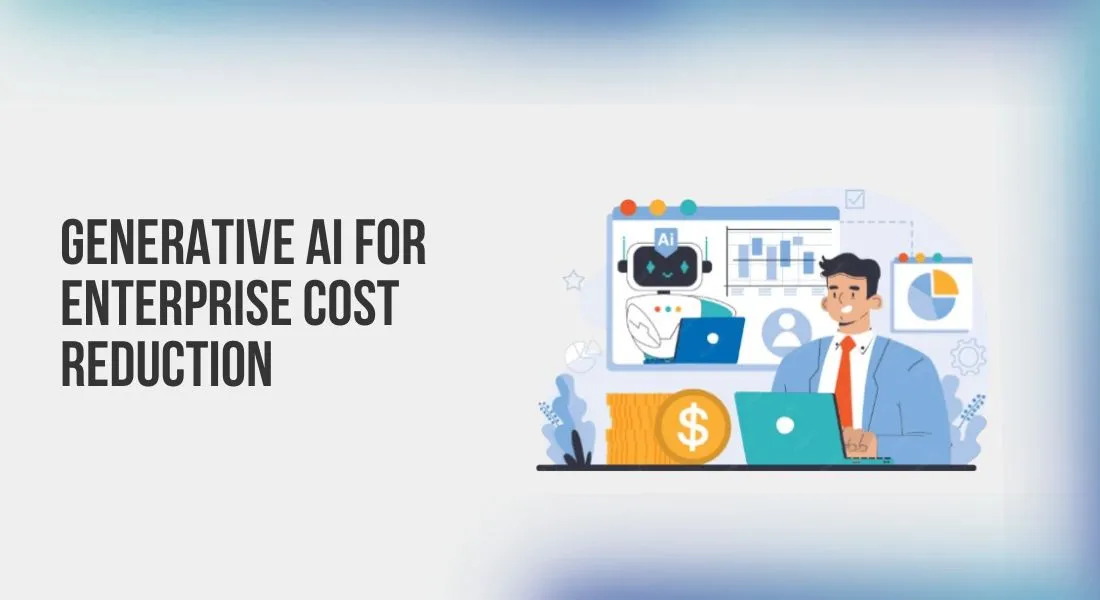

Most enterprise cost problems are not new. What is new is how precisely generative AI for enterprise cost reduction can target them. From automating repetitive knowledge work to compressing software delivery cycles, AI is changing where the money goes and how fast value gets realised.
CTOs are no longer asking whether AI fits into the budget. They are asking which cost centres to address first and what the realistic payback period looks like. This guide answers both questions with concrete examples and figures from real deployments.
Major Cost Challenges Enterprises Face
Before evaluating any solution, it helps to identify the to cost accumulation points at large-scale operations that need to be established. The majority of organizations that employ 1000 staff members or more experience operational challenges that follow a distinct pattern.
- Labour-intensive knowledge work. Analysts, support agents, legal reviewers, and finance teams spend a significant portion of their day on tasks that are structured and repetitive but difficult to automate with rule based tools. Salaries in these functions are high, and headcount scales linearly with demand.
- Slow software delivery cycles. Engineering teams lose weeks to boilerplate code, documentation, and manual QA. Each delayed release carries a downstream cost, whether that is a missed SLA, a delayed product launch, or a longer sales cycle.
- Customer support at volume. Live agent costs grow with your user base. First-contact resolution rates are often low, which compounds the cost per ticket.
- Procurement and supply chain inefficiency. Vendor analysis, contract review, and spend categorisation require specialist time that is rarely available in proportion to the volume of decisions being made.
- Compliance and reporting overhead. Regulatory requirements create recurring documentation and review cycles that pull senior staff away from higher value work.
Generative AI helps enterprises cut costs through automation, faster workflows, and smarter decision-making. Businesses can improve efficiency while reducing manual operations and overhead expenses. Hire Generative AI developers to build scalable AI-powered enterprise solutions.
How Generative AI Reduces Enterprise Costs Across Functions
Generative AI works across cost centres rather than being confined to a single function. The following breakdown covers where deployments have produced the clearest financial results.
Customer Support Automation
The AI support system manages first-level inquiries through automated functions without needing human intervention. The system handles password reset requests, billing inquiries, order status checks and fundamental troubleshooting tasks at a much lower cost compared to live agents. Companies that implement conversational AI into their support systems experience between 30 to 60 percent decreases in contact expenses, which depend on the complexity of customer inquiries and their deflection rate. The implementation of generative AI for enterprise cost reduction in support functions enables human agents to dedicate their efforts toward handling more complex cases, which results in better resolution outcomes and higher work efficiency.
Software Development Productivity
AI code assistants help engineering teams produce functional code at a higher speed while reducing production errors. Research that compares developer performance before and after implementing AI tools shows that routine coding tasks become 20% to 45% more efficient with AI tool implementation. Engineering teams use AI cost reduction methods to achieve higher output without decreasing employee numbers. The organization aims to boost operational output through existing teams while decreasing product delivery time and minimizing expenses linked to late-stage bug fixes.
Internal Knowledge Work and Document Processing
The legal, finance, HR and compliance functions create and handle substantial amounts of paperwork. The generative models create contracts and produce document summaries and they extract essential contract terms, sort documents, and identify irregularities. The time required for senior staff to complete their tasks has decreased from multiple hours to two minutes of verification work. Organizations that implement AI-based cost reduction methods for their knowledge-based back office operations have achieved labor savings between 25 percent and 40 percent on specific tasks while maintaining their current error levels.
Procurement and Vendor Management
AI tools analyse vendor proposals, benchmark pricing against market data, and flag contract terms that carry financial risk. Procurement teams using these capabilities make faster decisions with better information. They also reduce dependence on external consultants for spend analysis work that AI can handle in real time.
ROI of Generative AI Adoption
ROI calculations for AI projects depend heavily on two variables: the baseline cost of the process being replaced or augmented, and the speed of deployment. Both are worth scrutinising before committing to a build.
| Use Case | Typical Cost Reduction | Payback Period |
| Customer support deflection | 30% to 60% per contact | 3 to 6 months |
| Developer productivity tools | 20% to 45% output gain | 2 to 4 months |
| Document review and drafting | 25% to 40% labour saving | 4 to 8 months |
| Procurement spend analysis | 10% to 20% cost avoidance | 6 to 12 months |
| Compliance reporting automation | 30% to 50% time reduction | 4 to 9 months |
Projects with the shortest payback periods tend to share two characteristics. First, they target high-volume, well-defined processes rather than broad organisational change. Second, they deploy on existing infrastructure rather than requiring a full platform replacement. Generative AI for enterprise cost reduction works best when it is scoped narrowly at first and expanded once baseline performance is confirmed.
Chech indepth of implementation of generative AI in the enterprise and how it is trained on incomplete or inconsistent internal data produce unreliable outputs, which creates downstream rework that erodes projected savings. Investing in data preparation before deployment directly determines whether the ROI case holds.
Summary
Enterprises that see the clearest financial results from AI share a common approach. They identify specific processes with measurable costs, deploy AI to those processes with defined success metrics, and scale only after initial results are validated. AI cost reduction strategies that follow this pattern tend to deliver within the projected timeframe.
Generative AI for enterprise cost reduction does not require a long evaluation cycle before results become visible. In customer support, developer productivity, and document processing, deployments have produced measurable savings within a single quarter.
For CTOs and engineering leads, the practical question is not whether AI can reduce costs. It is which process to start with and how to measure the outcome with enough precision to build the internal case for broader adoption.



























Sign in to leave a comment.