
Organizations are generating unprecedented volumes of unstructured data across their operational environments. Managing this continuous data lifecycle requires intelligent systems capable of differentiating between highly active transactional data and dormant archives. Traditional storage arrays often struggle to manually categorize and move this data efficiently, leading to either performance bottlenecks or bloated infrastructure budgets.
Access pattern forecasting solves this complex operational challenge. By observing how users, applications, and automated processes interact with files, modern NAS Storage arrays can predict future I/O demands. This continuous observation allows the storage system to autonomously position data on the most appropriate physical or virtual storage tier.
Administrators can maintain high-performance levels for mission-critical applications without over-provisioning expensive solid-state media. This systematic approach to data placement significantly enhances both the economic and technical efficiency of an IT environment, ensuring that storage resources are utilized to their maximum potential.
The Mechanics of Predictive Data Management
Analyzing Storage Telemetry
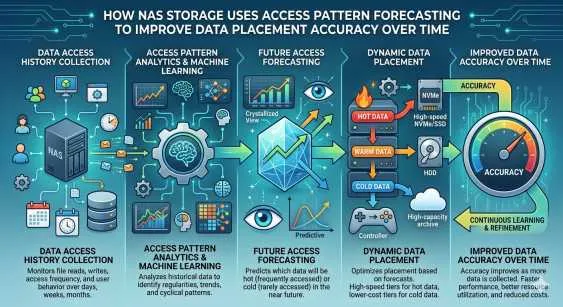
Data placement accuracy relies heavily on robust telemetry collection. Enterprise nas environments constantly log metadata regarding file creation dates, modification frequencies, read operations, and user access patterns. Access pattern forecasting ingests this vast amount of historical telemetry to identify underlying usage trends.
For instance, a quarterly financial report might experience heavy read and write activity at the end of a fiscal period but remain entirely untouched for the subsequent months. A predictive system recognizes this cyclical pattern. Instead of treating the file as permanently cold after a few days of inactivity, the system understands the chronological context of the data and prepares the storage tiers accordingly.
Machine Learning Algorithms
Predictive models apply machine learning algorithms to this telemetry data. Instead of relying on static, administrator-defined thresholds—such as moving any file untouched for 30 days to a slower tier—the algorithms calculate the exact probability of a file being requested in the near future.
The NAS Storage system uses these probability scores to preemptively migrate data across the network. If the predictive model determines a high likelihood of imminent access, it promotes the specific file to a high-performance NVMe or SSD tier. Conversely, data with a statistically low probability of access is demoted to high-capacity, lower-cost mechanical drives. This dynamic movement happens seamlessly in the background, without disrupting active workloads.
Continuous Improvement in Data Placement
Feedback Loops in Enterprise Architecture
The fundamental technical advantage of access pattern forecasting is its inherent ability to learn and adapt. Every time the Enterprise nas system makes a data placement decision, it continuously monitors the outcome of that decision. If a file moved to a slower tier is unexpectedly requested by an application, resulting in increased I/O latency, the system registers this event as a miscalculation.
The underlying algorithm immediately adjusts its weighting parameters to prevent similar errors from occurring in the future. Over time, this continuous feedback loop refines the predictive accuracy of the NAS Storage infrastructure. The system becomes highly customized to the specific workload behaviors, application demands, and user habits of the individual organization.
Cloud Integration and Hybrid Deployments
Many organizations extend their on-premises infrastructure into public cloud environments to handle rapid data growth and disaster recovery requirements. Access pattern forecasting plays a critical role in optimizing these hybrid deployments. When integrating with public cloud platforms like Azure disk storage, predictive models calculate the financial costs and latency implications of moving data across the wide area network.
If the Enterprise nas determines that certain datasets are entirely dormant and will not be required for operational processing, it can seamlessly migrate them to a highly cost-effective cloud archive tier. Alternatively, when active computational workloads are shifted to the cloud for heavy processing, the storage system might automatically provision high-IOPS Azure disk storage to guarantee that performance metrics are strictly met.
Operational Benefits of Intelligent Tiering
Maximizing Hardware Return on Investment
Procuring enterprise-grade storage hardware requires significant capital expenditure. By utilizing access pattern forecasting, organizations maximize the lifespan and physical utility of their existing assets. High-performance tiers are kept strictly clear of inactive, cold files, ensuring that costly solid-state drives are reserved only for operations that require microsecond latency.
As data naturally cools over its lifecycle, it is reliably shifted to dense mechanical drives or scalable cloud repositories like Azure disk storage. This automated, intelligent tiering prevents premature hardware upgrades and allows IT departments to control data center footprints accurately.
Ensuring Strict Workload Performance
Predictive data placement eliminates the performance degradation often associated with reactive storage tiering methodologies. Reactive systems initiate data movement only after a performance bottleneck occurs, which means the application has already experienced latency.
A forecasting-enabled NAS Storage platform moves data well before the bottleneck materializes. Applications experience consistent read and write speeds because the Enterprise nas has already positioned the required files on the optimal storage medium based on its predictive calculations.
Frequently Asked Questions About Storage Forecasting
How does predictive tiering differ from traditional automated storage tiering?
Traditional automated tiering relies on static, rule-based policies determined by administrators, such as moving files that have not been accessed in 60 days. Predictive tiering utilizes machine learning to forecast future access based on historical trends and telemetry. This allows the Enterprise nas to move data proactively based on probability, rather than reactively based on a rigid timer.
Can access pattern forecasting work effectively with public cloud infrastructure?
Yes. Modern predictive storage systems can analyze access patterns and execute intelligent data placement policies across complex hybrid environments. This includes moving data seamlessly between local physical hardware and virtualized cloud platforms like Azure disk storage, depending on strict performance requirements and ongoing cost analysis.
Strategic Data Lifecycle Management
The management of unstructured data at scale requires autonomous, intelligent solutions. Access pattern forecasting provides the analytical foundation necessary for highly accurate data placement. By continuously analyzing storage telemetry and adjusting algorithmic weights to match specific workload behaviors, modern NAS Storage arrays ensure that critical data is always positioned on the right tier at the exact right time.
Whether leveraging on-premises all-flash arrays or migrating cold historical files to scalable Azure disk storage, IT leaders can rely on predictive algorithms to balance aggressive performance requirements with strict budgetary constraints. Implementing these predictive architectures enables organizations to build resilient, cost-effective data environments that automatically scale with shifting operational demands.





























Sign in to leave a comment.