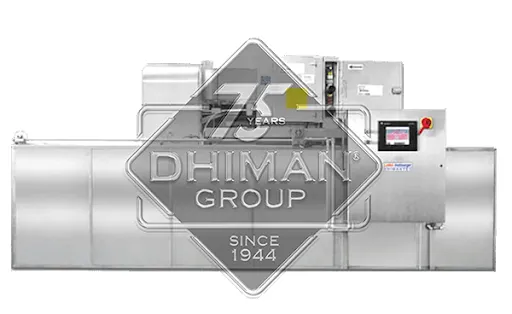

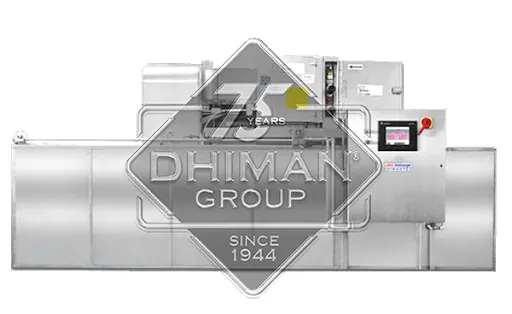
Gloss is never a co-incident in confectionery manufacturing. It is a direct result of precise thermal engineering. When hot sugar syrup leaves the cooker, it enters a volatile state where its structure can change instantly. If you expose it to uncontrolled air, the surface becomes dull or sticky within seconds. This critical transition phase determines whether your product looks premium or cheap. Managing this specific window requires more than just fans; it demands a dedicated cooling conveyor machine from Dhiman Industries that is designed to stabilise the sugar matrix immediately.
Does Temperature Shock Ruin the Surface Gloss?
Sugar chemistry reacts poorly to sudden changes. If you force a hot batch into a freezing environment, the outer shell contracts too fast. This creates microscopic cracks that scatter light, making the sweet look opaque rather than transparent. We call this 'thermal shock'. A gradual reduction in temperature preserves the glass-like structure of the candy.
- Controlled Gradient: The temperature must drop in stages, not all at once.
- Surface Tension: Proper airflow seals the outer layer without hardening the centre too quickly.
- Crystal Prevention: Rapid cooling stops sugar molecules from forming unwanted grainy crystals.
The objective is to bring the mass down to room temperature while keeping the core pliable. This balance prevents the centre from becoming brittle while ensuring the outside is hard enough to resist fingerprints.
How Does Airflow Management Affect Sticky Batches?
Humidity is the enemy of any sugar product. Toffee and hard candy are hygroscopic, meaning they naturally attract moisture from the atmosphere. If the air inside your cooling tunnel is stagnant, moisture pools around the warm product. The candy absorbs this water, and the surface becomes tacky.
Effective systems use laminar airflow. This means the air moves in smooth, parallel layers rather than turbulent swirls. It strips away the heat and moisture efficiently.
- Dew Point Control: Keeps the air dry enough to prevent condensation on the sweets.
- Uniform Velocity: Ensures every sweet on the belt receives the same amount of cooling.
- Exhaust Integration: Removes hot, moist air from the factory floor instantly.
Implementing a cooling conveyor machine from Dhiman Industries with integrated dehumidification solves the stickiness problem at the source. It allows you to package the product immediately without a resting period.
Can a Cooling Tunnel Prevent Shape Deformation?
Hot sugar behaves like a heavy liquid. It flows until it sets. If the belt vibrates or creates friction, the soft sweets will flatten at the bottom. This is known as 'cold flow'. The bottom of the candy takes the texture of the belt, while the top loses its definition.
The cooling process must support the physical shape of the product until it hardens.
Static Cooling vs. Active Conveyor Cooling
| Parameter | Natural / Static Cooling | Active Conveyor Cooling |
| Cooling Time | 30 to 45 minutes | 5 to 8 minutes |
| Surface Finish | Dull, often uneven | High gloss, glass-like |
| Floor Space | Large holding area needed | Compact, continuous line |
| Risk of Deformation | High (due to long soft state) | Low (rapid setting) |
What Role Does the Belt Material Play?
The belt is the only surface touching your product while it is soft. If the material retains heat, the bottom of the candy stays soft while the top cools. This uneven cooling causes internal stress, leading to cracks later.
Dhiman Industries use materials like Polyurethane (PU) or steel bands that conduct heat away from the product.
- Non-Stick Properties: Prevents the need for excessive release agents or oil.
- Hygiene Standards: Smooth surfaces are easier to sanitise during changeovers.
- Thermal Conductivity: Helps draw heat out from the base of the sweet.
Is Precise Timing the Secret to Perfect Packaging?
The final output must match the speed of your wrapping machines. If the cooling line is too slow, the wrappers wait, wasting energy. If it is too fast, warm sweets enter the wrapper and jam the cutting blades.
A variable-speed cooling conveyor machine acts as the regulator for your entire production line. It synchronises the cooker output with the packaging input. This ensures that every sweet arrives at the wrapping station at the exact temperature required for high-speed sealing.
Improving Your Production Line
Efficiency in confectionery comes from controlling the variables. If you are looking to upgrade your existing setup or install a new line, Dhiman Industries provides the engineering expertise to optimise your cooling and finishing processes.
Upcoming Exhibitions
We’re excited to connect with industry professionals and showcase our latest innovations at these upcoming global exhibitions:
Interpack Processing and Packaging
📅 7th May – 13th May 2026
📍 Düsseldorf, Germany
📌 Booth: 3C91
Sweets and Snacks Expo
📅 18th May – 19th May 2026
📍 Las Vegas, NV
📌 Booth: 6330
Visit us to explore our advanced solutions and discuss how we can support your business growth. We look forward to meeting you!
Frequently Asked Questions
What creates the shine on hard candy?
The shine comes from cooling the sugar mass quickly enough to prevent crystallisation but slowly enough to avoid surface cracking. It essentially freezes the sugar in a liquid state.
Why do my sweets stick to the wrapper?
This usually happens if the product was not cooled to the core before wrapping. The residual heat travels to the surface, causing the sugar to sweat inside the packet.
How long should a cooling conveyor be?
The length depends on your output volume and the size of the sweet. Larger products hold more heat and require a longer travel time to cool down completely.












![The Benefits of Using a CNC Touch Probe [Infographic]](https://writeupcafe.com/data/post/1677697/bfdf3e040e67936848aa232d2dfe3d03.jpg.webp)









Sign in to leave a comment.