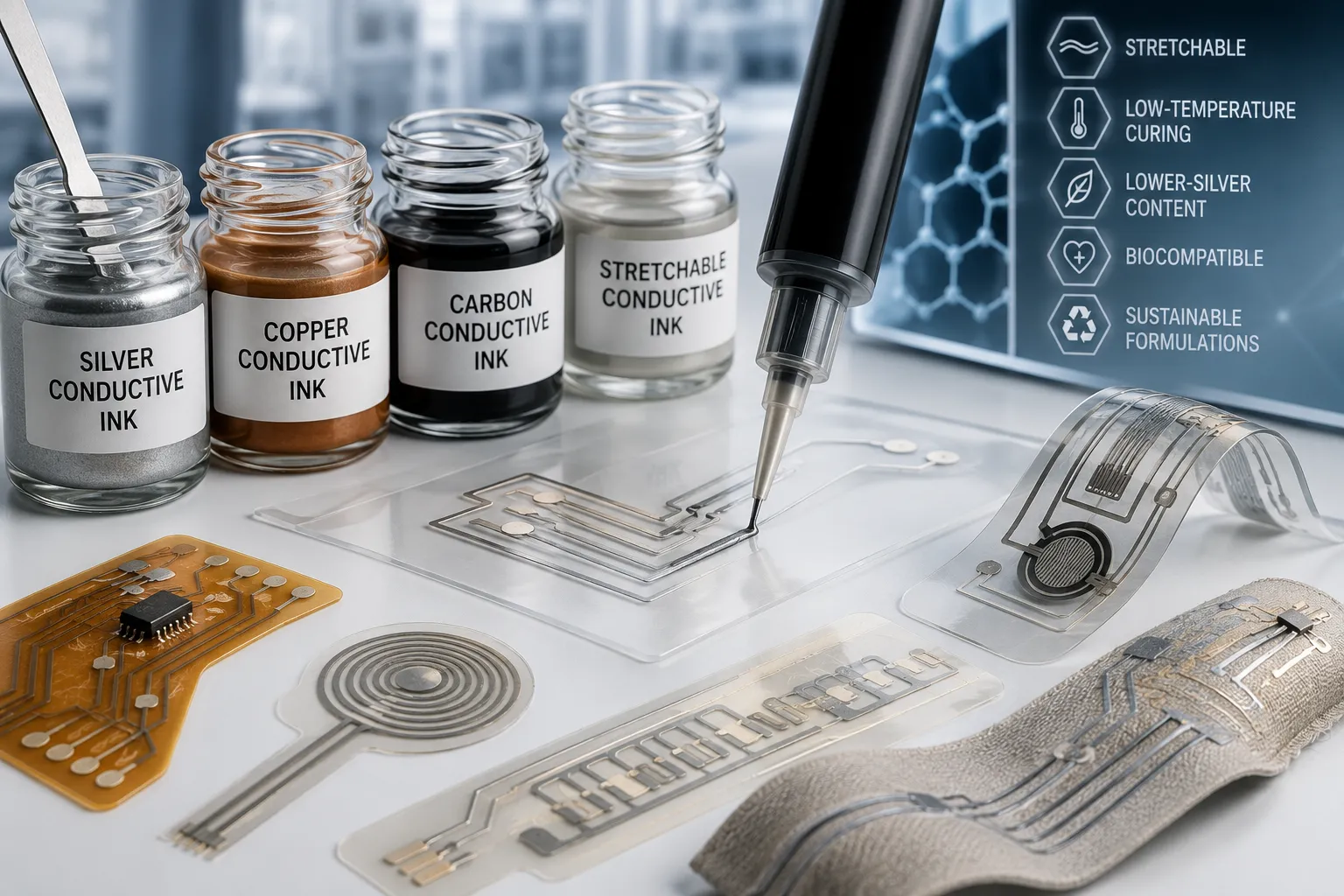


Conductive ink is the quiet foundation of printed electronics. It is what turns a printed pattern into a working circuit, sensor, heater, or antenna.
As demand grows for thinner, more flexible, and more sustainable electronics, conductive inks are evolving fast.
Here is a look at the innovations reshaping what printed electronics can do.
Quick answer: Conductive inks are printable, particle-loaded materials that carry electrical current once printed; innovations like stretchable, low-temperature, copper-based, and biocompatible inks are rapidly expanding what flexible and printed electronics can do.
The momentum is significant: the printed electronics market is projected to grow from about USD 19.5 billion in 2025 to USD 39.85 billion by 2030 (a 15.4 percent CAGR), with conductive inks a core enabler of that growth.
What Conductive Inks Are
Conductive inks are printable materials, usually loaded with silver, carbon, or other conductive particles, that carry electrical current once printed and cured. They are the basis of printed and flexible electronics, replacing etched metal with printed patterns.
Why Ink Innovation Matters
Better inks unlock better products.
- Thinner, lighter, and more flexible electronics
- Lower cost through less material and simpler processing
- New form factors that rigid boards cannot achieve
- More sustainable manufacturing
Key Innovations Shaping the Field
Several advances are pushing conductive inks forward.
- Stretchable inks that keep conducting while flexing and stretching with the body
- Lower-silver and copper-based inks that cut cost and material dependence
- Particle-free and reactive inks for finer, more uniform conductive traces
- Low-temperature curing inks that work on heat-sensitive films and fabrics
- Biocompatible inks formulated for safe skin contact
Stretchable and Wearable Inks
Some of the most exciting progress is in stretchable inks. Printed on flexible films and fabrics, they let circuits, biometric electrodes, and heaters move with the body, making comfortable, skin-conforming wearables possible.
Sustainability and Cost
Ink innovation is also driven by cost and the environment. Reducing silver content, enabling recyclable substrates, and lowering curing energy all make printed electronics cheaper and greener without sacrificing performance.
Applications Enabled by New Inks
Advances in conductive inks directly expand what printed electronics can build, from sensors and flexible heaters to printed antennas, biometric electrodes, and force sensors, all on thin, flexible substrates.
Where Manufacturing Precision Becomes Critical
An advanced ink is only as good as the process that prints it. Consistent deposition, curing, and lot control determine whether an innovative formulation performs reliably at scale.
Organizations working in printed electronics, printed electronics and conductive-ink devices, and related interface components, such as Butler Technologies, Inc., build these products on controlled, in-house production lines so performance stays consistent from the first unit to the ten-thousandth.
The Ink Behind the Innovation
Conductive inks rarely make headlines, but nearly every advance in printed electronics starts with them. As inks get stretchier, cleaner, and cheaper, the products they enable will keep getting thinner, smarter, and more capable.
Key Takeaways
- Conductive inks turn printed patterns into working circuits, sensors, and heaters
- Key innovations: stretchable, low-temperature, copper-based, and biocompatible inks
- Stretchable inks enable comfortable, skin-conforming wearables and electrodes
- Ink advances cut cost and silver dependence and improve sustainability
- Consistent deposition and curing determine whether new inks perform at scale
FAQs
What is conductive ink?
Conductive ink is a printable material loaded with conductive particles such as silver or carbon that carries electrical current once printed and cured. It is the foundation of printed and flexible electronics.
What are the latest innovations in conductive inks?
Key innovations include stretchable inks, lower-silver and copper-based inks, particle-free and reactive inks, low-temperature curing inks, and biocompatible formulations for skin contact.
Why are stretchable conductive inks important?
They keep conducting while flexing and stretching, which lets circuits, electrodes, and heaters move with the body, making comfortable, skin-conforming wearables and flexible devices possible.
How do conductive inks support sustainability?
Newer inks reduce expensive silver content, enable recyclable substrates, and cure at lower temperatures, lowering both cost and the environmental footprint of printed electronics.




























Sign in to leave a comment.