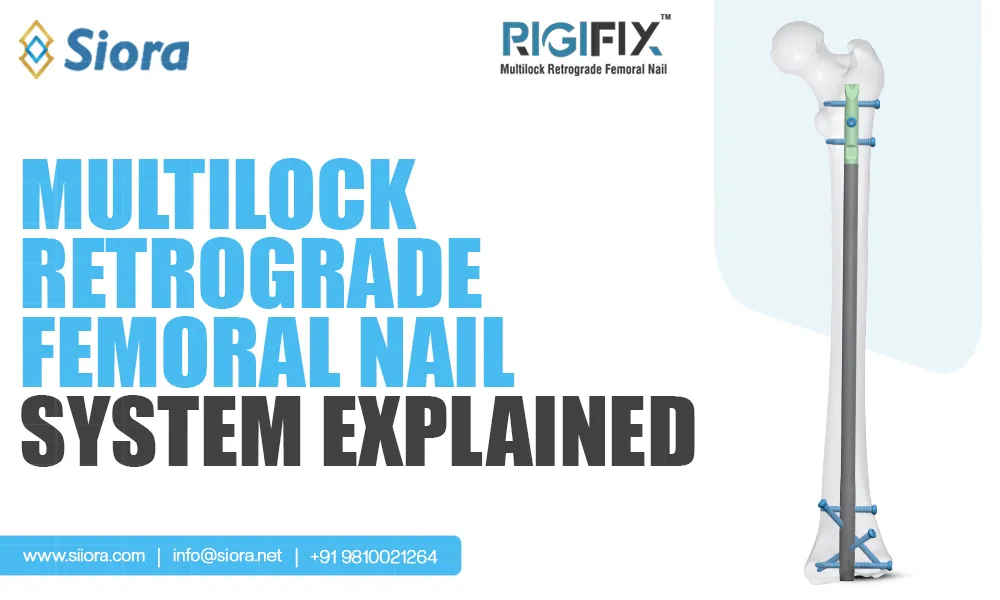

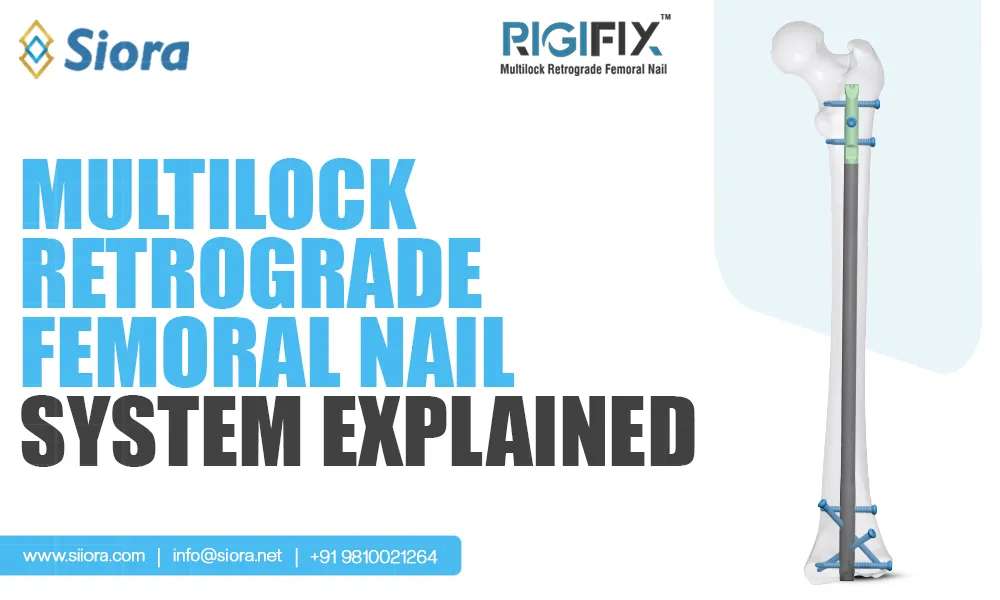
Treating femoral fractures can be difficult, especially when the fracture is located near the lower end of the femur. In such cases, achieving stable fixation while allowing early movement is important for recovery. Over the years, retrograde femoral nailing has become a trusted option for many orthopedic surgeons. Among the available solutions, the Multilock Retrograde Femoral Nail System is widely used because of its stable locking design and versatility in handling different fracture patterns.
This system is designed to provide strong fixation with better control over distal femoral fragments, especially in complex fractures.
What is a Multilock Retrograde Femoral Nail System?
A Multilock Retrograde Femoral Nail System is an intramedullary fixation device inserted from the distal end of the femur near the knee joint. Unlike antegrade nails, which are inserted from the hip side, retrograde nails enter through the intercondylar region of the femur and travel upward inside the medullary canal.
The term “multilock” refers to the multiple locking screw options available at both proximal and distal ends of the nail. These locking configurations help improve stability and prevent rotational or axial movement after fixation.
Common Indications
This nail system is commonly used in:
- Distal femur fractures
- Supracondylar femoral fractures
- Femoral shaft fractures extending distally
- Periprosthetic fractures above total knee replacements
- Certain cases of polytrauma where supine positioning is preferred
It is particularly useful when better distal fixation is needed due to comminution or poor bone quality.
Design Features of the System
One of the major advantages of the Multilock Retrograde Femoral Nail is its multiple locking options. The distal part of the nail allows placement of screws in different directions, helping surgeons achieve firm fixation even in small distal fragments.
Most modern systems also include:
Anatomical Nail Design
The nail is shaped to match the natural curvature of the femur. This improves implant fit and reduces stress within the bone.
Multiple Distal Locking Holes
These holes allow better fixation in distal femoral fractures, where stability is often difficult to achieve.
Cannulated Structure
Many retrograde nails are cannulated, allowing insertion over a guidewire for improved surgical accuracy.
Titanium or Stainless Steel Options
Depending on the surgeon’s preference and patient requirements, the system may be available in titanium or stainless steel.
Surgical Benefits
The Retrograde Femoral Nail System offers several practical advantages during surgery. Since the trauma implant is inserted through a smaller incision, soft tissue disruption is usually less compared to open plating procedures.
The technique also helps preserve fracture biology because minimal periosteal stripping is required. Reduced blood loss and shorter operative time can be beneficial, especially in elderly or polytrauma patients.
Another important advantage is stable fixation. The multiple locking screw configuration improves rotational control and supports early mobilization after surgery.
Postoperative Recovery
Recovery depends on fracture type, fixation stability, and patient condition. In many cases, early knee motion exercises can begin soon after surgery. Weight-bearing is usually guided by fracture healing and the surgeon’s assessment.
When proper reduction and fixation are achieved, patients often regain good functional outcomes with satisfactory fracture union.
Conclusion
The Multilock Retrograde Femoral Nail System has become an important option for managing distal femoral and selected shaft fractures. Its multiple locking features, minimally invasive approach, and stable fixation make it useful in both simple and complex fracture patterns. For orthopedic surgeons, understanding the design and practical advantages of this system helps in achieving reliable fixation and smoother patient recovery.





























Sign in to leave a comment.