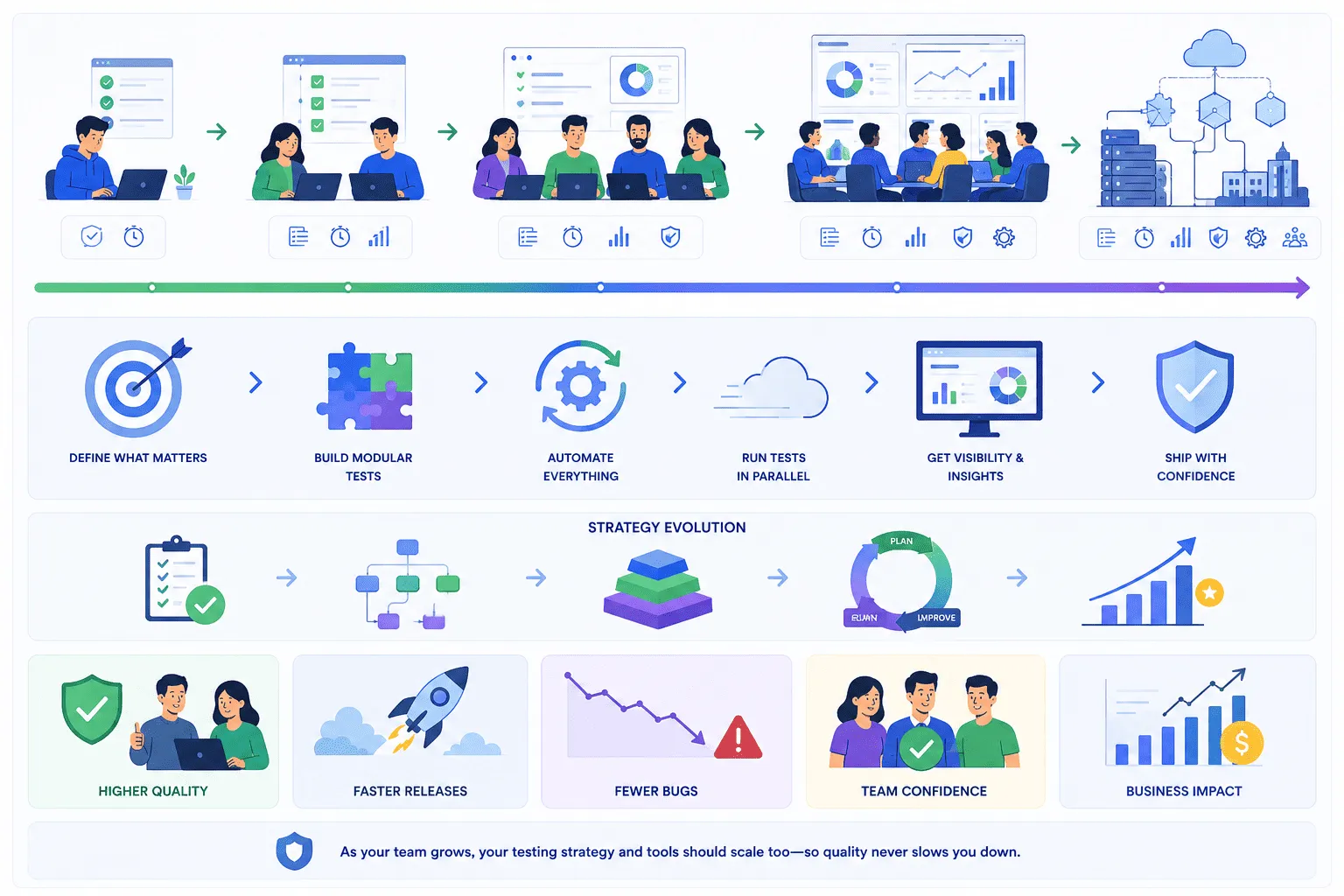

Your first developer writes tests. One person. One approach. No coordination needed. Tests live in the repository. Everyone knows how they work because there is only one person writing them. Then you hire a second developer. They learn the testing approach. They write tests. Things stay relatively simple.
By ten developers, something has changed. Testing is no longer personal. It is organizational. Different developers have different approaches. Some tests are clear. Others are cryptic. Some are reliable. Others fail randomly. The informal approach that worked for one person is breaking down. By fifty developers, testing has become infrastructure. You cannot rely on individual discipline. You need systems. You need tools. You need coordination. This journey from solo to team to organization is not just about team size. It is about how testing needs to evolve. And when regression testing tools become necessary.
The Testing Evolution
Testing needs change as teams grow. This is not because larger teams are worse at testing. It is because the problems change. One developer tests their own code. They understand the context. They know what broke. They can debug quickly. Testing is tight feedback.
Two developers means shared code. They need to understand each other's tests. Testing becomes communication. Five developers means you need standards. How should tests be written? How should they be organized? Without standards, you get chaos.
Ten developers means you need infrastructure. You cannot run all tests on every developer's machine. You need centralized test execution. You need visibility into results. Twenty developers means you need organization. Who maintains which tests? How do you prevent duplicate effort? How do you share knowledge? Fifty developers means you need formality. Testing process becomes explicit. You have testing standards. You have testing infrastructure. You have testing governance.
At each stage, new tools become useful. But the timing matters. Too early and tools create burden. Too late and you are drowning in chaos.
What Actually Changes at Different Scales
One to Five Developers: Basic testing practices work. Tests in the repository. Manual execution. Informal communication. No tools needed. A simple testing framework is enough.
Five to Twenty Developers: Coordination becomes important. You need standards. You need central test execution. Basic regression testing tools start to make sense. Primarily for visibility and coordination.
Twenty to Fifty Developers: Testing becomes infrastructure. You need test management. You need execution orchestration. You need reporting. Regression testing tools become essential.
Over Fifty Developers: Testing becomes a specialized function. You have dedicated testing infrastructure teams. Regression testing tools are baseline infrastructure. You layer additional tools on top.
This progression is not strict. Different organizations move through these stages at different paces. But the pattern holds. As teams grow, regression testing tools move from optional to essential.
When Regression Testing Tools Become Necessary
The honest answer is: later than most teams think.
Teams often adopt regression testing tools too early. They have ten developers. They buy expensive tools designed for hundred developer organizations. The tool creates overhead. The team resents it. Teams sometimes adopt too late. They have fifty developers. Testing has become chaotic. They finally adopt regression testing tools as emergency measure. Implementation is painful because the foundation is not ready.
The right time depends on specific signs:
- Testing coordination is breaking down. Different developers have different approaches. You cannot easily share tests. You cannot find tests you wrote.
- Test maintenance is becoming burden. Tests break frequently. When tests break, it takes hours to understand why. The cost of maintaining tests exceeds the cost of running them manually.
- Test results are unclear. You do not know which tests passed. You do not know which failed. You do not know why. Results are scattered across logs and email.
- Test execution is slow. The full test suite takes hours. Developers are not running tests. They are breaking things.
- Team coordination is difficult. Developers do not know what tests exist. They do not know who wrote them. They do not know what they cover. They write duplicate tests.
These signs indicate readiness for regression testing tools. Before these signs appear, tools create more burden than benefit.
Real Patterns of Tool Adoption
I have watched this evolution with multiple teams. Patterns emerge consistently.
Teams start small. One person. Tests in the repository. Works great.
Team grows. Testing practices spread organically. Developers learn from each other. Works pretty well. Team grows more. Inconsistency appears. Different developers have different approaches. Some tests are good. Others are not. Coordination problems emerge.
At this point, teams often jump to tools. But jumping too early creates problems. The team is not ready. The foundation is not there. Tools create overhead.
Better approach: Fix the foundation first. Establish standards. Create shared understanding. Document practices. Build communication channels. Then add tools.
Teams that do this succeed. Teams that skip to tools struggle. One team I know adopted regression testing tools when they had eight developers. They had no standards. No documentation. No communication process. The tool created chaos. They abandoned it. Two years later, with thirty developers and actual foundation in place, they adopted tools successfully.
Another team waited until they had thirty developers to adopt tools. They had standards. They had documentation. They had communication. Tool adoption was smooth. They quickly became more productive. The difference was not the tool. The difference was readiness.
Understanding Real Test Management
As teams grow, regression testing tools serve a specific purpose. They manage test inventory. They coordinate execution. They provide visibility.
But they do not create testing discipline. They do not create good tests. They do not guarantee quality. They are infrastructure, not solution.
Tools that help teams manage regression testing well are those that fit naturally into existing workflow. Tools that require changing how developers work create friction. Tools that observe actual test behavior and manage based on reality tend to work better than tools requiring extensive manual configuration.
For example, approaches that record actual regression behavior and use that as the specification for validation tend to integrate better as teams scale. Tools like Keploy, which record actual API behavior for regression testing, fit this pattern. They capture what the system actually does, then validate that behavior continues. This approach requires less manual test maintenance as teams scale.
Building the Foundation
Before tools, build foundation.
- First, establish what you are testing. What are the critical workflows? What would hurt most if broken? Start with those.
- Second, establish how you test. What testing approach will you use? Document it. Make it explicit.
- Third, establish standards. How should tests be named? How should they be organized? How should results be tracked? Write it down.
- Fourth, establish communication. How do developers share testing knowledge? How do they ask questions? How do they report problems?
- Fifth, establish ownership. Who is responsible for different tests? Who maintains them? Who debugs failures?
With these five things in place, regression testing tools add value. Without them, tools create burden.
Scaling Implementation
When you implement regression testing tools with growing teams, think strategically.
Start with small group. Not full organization. One team. One component. Real work. Learn what works.
- Fix problems before expanding. Do not roll out broadly with known issues. Solve them in the pilot.
- Document everything. How to use the tool. Why you chose it. What to expect. How to troubleshoot.
- Provide support. When developers have questions, they need answers quickly. Support is critical during adoption.
- Iterate based on feedback. The first implementation is not final. You will learn. You will adjust. That is normal.
Build incrementally. Do not expect full adoption in month one. Expect adoption to grow over several months.
Long-Term Strategy
Regression testing tools are not forever investments. They serve a purpose for a season. As your organization matures, your needs change.
Tools that work well for fifty developers might not work well for five hundred. You may outgrow them. You may need to move to different tools or build custom infrastructure.
This is normal. Plan for it. Choose tools that are not locking you into dead end. Choose approaches that can evolve.
Conclusion
Regression testing tools are not about team size. They are about organizational maturity. Small teams with mature practices may need tools. Large teams with immature practices may not benefit from them. Build foundation first. Establish standards. Create communication. Document practices. Build discipline. Then add tools. Tools amplify existing good practices. They do not create them.
Get the timing right and regression testing tools become valuable infrastructure. Get the timing wrong and they become burden. Think strategically about when your team is ready. Invest in foundation. Add tools when they solve problems, not before. Do this and testing remains effective as your team grows.























Sign in to leave a comment.