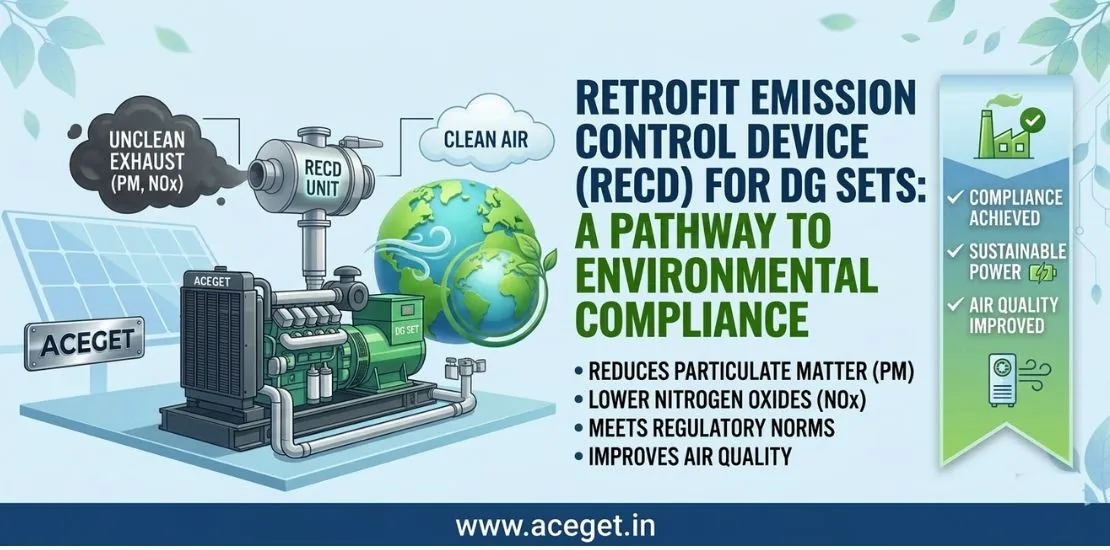

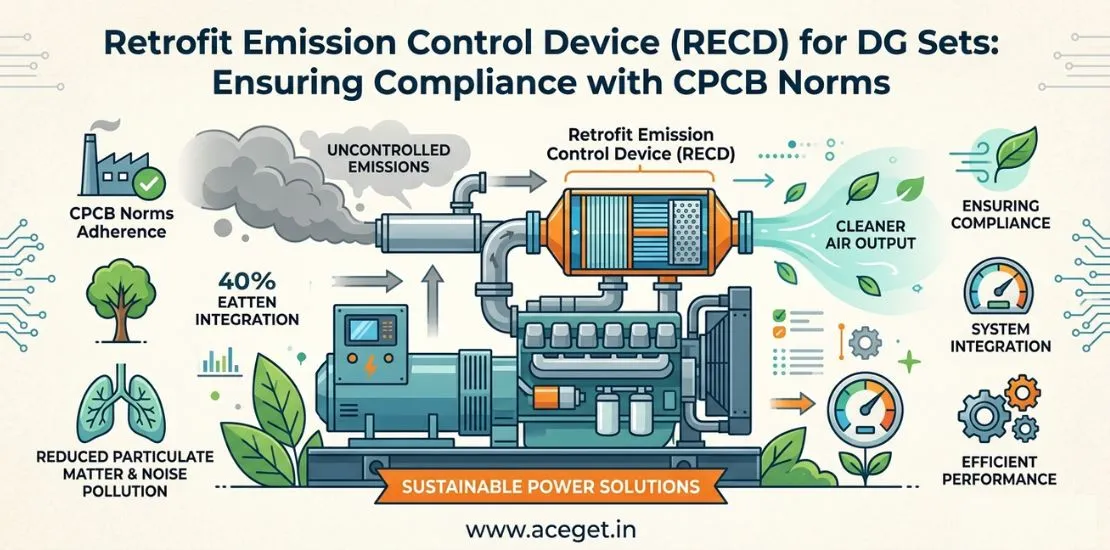
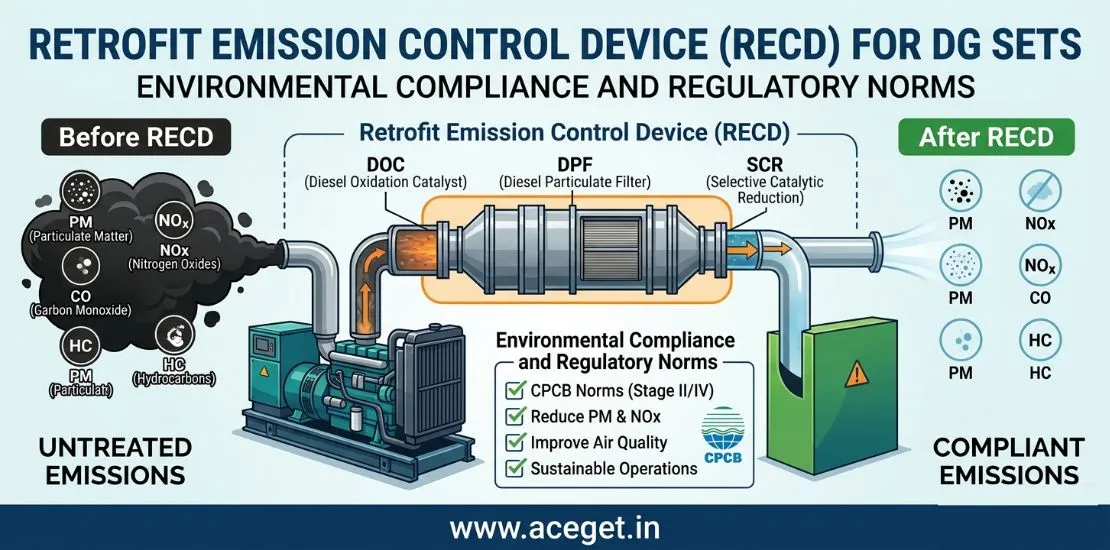
Air pollution has become one of the most pressing environmental challenges in India, particularly in urban and industrial regions where diesel generator (DG) sets are widely used as backup power sources. While DG sets ensure operational continuity during power outages, they are also significant contributors to air pollution, emitting particulate matter (PM), nitrogen oxides (NOx), carbon monoxide (CO), and hydrocarbons (HC). To address this issue, regulatory authorities have introduced stringent emission norms and mandated the use of Retrofit Emission Control Devices (RECDs) for certain DG sets. This blog explores RECD technology, its role in emission reduction, and compliance with Central Pollution Control Board (CPCB) norms.
Understanding RECD: Concept and Function
A Retrofit Emission Control Device (RECD) is an after-treatment system installed in the exhaust line of an existing diesel generator to reduce harmful emissions. Unlike new-generation engines that come with built-in emission control systems, older DG sets require retrofitting to meet current environmental standards.
RECDs are designed to target key pollutants such as PM, NOx, CO, and HC, significantly lowering their release into the atmosphere. These devices operate using a combination of filtration and catalytic processes. Common technologies used in RECDs include Diesel Particulate Filters (DPF), Diesel Oxidation Catalysts (DOC), Selective Catalytic Reduction (SCR), and Lean NOx Traps (LNT).
One of the major advantages of RECDs is that they can be installed without modifying the engine, making them a practical solution for upgrading existing DG sets. In many cases, RECDs can reduce emissions by up to 90–96%, depending on operating conditions and fuel quality.
Need for RECD in DG Sets
DG sets are widely used across industries, commercial buildings, hospitals, and residential complexes. However, their emissions significantly contribute to deteriorating air quality. Studies and regulatory observations indicate that DG sets are among the major stationary sources of particulate pollution in urban areas.
The need for RECD arises from:
- Increasing environmental and health concerns
- Stricter emission regulations
- The large number of legacy DG sets still in operation
- Rising enforcement actions by regulatory bodies
Recent regulatory interventions highlight the seriousness of DG emissions. Authorities have noted that non-compliant DG sets contribute substantially to pollution, prompting inspections and stricter enforcement measures.
CPCB Emission Norms for DG Sets
The Central Pollution Control Board (CPCB), under the Ministry of Environment, Forest and Climate Change, has established emission standards for DG sets to control pollution. These norms have evolved over time, becoming increasingly stringent.
Key Highlights of CPCB Norms
- Emission Limits
CPCB norms regulate emissions of PM, NOx, CO, HC, and smoke opacity for DG sets across different capacity ranges. - Applicability
- New DG sets must comply with updated emission standards (e.g., CPCB IV+ norms).
- Existing DG sets manufactured between July 2004 and June 2023 require retrofitting with RECDs in many cases.
- Implementation Timeline
Updated emission standards are being implemented progressively, with stricter norms expected to be mandatory from 2025 onwards for new generators. - Certification and Testing
DG sets must undergo testing and certification from authorized agencies such as ARAI, ICAT, or IIP to ensure compliance. - Stack and Exhaust Height Requirements
CPCB also specifies stack height and exhaust discharge norms to ensure proper dispersion of pollutants.
Mandatory Requirement of RECD
In regions with severe air pollution, such as the National Capital Region (NCR), regulatory authorities like the Commission for Air Quality Management (CAQM) have made RECD installation mandatory for certain DG sets.
Key Mandates Include:
- DG sets above a specific capacity (typically above 125 kVA) must install RECDs
- Smaller DG sets may require dual-fuel systems
- Only DG sets equipped with emission control systems are permitted to operate in regulated zones
Non-compliance can lead to penalties, shutdown notices, or legal action. Authorities are increasingly conducting inspections to ensure adherence to these norms.
CPCB-Approved RECD: What It Means
Not all emission control devices qualify for compliance. Only CPCB-approved RECDs are considered valid for regulatory purposes.
Features of CPCB-Approved RECD:
- Tested as per CPCB protocols and guidelines
- Proven efficiency in reducing emissions to permissible limits
- Certification and documentation for verification
- Compatibility with DG set specifications
Approval ensures that the device meets minimum emission reduction standards and is suitable for regulatory compliance. Using non-approved devices can result in rejection during inspections, even if the equipment appears functional.
Installation and Operational Considerations
Installing an RECD involves several technical and compliance-related steps:
1. Assessment
A detailed audit of the DG set is conducted to determine suitability and required RECD type.
2. Selection of Technology
Depending on emission levels and DG capacity, appropriate technology (DPF, SCR, etc.) is selected.
3. Installation
The RECD is installed in the exhaust system, ensuring minimal backpressure and optimal performance.
4. Testing and Commissioning
Post-installation emission testing is carried out to verify compliance.
5. Documentation
Proper records, including installation certificates, test reports, and vendor approvals, must be maintained.
Benefits of RECD Implementation
Environmental Benefits
- Significant reduction in air pollutants
- Improved ambient air quality
- Contribution to national clean air goals
Regulatory Compliance
- Ensures adherence to CPCB and CAQM norms
- Avoids penalties and operational disruptions
Economic Advantages
- Extends the life of existing DG sets
- More cost-effective than replacing generators
- Enhances asset value
Corporate Responsibility
- Supports sustainability initiatives
- Improves brand image and ESG compliance
Challenges in Implementation
Despite its advantages, RECD adoption faces certain challenges:
- High initial investment cost
- Lack of awareness among small operators
- Difficulty in identifying CPCB-approved vendors
- Maintenance and monitoring requirements
Additionally, improper installation or poor-quality devices can lead to performance issues and regulatory non-compliance.
Role of Compliance and Monitoring
Compliance is not a one-time activity but an ongoing process. Authorities require continuous monitoring, maintenance, and documentation.
Key compliance practices include:
- Periodic emission testing
- Regular maintenance of RECD systems
- Record-keeping for inspections
- Engagement with certified vendors
Conclusion
Retrofit Emission Control Devices (RECDs) play a crucial role in reducing emissions from existing DG sets and ensuring compliance with CPCB norms. With increasing environmental concerns and stringent regulations, installing CPCB-approved RECDs is no longer optional but a necessity for industries and commercial establishments.
By understanding regulatory requirements, choosing certified technologies, and maintaining proper compliance practices, organizations can achieve both environmental sustainability and operational continuity. RECDs not only help in meeting legal obligations but also contribute significantly to cleaner air and a healthier future.












![The Benefits of Using a CNC Touch Probe [Infographic]](https://writeupcafe.com/data/post/1677697/bfdf3e040e67936848aa232d2dfe3d03.jpg.webp)











Sign in to leave a comment.