

Artificial Intelligence is no longer a futuristic concept—it is a growing reality reshaping how industries function, make decisions, and serve customers. Whether businesses want to automate operations, personalize user experiences, or build intelligent products, AI plays a central role in achieving those goals. This growing demand has led many organizations to seek the right talent and hire AI developers who can turn algorithms into real-world solutions.
To meet the increasing complexity of AI projects, companies require specialists with a mix of technical knowledge, problem-solving ability, and domain understanding. This article explores the top skills every AI specialist should have in today’s evolving tech landscape.
Strong Foundation in Mathematics and Statistics
One of the most essential skill sets for any AI specialist is a strong grasp of mathematics, particularly linear algebra, calculus, and probability theory. AI models, especially those involving deep learning and machine learning, rely heavily on mathematical concepts.
Statistics is crucial for understanding data distributions, validating models, and evaluating outcomes. Knowledge of statistical tests, data sampling, and probability distributions enables professionals to handle data-driven challenges effectively.
A study by LinkedIn’s Emerging Jobs Report listed statistics and mathematics among the most important core competencies for AI and machine learning roles. These skills help professionals develop and refine algorithms that produce accurate and scalable results.
Expertise in Machine Learning Algorithms
AI specialists must be fluent in various machine learning techniques, including supervised, unsupervised, and reinforcement learning. Each of these approaches offers unique ways to teach machines how to make decisions based on data.
Understanding classic algorithms like decision trees, support vector machines, and k-nearest neighbors is essential. Additionally, proficiency in more advanced models such as random forests, XGBoost, and neural networks helps specialists address complex use cases.
According to O’Reilly’s AI Adoption in the Enterprise 2023 report, over 70% of businesses implementing AI initiatives required professionals who understood these models in depth. Simply using machine learning libraries is not enough; knowing how and why algorithms work provides a clear edge.
Knowledge of Deep Learning and Neural Networks
As AI continues to expand into areas like image recognition, natural language processing, and autonomous systems, deep learning skills have become increasingly important. Deep learning models, including convolutional neural networks (CNNs) and recurrent neural networks (RNNs), are essential for solving problems that involve unstructured data such as images, audio, or text.
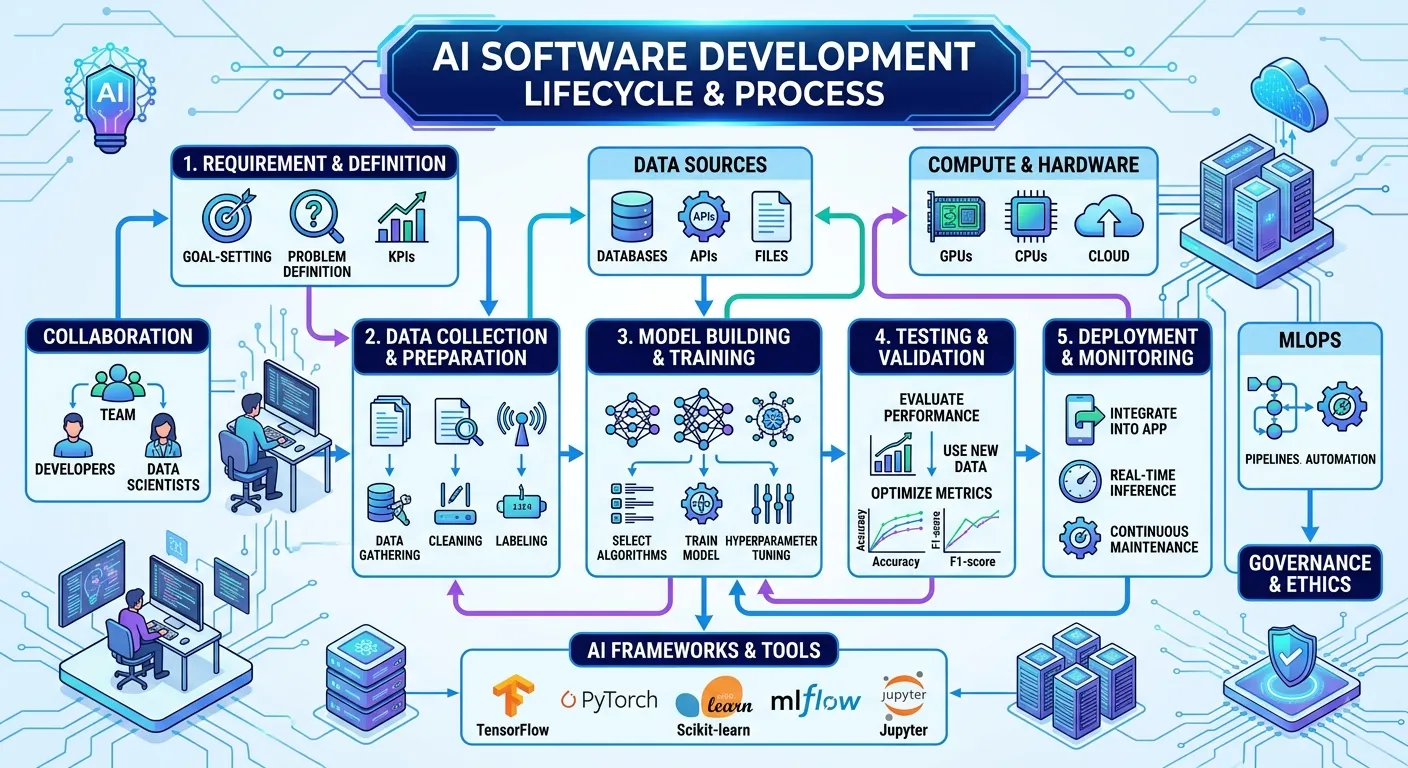
An AI specialist must understand the architecture and training process of neural networks, including forward and backward propagation, activation functions, and optimization techniques. Experience with frameworks like TensorFlow, Keras, or PyTorch is often expected.
In 2024, Statista reported that over 60% of AI projects in the healthcare, automotive, and finance industries relied on deep learning models. This trend will only grow, making deep learning knowledge a critical skill.
Proficiency in Data Handling and Preprocessing
AI models are only as good as the data they are trained on. One of the most time-consuming but important tasks in AI development is data preprocessing. This includes cleaning, normalizing, and transforming raw data into formats suitable for model training.
AI specialists must know how to identify missing or inconsistent values, remove outliers, balance datasets, and perform feature engineering. Familiarity with structured and unstructured data is equally important.
Real-world datasets often contain noise, bias, or inconsistencies. Poor data handling leads to weak models, so AI specialists must be skilled in building robust datasets that reflect reality accurately.
Problem-Solving and Analytical Thinking
While technical skills are vital, the ability to think analytically and solve problems creatively is what sets a good AI specialist apart from a great one. AI professionals need to understand the situation they are trying to solve and map it into a mathematical model.
They must assess which algorithm or approach is most appropriate, taking into account constraints such as time, accuracy, and data availability. In some cases, existing solutions may not apply, and professionals will need to develop custom models from scratch.
According to Gartner’s 2024 AI Skills Survey, problem-solving ranked as one of the top three soft skills valued by employers in AI roles. AI is more than code—it is about making intelligent decisions under uncertainty.
Familiarity with Big Data Tools and Cloud Platforms
Modern AI applications often deal with large-scale datasets that require distributed processing. AI specialists benefit from understanding big data technologies such as Apache Spark, Hadoop, and data lakes. These tools enable efficient data storage, retrieval, and processing.
In addition, experience with cloud platforms such as AWS, Google Cloud, or Microsoft Azure is a strong advantage. Many companies use cloud services to train and deploy AI models at scale. Knowing how to integrate cloud-based tools helps accelerate development and lower infrastructure costs.
The McKinsey Global Survey on AI 2023 found that 56% of high-performing AI teams used cloud-based machine learning environments to deploy their solutions. This shows a clear shift towards scalable and flexible AI development practices.
Strong Understanding of Ethics and Bias in AI
With great power comes great responsibility. AI systems can unintentionally reinforce societal biases if not developed carefully. An awareness of ethical considerations, transparency, and fairness is now essential in any AI project.
AI specialists must know how to evaluate bias models and ensure they do not lead to discriminatory outcomes. This involves understanding the sources of bias in data, conducting fairness audits, and developing interpretable models.
Organizations today face regulatory pressure to make AI systems transparent and accountable. Being aware of ethical challenges positions specialists to build systems that align with legal standards and social values.
Communication and Collaboration Skills
AI specialists rarely work in isolation. They collaborate with data engineers, product managers, UX designers, and stakeholders. Clear communication ensures that the AI solution being built aligns with business goals and user needs.
The ability to explain complex technical concepts in simple terms is vital. Whether presenting model results to executives or working with developers to deploy a system, communication makes or breaks a project.
According to IBM’s 2024 AI Workforce Study, over 40% of hiring managers emphasized communication skills when hiring for AI roles. The ability to translate AI capabilities into business value is a must-have trait.
Continuous Learning and Adaptability
AI is a rapidly evolving field. New models, frameworks, and research papers emerge regularly. AI specialists must commit to lifelong learning to stay current with the latest developments.
Platforms such as arXiv, GitHub, Coursera, and AI conferences provide valuable resources for staying up to date. Curiosity and a proactive approach to learning help professionals adapt quickly and remain competitive.
Those who embrace change and seek to learn continuously tend to bring innovative ideas and cutting-edge solutions to their teams.
Conclusion
The demand for AI specialists is rising, but not all professionals are equally equipped to deliver results. From mathematics and machine learning expertise to communication and ethical awareness, the role of an AI specialist is complex and multifaceted.
Organizations that understand these essential skills will be better positioned to find the right talent. Whether building a new AI team or expanding an existing one, knowing what to look for can make a significant difference in project success.
In today’s data-driven world, AI is not just a technological advantage—it is a strategic asset. Choosing specialists with the right blend of technical and human skills will help companies innovate responsibly and effectively.




























Sign in to leave a comment.