
Preventing catastrophic failures is a top concern in industries that use metal parts, like aerospace, energy, and manufacturing. That's why understanding what is eddy current testing and how it works is so important. This non-destructive testing method helps professionals spot tiny cracks, corrosion, or thinning before they turn into major problems. In this article, we’ll break down the science behind eddy currents, explore what is eddy current testing used on, and show how it's vital for keeping components safe and reliable.
What Is Eddy Current Testing?
Eddy current testing is a non-invasive inspection method based on electromagnetic induction. An alternating current (AC) runs through a coil in the test instrument, creating a changing magnetic field. When you place this coil near a conductive surface, the magnetic field induces swirling electrical currents—called eddy currents—in the material.
Here’s how it works:
1. The AC passes through the coil.
2. A magnetic field forms around it.
3. The conductive material reacts with its eddy currents.
4. Flaws in the material—like cracks or corrosion—disturb these currents.
5. The test instrument detects these disturbances.
6. Technicians interpret the signal to identify defects.
This method is perfect for fast, non-destructive inspections. It works while parts are still in place and provides instant results. This is incredibly valuable when downtime is expensive.
What Is Eddy Current Testing Used On?
What is eddy current testing used on? Quite a lot. Here are some of the most common applications:
● Fastener holes in aircraft: Detects cracks around rivets or bolts.
● Heat exchanger tubes: Find wall thinning and corrosion.
● Engine rotors and shafts: Spots surface fatigue or stress fractures.
● Weld seams in structures and pipelines: Checks for cracks and porosity.
● Metal sheets and plates: Measures coating thickness and heat treatment changes.
This method is widely used for any conductive material—steel, aluminum, copper, titanium, and more. It’s perfect for checking surface and sub-surface flaws without cutting or dismantling parts.
Why It Matters for Preventing Failures
1. Detects Early-Stage Flaws
Using eddy current testing helps spot small defects before they grow. Early detection lets you fix issues without shutting down the entire system. That can save both money and time.
2. Enables Regular Monitoring
This method allows for frequent inspections with minimal downtime. You can set up baseline tests and compare future scans over time. That helps track wear and predict when maintenance will be needed.
3. Maintains Structural Integrity
In high-risk sectors, one missed crack can lead to disaster. Eddy current testing gives confidence that parts remain safe and within operational limits.
4. Saves Time and Costs
Because this method doesn’t require disassembly or chemicals, it’s quick and cost-effective. You can inspect a heat exchanger or aircraft panel in minutes, not hours.
How It Looks In Practice
Let’s explore two real-world examples:
Example: Aerospace Fastener Inspection
● Inspectors use pencils or rotating probes on aircraft skins.
● They scan holes and rivet lines for crack signatures.
● The instrument measures phase and amplitude changes.
● Signals above a threshold trigger inspection, repair, or replacement.
Example: Tube Inspection in Power Plants
● Technicians use bobbin probes to scan tube interiors.
● They look for lift-off signals that drop due to wall loss.
● Multi-frequency scans detect both internal and external flaws.
● Early corrosion detection prevents leaks and shutdowns.
Choosing the Right Test Setup
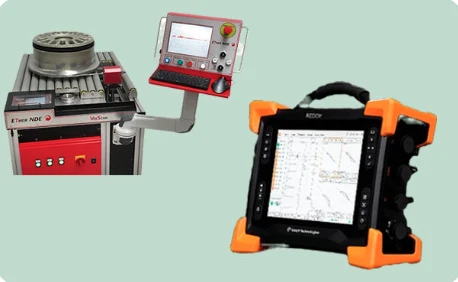
To get reliable results, you need the right eddy current inspection equipment and an optimized eddy current machine. Here’s what to look for:
● Frequency range: High for surface, low for subsurface flaws.
● Probe type: Bobbin, pencil, reflection, or array, depending on geometry.
● Signal processing: Phase-angle settings, C-scan imaging, threshold alarms.
● Data storage: Exportable data for trend analysis and reporting.
● Durability: Rugged, field-ready devices with strong battery life.
Technical teams must match the tool to the test scenario. That ensures accuracy, repeatability, and compliance with standards.
The Future of Eddy Current Testing
Eddy current technology continues to evolve:
● Multi-frequency systems improve flaw characterization across depths.
● C-scan imaging creates 2D maps of part surfaces.
● Wireless probes enable easier access in tight spots.
● AI-assisted analysis automates signal interpretation and reduces human error.
These innovations make it easier for professionals to achieve pinpoint accuracy, improved coverage, and shorter inspection cycles.
Conclusion
Understanding what is eddy current testing and what is eddy current testing used on is essential for professionals working with conductive materials. This non-destructive method supports reliable maintenance programs, preventive strategies, and safety compliance in high-risk industries. By adopting the right test setup and process, engineers ensure that small problems are spotted early and resolved before they create real hazards.





























Sign in to leave a comment.