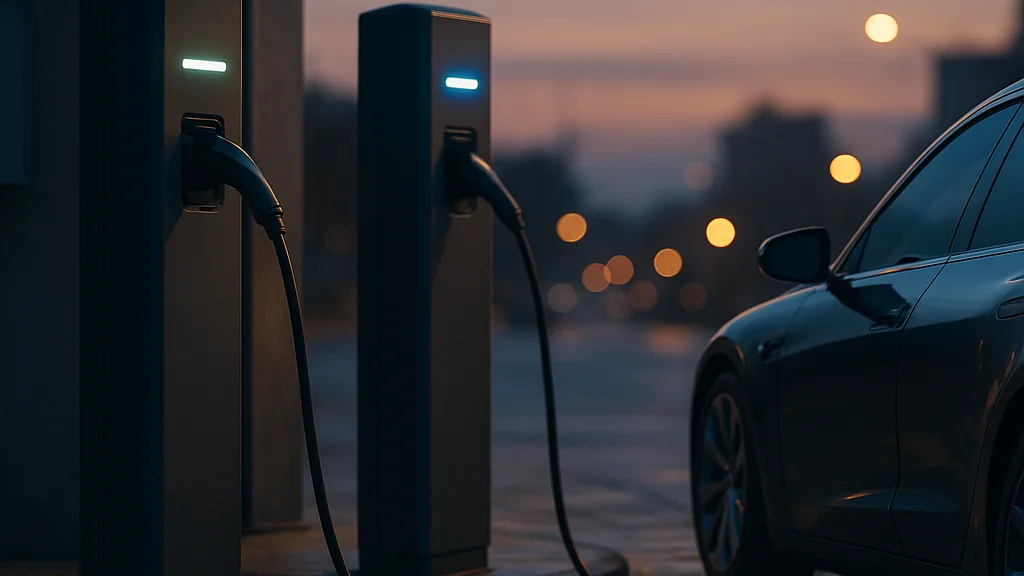

A charging revolution is visible on ordinary streets
On a summer evening in Stockholm, it is now common to see an electric taxi topping up beside a grocery store, a delivery van charging behind an apartment block, and a family car plugged in quietly at a motorway stop before the road bends north toward the pine forests. That ordinary scene tells the real story of electric vehicle infrastructure growth: this is no longer a niche experiment. Charging is becoming part of the built environment, as normal as street lighting or broadband, though still uneven, still political, and still full of technical trade-offs.
The most important shift is simple. For years, the public debate focused on the number of electric vehicles sold. In 2026, the harder question is whether charging networks are growing in the right places, at the right speeds, with the right reliability and pricing. A city can boast thousands of chargers and still fail drivers if too many are slow, broken, blocked, or concentrated in affluent districts. Rural regions can be left behind even while national totals look healthy. That is why infrastructure quality matters as much as infrastructure quantity.
Consumers are also learning that “charging infrastructure” is not one thing. It includes home wallboxes, workplace chargers, destination charging at hotels and retail centers, curbside AC points for residents without driveways, fleet depots for vans and buses, and ultra-rapid DC hubs along highways. Each serves a different rhythm of life. Lagom, the Swedish instinct for balance, applies well here: the best system is not the one with only the fastest chargers, but the one with the right mix.
Recent mainstream guides from AOL.co.uk and The Independent show how public understanding has matured. The conversation is moving beyond basic range anxiety toward cost, charging speed, interoperability, and access. That is healthy. A mature market asks mature questions.
“The transition to electric mobility succeeds or fails at the charger, not just at the showroom.”
If you want a broad primer on the market’s pace, WriteUpCafe’s How Electric Vehicle Charging Infrastructure Is Scaling offers a useful companion read. The deeper issue, though, is not whether infrastructure is growing. It is. The issue is how that growth is being financed, regulated, standardized, and distributed.
How we got here: from pilot projects to national build-outs
The modern charging market grew in three overlapping waves. First came the early-adopter phase, when chargers were installed mainly to prove the concept. Utilities, municipalities, and a handful of automakers funded pilot stations, often with awkward payment systems and inconsistent connectors. Then came the second wave, when EV sales accelerated and policymakers began tying climate goals to transport electrification. That pushed charging from demonstration to infrastructure strategy. The third wave, the one defining 2026, is industrialization: bigger capital, stricter uptime expectations, and tougher scrutiny of whether networks can make money.
Europe moved early through a mix of emissions regulation, city clean-air policies, and consumer incentives. China built at extraordinary scale, pairing industrial policy with aggressive deployment. The United States, after a slower and more fragmented start, began accelerating through federal and state funding, utility investment, and private charging networks seeking prime highway and urban locations. The result is a global market with common themes but very different local realities.
Connector standards and charging architecture have also evolved. Alternating current charging remains the backbone for homes, offices, and long dwell times, because it is cheaper to install and gentler on local grids. Direct current fast charging became essential for road trips, ride-hailing, and commercial fleets where time matters more than equipment cost. As battery sizes rose and charging curves improved, the market demanded higher-power stations, more dynamic load management, and smarter software.
That history matters because today’s bottlenecks are the legacy of yesterday’s assumptions. Early planners often underestimated apartment charging demand, overestimated how many drivers would accept slow public charging, and failed to appreciate the importance of seamless payments. According to The Conversation, prospective EV buyers still need clear guidance on charging behavior, battery realities, and practical ownership patterns. Infrastructure planning that ignores those habits tends to produce expensive mistakes.
Another turning point came when investors realized charging is not a pure technology play. It is a real-estate business, a power-management business, and a customer-service business at once. The best sites are near traffic, amenities, and grid capacity. The best operators minimize downtime, secure favorable electricity contracts, and maintain intuitive apps or card payment options. The charger itself is only the visible tip of a much larger system.
- Wave 1: pilot installations and early-adopter experimentation
- Wave 2: policy-driven expansion tied to emissions goals and EV incentives
- Wave 3: commercial scaling focused on reliability, utilization, and return on investment
That is why coverage such as WriteUpCafe’s Expanding Electric Vehicle Charging Infrastructure: Progress and Prospects resonates with readers. Progress is visible, yes, but prospects depend on solving structural issues, not merely adding pins to a map.
The numbers that matter are not just charger counts
Public discussion still leans heavily on headline totals: how many public charge points a country has, how many rapid chargers were added in a quarter, how many billions have been pledged. Those figures matter, but they can mislead. A network with 10,000 low-power chargers in the wrong places may serve drivers worse than one with 4,000 well-maintained chargers integrated into daily travel patterns. Analysts now pay closer attention to utilization rates, uptime, charging speed, queue times, geographic coverage, and the ratio of EV growth to charger growth.
One reason is that vehicle adoption has become more diverse. Early EV owners were more likely to have driveways and predictable routines. The next wave includes apartment residents, small businesses, tradespeople, and used-EV buyers who may be more price-sensitive. As the MSN guide on buying a used electric car suggests, the second-hand market is widening access. That is good for decarbonization, but it raises pressure on shared charging infrastructure because many lower-cost buyers do not have ideal home-charging setups.
Price transparency has become another decisive metric. The Independent has reported on the complexity of public charging prices, and drivers know the frustration well: tariffs can vary by network, time of day, membership plan, and payment method. Some stations bill by kilowatt-hour, others by time, and idle fees may apply. For mass adoption, charging must feel less like decoding a rail fare table and more like a predictable utility service.
The core metrics worth watching include the following:
- Uptime: whether chargers are actually working when drivers arrive.
- Power availability: whether a “rapid” charger consistently delivers expected speeds.
- Coverage: whether rural corridors, apartment districts, and lower-income areas are served.
- Queue management: whether popular sites have enough stalls to avoid long waits.
- Interoperability: whether drivers can pay simply and roam across networks.
- Grid readiness: whether local distribution systems can support expansion without long delays.
There is also a subtle but crucial distinction between installed capacity and usable capacity. A motorway hub may advertise eight ultra-fast chargers, but if two are offline and another two are power-sharing heavily during peak demand, the real experience is very different. Reuters and other major newsrooms have repeatedly highlighted this gap across several markets over the past two years, especially where deployment raced ahead of maintenance.
“A charger on a map is not the same thing as a charger that is available, affordable, and delivering full power.”
From a sustainability perspective, this matters beyond convenience. Poorly planned infrastructure can slow EV adoption, waste capital, and deepen public skepticism. Better data standards, transparent uptime reporting, and rigorous maintenance contracts are becoming as important as ribbon-cutting ceremonies.
What is changing in 2026: reliability, depots, and curbside access
The year 2026 feels different because the market is entering a more disciplined phase. Investors are less impressed by raw expansion and more interested in whether charging operators can achieve durable economics. Governments, likewise, are shifting from subsidy announcements toward performance standards. In practical terms, that means more attention to uptime requirements, open payment systems, and minimum service levels on major corridors.
One of the clearest developments is the rise of fleet and depot charging. Passenger cars still dominate public attention, but electrification of delivery vans, municipal vehicles, buses, and service fleets is reshaping infrastructure demand. Depot charging can be easier to manage than public fast charging because vehicles return on schedule and charge overnight, yet it can also require expensive grid upgrades and sophisticated energy management. For logistics operators, charging is now a boardroom issue, not just a facilities issue.
Urban curbside charging is another major front. Cities across Europe are under pressure to support residents who park on the street. That challenge is especially acute in older neighborhoods where private driveways are rare. The policy debate has shifted from whether curbside charging is needed to what form it should take: bollard chargers, lamppost conversions, neighborhood charging hubs, or shared parking solutions. None is perfect. Lamppost chargers are elegant in dense districts, very Scandinavian in their understatement, but they are usually slower and depend on local electrical constraints.
Recent reporting from The Irish Times captures the tension well. Ireland’s debate over a “dismal” charging network is not unique; many countries face the same mismatch between EV ambitions and local implementation. Permitting delays, grid bottlenecks, and fragmented responsibility between national agencies, utilities, and local authorities can leave obvious gaps unresolved for years.
Another 2026 shift is the spread of larger charging hubs with amenities. Instead of one or two isolated fast chargers, operators increasingly favor sites with multiple high-power stalls, lighting, food, toilets, and weather protection. This is not cosmetic. It improves throughput, safety, and customer trust. A family on a winter trip in northern Europe is far more likely to embrace electric mobility if charging feels reliable and humane rather than improvised in a dark corner of a car park.
WriteUpCafe’s Electric Vehicle Charging Infrastructure Growth in 2026: Trends and Insights tracks many of these themes, but the headline is straightforward: the market is maturing from expansion at any cost to smarter expansion with accountability.
The hidden constraints: grid capacity, permitting, and business models
Ask charging operators what slows projects, and many will mention the same obstacle before anything else: the grid. Installing a fast charger is not like installing a vending machine. High-power sites may require transformer upgrades, substation work, utility approvals, and long interconnection queues. In some regions, the delay between securing a location and energizing it can stretch into years. That timeline is often invisible to consumers, who simply see too few chargers and assume companies are moving slowly.
Permitting is the second major constraint. A single charging hub may need approvals from transport authorities, landowners, local councils, utilities, environmental agencies, and sometimes heritage bodies. The complexity varies by country, but the effect is familiar: projects that look straightforward on paper can become administrative marathons. This is one reason governments increasingly talk about “streamlining” charging deployment rather than only funding it.
Then there is the business model problem. Fast charging is capital-intensive. Equipment is costly, installation can be very costly, land is expensive in prime areas, and utilization may be low in the early years. Operators need enough traffic to cover electricity costs, demand charges where applicable, maintenance, software, customer support, and financing. That is why many networks started in dense urban markets or along major highways. Marginal rural routes are socially important but commercially harder.
Several tensions define the sector:
- Speed versus cost: ultra-rapid chargers improve convenience but require heavier investment.
- Coverage versus utilization: remote sites may be essential for confidence yet underused for long periods.
- Open access versus loyalty models: consumers want simplicity, operators seek recurring revenue.
- Public policy versus private returns: governments want universal service, investors want viable margins.
Utilities are becoming more central because charging is now intertwined with load balancing, distributed energy resources, and storage. Some operators pair batteries with fast-charging hubs to reduce peak demand charges and ease grid stress. Others integrate solar canopies, though solar alone rarely solves high-power charging needs. The real value is in smart energy orchestration: charging vehicles when electricity is cleaner or cheaper, shifting loads, and eventually using vehicles more actively within flexible power systems.
Greta Thunberg has long argued that climate action must move from slogans to systems change. The charging build-out illustrates that perfectly. Electrifying transport is not merely about replacing engines. It means redesigning pieces of the energy system, the streetscape, and local planning rules. That is slower than many politicians promised, but it is also more durable when done well.
Who benefits, who gets left out, and why equity matters
Charging infrastructure is often discussed as a technical challenge, yet it is also a social one. Access is uneven. Homeowners with off-street parking typically enjoy the cheapest and simplest charging. Apartment residents, renters, and people in older urban neighborhoods rely more on public options, which are often pricier per kilowatt-hour and less convenient. If that gap persists, the transition risks rewarding those already well served while asking others to pay more for cleaner mobility.
This equity issue has several dimensions. Geographic inequality is the most visible. Capital cities and wealthy suburbs tend to attract early investment because utilization is easier to predict. Rural communities then fear being stranded, especially where public transport is limited and driving distances are longer. The second dimension is housing. Multi-unit dwellings need landlord cooperation, building upgrades, and fair cost-sharing mechanisms. The third is digital access. Some networks still work best through apps and subscriptions, which can exclude occasional users, tourists, or people without strong digital confidence.
There is also a pricing justice question. Public charging often costs substantially more than home charging, especially at rapid sites. That makes sense in part because infrastructure and land costs are higher, but policymakers are increasingly aware that a transition built on unequal energy prices can undermine public support. Some cities are experimenting with regulated curbside tariffs, while others support neighborhood charging hubs to reduce dependence on premium motorway-style pricing.
Scandinavian design offers an instructive lens here. Good public infrastructure should be intuitive, inclusive, and quietly efficient. A charger should not require a manual worthy of a flat-pack wardrobe. Clear signage, accessible cable management, contactless payment, weather protection, and visible uptime information are not luxuries. They are part of democratic design.
For households considering an EV, a practical checklist helps:
- Map your regular charging options before buying, not after.
- Compare home, workplace, and public tariffs in your area.
- Check whether your building or landlord allows future charger installation.
- Look at local rapid hubs for holiday travel and emergency top-ups.
- Consider used EVs only alongside realistic charging access, not just purchase price.
As The Conversation and The Independent both emphasize in different ways, successful EV ownership depends less on theoretical maximum range than on dependable charging routines. When infrastructure planning supports those routines for ordinary people, adoption broadens naturally.
What to watch next: consolidation, standards, and smarter energy use
The next chapter of charging infrastructure growth will be shaped by three forces: consolidation, standardization, and energy intelligence. Consolidation is already under way as weaker operators struggle with capital costs and intense competition for prime sites. Some networks will merge, some will partner with retailers or oil majors, and some will pivot toward fleet services where demand is more predictable. That does not mean fewer chargers. It means the ownership map may become more concentrated even as the physical network expands.
Standardization will matter just as much. Drivers increasingly expect universal contactless payment, transparent pricing, roaming between networks, and accurate real-time availability data. Regulators in multiple markets are pushing in that direction. The less friction drivers face, the less public charging feels like a specialist activity. That is essential if EVs are to become fully mainstream across income groups and travel patterns.
Smarter energy use may prove the most transformative trend. As EV numbers rise, unmanaged charging could strain local grids during evening peaks. Managed charging, dynamic tariffs, battery-buffered hubs, and vehicle-to-grid or vehicle-to-home systems can reduce that pressure. The promise is elegant, almost like a Swedish archipelago at dusk, each island connected yet distinct: millions of vehicles acting not only as loads but as flexible assets within a cleaner electricity system.
There are, however, reasons for caution. If policy support weakens too abruptly, if grid upgrades lag, or if public charging remains expensive and unreliable, adoption could slow in key segments. Used-EV buyers, renters, and small commercial operators are particularly sensitive to infrastructure quality. The market can absorb inconvenience for enthusiasts; it cannot scale on inconvenience for everyone else.
So what should readers remember most?
- Charging growth is real, but distribution and reliability matter more than raw totals.
- Home charging remains the cheapest anchor for many drivers, though not all have access.
- Public fast charging is becoming more professional, with larger hubs and better amenities.
- Grid capacity and permitting are often the true bottlenecks behind slow rollouts.
- Equity, pricing transparency, and apartment access will define the next stage of adoption.
Electric mobility no longer depends on proving that the technology works. That part is largely settled. The decisive task now is building infrastructure that is fair, resilient, and pleasant to use. If cities, utilities, operators, and regulators get that right, the transition will feel less like a sacrifice and more like progress, crisp and practical, a bit like stepping into clean winter air and realizing the future has already arrived.




































Sign in to leave a comment.