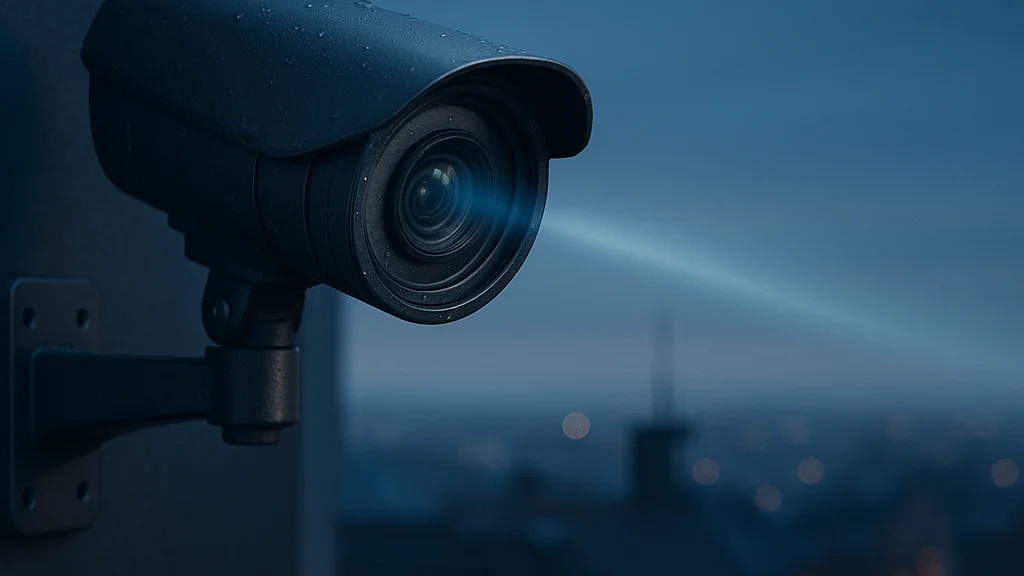

A remote worker closes laptop at 18:10, steps away for a short Fika break, and still wants to know whether gate at the far end of property is secure. That small scene explains why long-range wireless security cameras now matter far beyond traditional home surveillance. For people working from a garden office, a workshop, a farm outbuilding, a warehouse annex, or a rural co-working site, camera range is not a luxury feature. It is operational infrastructure.
The phrase that catches attention is simple: cameras you can install over half a mile away. The promise sounds almost too neat, and often marketing around it is. A camera itself does not magically send perfect video through forests, steel walls, and bad weather over 800 meters. What usually makes such deployments possible is a combination of camera sensor, power plan, radio bridge, antenna design, line-of-sight conditions, compression technology, and realistic expectations about bitrate. If one piece fails, whole setup becomes frustrating, expensive, and less secure than brochure suggests.
That is why remote work angle is important. Security and productivity are connected. A founder who must drive to check remote gate twice a day loses time. A consultant with detached studio loses focus when package deliveries arrive at an unseen entrance. A small team running hybrid operations from semi-rural property needs visibility without trenching cable across long distance. In practical terms, long-range wireless cameras can remove interruption, reduce travel around site, and support work-life balance, but only when buyer understands limits before purchase.
WriteUpCafe has already covered the basic product category in Wireless Security Cameras You Can Install Half a Mile Away and the broader planning issues in What You Need to Know About Long-Range Wireless Cameras. What follows goes deeper, with focus on how these systems really work, where claims are credible, and what changed by 2026.
Why half-mile camera claims are both real and misunderstood
Manufacturers and installers use the term wireless in a very loose way. Sometimes it means battery-powered Wi-Fi camera. Sometimes it means camera connected to a wireless bridge. Sometimes it means a full point-to-point network carrying IP video from one building to another. Those are very different systems, and only the latter two are usually relevant when distance moves toward half a mile or more.
The first misunderstanding is range versus usability. A radio link may technically connect at 0.5 miles, but if throughput drops, latency spikes, or packet loss rises, recorded video becomes choppy. High-resolution video is data-hungry. A 4MP or 4K stream at useful frame rates can stress weak links, especially when several cameras are sharing one bridge. This is why professional installers often tune bitrates, use H.265 compression, and separate critical recording traffic from casual mobile viewing.
The second misunderstanding is line of sight. Over long distances, trees, walls, terrain changes, and even seasonal foliage matter. A setup that works in January may degrade in June when leaves return. Rural users know this problem well. Scandinavian field studies on wireless coverage in mixed terrain have long shown that physical environment, not only radio specification, determines real performance. Stiff brochures ignore this, but installers do not.
A third issue is power. Many consumers imagine a battery camera on a fence post half a mile away. That can work for low-traffic motion clips, but not always for continuous recording. Solar panels help, yet winter conditions, cloud cover, and camera wake frequency all affect uptime. For remote work sites where reliability matters, stable power often decides whether solution is productive or annoying.
Long-range wireless camera systems are rarely just cameras. They are small networks, and they succeed or fail like networks.
There is also security tradeoff. According to MSN’s discussion of wired versus wireless security cameras, wireless models can offer flexibility and easier installation, but network security and signal reliability remain central concerns. For remote professionals, convenience is valuable, yet convenience without resilience tends to create more interruptions later.
How these systems actually work over long distances
When people hear “wireless security camera over half a mile away,” they often picture one device talking directly to home router. In most credible installations, there is more structure. The camera may sit at a gate, barn, detached office, parking area, or perimeter fence. Nearby, there may be a wireless bridge or access point with directional antenna. At main building, another bridge receives signal and passes it into recorder, router, or cloud gateway. The camera link is therefore part of larger engineered path.
There are several architectures commonly used in 2026:
- Direct Wi-Fi camera connection: usually suitable only for shorter distances, open areas, and modest bandwidth needs.
- Camera plus point-to-point bridge: common for farms, estates, and business compounds, especially when one or several cameras sit in remote zone.
- Cellular camera: useful where no local network exists, but recurring data costs can rise fast with frequent video uploads.
- Mesh or relay design: can extend coverage across larger properties, though every hop introduces complexity.
- Hybrid wired-wireless setup: camera wired locally to power and switch, then backhauled wirelessly to main site.
Directional antennas are key. They focus radio energy along a path, unlike ordinary indoor Wi-Fi which spreads signal broadly. This is why a long-range camera setup can work across open land while a premium home router fails at one quarter of distance. Frequency band matters too. Lower frequencies may penetrate obstacles better, but bandwidth is often lower. Higher frequencies can deliver stronger throughput with cleaner line of sight, though weather and obstruction can hurt more.
Compression standards make modern deployments more practical than they were few years ago. Better codecs reduce bandwidth needs, especially for scenes with limited motion. Smart event recording also helps. If your detached office entrance sees motion only a few times per hour, system can prioritize clips and alerts rather than constant high-bitrate streaming. That is useful for productivity, because user gets signal only when event matters, not endless noise.
Another major factor is where recording happens. If camera records locally to SD card, long-range link is needed mainly for live view and alert snapshots. If all footage must stream to central NVR, bandwidth requirement is much higher. For remote workers, this becomes a design decision: do you want forensic archive, instant notifications, or both? Different goals produce different hardware stacks.
For readers comparing options, Wireless Security Cameras You Can Install Over Half a Mile Away gives a useful category overview, but the operational question is simpler: what path moves video from camera to you, and what happens when weather, power, or network quality changes?
What remote workers and small businesses should measure before buying
Productivity people, myself included, like systems that remove friction. Long-range camera projects often do opposite when they are bought backward, starting with marketing claim and ending with troubleshooting. Better approach is to begin with use case, then distance, then power, then network.
Start with the actual task. Are you watching a driveway 900 meters away, checking deliveries at detached studio, monitoring equipment shed, or securing rural co-working entrance? The difference matters because scene activity determines recording mode and bandwidth. A quiet gate can use aggressive motion filtering. A loading area with vehicles and people needs stronger processing and more stable upload.
Before purchase, measure these factors carefully:
- Distance in real path, not map estimate. Half a mile across open field is not same as half a mile through buildings and trees.
- Elevation and line of sight. Small hill, dense hedge, or metal roof can break otherwise promising link.
- Power availability. Mains power, PoE from local outbuilding, battery, or solar all change camera options.
- Required image quality. Identifying license plate needs more than casual activity awareness.
- Storage strategy. Local SD, on-site NVR, or cloud each has cost and resilience implications.
- Alert tolerance. Too many false notifications reduce focus and make system less useful.
There is also a work-rhythm issue. A good security setup supports concentration by reducing unnecessary checking. A bad one produces constant app pings, battery warnings, and reconnect messages. This is where Swedish lagom is useful, not as decoration but as design principle. Enough coverage, enough detail, enough alerts, not maximum everything. More is often worse.
Scandinavian workplace research has repeatedly linked interruption management to perceived productivity and lower stress. Security systems are part of that environment now. If camera app becomes another distraction channel, benefit disappears. Smart scheduling, privacy zones, and event-based notifications are therefore not minor features. They are productivity features.
The best remote security camera is not the one with longest quoted range. It is the one you do not need to babysit during workday.
For many buyers, a practical compromise works best: one or two critical remote cameras on robust bridge connection, with less important areas covered by standard Wi-Fi or local recording units. That structure controls cost and reduces maintenance burden.
The wired versus wireless question still matters in 2026
Wireless flexibility is attractive, especially when trenching cable across large property is expensive or impossible. Yet the wired-versus-wireless debate remains alive because long-distance reliability is not solved by branding alone. According to the MSN source cited earlier, wired cameras generally offer stronger stability and lower risk of signal drop, while wireless cameras win on installation convenience and placement flexibility. That summary remains accurate in 2026, but field practice is more nuanced.
For detached office or remote gate, pure wired installation may require conduit, labor, permits, and weatherproofing that cost more than the camera system itself. In that case, wireless backhaul is rational. However, many strong long-range deployments are not truly cable-free. They are locally wired and remotely bridged. Camera may use Ethernet and fixed power at the far point, then transmit data wirelessly back to main building. This hybrid model often gives best balance of uptime and manageable cost.
What changed recently is maturity of prosumer networking gear. Better bridge kits, smarter mobile setup tools, and improved low-light image processing have lowered barrier for small businesses and advanced home-office users. At same time, cyber risk is more visible. Default passwords, outdated firmware, and unsecured remote access remain common failures. Reuters and other major outlets have repeatedly reported on broader IoT security concerns over recent years, and camera systems are part of that pattern even when a specific long-range model is not named.
There are clear cases where wired remains superior:
- Continuous recording from multiple high-resolution cameras
- Sites with heavy RF interference
- Locations where legal or insurance requirements demand maximum reliability
- Installations with abundant trench access during construction or renovation
Wireless, meanwhile, tends to shine when:
- Property is large and cabling costs are disproportionate
- Temporary or semi-permanent monitoring is needed
- Remote work site must be secured quickly
- Terrain allows strong line-of-sight bridge placement
That distinction is important for productivity budgeting. Spending less upfront on weak wireless setup that fails weekly is false economy. Spending heavily on trenching for a lightly used side entrance may also be wasteful. The right question is not which technology is universally better. It is which failure mode you can tolerate least.
What changed recently: the 2026 market and deployment reality
By 2026, several trends have made long-range camera installations more practical for remote professionals, though not necessarily simpler. First, AI-assisted motion detection has improved enough to reduce false alerts from shadows, leaves, and small animals on many modern systems. That matters on large properties where environmental motion used to flood the app. Better filtering means fewer interruptions during focused work blocks.
Second, battery and solar ecosystems are more mature, but winter reliability remains uneven. In northern climates, including Sweden, short daylight hours still make all-season solar claims optimistic unless traffic is low and panel placement is excellent. Buyers should remain skeptical of marketing that assumes Arizona sun for Scandinavian December. Practical testing over one season tells more than specification sheet.
Third, edge processing has become stronger. Cameras can now classify person, vehicle, and package events with more confidence than earlier consumer models. This reduces bandwidth because system can send event metadata instead of constant manual checks. For a consultant working from home office, that means quicker glance decisions: ignore deer, review van, answer courier.
Fourth, cloud costs are under more scrutiny. Subscription fatigue is real. Small businesses increasingly prefer local recording plus selective remote access, especially when multiple cameras are involved. This is one reason articles such as Wireless Security Cameras That Work Over Half a Mile remain useful as starting points, but buyers now ask harder questions about total cost of ownership over three years, not just camera price on day one.
Another development is professionalization of rural broadband alternatives. In some areas, fixed wireless internet and private bridge networks have improved enough that remote outbuildings can support stronger video links. In others, congestion and patchy service still make local recording essential. There is no single 2026 answer. Geography still decides much.
One more shift deserves attention: privacy expectations. As remote work spreads into mixed residential-commercial spaces, camera placement around shared driveways, neighboring boundaries, and delivery zones raises legal and ethical issues. Good productivity culture includes trust. Over-monitoring staff, family members, or visitors can create stress that undermines the calm systems one tries to build.
Real-world scenarios where long-range cameras make sense
The strongest use cases are not abstract. They are specific, repetitive, and tied to time savings. Consider a freelancer with detached studio 600 meters from main house. Deliveries, client arrivals, and after-hours equipment security all matter. A standard indoor router will not cover path reliably. A long-range bridge plus outdoor camera can provide event alerts and two-way audio, removing repeated walks back and forth. Over a month, that saves hours and preserves concentration.
Now consider small e-commerce business operating from converted rural property. Inventory sits in outbuilding, courier pickups happen at side gate, and owner manages customer support from home office. Here, camera is not just security. It becomes logistics tool. One glance confirms whether pickup happened, whether truck arrived, whether gate was left open. The value is less about dramatic crime prevention and more about reducing micro-decisions and uncertainty.
Another scenario is hybrid team using satellite office or workshop across larger campus. Instead of staffing reception at all points, cameras provide situational awareness during deliveries, maintenance visits, and late departures. If combined with smart alerts and shared access controls, system supports lean operations without constant physical checking.
Common productive deployments include:
- Remote gate or driveway monitoring for home-office professionals
- Barn, shed, or equipment yard oversight for agricultural side businesses
- Detached studio protection for designers, therapists, and consultants
- Warehouse annex visibility for small online retailers
- Temporary project-site monitoring during renovations or seasonal operations
Yet there are poor fits too. Dense urban apartments, highly obstructed lots, and sites requiring guaranteed forensic-grade continuous video often do better with wired infrastructure or different security model. Buyers should resist forcing long-range wireless into every problem merely because trenching sounds unpleasant.
If your main objective is peace during workday, ask one blunt question: will this system reduce the number of times I physically go and check something? If answer is no, then installation may be more hobby than productivity tool.
Practical buying advice, deployment mistakes, and final takeaways
Most mistakes happen before box is opened. Buyers underestimate distance, overestimate battery life, ignore antenna placement, and expect app setup to compensate for poor site conditions. Better method is slow and structured, which I admit sounds very Swedish, but it works. Sketch property. Mark power points. Identify obstacles. Decide what event truly matters. Then buy system that fits that map, not the dream version of it.
A sensible shortlist process should include these questions:
- Does vendor specify tested range under line-of-sight conditions, or only vague maximums?
- Can system record locally if link drops?
- Is there secure remote access with regular firmware support?
- Can notifications be tuned by schedule, zone, and object type?
- What happens in winter, during storms, or after power loss?
- If using bridge hardware, is throughput sufficient for all planned cameras together?
Installation mistakes are equally predictable. Antennas mounted too low. Solar panels shaded. Cameras aimed into sunrise. Shared passwords. No maintenance plan. No test during rain. These are avoidable. A half-day of planning can prevent months of low-level annoyance, and annoyance is enemy of productive remote work.
There is also human discipline. Camera systems should support boundaries, not erase them. Remote workers already blur home and work spaces. If every motion alert pulls your attention at dinner, setup is badly tuned. Schedule quiet periods. Use event priorities. Keep one dashboard for work-critical zones and another for household convenience. Work-life balance is not abstract policy; it is configuration choice.
For readers wanting more product-focused context, Install Wireless Security Cameras Over Half a Mile in 2026 offers another angle on setup decisions. Still, broad conclusion is stable. Yes, you can install wireless security cameras over half a mile away. No, that does not mean every wireless camera can do it, or that installation will be simple. The credible path usually involves line of sight, bridge networking, realistic bitrate planning, local power, and careful alert management.
When those pieces align, long-range cameras become quietly powerful. They reduce unnecessary walking, checking, guessing, and worrying. They protect assets, but also attention. For remote workers, that may be the more valuable function. Security is not only about stopping bad events. It is also about creating calm enough environment to do meaningful work, take proper Fika break, and return to desk without small uncertainty pulling mind away.
Good security technology does not demand constant attention. It gives attention back.
That is what you need to know before believing the half-mile promise. Treat the camera as part of system, not miracle object, and the result can be both secure and genuinely productive.




























Sign in to leave a comment.