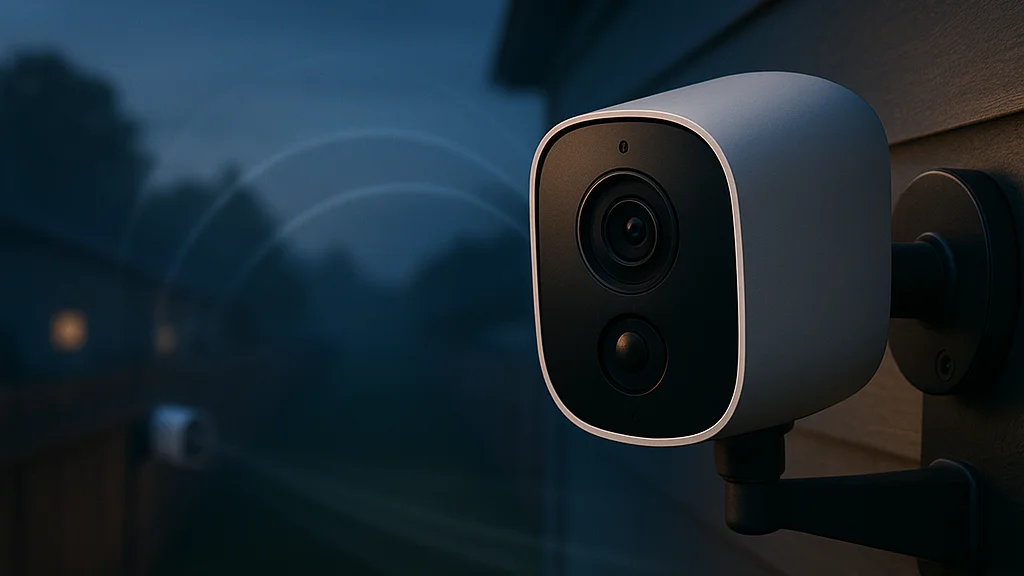

Why long-range cameras suddenly matter to remote workers
A half mile is a long way in security terms. It is the distance between a home office and a detached workshop on rural property, between a founder’s main building and a shipping gate, between a farm office and the equipment shed where expensive tools disappear first. For remote workers, solopreneurs, and distributed teams running lean operations, that distance used to create a blind spot. You either paid for trenching and wired infrastructure, or you accepted patchy visibility and hoped for the best.
That trade-off has changed. A new class of long-range wireless security cameras and bridge systems can push video, alerts, and management signals far beyond the reach of ordinary consumer Wi-Fi. The key detail is that these setups are not usually “wireless cameras” in the casual apartment-dweller sense. They often combine battery or solar-powered cameras with directional antennas, point-to-point wireless bridges, private LTE links, or sub-GHz radios for control traffic. In other words, the camera may be wireless, but the network design is doing the heavy lifting.
That distinction matters if your workday depends on calm, uninterrupted focus. Security interruptions are productivity killers. A missing delivery at a rural studio, a gate left open at a small warehouse, or repeated false alerts from a weak connection can pull you out of deep work faster than any Slack notification. I see this more often in the remote work crowd than most people expect—especially among consultants, creators, e-commerce operators, and startup teams using converted garages, barns, and satellite offices.
If you have read Wireless Security Cameras You Can Install Over Half a Mile Away, you already know the headline promise. The real question is which technologies actually deliver that range, what compromises come with them, and whether they fit a work-driven environment where reliability matters more than flashy specs.
“The camera is only half the system. The other half is the link budget—power, antenna gain, interference, and line of sight decide whether ‘half a mile’ is real or marketing.”
That is the lens worth using here. Not hype. Not packaging. Practical performance.
How we got from backyard cams to half-mile deployments
Consumer security cameras exploded during the work-from-home boom of the early 2020s. The first wave prioritized convenience: peel-and-stick mounts, smartphone setup, cloud recording, and battery operation. Brands won customers by making installation feel as easy as pairing earbuds. That model worked beautifully for front doors and living rooms, but it hit a wall on larger properties. Standard Wi-Fi, especially on congested 2.4 GHz bands, was never built to guarantee stable video links over thousands of feet.
The industry’s answer came from several directions at once. Enterprise networking vendors had long used directional wireless bridges to connect buildings across campuses. Agricultural and industrial users relied on rugged radios where trenching cable was too expensive. Camera makers then started borrowing those ideas—sometimes directly, sometimes through integrators—to support remote gates, barns, trail entrances, parking lots, and job sites.
At the same time, battery efficiency improved. Solar charging became more practical. Image sensors got better in low light. AI-based motion filtering reduced the amount of unnecessary footage that had to be transmitted or stored. This was a major shift. When a camera can decide that a swaying branch is not a person, it conserves bandwidth and power, which is critical in long-range setups.
There is also a broader economic reason these systems are gaining attention. Remote and hybrid work changed where businesses operate. Plenty of small companies now run from mixed-use spaces: a home plus detached office, a suburban headquarters plus micro-warehouse, a founder’s home plus fabrication shed. Security infrastructure had to stretch with that geography.
Coverage from Mint’s guide to wireless cameras highlights how mainstream the category has become, even if most buyers still think in terms of front-porch use rather than extended-property coverage. The article reviews wireless camera options and buying factors, but the long-range segment adds another layer: network architecture. That is why a standard “good camera” recommendation does not automatically translate into a good half-mile deployment.
For readers building from scratch, How to Get Started With Long-Range Wireless Security Cameras is a useful companion because the setup logic matters as much as the camera body. A mediocre camera on a strong link often outperforms a premium camera on a weak one.
What “over half a mile” really means in technical and practical terms
The phrase sounds simple, but it hides several very different scenarios. A camera can be “installed” over half a mile away from your viewing location, your router, your recorder, or your nearest power source. Those are not the same challenge. For a remote worker deciding what to buy, the first step is defining which distance problem you actually need to solve.
Here are the main architectures that make half-mile deployments possible:
- Point-to-point wireless bridge: A directional radio at the main building talks to another directional radio near the camera location. This is often the most stable option when there is clear line of sight.
- Cellular camera: The camera uses 4G LTE or 5G instead of your local Wi-Fi. Distance from your home network becomes irrelevant, but data plans and signal quality become critical.
- Mesh or repeater-assisted network: Intermediate devices extend coverage, though true half-mile performance is highly dependent on terrain and power availability.
- Sub-GHz hybrid systems: Some systems use lower-frequency radios for triggers and control, then handle video separately. These can be efficient for low-power remote monitoring.
- Local recording plus remote sync: The camera records on-site and sends clips or alerts rather than constant high-bitrate video, reducing bandwidth demands.
Line of sight is the phrase you will hear most, and for good reason. Trees, metal buildings, hills, and even heavy rain can reduce effective range. A half-mile claim in open air may collapse quickly in a wooded property. That is why installers often talk about Fresnel zone clearance, antenna elevation, and interference rather than just raw distance.
Bandwidth is another reality check. A 4K stream at high frame rate needs far more throughput than a 1080p event-driven camera. If your priority is identifying vehicles at a gate, you may need sharper video and dedicated lighting. If your goal is simply knowing whether someone entered a remote outbuilding, lower resolution with reliable alerts may be the smarter productivity choice.
Battery life can also become a hidden bottleneck. Long-range links, cold weather, night vision, and frequent motion events all increase power draw. Solar helps, but panel placement and seasonal sun exposure determine whether “set and forget” is realistic or fantasy.
“For most owners, the best long-range camera is not the one with the most features. It is the one that still sends a useful alert on a dark, windy night after three cloudy days.”
That is not glamorous, but it is exactly how these systems should be evaluated.
The numbers that matter more than marketing claims
When I assess long-range camera setups for productivity-minded users, I look at five metrics before brand names enter the conversation: link stability, image usefulness, power resilience, storage strategy, and total cost of ownership. Those metrics tell you whether the system will reduce stress or create another maintenance chore.
Start with link stability. A bridge rated for multiple miles in ideal conditions may still underperform if mounted too low or aimed poorly. Professional-grade point-to-point radios from networking specialists can exceed the half-mile mark comfortably with proper alignment, but they often require more setup discipline than plug-and-play consumer devices. That is the trade. More capability, less instant gratification.
Then there is image usefulness. Resolution alone is not enough. Sensor size, dynamic range, infrared performance, and compression quality affect whether a clip helps you identify a person or simply confirms movement. For remote businesses, useful video often means balancing retention time against detail. A warehouse gate may need crisp daytime plate capture, while a distant shed may only need dependable after-hours motion events.
Here is a practical checklist for evaluating a system:
- Distance profile: Measure actual path length and note hills, trees, metal roofs, and seasonal foliage.
- Power plan: Decide whether the site has AC power, solar potential, or must rely on battery swaps.
- Recording mode: Choose between continuous recording, scheduled recording, or event-only clips.
- Alert tolerance: Determine how many false positives you can live with before productivity starts to suffer.
- Weather exposure: Review operating temperatures, enclosure ratings, and wind load for mounted antennas.
- Data economics: For cellular setups, calculate monthly upload costs under real motion conditions.
Total cost of ownership surprises many buyers. The cheapest camera is rarely the cheapest system. Mounts, solar panels, bridge radios, poles, surge protection, memory cards, and cloud fees add up fast. Yet trenching Ethernet across large property can cost even more, especially where permits or hardscape are involved. In that sense, long-range wireless often wins not because it is cheap, but because it avoids the most painful infrastructure expense.
Recent buyer guidance in mainstream publications such as Mint reflects growing consumer comfort with wireless security, but long-range users should remain skeptical of one-box promises. Half-mile performance is usually a systems question, not a camera-only question. That is also why What You Need to Know About Long-Range Wireless Cameras is a valuable read alongside product shopping. It frames the purchase around deployment realities rather than brochure language.
What has changed recently in 2026
The 2026 market is stronger than it was even two years ago, mostly because three trends have converged. First, AI detection has improved enough to cut nuisance alerts in many midrange systems. Person, vehicle, animal, and package classification is no longer reserved for premium gear. That matters a lot for remote properties where wind, wildlife, and shifting shadows used to flood owners with useless notifications.
Second, solar-powered deployments are more credible. Better battery chemistry, lower idle power consumption, and smarter event handling mean remote cameras can survive longer on smaller panels than earlier generations. They are still not magic—winter remains unforgiving—but the baseline is better. This is especially useful for remote workers managing side businesses or inventory spaces where running power is impractical.
Third, edge processing has become more important. Instead of pushing every second of footage over a long or expensive link, more systems analyze motion locally and send only the clips or metadata that matter. For productivity, this is huge. It means fewer bandwidth spikes, lower cloud costs, and more relevant alerts during working hours.
Another notable shift is buyer sophistication. Small-business owners now ask questions that used to come only from IT managers: Can this system fail over to local storage? Does it support encrypted transmission? What happens after an internet outage? Those are healthy questions, especially as remote work has blurred the line between home security and business continuity.
There is also more public awareness that “wireless” does not mean “maintenance-free.” Batteries age. Firmware needs updates. Solar panels gather dust. Mounting angles drift. In 2026, the strongest products are the ones designed to make that maintenance visible and manageable through dashboards, health alerts, and remote diagnostics.
If you are comparing options right now, the article Install Wireless Security Cameras Over Half a Mile in 2026 fits the current moment well because it reflects how the category has matured. The big lesson is simple: modern systems are better at preserving attention. And for anyone working remotely, attention is the real scarce resource.
Real-world use cases: where these systems earn their keep
The most convincing case for long-range wireless cameras is not technical elegance. It is operational calm. Consider a consultant who runs a home office but stores client event equipment in a detached building across a large lot. A basic indoor-outdoor Wi-Fi camera may connect on paper and fail in practice—dropping offline whenever weather shifts or the router gets crowded. A proper bridge link with a weather-rated camera turns that unreliable setup into a stable checkpoint. The owner stops walking out to inspect doors and gets back an hour a week.
Another common case is the rural e-commerce operator. Inventory may sit in a converted barn or shipping container far from the main house. Deliveries arrive at odd times. Contractors come and go. A long-range camera with local recording and filtered mobile alerts lets the owner verify activity without leaving a video call. For a solo business, that is not a convenience feature. It is workflow protection.
Small creative studios are using these systems too. Think ceramic workshops, fabrication garages, or photography spaces on shared property. Expensive tools, sporadic access, and off-hours package drops create a perfect use case for remote visual coverage. The cameras become a kind of ambient operational awareness—quiet when nothing matters, immediate when something does.
Here are the settings where half-mile-capable systems make the most sense:
- Detached home offices with separate entrances or parking areas
- Rural workshops, barns, and outbuildings storing tools or inventory
- Startup micro-warehouses and secondary loading gates
- Shared campuses with multiple small structures
- Large residential properties where standard Wi-Fi cannot reach perimeter points
- Temporary job sites needing fast deployment without trenching
What all these examples share is geography. Work is no longer confined to one compact office footprint. Silicon Valley taught the world to think digitally, but physical operations still matter—especially for founders and independent professionals building hybrid businesses from wherever they can make the numbers work. A camera that reaches half a mile is really a tool for shrinking operational distance.
How to choose without getting distracted by spec-sheet theater
My advice is to work backwards from your interruptions. Ask what problem is stealing time or peace of mind today. Is it missed deliveries? Unverified after-hours motion? Repeated trips to check a gate? Fear of tool theft during client calls? Once you name the interruption, the right camera architecture gets much easier to identify.
If you have clear line of sight and access to power at both ends, a point-to-point bridge plus a standard IP camera is often the strongest answer. It offers flexibility, better sustained throughput, and room to expand later. If the distant location has no power and only needs event-based monitoring, a solar cellular camera may be more practical even if monthly fees are higher. If you need continuous recording, prioritize local storage at the remote end so the link is not carrying unnecessary traffic all day.
Do not underestimate mounting and placement. A beautifully reviewed camera placed too high, too low, or directly into glare will disappoint. Nor should you ignore cybersecurity basics. Use strong passwords, enable multi-factor authentication where available, update firmware, and segment security devices from your main work network if your setup allows it.
My preferred decision framework looks like this:
- Define the exact monitoring goal in one sentence.
- Map the site and identify line-of-sight obstacles.
- Choose the network method before choosing the camera body.
- Estimate ongoing maintenance, not just purchase price.
- Test alert quality during real working hours.
- Review footage for usefulness, not just sharpness.
The motivational quote I keep coming back to here is simple: “What gets measured gets managed.” In a remote-work context, that means the right security system should reduce uncertainty you are currently carrying in your head. If it adds complexity without reducing uncertainty, it is the wrong system.
And if you are still in research mode, pair product reading with deployment-focused guides. The strongest buying decisions usually come from understanding the environment first and the hardware second.
The bigger takeaway for productivity, privacy, and peace of mind
Long-range wireless security cameras are not niche gadgets anymore. They sit at the intersection of remote work, property technology, and small-business resilience. As more people build livelihoods across distributed spaces—a home office here, a workshop there, inventory in a third place—the need for dependable visual awareness will keep growing.
There is a productivity angle that often gets missed in mainstream security coverage. Good monitoring does not just prevent loss. It preserves concentration. It reduces the mental tax of wondering whether the gate was left open, whether the courier arrived, whether the detached office is secure after dark. For knowledge workers, that reduction in background anxiety can be as valuable as the footage itself.
Still, buyers should stay grounded. A half-mile claim is achievable, but only under the right conditions and usually with the right supporting hardware. The smartest purchases come from treating range as a design problem rather than a label on a box. Check your terrain. Check your power. Check your tolerance for maintenance. Then buy the system that fits your actual workflow.
That is the real promise here. Not futuristic surveillance. Not gadget bragging rights. Just a practical way to keep physically spread-out workspaces connected to your attention without constantly demanding it.
For remote professionals juggling calls, deadlines, deliveries, and side operations, that is a meaningful upgrade. Quiet confidence is underrated—and the best long-range camera systems deliver exactly that.


























Sign in to leave a comment.