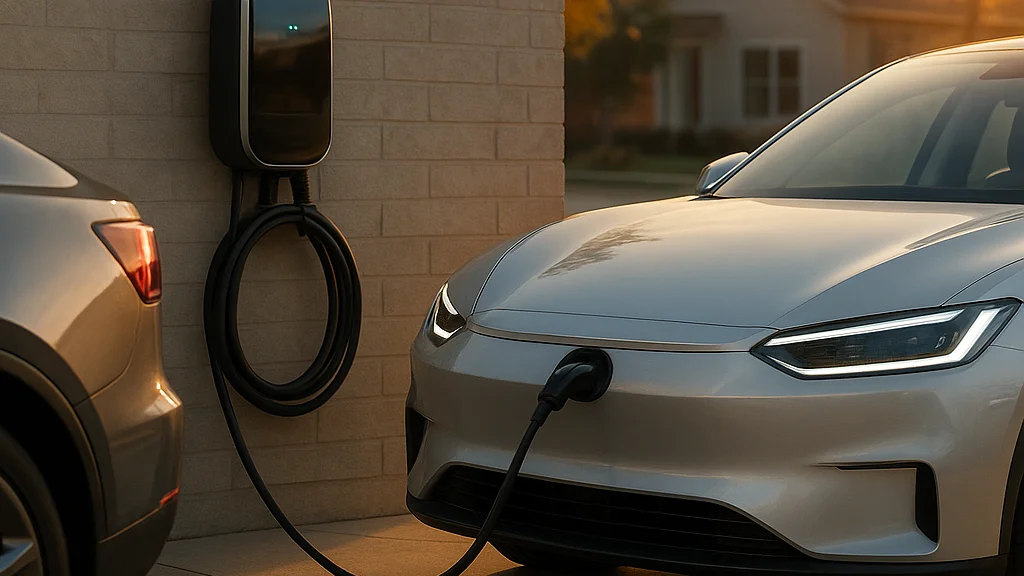

A friend in Oakland called me this spring with a question I hear constantly in the Bay Area: should he keep squeezing a few more years out of his 11-year-old crossover, or finally switch to an electric vehicle? His gas car was paid off, still running, and not especially glamorous. But it also needed tires, a brake job, and a repair estimate that was drifting toward four figures. Meanwhile, his apartment complex had just installed shared Level 2 chargers. That combination changed the math. The decision was no longer ideological. It was financial, logistical, and oddly personal.
That is the real threshold for most drivers. The right moment to ditch a gas car for an EV is rarely the day you become convinced that electrification is the future. It is the day your ownership math, charging access, driving pattern, and replacement options line up well enough that staying with gasoline starts to look like the more expensive inconvenience.
The question has become sharper in 2026 because the market is more mature than it was even two years ago. Charging standards are converging, more used EVs are available, battery durability has held up better than many skeptics expected, and fuel and maintenance costs continue to punish drivers who hang onto aging internal-combustion vehicles. At the same time, purchase incentives are more complicated, insurance can be uneven, and not every household has a simple charging setup. So the answer is not a slogan. It is a framework.
According to WUSF Public Media’s recent reporting on when it makes sense to switch, the biggest variables are often the ones drivers underestimate: annual mileage, repair risk, local electricity rates, and whether charging is routine rather than aspirational. That tracks with what I see across California and in conversations with drivers elsewhere. The EV tipping point is not universal. But it is measurable.
The smartest time to replace a gas car is usually not when it dies on the roadside. It is when the next major repair collides with a charging setup and an ownership profile that clearly favors electricity.
The first test: stop thinking in sticker prices alone
Consumers still get trapped by the oldest comparison in the book: gas car purchase price versus EV purchase price. That is understandable, but it is incomplete. The better comparison is total cost of ownership over the next five to eight years, especially if your current vehicle is already aging into its expensive years. A paid-off gas car can feel cheap because there is no monthly payment. Yet once fuel, oil changes, transmission service, emissions-related repairs, and surprise maintenance enter the picture, that apparent bargain can erode fast.
Consider the core operating difference. EVs do not need oil changes, spark plugs, timing belts, or exhaust-system repairs. Regenerative braking reduces wear on brake pads. There are still costs, of course—tires, insurance, and the occasional suspension or HVAC issue do not disappear—but the routine maintenance stack is thinner. For drivers who rack up miles, that difference compounds quickly.
Energy cost is the second lever. If you can charge at home or at work at a reasonable rate, electricity often undercuts gasoline by a meaningful margin. If you rely mostly on expensive public fast charging, the savings shrink and can sometimes nearly vanish depending on your region. This is why charging access matters as much as vehicle selection. Readers trying to understand the practical side of charger setup may find useful context in this WriteUpCafe guide to EV charging point installation for homes and businesses; although it is UK-focused, the underlying lesson is universal: charging convenience is not a side issue, it is the operating system of EV ownership.
There is also depreciation to consider. New EV prices have moderated from earlier peaks, and the used market has expanded. That means buyers who were priced out before may now find a lightly used EV with enough range for daily life at a much lower entry point. The right comparison, then, is not your old gas car versus a brand-new premium EV. It may be your old gas car versus a two- or three-year-old electric crossover with a factory battery warranty still in place.
- Best case for switching now: your gas car needs repairs, you drive more than 10,000 to 12,000 miles a year, and you have reliable charging.
- Mixed case: your gas car is dependable, your annual mileage is low, and charging would be inconvenient or expensive.
- Weak case for switching immediately: your current car is efficient, recently repaired, and you lack home or workplace charging.
That framework is more useful than broad claims about EVs being automatically cheaper. Sometimes they are. Sometimes they are not. The point is to know which side of the line you are on.
What usually triggers the switch: repairs, mileage, and fuel burn
If you want one practical answer to the headline question, here it is: it often makes sense to ditch a gas car when the next repair bill arrives at the same moment your annual driving is high enough for fuel savings to matter. The emotional temptation is to keep “just one more year” out of an older vehicle. But older gasoline cars have a habit of stacking costs rather than presenting them one at a time. A cooling-system repair turns into a suspension issue. Then the check-engine light comes back. Then inspection or emissions compliance becomes a headache. By then, the driver is paying not only in dollars, but in uncertainty.
WUSF’s reporting highlighted that the answer depends heavily on how much you drive. That is exactly right. A household covering 15,000 to 20,000 miles a year will feel the fuel-cost difference far more than someone who uses a car only for errands and the occasional weekend trip. High-mileage drivers are also more likely to appreciate the smoother, quieter, lower-maintenance nature of EV ownership because they spend more time behind the wheel. Every avoided gas-station stop becomes tangible.
There is a second threshold: age plus reliability. A six-year-old gas car with low miles and no looming repairs is a different proposition from a 12-year-old car with 140,000 miles and a transmission that could become tomorrow’s emergency. The latter is where EV math gets persuasive fast. Once repair risk becomes nontrivial, replacing the vehicle before a crisis can preserve trade-in value and widen your choice set.
My rule of thumb is to think in terms of the next 24 months rather than the next 24 days. Ask what your gas car is likely to cost over two years, not whether it can survive one more summer. That means estimating fuel, insurance, routine maintenance, likely repairs, and resale decline. Then compare that with an EV payment or cash purchase, electricity, insurance, and charger costs if needed.
- Estimate your annual mileage honestly, not aspirationally.
- Look up your last 12 months of fuel spending.
- Add expected maintenance and one realistic repair reserve.
- Price an EV that actually fits your life, including used options.
- Calculate charging cost based on your real utility rate or public charging pattern.
- Compare the next five years, not just month one.
This is similar to how investors think about timing risk versus opportunity cost. In a completely different context, this WriteUpCafe piece on when it makes sense to invest in pre-IPO companies gets at the same discipline: the decision is less about hype than about whether your timing, risk tolerance, and fundamentals align. Cars are not venture capital, obviously, but the decision logic is surprisingly close.
High fuel spending and rising repair risk are the twin signals that a gas car may no longer be the cheaper option, even if it is already paid off.
Charging is the make-or-break variable most buyers misread
Ask longtime EV owners what determines satisfaction, and many will not start with range. They will start with charging routine. If you can plug in where you sleep or where you work, owning an EV often feels effortless. If every charge requires a detour, waiting, or price uncertainty, the ownership experience changes dramatically. That is why the right time to switch is often tied less to the car market than to your housing and parking situation.
In 2026, charging access is improving, but unevenly. More apartment buildings, office campuses, municipal lots, and retail sites now offer charging than they did a few years ago. Tesla’s North American Charging Standard has also become more influential across the industry, helping reduce connector confusion and widening fast-charging compatibility. Still, a renter in a dense urban corridor without reserved parking faces a different reality from a suburban homeowner with a garage outlet and off-peak utility pricing.
The practical question is simple: where will the car get its energy 80 percent of the time? If the answer is home overnight at a manageable rate, the case for switching strengthens. If the answer is a patchwork of public stations, the economics and convenience become less predictable. Public fast charging is excellent for road trips and occasional top-ups. It is less ideal as your primary fueling strategy unless prices are favorable and stations are consistently available.
There is a subtle Silicon Valley lesson here. The best technology wins in daily life when friction disappears. Consumers rarely abandon a system because it is conceptually flawed; they abandon it because the workflow is annoying. EVs are no different. A modest-range EV with reliable overnight charging can be a better ownership experience than a long-range EV for someone who must hunt for chargers weekly.
Prospective buyers should also investigate utility programs. Some regions offer time-of-use rates, charger rebates, or managed charging incentives that significantly improve the economics. Others do not. This is one reason broad national averages can mislead. Your local grid price after 11 p.m. matters more than a generic national estimate. For households deciding whether to electrify one car first or both eventually, charging capacity at home—panel load, parking layout, and installation cost—should be part of the conversation from day one.
- Strong charging scenario: garage, driveway, or reserved parking with regular access to a plug.
- Workable scenario: dependable workplace charging or nearby low-cost public Level 2 charging.
- Risky scenario: exclusive reliance on high-priced fast charging with uncertain station availability.
If your charging setup is weak today but likely to improve after a move, a job change, or a building retrofit, waiting may be rational. Timing matters.
What has changed recently in 2026—and why the answer is different now
The switch calculus in 2026 is not the same as it was in 2022 or 2023. Back then, many buyers faced inflated vehicle prices, limited inventory, and more anxiety around charging compatibility. Today, the market is broader and more nuanced. New EV prices in several segments have become more competitive, while used inventory has expanded enough that shoppers can comparison-shop rather than pounce on whatever appears. That alone changes the “when should I switch?” equation, because replacement no longer requires perfect timing in a constrained market.
Battery durability has also become less mysterious. Real-world experience across high-mileage fleets and private owners has shown that catastrophic battery failure is not the norm many feared. Capacity loss happens, as expected, but modern battery management systems and warranty coverage have made the issue more manageable for mainstream buyers. For a used EV shopper, that means the conversation can focus on battery health, charging speed, and software support rather than generalized fear.
Another major shift is charging standard alignment. The industry’s movement toward broader access to Tesla’s charging network and connector ecosystem has reduced one of the market’s biggest friction points. That does not solve every problem—station reliability and pricing still matter—but it simplifies ownership for many drivers considering brands beyond Tesla. In practical terms, the road-trip penalty for choosing an EV has narrowed.
Policy remains a moving target. Federal, state, and local incentives still exist in various forms, but eligibility rules can be technical and sometimes change faster than shoppers expect. That makes timing important. If you are on the edge financially, an available tax credit, rebate, or utility incentive can pull the switch point forward by a year or two. If your preferred model loses eligibility, the case may shift toward a used EV or a different configuration.
Meanwhile, gasoline has not become more predictable. Price spikes remain a recurring feature, and maintenance on aging combustion vehicles has not gotten cheaper. Parts, labor, and insurance continue to pressure ownership costs. That is why 2026 feels like a more pragmatic EV moment than an ideological one. The market is not perfect. It is simply more usable.
For readers who enjoy broader lifestyle decision frameworks, there is an odd but useful analogy in this WriteUpCafe article about making sense of wellness choices in daily life. The point is not that cars are wellness products; it is that durable decisions improve when they fit daily habits rather than abstract aspirations. EV adoption works the same way.
When keeping the gas car still makes sense
Electrification advocates do the movement no favors by pretending every driver should switch immediately. There are still clear cases where hanging onto a gas car is the rational move. If your current vehicle is relatively efficient, mechanically sound, and lightly used, replacing it purely for principle can produce a weaker financial outcome than waiting. Manufacturing emissions matter too. From a climate perspective, replacing a perfectly serviceable car too early can dilute some of the environmental benefit, especially if the old vehicle has years of useful life left and low annual mileage.
This is especially true for households with unusual use cases. Think rural drivers with very long towing distances, residents in buildings with no realistic charging path, or families that need one vehicle for infrequent but punishing road-trip duty while putting modest annual miles on it. In those cases, the better strategy may be to keep the gas car a little longer, electrify the other household vehicle first, or wait for charging access and model fit to improve.
Insurance is another variable that deserves honesty. In some ZIP codes and for some models, EV insurance quotes can surprise buyers. The same is true for registration fees in states that impose EV-specific charges to offset lost gas-tax revenue. Neither issue necessarily kills the economics, but both should be included in the spreadsheet. Skipping them leads to bad decisions.
There is also a behavioral trap worth calling out. Some drivers imagine they will suddenly become avid road-trippers or frequent tower-haulers once they buy a car. Usually, their actual usage remains close to what it was before. But occasionally the reverse happens: someone with a genuinely demanding use case talks themselves into an EV that does not fit because the brand, software, or social cachet is compelling. The smarter move is to buy for your dominant use pattern, not your fantasy self.
So when does keeping the gas car make sense?
- Your annual mileage is low enough that fuel savings would be modest.
- Your current car is reliable and recently had major maintenance completed.
- You lack practical charging access at home or work.
- Your use case includes frequent towing, remote travel, or specialized needs not well served by current EV options.
- The EV you would buy requires financial stretching that undermines the whole point of the switch.
That is not anti-EV. It is disciplined timing.
A practical decision framework for households on the fence
When I talk with households considering the switch, I ask them to score five categories from one to five: charging access, annual mileage, current repair risk, replacement budget, and local incentives. If at least four of those categories look favorable, the odds are good that moving to an EV now will feel smart within the first year of ownership. If only one or two are favorable, waiting is often wiser than forcing the transition.
Start with charging. Can you reliably charge at home, at work, or both? Next, look at mileage. The more you drive, the faster operating savings can offset the switch. Then evaluate your current gas car with brutal honesty. Is it merely old, or is it becoming financially noisy? A car that needs one expensive repair is not always a lemon. A car that needs one expensive repair every six months is sending a message.
Budget comes next. The sweet spot for many buyers in 2026 is not the newest flagship EV with every software flourish. It is a sensible, well-supported model with enough range for normal life and a payment structure that leaves room for insurance, charging equipment, and the rest of adulthood. A used EV with documented battery health can be a stronger move than a flashy new one with a stretched monthly payment.
Finally, check incentives and utility tariffs before making assumptions. A charger rebate, a used-EV incentive, or lower overnight electricity pricing can materially improve your economics. So can employer charging. These details are not glamorous, but they are often what separates a great EV ownership experience from a merely decent one.
If your current gas car is entering its expensive years and you can charge where you live or work, the switch point may already have arrived—even if you have been thinking of EVs as a future decision.
The broader lesson is simple. Do not wait for perfect certainty. Cars are depreciating tools, not sacred objects. The right moment to ditch a gas car is when electricity fits your routine better than gasoline fits your budget. For some drivers, that moment came years ago. For many others, 2026 is the first time the numbers, infrastructure, and vehicle choices have lined up cleanly enough to make the answer obvious.
And if you are still unsure, run the two-year and five-year comparisons on paper. That exercise cuts through more noise than any online argument ever will. Once the spreadsheet and your daily routine agree, the decision tends to make itself.






























Sign in to leave a comment.