

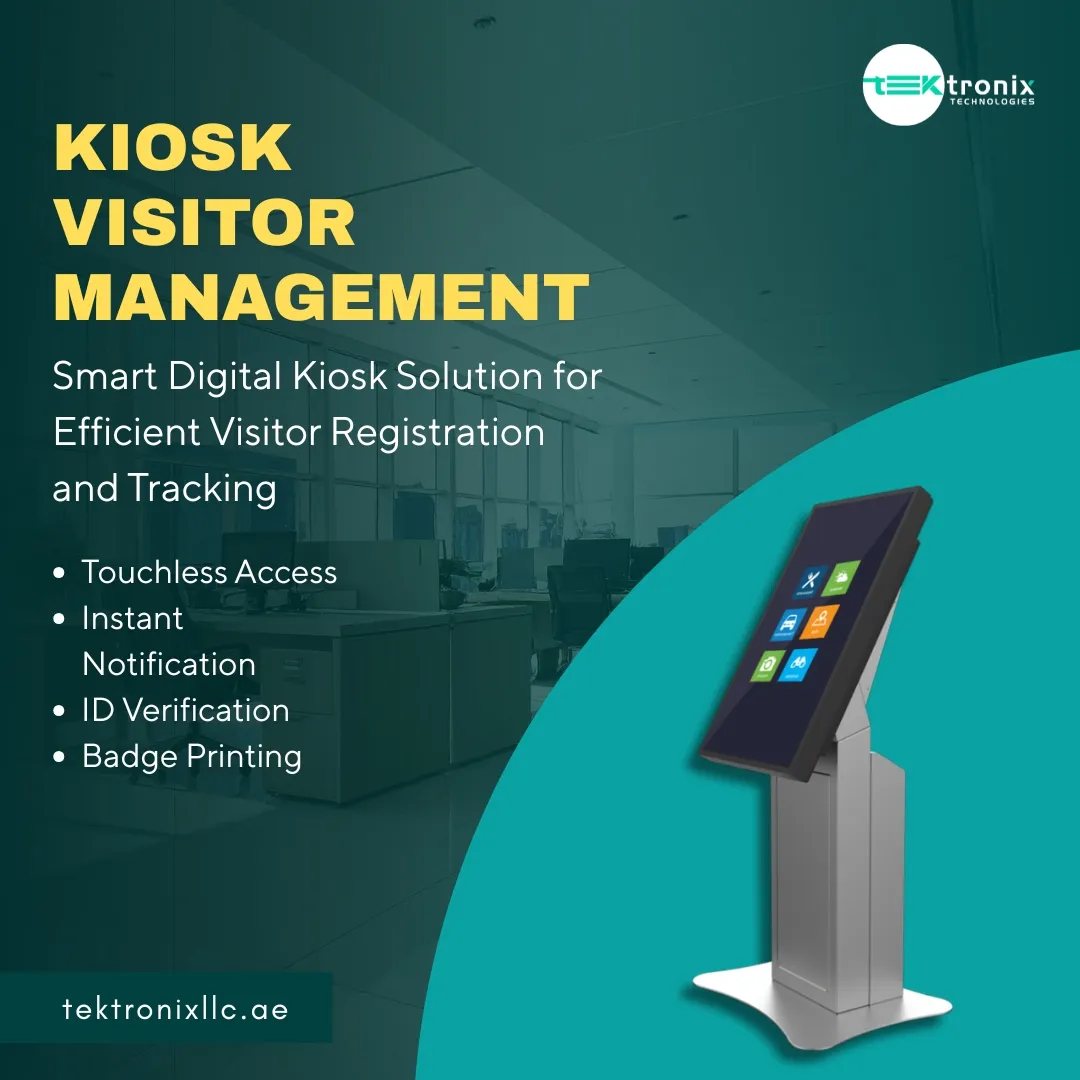
A Kiosk Visitor Management System is rapidly replacing the traditional paper logbook and manned reception desk as the operational standard for modern business premises across the UAE. As organisations in Dubai, Abu Dhabi, and across all seven Emirates compete to project professionalism, enforce security protocols, and comply with increasingly stringent data protection and workplace safety regulations, the self-service visitor kiosk has emerged as the single most impactful upgrade available to any facility’s front-of-house operation. This guide explains what a kiosk-based visitor management platform delivers, how its core technology features work, and why UAE businesses of every size and sector are accelerating adoption.
The Problem with Traditional Visitor Management in UAE Workplaces
Walk into the reception area of a mid-size UAE office today and the odds are still high that visitors are being asked to write their name, company, and purpose in a paper register, or type their details into an unmonitored desktop form. This approach has never been adequate from a security perspective, and it is becoming progressively less acceptable from a regulatory standpoint. The UAE Personal Data Protection Law (Federal Decree-Law No. 45 of 2021) requires that personal data collected at the point of entry be handled with defined consent, stored securely, and retained only for the period necessary for the original purpose. A paper logbook or unencrypted spreadsheet satisfies none of these requirements.
Beyond compliance, the operational inefficiencies of manual visitor handling are significant. Reception staff are diverted from higher-value tasks to manage the check-in queue. Hosts are not notified of their guests’ arrival in a timely or consistent way. Visitor identity is not verified against any authoritative document. Emergency evacuation lists are incomplete or out of date. And the organisation has no structured, searchable record of who visited, when, and for how long. A purpose-built kiosk visitor management platform resolves all of these deficiencies simultaneously, at a total cost of ownership that compares favourably with the ongoing salary cost of a dedicated reception agent.
Core Technology Features of a Modern Visitor Kiosk Platform
Touchscreen Self-Registration
Touchscreen Self-Registration is the defining user experience feature of the kiosk platform. Visitors interact with a high-brightness, multi-language touchscreen display — configured to present interface options in English, Arabic, and any additional languages relevant to the facility’s visitor profile — to complete their own check-in without requiring any assistance from reception staff. The guided registration workflow captures visitor name, company, purpose of visit, and host name in a structured format that feeds directly into the visitor management database, eliminating the illegible handwriting, incomplete entries, and inconsistent formatting that characterise paper-based records.
Emirates ID & Passport Scanning
Emirates ID & Passport Scanning transforms visitor identity verification from a subjective visual check by a receptionist into an objective, document-authenticated process. The kiosk’s integrated OCR scanner reads the machine-readable zone (MRZ) of any ICAO-standard travel document — UAE Emirates ID, GCC national ID cards, international passports, and UAE resident visas — and populates the visitor record automatically with the verified identity data extracted from the chip or printed MRZ. This eliminates manual data entry errors, ensures that visitor identity is always tied to an authoritative document, and creates an audit trail that satisfies the visitor identity verification requirements of UAE security-sensitive facilities.
Badge Printing
Badge Printing converts the completed visitor registration into a physical access credential within seconds of check-in completion. Printed visitor badges display the visitor’s name, photo, host name, date and time of arrival, and an optional QR code or barcode that can be scanned by security personnel or access control readers at internal checkpoints throughout the facility. Colour-coded badge templates can be configured per visitor category — standard visitor, contractor, VIP, delivery, or escorted guest — allowing security staff and employees to instantly identify the authorisation level of anyone moving through the building at a glance.
Host Notification System
Host Notification System functionality ensures that the moment a visitor completes check-in at the kiosk, the person they have come to meet is automatically notified via their preferred channel: SMS, email, Microsoft Teams message, or mobile push notification. This eliminates the delay and inconsistency of the traditional “I’ll call up and let them know you’re here” reception model, reduces lobby waiting times, and creates a measurable improvement in the visitor experience that reflects directly on the professionalism of the host organisation. Hosts can respond to the notification to confirm they are on their way, or delegate to a colleague if they are temporarily unavailable.
Pre-Registration Portal
Pre-Registration Portal capability allows hosts to register their expected visitors in advance through a web or mobile interface, generating a unique visit reference number or QR code that is sent to the visitor by email before their arrival. When the pre-registered visitor arrives at the kiosk, they simply scan their QR code or enter their reference number, confirm their identity document, and complete check-in in under 15 seconds — a fraction of the time required for a first-time walk-in registration. For high-volume meeting days, pre-registration dramatically reduces lobby queue formation and allows security teams to pre-screen visitor lists against watchlists before guests arrive on-site.
Facial Recognition Check-In
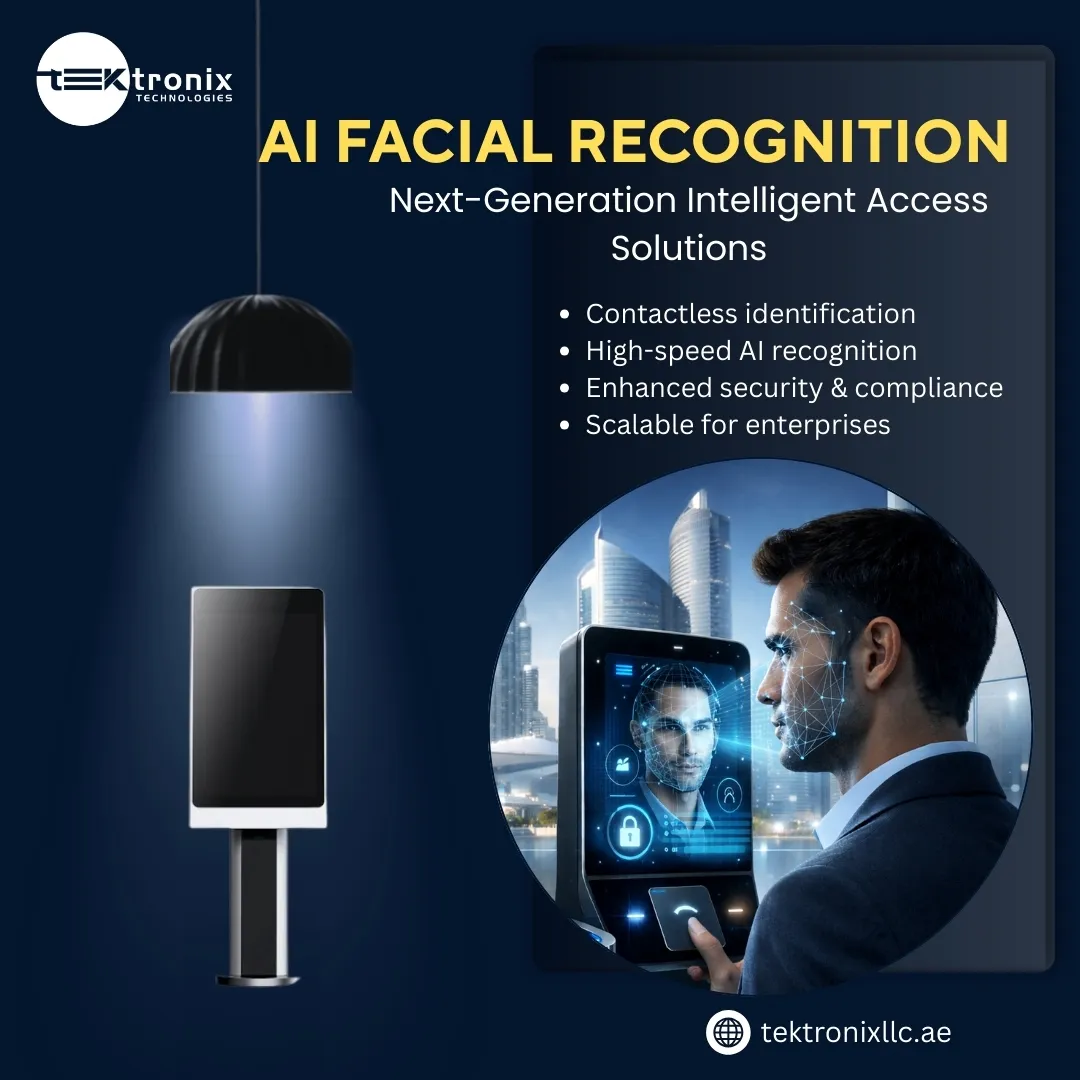
Facial Recognition Check-In represents the most advanced tier of visitor kiosk capability, enabling returning visitors who have previously enrolled their biometric data to complete check-in with a single facial scan in under two seconds, with no document handling or touchscreen interaction required. Integrated liveness detection prevents spoofing attempts using photographs or screen replays, and the biometric match is performed against the organisation’s own visitor database rather than any external government system, ensuring compliance with UAE PDPL data minimisation and purpose-limitation principles. For VIP visitors, executives, and frequent contractors, facial recognition check-in delivers a frictionless arrival experience that reinforces the sophistication of the host organisation.
Key Business Benefits of Deploying a Visitor Kiosk Platform in the UAE
1. Measurable Security Uplift at Every Entry Point
Manual reception processes create predictable security gaps: visitors who bypass sign-in during busy periods, identity documents that are glanced at rather than verified, and visitor badges that are fabricated or reused. A kiosk platform with integrated document scanning and badge printing closes all three gaps simultaneously. Every visitor is identity-verified against an authoritative document, every badge is freshly printed with the current visit date and a time-limited validity indicator, and every check-in generates a timestamped database record that security operations teams can query in real time.
2. UAE PDPL and Workplace Data Compliance
Visitor personal data collected at the kiosk — name, identity document details, photograph, and visit metadata — is stored in an encrypted, access-controlled database with configurable retention periods and automated deletion workflows that satisfy UAE Federal Decree-Law No. 45 of 2021 requirements. The kiosk workflow includes a digital consent acknowledgement step where visitors confirm they have read the facility’s visitor privacy notice before submitting their data, providing the documented lawful basis for data processing that paper registers cannot establish.
3. Emergency Evacuation Accuracy
UAE Civil Defence regulations require building operators to maintain accurate occupancy records that can be used to account for all persons on-site in the event of an emergency evacuation. A kiosk-based visitor management system provides a live, accurate count of checked-in visitors at any point in time, accessible to the building fire warden from a mobile device or security desk terminal. Visitor check-out via kiosk or QR scan on departure keeps the occupancy record current, eliminating the guesswork and liability exposure that come with manually maintained visitor logs.
4. Significant Operational Cost Reduction
In the UAE’s competitive commercial real estate market, where front-of-house staffing represents a material fixed cost, the ability to automate visitor self-check-in reduces reception headcount requirements at secondary entry points and frees senior reception staff at primary entrances to focus on relationship management and complex visitor coordination rather than routine data entry. Most UAE organisations deploying kiosk visitor management systems report a full return on hardware and software investment within 12 to 18 months, primarily through reception staffing efficiency gains.
5. Brand and Guest Experience Differentiation
In sectors where the visitor experience is a direct reflection of the organisation’s brand value — financial services, professional advisory, luxury real estate, and premium hospitality — a sleek, fast, and fully automated check-in process communicates operational sophistication and data discipline that a paper logbook cannot. Kiosk platforms are fully brandable with corporate logos, colour schemes, and welcome messages, and the printed visitor badge reinforces brand identity throughout the visit.
Kiosk Visitor Management System UAE: Compliance and Integration Architecture
Deploying a Kiosk Visitor Management System UAE-wide requires compliance with a layered set of regulatory and technical standards that vary by industry sector and emirate.
- UAE PDPL Compliance: Visitor data must be collected with explicit consent, stored with defined retention limits, protected by encryption at rest and in transit, and subject to documented access controls. Kiosk platforms must support automated data deletion workflows and provide data subject access request handling capabilities.
- DIFC and ADGM Data Protection: Organisations operating within the Dubai International Financial Centre or Abu Dhabi Global Market must comply with DIFC Data Protection Law 2020 or ADGM Data Protection Regulations 2021 respectively, both of which impose obligations on visitor data handling that are broadly equivalent to GDPR and require a lawful basis for processing biometric data where facial recognition check-in is deployed.
- UAE Civil Defence Integration: Live visitor occupancy data must be exportable in a format compatible with the building’s emergency response plan, and the system must support instant evacuation list generation accessible to fire wardens without requiring IT system access.
- Access Control Integration: Visitor management platforms should connect to existing physical access control systems via standard protocols (Wiegand, OSDP, REST API) to enable temporary visitor access credentials to be generated and revoked automatically as part of the check-in and check-out workflow.
- Active Directory and SSO Integration: Host notification and pre-registration workflows should integrate with Microsoft Active Directory, Azure AD, or equivalent identity platforms to ensure that the host directory used by the kiosk system is always current and that hosts can manage visitor invitations through familiar tools such as Microsoft Outlook calendar.
Kiosk Visitor Management System Dubai: Sector Deployment Highlights
Dubai’s status as the region’s most active commercial and hospitality hub generates the UAE’s highest concentration of Kiosk Visitor Management System Dubai deployments across the following verticals:
- Financial Services (DIFC, Business Bay, Downtown Dubai): Investment banks, asset managers, and legal firms deploy kiosk platforms with Emirates ID scanning and biometric check-in to satisfy DIFC visitor identity verification requirements and to project the operational sophistication that institutional clients expect.
- Commercial Free Zones (JAFZA, Dubai Internet City, Dubai Media City): Multi-tenant free-zone campuses deploy shared kiosk infrastructure with tenant-segregated visitor databases, enabling each occupying company to manage its own visitor data independently within a shared physical reception environment.
- Healthcare (DHA-Regulated Hospitals and Clinics): Dubai Health Authority-regulated facilities use kiosk check-in to manage patient companion, contractor, and vendor visitor flows, with integration into hospital information systems for appointment-linked pre-registration and infection control category screening.
- Government and Semi-Government Buildings: Ministerial offices and public-sector customer service centres deploy Arabic-first kiosk interfaces with Emirates ID scanning to manage the high volumes of public visitors that characterise government service environments, reducing counter queue times and improving service delivery metrics.
- Luxury Hospitality and Serviced Offices (Palm Jumeirah, Dubai Marina): Premium co-working and serviced office operators use branded kiosk platforms to deliver a five-star arrival experience for members’ guests, with instant host notification and pre-printed personalised visitor badges that reinforce the premium positioning of the venue.
Kiosk Visitor Management System Abu Dhabi: Capital-Region Applications
Abu Dhabi’s visitor management technology market is characterised by a higher concentration of government, defence-adjacent, and critical infrastructure deployments than Dubai, creating specific requirements for the Kiosk Visitor Management System Abu Dhabi segment:
- Federal Government and Ministerial Campuses: Abu Dhabi’s concentration of federal ministries and government authorities drives demand for Arabic-language kiosk platforms with Emirates ID-primary check-in flows, watchlist screening integration, and secure visitor data environments that satisfy UAE government information security classification requirements.
- ADNOC and Energy Sector Facilities: Visitor management at ADNOC headquarters and affiliated downstream facilities requires integration with contractor management platforms, HSE induction completion verification, and site-specific access zone authorisation — all of which modern kiosk platforms can enforce as mandatory steps in the check-in workflow.
- Healthcare (DOH-Regulated Facilities, Cleveland Clinic Abu Dhabi, SEHA Network): Abu Dhabi Department of Health-regulated hospitals apply visitor management kiosks as part of their infection prevention and patient privacy frameworks, with time-bounded visitor passes and ward-specific access rules enforced through integration with the hospital’s physical access control system.
- Al Maryah Island and ADGM Financial Centre: ADGM-regulated financial institutions deploy GDPR-equivalent visitor management workflows with biometric check-in capability for pre-approved frequent visitors, satisfying both ADGM Data Protection Regulations and the security requirements of global institutional tenants.
Deployment Methodology: From Requirement Scoping to Go-Live
- Requirement Scoping & Workflow Design: Define visitor categories, check-in workflow steps, required integrations, language requirements, badge template design, and data retention policies.
- Hardware Specification & Placement: Select kiosk form factor (floor-standing, counter-top, or wall-mounted), screen size, peripheral devices (ID scanner, badge printer, camera), and identify optimal placement for pedestrian flow management.
- Software Configuration: Configure tenant branding, host directory integration (Active Directory / Azure AD), access control system API connection, notification channel setup (SMS, email, Teams), and data retention automation.
- Compliance Documentation: Prepare visitor privacy notice, consent workflow content, Data Protection Impact Assessment (DPIA), and data processing agreement documentation as required under UAE PDPL or applicable free-zone data protection law.
- User Acceptance Testing: End-to-end testing of all visitor categories, document scanner accuracy validation, badge printer output quality verification, host notification delivery testing, and evacuation list export validation.
- Staff Training & Go-Live: Reception and security staff training on admin console operation, visitor record management, and system escalation procedures, followed by phased or full go-live with hypercare support during the first two weeks of operation.
Why Tektronix LLC Is the UAE’s Trusted Visitor Management Partner
Tektronix LLC has designed and deployed kiosk visitor management solutions across Dubai, Abu Dhabi, and the wider UAE and GCC region for a portfolio spanning DIFC financial institutions, Abu Dhabi government authorities, DHA-regulated hospitals, luxury hospitality venues, and multi-tenant commercial campuses. Our platforms are configured to the specific regulatory requirements of each deployment environment, and our engineering team manages the full project lifecycle from initial workflow design through hardware installation, software configuration, compliance documentation, and post-go-live support under an SLA-backed maintenance contract.
We provide UAE-resident technical support with a guaranteed same-business-day response to critical system faults, proactive software update management, and annual compliance review services to ensure your visitor management platform remains aligned to evolving UAE regulatory requirements. Our Arabic-language configuration capability ensures that every kiosk deployment meets the language accessibility standards expected in UAE government and public-facing environments.
Conclusion
The case for deploying a Kiosk Visitor Management System in UAE business premises has never been stronger. Tightening data protection legislation, growing security consciousness among employers and building operators, rising visitor volume in the UAE’s expanding commercial ecosystem, and the increasing expectation of a frictionless, technology-enabled arrival experience from business visitors all point in the same direction: the paper logbook and manually managed reception desk are no longer fit for purpose in the modern UAE workplace.
A properly specified and professionally deployed kiosk visitor management platform addresses every dimension of this challenge simultaneously — security, compliance, efficiency, guest experience, and emergency preparedness — at a total cost of ownership that most UAE organisations recover within the first 18 months of operation. Whether your facility receives 20 visitors per day or 2,000, automating your front-of-house visitor journey is one of the highest-return infrastructure investments available to UAE businesses today.
FAQs
1. Is Emirates ID & Passport Scanning at a visitor kiosk compliant with UAE data protection law?
Yes, provided the deployment is configured in accordance with the UAE Personal Data Protection Law (Federal Decree-Law No. 45 of 2021). This requires that visitors be presented with a clear privacy notice explaining what data is being collected, for what purpose, and for how long it will be retained, and that they provide explicit consent before their identity document is scanned. The scanned data must be stored in an encrypted, access-controlled system with a defined retention period and automated deletion workflow. Organisations operating within the DIFC or ADGM must additionally comply with the respective free-zone data protection frameworks, which impose GDPR-equivalent standards. Tektronix LLC configures all kiosk deployments with compliant consent workflows and data handling architectures as standard.
2. How does the Pre-Registration Portal reduce lobby congestion for high-visitor-volume UAE facilities?
The pre-registration portal allows hosts to send their expected visitors a unique QR code or reference number before the visit date. On arrival, the pre-registered visitor scans their code at the kiosk, confirms their identity document in a single scan, and completes check-in in under 15 seconds. Compared to a first-time walk-in registration that may take 60 to 90 seconds including form completion and badge printing, pre-registration reduces per-visitor kiosk occupancy time by up to 80 percent. For facilities processing 50 or more visitors per morning peak hour, this throughput improvement is the difference between an orderly and a congested lobby. Pre-registration also allows security teams to pre-screen the expected visitor list against access control watchlists before guests arrive on-site, adding a proactive security layer that reactive kiosk check-in alone cannot provide.
3. Can the Host Notification System integrate with Microsoft Teams and Outlook in UAE enterprise environments?
Yes. Modern visitor management platforms provide native integration with Microsoft 365 environments, enabling host notifications to be delivered directly as Microsoft Teams messages and allowing hosts to manage visitor pre-registrations through Outlook calendar meeting invitations. When a host creates a meeting in Outlook and adds an external attendee, the platform can automatically generate a pre-registration invitation and send it to the visitor without any additional action by the host. This seamless workflow integration removes friction from the pre-registration process and drives adoption among hosts who might otherwise skip the pre-registration step. Azure Active Directory synchronisation ensures the host directory in the kiosk system always reflects the current employee database without manual maintenance.
4. What happens to visitor Badge Printing if the kiosk printer experiences a fault?
A professionally configured kiosk visitor management deployment includes both hardware redundancy and a defined fault-response procedure to ensure that a badge printer fault does not halt the visitor check-in process. At the system level, visitor check-in can be completed and the visitor record created without a physical badge being printed — the host notification is still dispatched and the occupancy record is updated regardless of printer status. At the operational level, reception staff are trained on a manual override procedure for issuing temporary handwritten badges in the event of a printer outage. Tektronix LLC’s SLA-backed maintenance contracts include next-business-day hardware replacement for critical components including badge printers at UAE client sites.
5. How does Facial Recognition Check-In at a visitor kiosk comply with UAE biometric data regulations?
Facial recognition check-in at a visitor kiosk collects and processes biometric data, which is classified as a special category of personal data under the UAE PDPL and requires explicit consent from the data subject before collection. In practice, this means that biometric enrolment for returning visitor check-in must be an opt-in process — not a default — with a clear explanation of how the biometric template will be stored, used, and deleted. The biometric template must be stored in encrypted format, processed only for the stated identity verification purpose, and deleted at the end of the defined retention period or on the visitor’s request. Tektronix LLC configures facial recognition check-in deployments with a separate biometric consent workflow, encrypted template storage with configurable retention and deletion automation, and a documented Data Protection Impact Assessment, ensuring full UAE PDPL compliance from day one.
Kiosk Visitor Management System



























Sign in to leave a comment.