
Data doesn't just grow anymore; it explodes. From high-definition video archives and IoT sensor logs to massive AI training datasets, the sheer volume of unstructured data generated by modern enterprises is staggering. For years, organizations relied on traditional storage architectures like Storage Area Networks (SAN) or Direct Attached Storage (DAS) to house their digital assets. While these legacy systems served their purpose in an era of structured databases and predictable growth, they are rapidly becoming bottlenecks.
The rigidity of legacy hardware simply cannot keep pace with the agility required by today's digital landscape. Businesses are finding that sticking to old methods results in data silos, skyrocketing management costs, and an inability to leverage the cloud. This friction has accelerated the adoption of modern Network Attached Storage (NAS), a technology that has evolved from simple file serving to becoming the backbone of enterprise data management.
Understanding why NAS is outlasting its predecessors requires looking at the fundamental shifts in how we work. It is no longer just about storing data; it is about accessing, sharing, and scaling that data without disruption.
The Problem with Legacy Architecture
To appreciate the solution, we must first diagnose the problem. Legacy storage systems were primarily designed for performance and structured data. SANs, for instance, excel at block-level storage needed for high-speed databases. However, they are notoriously complex to manage. They often require specialized Fibre Channel networks and dedicated administrators with niche skill sets.
Furthermore, legacy infrastructure typically relies on a "scale-up" architecture. When you run out of capacity, you must add more drives to a single controller until that controller maxes out. Once you hit that ceiling, your only option is a "forklift upgrade"—buying an entirely new, larger network attached storage system and migrating everything over. This process is expensive, disruptive, and risky..
In contrast, modern workflows are dominated by unstructured data—files, images, and media—that require flexible access rather than raw block-level speed. Legacy systems effectively trap this data in hardware silos, making it difficult for distributed teams to collaborate.
The Flexibility of Network Attached Storage
Network Attached Storage solves the accessibility problem by design. Unlike a SAN, which appears to the server as a local disk, a NAS device connects directly to the network and serves files to authorized users and clients. It operates using standard network protocols like TCP/IP and Ethernet, meaning it plugs into existing infrastructure without the need for specialized cabling.
This accessibility is a primary reason why NAS is displacing legacy options. It democratizes data. Whether an employee is in the headquarters or working remotely via a VPN, they access files through a unified namespace. For enterprises managing collaborative projects—such as video post-production or software development—this concurrent file access is non-negotiable.
Breaking Limits with Scale-Out Architecture
Perhaps the most significant advantage modern NAS holds over legacy systems is scalability. As mentioned, legacy tech forces you to scale up. Modern enterprise NAS, however, utilizes scale out nas architecture.
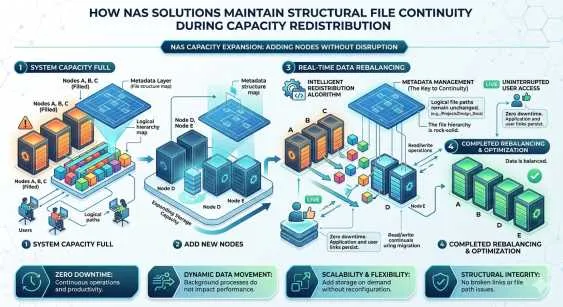
With scale-out technology, storage is not limited to the physical constraints of a single box. Instead, the system is composed of nodes. Each node contains its own storage capacity and processing power. When an enterprise needs more space, IT simply adds another node to the cluster.
This approach offers two distinct advantages:
- Linear Performance: In a legacy system, adding more data puts more strain on the single controller, often degrading performance. In a scale-out NAS environment, adding a node adds more processing power. Performance remains stable or even improves as the system grows.
- Zero Downtime: New nodes can be added on the fly. There is no need to shut down the system or perform a complex migration. The software automatically rebalances the data across the new hardware.
Bridging the Gap to the Cloud
Legacy storage is hardware-centric and often anchored to a physical data center. This is a major liability in a cloud-first world. Modern NAS solutions have evolved to become software-defined, decoupling the data management layer from the underlying metal. This evolution allows for seamless integration with public cloud providers.
Deploying NAS In AWS Cloud environments, for example, allows enterprises to extend their on-premises workflow into the cloud without refactoring their applications. Because the NAS operating system in the cloud looks and acts exactly like the one in the data center, applications don't know the difference.
This hybrid capability unlocks powerful use cases:
- Cloud Bursting: When on-premise compute resources are maxed out, workloads can be temporarily shifted to the cloud.
- Disaster Recovery: Instead of maintaining a costly second data center, businesses can replicate their data to a cloud-based NAS instance, paying only for what they use.
- Global Collaboration: Data can be synchronized across multiple geographies, ensuring that teams in London, New York, and Tokyo are working with the most current files.
Reducing Total Cost of Ownership
While legacy systems might initially seem cost-effective for specific niche workloads, their total cost of ownership (TCO) rises sharply over time. The costs associated with specialized hardware, complex maintenance, power, cooling, and the inevitable forklift upgrades add up.
Modern NAS reduces these operational expenditures. Because it runs on standard Ethernet networks, it can be managed by generalist IT staff rather than expensive storage specialists. The ability to mix and match node types allows businesses to tier their data efficiently—keeping hot data on expensive flash storage and moving cold, archival data to cheaper, high-capacity spinning disks or the cloud. This intelligent tiering ensures that companies aren't paying premium prices to store data they rarely access.
Future-Proofing Your Data Strategy
The shift away from legacy storage is not just a trend; it is a necessary adaptation to a data-heavy reality. Old rigid architectures are simply too brittle to handle the volume and velocity of modern business data, making NAS in AWS Cloud an essential solution for scalable, high-performance storage.
By adopting Network Attached Storage built on flexible, scale-out principles, enterprises gain the agility to react to market changes instantly. They can expand capacity in minutes, integrate with the cloud for infinite scalability, and reduce the burden on their IT teams.
If your organization is still struggling with storage silos, complex upgrades, and an inability to leverage the cloud, it is time to reassess your infrastructure. Moving to a modern NAS environment isn't just about buying new storage; it's about liberating your data to drive business growth.






















Sign in to leave a comment.