

Modern enterprises are generating and processing data at an unprecedented scale. From AI pipelines and analytics platforms to virtualization, media workflows, and cloud-native applications, today’s workloads demand storage systems that can handle millions of concurrent file operations without performance degradation. Traditional storage architectures struggle under this pressure, often leading to bottlenecks and unpredictable latency. This is where Scale out NAS emerges as a critical foundation for high-performance, enterprise-grade file storage.
This blog explores how NAS systems built on scale-out architectures deliver consistent low latency, high throughput, and linear scalability—even under extreme concurrency.
The Performance Challenge of Concurrent File Operations
File-based workloads generate a high volume of metadata requests, read/write operations, and concurrent user access. In traditional NAS architectures, performance is often constrained by a single controller or limited processing resources. As concurrency increases, these systems experience contention, resulting in latency spikes, queue buildup, and reduced throughput.
Modern enterprise environments require NAS systems that can handle:
- Millions of small and large file operations per second
- Thousands of simultaneous clients
- Mixed workloads with unpredictable access patterns
- Real-time performance consistency
Scale-out NAS addresses these challenges by eliminating architectural bottlenecks and distributing load across multiple nodes.
What Is Scale-Out NAS?
Scale out NAS is a distributed file storage architecture where multiple independent nodes work together as a single unified system. Each node contributes processing power, memory, network bandwidth, and storage capacity. Instead of scaling “up” by upgrading a single controller, organizations scale “out” by adding nodes horizontally.
Unlike traditional NAS systems, scale-out architectures are designed from the ground up to handle massive concurrency. As workloads grow, performance scales proportionally—ensuring predictable response times even under heavy load.
Distributed Metadata Management
One of the primary causes of latency in file storage systems is metadata contention. File operations such as open, close, rename, and permission checks require frequent metadata access. In legacy NAS systems, metadata is often managed by a centralized controller, creating a performance bottleneck.
Scale out NAS eliminates this issue by distributing metadata across multiple nodes. Each node manages a portion of the metadata namespace, allowing requests to be processed in parallel. This distributed approach ensures that metadata-intensive workloads do not overwhelm a single point in the system.
By spreading metadata operations across nodes, scale-out NAS systems maintain low latency even during peak access periods.
Parallel Data Path Architecture
Traditional NAS systems often rely on a single data path, which limits throughput and increases contention as more clients connect. Scale out NAS systems implement a parallel data path architecture, enabling multiple clients to access data simultaneously through different nodes.
Each node can handle read and write requests independently, allowing file operations to execute in parallel rather than sequentially. This architecture significantly reduces wait times and prevents performance degradation when concurrency increases.
Parallel data paths are especially critical for workloads such as analytics, virtualization, and media processing, where high throughput and low latency are essential.
Intelligent Load Balancing Across NAS Systems
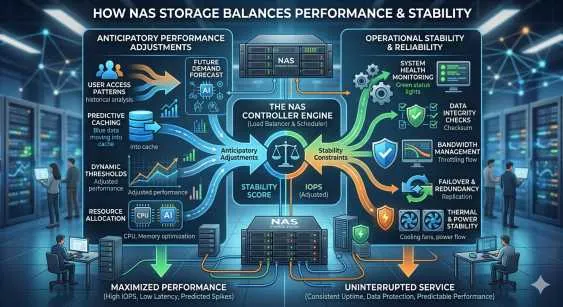
Another key factor in preventing latency spikes is intelligent load balancing. Scale out NAS systems continuously monitor node utilization, workload patterns, and network traffic. Based on this data, file requests are dynamically routed to the optimal node.
This real-time load distribution prevents any single node from becoming a hotspot. As demand fluctuates, the system adapts automatically, maintaining consistent performance without manual intervention.
By evenly distributing workloads, scale out NAS ensures predictable latency across diverse access patterns.
In-Memory Caching and Request Optimization
Scale out NAS systems leverage large, distributed memory pools to accelerate file operations. Frequently accessed metadata and data blocks are cached in memory across multiple nodes, reducing the need for disk access.
Advanced caching algorithms predict access patterns and prefetch data before it is requested. This minimizes I/O wait times and ensures fast response even during bursts of activity.
Because cache is distributed across the cluster, overall cache capacity increases as nodes are added—further improving performance and reducing latency.
High-Speed Interconnects and Network Optimization
Network performance plays a critical role in file system latency. Scale out NAS systems are designed to take advantage of high-speed interconnects such as 25GbE, 40GbE, and 100GbE networks.
These systems optimize network traffic by minimizing chatter between nodes and clients. Techniques such as request coalescing, protocol optimization, and efficient packet handling ensure that network overhead does not become a performance bottleneck.
As a result, NAS systems maintain consistent throughput and low latency even as client counts grow.
Eliminating Single Points of Failure
Latency spikes often occur during failover events in traditional NAS architectures. When a controller fails, workloads must be transferred to a standby system, causing temporary performance degradation.
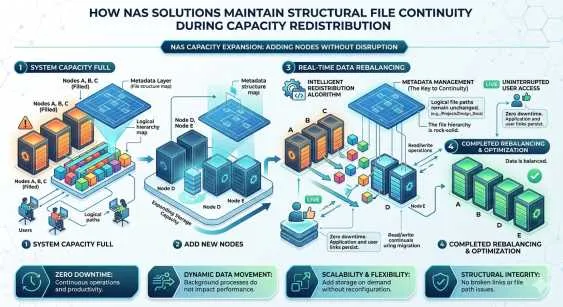
Scale out NAS systems are inherently resilient. Because data and metadata are distributed across multiple nodes, the system continues operating seamlessly even if a node fails. Workloads are redistributed automatically without disrupting client access.
This fault-tolerant design ensures consistent performance and eliminates latency spikes caused by hardware failures or maintenance events.
Consistent Performance Under Mixed Workloads
Modern enterprises rarely run a single type of workload. NAS systems must support a mix of sequential and random I/O, large and small files, and read-heavy and write-heavy operations simultaneously.
Scale out NAS is designed to handle these mixed workloads efficiently. By isolating workloads across nodes and optimizing I/O scheduling, the system prevents resource contention that could impact performance.
This capability is critical for environments supporting virtualization, analytics, backups, and collaboration on the same storage platform.
Real-World Use Cases for High-Concurrency NAS Systems
Scale out NAS systems are widely adopted in environments where performance consistency is non-negotiable:
- AI and machine learning pipelines with massive parallel access
- Virtualized infrastructure supporting thousands of VMs
- Media and entertainment workflows with high throughput demands
- Enterprise analytics platforms processing large datasets
- Cloud-native applications with unpredictable I/O patterns
These use cases demonstrate why scale-out architectures are essential for modern NAS systems.
Best Practices for Deploying Scale-Out NAS
To maximize performance and minimize latency, organizations should follow these best practices:
- Design for horizontal scalability from the beginning
- Use high-speed network infrastructure
- Monitor performance metrics continuously
- Distribute workloads evenly across nodes
- Plan capacity growth proactively
Implementing these practices ensures that NAS systems remain responsive as workloads grow.
Conclusion
Handling millions of concurrent file operations without latency spikes requires more than incremental upgrades—it demands a fundamentally different storage architecture. Scale out NAS delivers this capability by distributing metadata, data paths, and processing resources across multiple nodes.
Modern NAS systems built on scale-out architectures provide the performance, scalability, and resilience needed to support today’s data-intensive workloads. As enterprises continue to scale their operations, scale-out NAS will remain the backbone of high-performance, low-latency file storage infrastructure.


























Sign in to leave a comment.