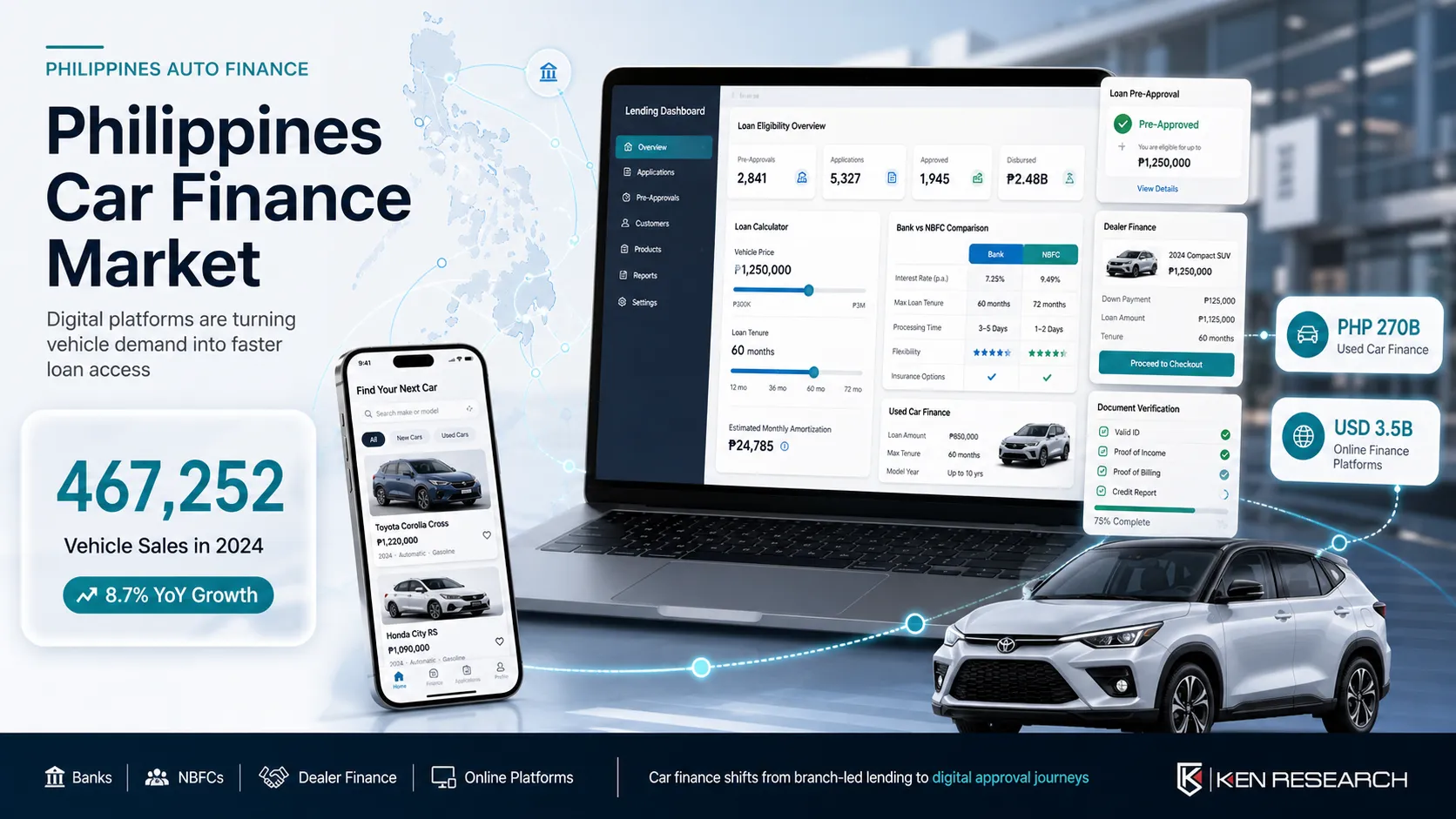

The Philippines banking system recorded PHP 502.684 billion in motor vehicle loans by December 2025, with PHP 480.927 billion performing and PHP 21.757 billion non-performing, according to Bangko Sentral ng Pilipinas loan-account data. That makes the Philippines car finance market update a credit-quality story, not only an automotive sales story. Vehicle sales reached a record 467,252 units in 2024, up 8.7%, but the real market opportunity depends on how lenders convert demand into responsibly underwritten loans.
According to the Philippines car finance market report by Ken Research, the study covers loan tenure, vehicle type, new and used cars, banks, non-banks, vehicle registration regions, competitive landscape, government regulations, SWOT, growth opportunities, upcoming business models, and future industry analysis. The report updates the base year to 2019 and future projections to 2024.
PHP 502.7B Motor Vehicle Loans Show the Market Is Now About Portfolio Quality
The strongest finance signal is the scale of motor vehicle loans on bank balance sheets. A market with more than half a trillion pesos in outstanding motor vehicle credit cannot be judged only by vehicle sales. Lenders need to track performing loans, non-performing loans, portfolio seasoning, approval quality, borrower income stability, and recovery risk.
BSP’s loan-account data shows motor vehicle loans rising through 2025 from PHP 453.480 billion in March to PHP 502.684 billion in December. That progression gives the market a stronger credit-growth narrative than a simple auto-sales headline. It also explains why the target report’s focus on credit disbursed, auto loan outstanding, and number of automobiles financed is strategically useful.
For banks and non-banks, the Philippines auto finance market is now about balancing acquisition and collections. Approval speed matters, but sustainable growth requires borrower screening, down-payment discipline, vehicle valuation, tenure matching, and early-warning systems for stressed accounts.
Bank, NBFC and Dealer Finance Models Need Different Risk and Conversion Playbooks
The Philippines car finance ecosystem is shaped by banks, non-bank finance companies, and dealer-linked finance providers. Each model wins at a different point in the buyer journey, and each carries a different risk profile.
| Finance model | Data-backed opportunity | Risk to manage |
|---|---|---|
| Banks | Can use deposit relationships, salary accounts, and credit history to target borrowers as motor vehicle loans cross PHP 502.684 billion. | Must prevent non-performing motor vehicle loans, which stood at PHP 21.757 billion in December 2025. |
| NBFCs | Can serve borrowers needing faster or more flexible approval, especially for used vehicles and non-standard income profiles. | Need tighter collections, documentation, and borrower verification to avoid weak repayment performance. |
| Dealer-linked finance | Can convert showroom demand at the final purchase moment, especially after 467,252 vehicles were sold in 2024. | Must avoid pushing unsuitable loans simply to close vehicle sales. |
The report covers banks such as Metro Bank, BDO Bank, PS Bank, East West Bank, PNB, BPI, and Maybank Philippines. It also covers non-bank and dealership finance players such as Toyota Financial Services Philippines Corporation, MAFS, Unistar Credit and Finance Corporation, and Radio Wealth Finance Company.
Key Insights
Motor vehicle loans reached PHP 502.684 billion by December 2025, including PHP 480.927 billion performing and PHP 21.757 billion non-performing loans. Vehicle sales also hit 467,252 units in 2024. The market’s next opportunity is disciplined credit growth.
Used Car Finance and Online Platforms Are Expanding the Addressable Borrower Base
The target report includes new and pre-owned vehicle financing, passenger cars, utility vehicles, sports utility vehicles, two-wheelers, trucks, buses, trailers, and loan terms from one year to five years and above. This scope matters because borrowers do not all need the same loan product. Some want new-car financing, while others need affordability-led used-car loans.
The related Philippines Used Car Finance Market is valued at PHP 270 billion. That supports a sharper opportunity in pre-owned vehicle lending, where lenders can serve first-time owners and price-sensitive buyers if they manage vehicle condition, resale value, borrower capacity, and collections discipline.
The related Philippines Online Car Finance Platforms Market is valued at USD 3.5 billion. Online platforms can strengthen lead qualification, loan comparison, pre-approval, document collection, and dealer coordination before the buyer reaches the final purchase stage.
Loan Tenure and Regulation Will Decide Whether Growth Is Durable
The report covers government regulations, license requirements for financial institutions, documentation for new car financing, regulatory framework for multi-finance companies, and documentation requirements for used car financing. These details matter because fast credit expansion can become fragile if documentation and borrower verification are weak.
Longer loan tenures can improve monthly affordability, but they can also raise repayment exposure if household income or vehicle value changes. Used car finance can broaden access, but it needs stronger valuation checks and loan-to-value discipline. Online platforms can scale origination, but they need responsible pre-screening rather than simple lead generation.
For decision-makers, the path is clear: combine bank-grade risk controls with NBFC flexibility and digital access. The Philippines market has enough demand signals. The harder task is building a finance model where growth, approval quality, and portfolio performance move together.
If you want bank and NBFC benchmarking, loan-tenure segmentation, used car finance analysis, government regulation review, and future projections, download sample report for a detailed preview of the full market analysis.
Conclusion
The Philippines car finance market is becoming a stronger credit opportunity as vehicle sales rise and motor vehicle loans expand. But the real opportunity is not simply more lending. It is better conversion of vehicle demand into performing, responsibly structured loans across new cars, used cars, banks, NBFCs, and online platforms.
The Philippines Car Finance Market by Ken Research provides a structured view of institutions, vehicle categories, tenure, regions, regulations, competitive landscape, and future outlook. For lenders and dealers, the next phase will be won through credit discipline, not only demand capture.
Frequently Asked Questions
What does the Philippines car finance market update cover?
According to Ken Research, the report covers loan tenure, vehicle type, new and used cars, banks, non-banks, vehicle registration regions, competitive landscape, government regulations, future industry analysis, SWOT, growth opportunities, upcoming business models, and analyst recommendations.
How large are motor vehicle loans in the Philippines?
BSP loan-account data shows motor vehicle loans at PHP 502.684 billion by December 2025. Of this, PHP 480.927 billion was performing and PHP 21.757 billion was non-performing, making portfolio quality a key market issue.
Why is used car finance important in the Philippines?
As per Ken Research, pre-owned vehicle financing is part of the target market scope. Used car finance supports affordability-led ownership and expands access for first-time or price-sensitive buyers, especially when lenders manage valuation and repayment risk carefully.
Which companies operate in the Philippines car finance market?
Ken Research covers banks such as Metro Bank, BDO Bank, PS Bank, East West Bank, PNB, BPI, and Maybank Philippines, along with finance players including Toyota Financial Services Philippines, MAFS, and Unistar Credit and Finance Corporation.

























Sign in to leave a comment.