
Introduction
The global transition toward renewable energy is accelerating at an unprecedented pace. Governments, utilities, and private investors worldwide are investing heavily in clean energy infrastructure to meet growing electricity demand while reducing carbon emissions. Among all renewable energy technologies, wind power continues to play a central role in achieving global sustainability goals.
As wind farms expand and turbine capacities increase, the industry faces a critical engineering challenge: building larger, stronger, and more efficient wind energy systems without significantly increasing weight or maintenance requirements. Modern wind turbines now exceed 15 MW in offshore applications, with blade lengths surpassing 120 meters in some next-generation designs. These advancements demand materials capable of delivering exceptional structural performance under extreme operating conditions.
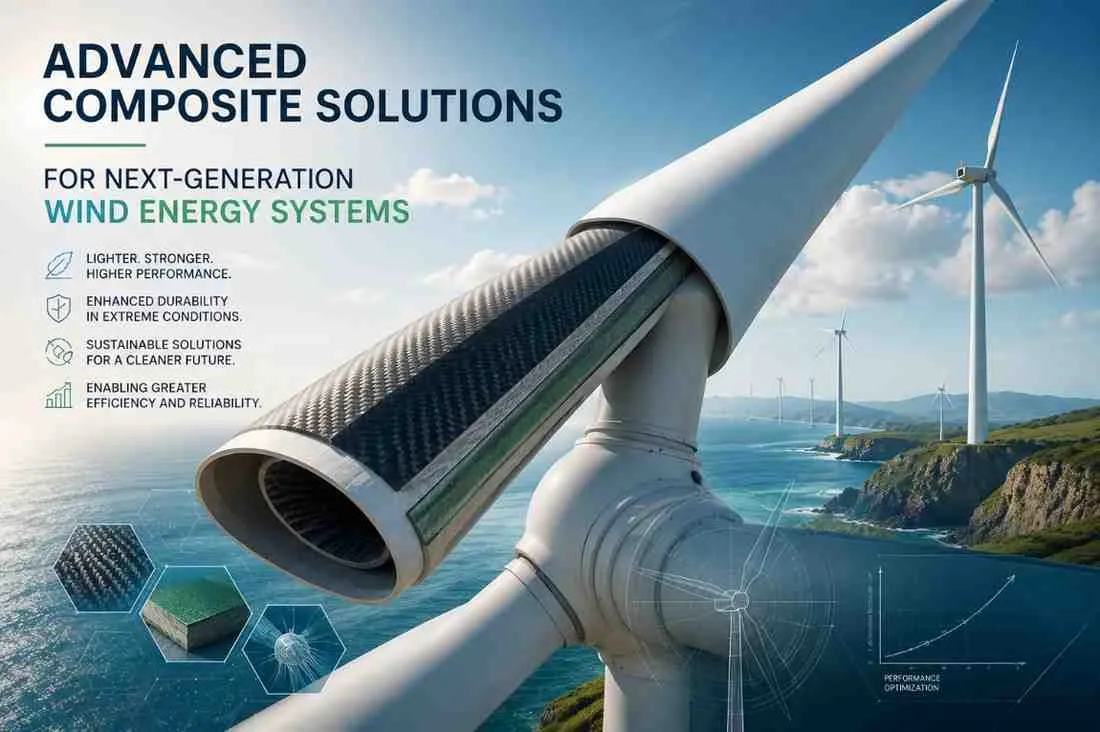
This is where advanced composite materials have become indispensable. Composite engineering has transformed wind turbine design by enabling lightweight structures with outstanding strength, fatigue resistance, and durability. From turbine blades and spar caps to nacelle components and offshore structures, advanced composites are helping manufacturers push the boundaries of renewable energy innovation.
This article explores how advanced composite solutions are shaping the future of wind energy systems, the technologies driving this transformation, and what lies ahead for the industry.
Why Composite Materials Are Transforming Wind Energy
Wind turbines operate in one of the most demanding mechanical environments in modern infrastructure. Components must withstand continuous loading cycles, changing weather conditions, UV exposure, moisture, and temperature fluctuations over operational lifespans that often exceed 25 years.
Traditional materials such as steel and aluminum remain important, but advanced composites offer significant advantages that make them increasingly attractive for modern turbine designs.
Weight Reduction
One of the most significant benefits of composites is their high strength-to-weight ratio. Reducing component weight directly impacts transportation, installation, and operational efficiency.
Lighter turbine blades can be manufactured at greater lengths without introducing excessive gravitational loads. This enables turbines to capture more wind energy while maintaining structural integrity.
Structural Strength
Composite materials provide exceptional mechanical properties, allowing engineers to optimize designs for both strength and stiffness.
By tailoring fiber orientation and resin systems, manufacturers can create structures engineered to withstand specific load conditions encountered during turbine operation.
Corrosion Resistance
Unlike many metallic materials, composites exhibit outstanding resistance to corrosion and environmental degradation.
This characteristic is particularly valuable in offshore wind farms where components are continuously exposed to saltwater, humidity, and harsh marine conditions.
Fatigue Performance
Wind turbines experience millions of load cycles throughout their service life.
Advanced composites offer superior fatigue resistance, helping maintain performance and structural reliability over decades of operation.
Lifecycle Advantages
While initial manufacturing costs can be higher than conventional materials, composites often deliver lower lifecycle costs through:
- Reduced maintenance requirements
- Longer service intervals
- Improved energy generation efficiency
- Enhanced operational reliability
- Extended component lifespan
These advantages contribute significantly to lowering the levelized cost of energy (LCOE).
Key Composite Materials Used in Modern Wind Energy Systems
Glass Fiber Reinforced Polymers (GFRP)
Glass Fiber Reinforced Polymers remain the most widely used composite materials in wind turbine manufacturing.
GFRP combines glass fibers with polymer resin systems to create lightweight, durable structures suitable for large-scale production.
Benefits include:
- Cost-effectiveness
- High tensile strength
- Excellent corrosion resistance
- Good fatigue performance
- Established manufacturing processes
Most commercial wind turbine blades incorporate substantial amounts of GFRP due to its balance of performance and affordability.
Carbon Fiber Reinforced Polymers (CFRP)
As turbine sizes increase, manufacturers increasingly integrate Carbon Fiber Reinforced Polymers into critical structural regions.
Carbon fiber offers:
- Exceptional stiffness
- High strength-to-weight ratio
- Reduced material weight
- Improved load-bearing capacity
Although more expensive than glass fiber, CFRP enables longer blade designs while minimizing structural deflection.
This has become particularly important in offshore wind applications where maximizing energy capture is essential.
Hybrid Composite Structures
Hybrid composites combine multiple reinforcement materials within a single structure.
Common examples include:
- Glass-carbon hybrids
- Multi-material laminate systems
- Selective reinforcement architectures
Hybrid approaches allow engineers to optimize performance while controlling material costs.
For example, carbon fiber may be concentrated in high-stress areas while glass fiber provides economical reinforcement elsewhere.
Thermoplastic Composites
Thermoplastic composite technologies are gaining attention as the industry pursues greater sustainability and recyclability.
Advantages include:
- Faster manufacturing cycles
- Improved impact resistance
- Enhanced repairability
- Potential recyclability
As recycling regulations evolve, thermoplastic solutions are expected to play an increasingly important role in future turbine development.
Applications of Advanced Composites in Wind Turbines
Wind Turbine Blades
Wind turbine blades represent the largest composite structures in the renewable energy sector.
Modern blades require materials capable of delivering:
- High stiffness
- Low weight
- Long-term fatigue resistance
- Environmental durability
Advanced composite laminates enable manufacturers to produce increasingly larger blades without compromising performance.
Spar Caps and Structural Reinforcements
Spar caps form the primary load-bearing backbone of turbine blades.
These structural elements experience significant tensile and compressive loads throughout operation.
Advanced fiber-reinforced composite solutions improve stiffness, control blade deflection, and enhance structural stability.
As blade lengths continue increasing, pultruded reinforcement systems are becoming essential for maintaining performance and reliability.
Manufacturers seeking high-performance structural components often rely on advanced FRP reinforcement solutions engineered specifically for demanding wind energy applications.
Nacelle Components
The nacelle houses critical equipment including:
- Gearboxes
- Generators
- Cooling systems
- Control electronics
Composite materials contribute to lighter enclosures while improving resistance to environmental degradation.
Tower Structures
Hybrid tower concepts increasingly incorporate composite sections alongside steel components.
Benefits include:
- Reduced transportation costs
- Improved corrosion resistance
- Enhanced fatigue performance
- Increased design flexibility
Researchers are actively exploring composite-intensive tower architectures for future ultra-tall turbines.
Offshore Wind Installations
Offshore wind farms represent one of the fastest-growing segments of renewable energy.
Composite materials provide substantial advantages in marine environments through:
- Corrosion resistance
- Reduced maintenance needs
- Improved durability
- Lower lifecycle costs
These characteristics support the industry's push toward larger offshore installations and floating wind platforms.
Engineering Benefits of Advanced Composite Solutions
Improved Energy Output
Longer and lighter blades can capture more wind energy, increasing annual energy production and project profitability.
Longer Blade Lengths
Composite engineering enables the development of ultra-long blades that would be impractical using traditional materials.
Larger rotor diameters significantly improve energy capture efficiency.
Reduced Maintenance
Corrosion resistance and fatigue durability contribute to fewer maintenance interventions and lower operational costs.
Enhanced Durability
Advanced composite structures maintain performance under challenging environmental conditions, extending asset lifespan.
Improved Load Management
Tailored fiber architectures allow engineers to optimize load distribution, reducing stress concentrations and improving overall structural behavior.
How Pultrusion Technology Supports Wind Energy Innovation
Pultrusion has emerged as one of the most important manufacturing technologies supporting next-generation wind turbine development.
The process involves continuously pulling fiber reinforcements through a resin system and heated die to produce high-strength structural profiles.
Manufacturing Efficiency
Pultrusion enables continuous production with minimal material waste and high throughput.
Consistent Quality
Automated manufacturing processes ensure exceptional dimensional consistency and repeatable mechanical properties.
Scalability
As global wind energy demand grows, pultrusion provides a scalable manufacturing solution capable of supporting high-volume production requirements.
Structural Reliability
Pultruded composite structures offer predictable performance characteristics, making them ideal for critical structural applications such as spar caps and reinforcement systems.
Their combination of strength, stiffness, and manufacturing precision makes pultrusion a cornerstone technology for modern wind turbine engineering.
Sustainability and Circular Economy in Composite Manufacturing
Sustainability is becoming a major focus throughout the wind energy supply chain.
While wind turbines generate clean electricity, manufacturers are increasingly evaluating the environmental impact of component production and end-of-life management.
Recyclable Composites
Research into recyclable resin systems and thermoplastic composites is accelerating.
These innovations aim to reduce landfill waste and support circular economy initiatives.
Environmental Impact Reduction
Manufacturers are implementing:
- Energy-efficient production methods
- Low-emission resin technologies
- Recycled reinforcement materials
- Waste minimization programs
Future Material Innovations
Emerging developments include:
- Bio-based resins
- Recyclable carbon fiber systems
- Natural fiber composites
- Circular manufacturing platforms
These technologies have the potential to significantly improve sustainability metrics across the industry.
Emerging Trends in Next-Generation Wind Energy Systems
Smart Composites
Embedded sensors are enabling real-time structural health monitoring.
These systems provide valuable data regarding stress, strain, temperature, and damage accumulation.
Digital Monitoring
Digital twins and predictive analytics are helping operators optimize maintenance strategies and improve asset performance.
AI-Assisted Maintenance
Artificial intelligence is transforming wind farm operations by identifying potential failures before they occur.
When combined with smart composite technologies, AI can significantly reduce downtime and maintenance costs.
Recyclable Blade Materials
Leading manufacturers are actively developing recyclable blade technologies designed to address end-of-life sustainability concerns.
Ultra-Long Wind Turbine Blades
Future turbines will likely feature blade lengths exceeding current industry standards.
Advanced composite engineering will be essential for enabling these larger structures while maintaining performance and reliability.
Challenges Facing Composite Adoption
Despite their advantages, composites present several challenges that manufacturers must address.
Manufacturing Costs
High-performance fibers and advanced resin systems can increase production expenses.
Balancing performance and affordability remains a key objective.
Recycling Complexity
Many thermoset composite systems remain difficult to recycle economically.
Industry-wide solutions are still evolving.
Supply Chain Concerns
Growing demand for carbon fiber and specialty materials can create supply chain pressures and price volatility.
Certification Requirements
Wind turbine components must satisfy rigorous international standards for safety, durability, and performance.
Certification processes can be time-consuming and resource-intensive.
Future Outlook for Composite Technologies in Renewable Energy
The future of wind energy is closely linked to advancements in composite engineering.
Several trends are expected to shape the next decade:
- Increased use of carbon fiber reinforcement
- Growth of thermoplastic composite technologies
- Expansion of automated manufacturing systems
- Adoption of digital engineering tools
- Integration of smart monitoring technologies
- Development of fully recyclable turbine components
As turbine capacities continue increasing, advanced composites will become even more critical for achieving higher efficiency, lower lifecycle costs, and greater sustainability.
The organizations that invest in next-generation composite technologies today will be better positioned to lead the renewable energy transition tomorrow.
Key Takeaways
- Advanced composites are fundamental to modern wind turbine design.
- Lightweight structures improve energy generation efficiency.
- GFRP and CFRP remain the dominant wind turbine blade materials.
- Pultrusion technology enables scalable, high-quality structural reinforcement production.
- Offshore wind projects benefit significantly from composite corrosion resistance.
- Smart composites and digital monitoring are transforming asset management.
- Recyclable composite technologies are emerging as a major industry focus.
- Advanced composite engineering will play a vital role in future renewable energy infrastructure.
Frequently Asked Questions (FAQ)
1. Why are composite materials important in wind energy systems?
Composite materials provide high strength, low weight, excellent fatigue resistance, and corrosion protection, making them ideal for demanding wind turbine applications.
2. What are the most common composite materials used in wind turbine blades?
Glass Fiber Reinforced Polymers (GFRP) and Carbon Fiber Reinforced Polymers (CFRP) are the most commonly used materials in modern blade manufacturing.
3. How does pultrusion benefit wind turbine manufacturing?
Pultrusion enables continuous production of high-strength composite profiles with consistent quality, making it ideal for spar caps and structural reinforcement applications.
4. Are wind turbine composites recyclable?
Traditional thermoset composites present recycling challenges, but new thermoplastic and recyclable resin technologies are improving end-of-life sustainability.
5. What is the future of composite materials in renewable energy?
Future developments include smart composites, recyclable materials, AI-integrated monitoring systems, automated manufacturing, and ultra-lightweight structural solutions for next-generation wind turbines.
Conclusion
The rapid evolution of wind energy technology is driving unprecedented demand for stronger, lighter, and more durable materials. Advanced composite solutions have emerged as a foundational technology enabling larger turbines, longer blades, improved energy output, and enhanced lifecycle performance.
From GFRP and CFRP materials to pultruded structural reinforcements and smart composite systems, these technologies are reshaping how renewable energy infrastructure is designed, manufactured, and maintained. Their ability to deliver exceptional mechanical performance while supporting sustainability goals makes them indispensable to the future of wind power.
As the renewable energy sector continues expanding worldwide, advanced composite engineering will remain at the forefront of innovation. Organizations that embrace these technologies will be better equipped to meet evolving performance requirements, reduce operational costs, and contribute to a more sustainable energy future.

























Sign in to leave a comment.