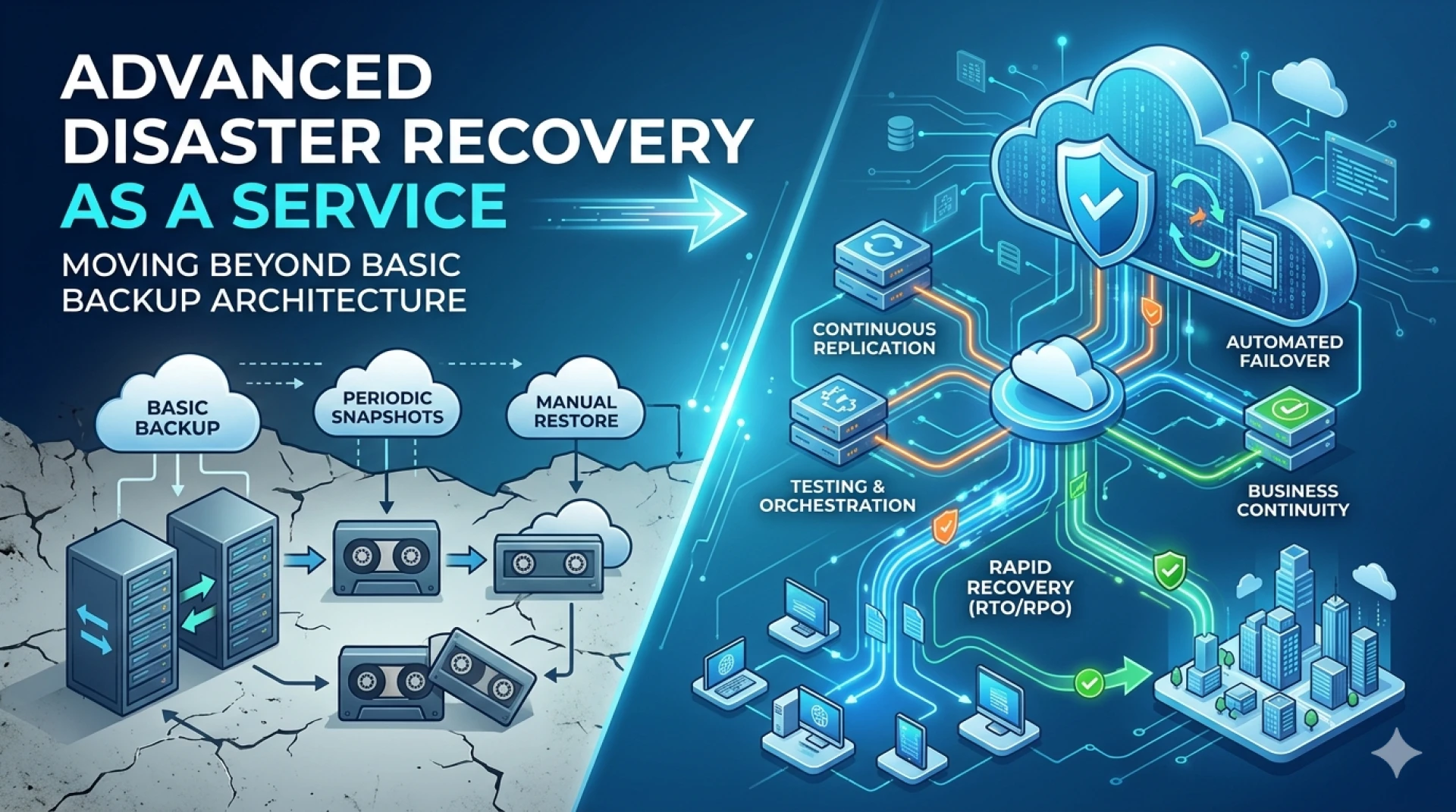

Disaster recovery has evolved far beyond the daily tape backups and secondary data center configurations of the past. As enterprise architectures grow increasingly complex and cyber threats become more sophisticated, basic replication strategies are no longer sufficient to guarantee business continuity. Advanced Disaster Recovery as a Service (DRaaS) represents the next evolution in organizational resilience, moving away from passive data storage toward active, intelligent, and automated recovery ecosystems.
While traditional DR and basic DRaaS solutions often struggle with high latency, manual failover processes, and vulnerability to advanced persistent threats, advanced disaster recovery as a service integrates continuous data protection with predictive analytics. This shift allows technology leaders to fundamentally rethink how their organizations withstand and recover from catastrophic system failures or targeted ransomware attacks.
Key Components of Advanced DRaaS Infrastructure
The transition to an advanced DRaaS model requires implementing specific technical capabilities that drastically reduce recovery windows and eliminate manual intervention during crisis scenarios.
Near-Zero RTO and RPO via Continuous Replication
Basic backup schedules leave organizations vulnerable to significant data loss between replication intervals. Advanced DRaaS utilizes continuous data replication at the block or hypervisor level. This active synchronization guarantees near-zero Recovery Point Objectives (RPO) and Recovery Time Objectives (RTO), ensuring that mission-critical applications remain available with virtually no data degradation.
Predictive Analytics Driven by AI and ML
Modern DRaaS platforms incorporate machine learning algorithms to monitor baseline infrastructure behavior. By analyzing traffic patterns and storage metrics in real time, these predictive AI models can detect anomalies indicative of impending hardware failure or lateral cyber threat movement. Proactive threat detection allows system administrators to quarantine affected environments before a full-scale outage occurs.
Automated Orchestration and Failover Mechanisms
When an outage strikes, manual routing and configuration changes cost valuable time. Advanced DRaaS provides automated runbook orchestration. Network configurations, DNS updates, and application dependencies are mapped and executed automatically during failover and failback operations, ensuring applications spin up in the correct sequence without human error.
Immutable Backups and Ransomware Protection
With ransomware variants specifically targeting backup repositories, advanced DRaaS implements immutable storage architectures. Immutable backup solutions utilize Write-Once-Read-Many (WORM) technology, preventing data from being encrypted, altered, or deleted by unauthorized actors or malicious scripts.
Granular Recovery Capabilities
Instead of forcing a full virtual machine restoration for a minor corruption issue, advanced solutions offer granular recovery. IT teams can extract individual files, specific application states, or single database tables directly from the replicated environment, accelerating the recovery process for localized incidents.
Strategic Enterprise Benefits
Deploying an advanced DRaaS architecture delivers measurable strategic advantages that extend beyond the IT department.
By eliminating the need to maintain mirrored secondary data centers, organizations significantly reduce capital expenditures and operational complexity. The transition to an OpEx-driven cloud model allows technology teams to allocate resources toward innovation rather than infrastructure maintenance.
Furthermore, advanced DRaaS simplifies strict regulatory compliance. Automated reporting, regular testing logs, and provable data integrity mechanisms streamline the auditing process for frameworks like SOC 2, HIPAA, and GDPR. Ultimately, the organization achieves an enhanced state of cyber resilience, capable of withstanding both natural disasters and sophisticated state-sponsored cyberattacks with minimal operational disruption.
Critical Considerations for Implementation
Successfully integrating advanced DRaaS into an existing technology stack requires meticulous planning and rigorous technical assessment.
Begin by mapping application dependencies and conducting a comprehensive infrastructure assessment. Not all workloads require near-zero RTO; tiering applications ensures cost-effective resource allocation.
Vendor selection is equally critical. Evaluate potential partners based on their hypervisor compatibility, data center geographical diversity, compliance certifications, and Service Level Agreement (SLA) guarantees regarding failover performance.
Finally, establish aggressive testing and validation strategies. Advanced DR scenarios must be simulated regularly using non-disruptive sandbox environments to validate runbooks and ensure the orchestration logic accurately reflects the current production architecture.
Future-Proofing Operations with Advanced DRaaS
Maintaining organizational resilience requires a continuous commitment to upgrading recovery capabilities. Advanced DRaaS equips enterprises with the automated orchestration, immutable storage, and predictive intelligence necessary to mitigate modern threats effectively.
Relying on legacy backup protocols introduces unacceptable operational risk. Technology leaders must evaluate their current disaster recovery posture against these advanced capabilities. Assess your application dependencies, review your existing failover mechanisms, and explore how an advanced DRaaS strategy can fortify your infrastructure against the unexpected.



























Sign in to leave a comment.