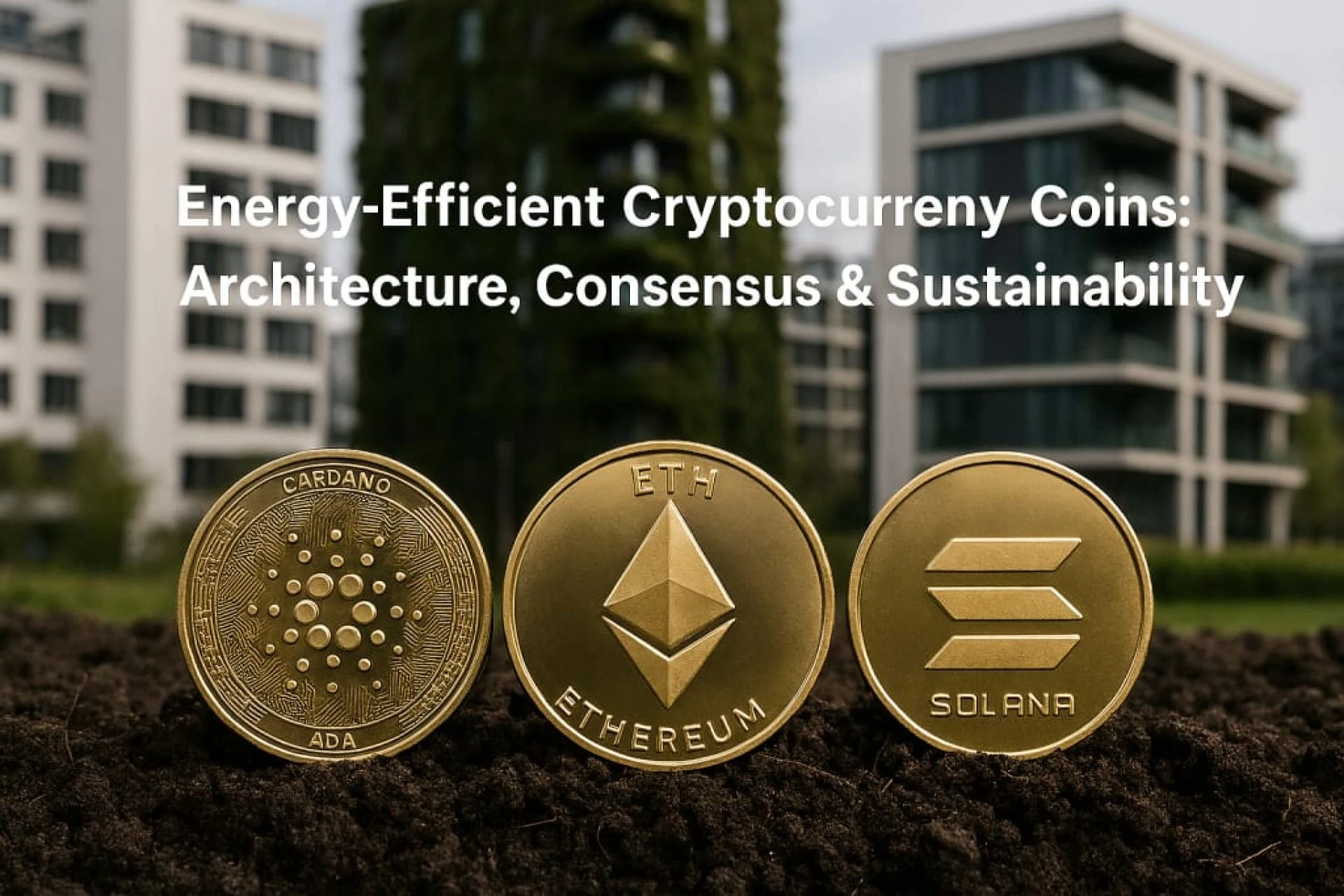

The accelerated adoption of blockchain networks has fundamentally reshaped how digital infrastructure is evaluated. Beyond throughput, security, and decentralization, environmental performance is now a decisive benchmark. Energy-efficient cryptocurrency coins are no longer positioned as niche alternatives; they represent an architectural recalibration of distributed ledger systems. As institutional investors apply ESG filters and regulators examine carbon disclosures, sustainability has become embedded within protocol engineering rather than layered on as an afterthought.
Energy efficiency in blockchain should not be narrowly interpreted as reduced electricity usage. It encompasses computational finality models, validator selection logic, state storage optimization, hardware thresholds, and transaction-per-second scalability. Each architectural decision influences the network’s kilowatt-hour intensity per confirmed transaction. Consequently, sustainability in blockchain is a systems-level outcome.
Architectural Engineering for Low-Energy Networks
First-generation blockchain systems relied heavily on redundant computation. Mining nodes simultaneously competed to solve cryptographic puzzles, expending massive processing power in parallel. Modern energy-efficient cryptocurrency coins diverge from this paradigm by minimizing competitive redundancy and emphasizing coordinated validation.
Protocol architecture now frequently separates execution, consensus, and data availability layers. This modularity reduces duplicated workload across nodes and enables resource-efficient scaling. Lightweight node requirements further democratize participation by lowering hardware dependency. When validator nodes operate without industrial mining rigs, baseline energy consumption decreases substantially.
Optimized block propagation mechanisms also contribute to efficiency. Compact block relay, refined gossip protocols, and bandwidth-conscious peer synchronization limit unnecessary data replication. Additionally, state pruning and compression techniques reduce long-term storage burdens. Since archival storage has its own energy footprint, managing historical data responsibly becomes part of sustainable engineering.
The result is a transition from brute-force validation toward deterministic or probabilistic finality mechanisms that preserve cryptographic integrity while lowering power demand.
Consensus Innovation Beyond Proof of Work
Consensus design remains the single most influential determinant of blockchain energy intensity. Proof of Work (PoW) networks inherently require sustained computational hashing to maintain security. While robust, this method ties network integrity to continuous electricity expenditure.
Energy-efficient cryptocurrency coins typically employ alternative consensus algorithms that secure validation through economic stake rather than computational competition. Proof of Stake (PoS) frameworks select validators based on locked token value, eliminating the need for energy-heavy mining operations. Delegated Proof of Stake (DPoS) narrows validator sets through token-holder elections, increasing throughput and reducing redundant verification cycles.
Proof of Authority (PoA) introduces identity-based validation, while hybrid models integrate Byzantine Fault Tolerance (BFT) to achieve rapid deterministic finality. These mechanisms secure the ledger through cryptographic attestation rather than energy-intensive puzzle solving.
By shifting security guarantees from hardware expenditure to economic alignment, consensus innovation reduces carbon intensity per block confirmation. Adaptive validator rotation and dynamic staking thresholds further optimize decentralization without inflating energy use. The defining feature of energy-efficient cryptocurrency coins is not merely alternative consensus, but consensus engineered for minimal systemic waste.
Measurable Sustainability and Carbon Accountability
Credible sustainability claims require quantifiable metrics. Modern blockchain ecosystems increasingly disclose energy-per-transaction statistics, total annualized consumption, and renewable energy distribution across validator nodes. Such transparency aligns with global ESG reporting standards and strengthens institutional confidence.
Energy intensity per transaction (kWh/tx) has emerged as a benchmark metric. However, evaluating sustainability also requires examining validator geography, renewable energy mix, and lifecycle hardware impact. Efficient smart contract execution and gas optimization further reduce computational strain. High scalability directly improves marginal energy efficiency, as greater throughput distributes base-level consumption across more transactions.
Some protocols integrate carbon accountability directly into governance frameworks. Token holders may vote on treasury allocations supporting renewable infrastructure or on-chain carbon credit integration. This embeds environmental considerations within network economics rather than treating them as external compliance obligations.
Sustainable Tokenomics and Economic Alignment
Energy efficiency can erode if token reward structures incentivize excessive validator expansion. Sustainable blockchain design therefore extends into tokenomics. Inflation schedules are often tapered to prevent unnecessary hardware proliferation. Dynamic staking rewards adjust participation rates to maintain optimal validator counts without increasing idle computational capacity.
Layer-2 scaling solutions also contribute to sustainability. Rollups, sidechains, and state channels aggregate transactions off-chain before settlement, significantly lowering base-layer validation workload. By reducing congestion and minimizing redundant computation, these scaling architectures reinforce energy efficiency across the ecosystem.
Enterprises evaluating blockchain deployment increasingly assess consensus architecture, emission curves, and scalability mechanisms before integration. Technical frameworks outlined by development providers such as https://shamlatech.com/cryptocurrency-coin-development/ describe structural coin design considerations, including consensus selection and token engineering. While implementation strategies vary, the sustainability principles underpinning energy-efficient cryptocurrency coins remain consistent: minimize redundancy, optimize validation, and align incentives with long-term ecological responsibility.
The Structural Evolution of Blockchain Sustainability
Energy-efficient cryptocurrency coins reflect a broader transformation in distributed ledger engineering. Security is no longer derived from maximum computational expenditure but from optimized coordination and economic alignment. Architectural modularity, advanced consensus algorithms, transparent carbon metrics, and sustainable tokenomics collectively reduce environmental intensity without sacrificing decentralization.
As regulatory frameworks evolve and ESG compliance becomes integral to capital allocation, sustainability will shift from competitive advantage to baseline requirement. The next generation of blockchain networks will be evaluated not only on scalability and interoperability, but on measurable environmental performance.
In this context, energy efficiency is not a peripheral feature. It is the structural foundation of responsible digital asset infrastructure.
Do you like this personality?

























Sign in to leave a comment.