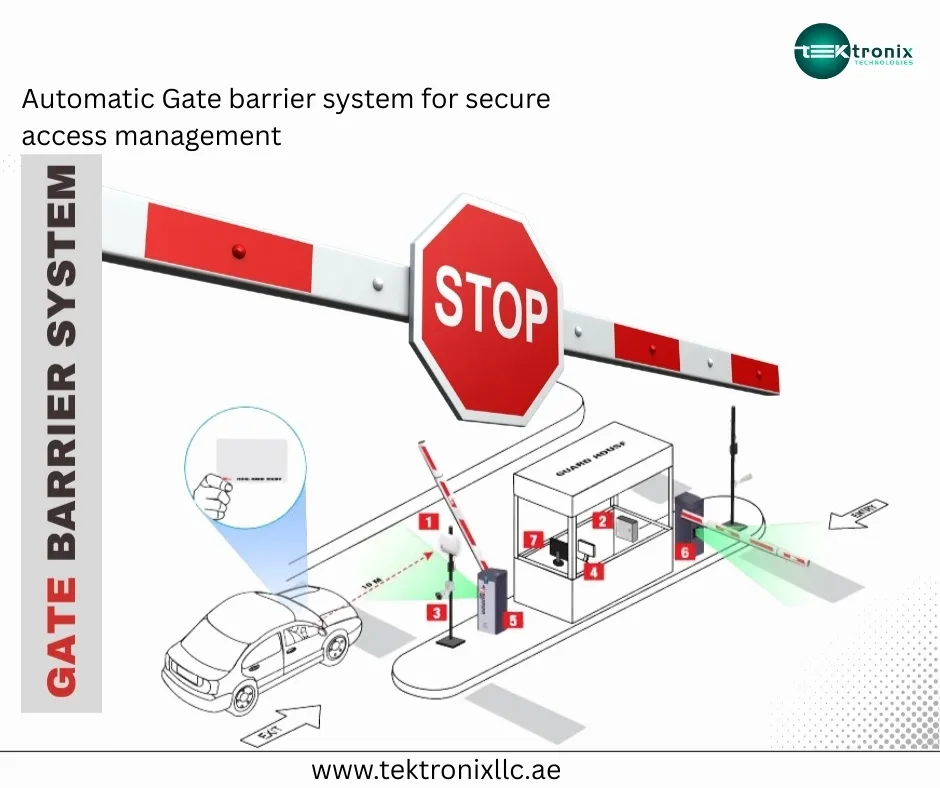

Protecting commercial premises, residential communities, and critical infrastructure in one of the world's most dynamic economies demands more than a padlock and a guard post. A purpose-engineered Gate Barrier System is today the baseline expectation for serious Vehicle Access Control across the UAE. Whether your facility is a multi-tenant office complex in Dubai Marina, a logistics hub in Abu Dhabi's industrial corridor, or a gated villa compound in Sharjah, selecting the right barrier technology — and the right integration partner — directly determines your site's security posture, operational throughput, and long-term cost of ownership. This guide examines every major barrier category, outlines city-specific deployment realities, and equips procurement decision-makers with the due-diligence checklist they need to get it right the first time.
Why the UAE Demands Purpose-Built Physical Security Infrastructure
The UAE's explosive commercial and infrastructure growth — underpinned by Dubai's D33 Economic Agenda and Abu Dhabi's Vision 2030 — has produced an urban landscape that is simultaneously highly accessible and acutely security-conscious. Free zones, smart-city districts, luxury hospitality assets, and government campuses all operate cheek-by-jowl, creating a complex mosaic of access requirements that no single off-the-shelf solution can satisfy. At the same time, rising vehicle traffic volumes, the proliferation of unmanned parking facilities, and stringent CIRAS and SIRA regulatory frameworks have made automated, intelligent Vehicle Access Control solutions essential rather than optional. The consequence is clear: facilities that deploy the right Gate Barrier System UAE solutions reduce security incidents, optimise traffic flow, and demonstrate the due-diligence credentials that insurers, regulators, and enterprise tenants increasingly require.
Core Product Categories: Understanding Your Options
The UAE market encompasses five principal barrier and access-control hardware categories, each engineered for distinct threat profiles, throughput requirements, and architectural contexts.
Boom Barrier System
The Boom Barrier System is the most widely deployed vehicle control mechanism across UAE commercial and residential sites. Comprising a motorised arm — typically between three and six metres in length — mounted on a robust drive unit, boom barriers open and close in response to authorised credentials: RFID cards, licence-plate recognition cameras, loop detectors, or remote commands from a security operations centre. Modern boom barrier drives incorporate variable-speed motors with soft-start and soft-stop profiles that dramatically reduce mechanical wear in high-cycle environments such as multi-storey car parks and corporate campuses where hundreds of vehicles pass daily. IP54-rated or IP65-rated enclosures protect the electronics against the UAE's extreme heat, humidity, and sand ingress, while built-in UPS modules ensure uninterrupted operation during power outages — a critical resilience feature in the region's summer months. Anti-crash safety loops and infrared obstacle-detection sensors prevent vehicle damage and personal injury, satisfying both insurer requirements and Dubai Municipality safety codes.
Toll Gate Barriers
Toll Gate Barriers are engineered for high-throughput, revenue-generating environments where payment or credential validation must occur at the point of vehicle entry. UAE road agencies, Salik-integrated facilities, paid parking operators, and port logistics companies all rely on toll-class barriers that handle thousands of vehicle transactions per day without service interruption. Unlike standard boom barriers, toll-grade units feature heavy-duty industrial motors with duty-cycle ratings of 100% — meaning they can operate continuously without a cooling interval — and integrate natively with payment terminals, ANPR (Automatic Number Plate Recognition) systems, and e-toll back-office platforms. Barrier arm lengths for toll applications are typically shorter — one to two metres — allowing faster actuation cycles and tighter lane control. When specified with redundant communication modules (4G, Wi-Fi, and wired Ethernet), Toll Gate Barriers deliver the network resilience that mission-critical road infrastructure demands.
Parking Gate Barrier
The Parking Gate Barrier segment is one of the fastest-growing categories in the UAE, driven by the exponential growth of mixed-use developments, smart parking operators, and real-estate developers mandating automated parking management as a standard building amenity. Parking gate solutions differ from general-purpose boom barriers in their deep software integration: they communicate in real time with parking management systems (PMS), guidance displays, occupancy sensors, and payment kiosks to create a fully automated entry-exit workflow. Licence-plate recognition at the entry gate eliminates physical ticket dispensers, reducing hardware maintenance and improving throughput. For residential towers and villa communities, Parking Gate Barrier systems with resident RFID or Bluetooth-based vehicle identification deliver frictionless access while logging every vehicle movement for community management and security audit purposes. UAE developers increasingly specify barriers with embedded IoT connectivity so facility managers can monitor gate status, cycle counts, and fault alerts from a centralised building management system.
Bollards
Bollards represent the highest tier of physical vehicle-access deterrence, engineered to stop hostile vehicles that deliberately attempt to breach a perimeter. In the UAE context, retractable and fixed anti-ram bollards are deployed around government ministries, embassies, financial district pedestrian zones, luxury hotel forecourts, critical utility infrastructure, and prominent public spaces. Automatic retractable bollards — powered by hydraulic or electromechanical actuators — rise and fall on command from an access credential, a security operations centre, or an integrated threat-detection trigger. Fixed-height steel bollards provide passive perimeter protection at locations where vehicular access is permanently prohibited. The specification of bollards for UAE projects must account for IWA 14-1 or PAS 68 impact-performance ratings, which certify that the bollard can arrest a defined vehicle mass at a given speed — a requirement routinely cited in both SIRA security assessments and government project tender documents. Bollards also serve an urban-design function: high-end stainless-steel or powder-coated designs enhance the streetscape aesthetic of premium commercial and hospitality precincts.
City-Specific Deployment Insights Across the Emirates
Each of the UAE's major business hubs presents a distinct deployment context that shapes product selection, integration requirements, and regulatory expectations.
Gate Barrier System Dubai
Dubai's status as a global financial, hospitality, and logistics hub creates some of the world's most demanding requirements for Gate Barrier System Dubai deployments. DIFC, Business Bay, Dubai South, and the Jebel Ali Free Zone collectively host thousands of high-value facilities that require barriers capable of managing peak vehicle loads exceeding 500 movements per hour per lane. Dubai's Roads and Transport Authority (RTA) enforces strict guidelines on lane widths, signage, and safety loop requirements for any barrier installation that connects to a public road. Smart-city integration is no longer aspirational here: barrier systems in Dubai's newest mixed-use developments are expected to communicate with centralised command-and-control platforms via REST APIs, enabling real-time traffic analytics and automated incident reporting. The city's Salik electronic toll infrastructure has also raised operator expectations for frictionless, ANPR-first access workflows that eliminate manual credential checking entirely.
Gate Barrier System Abu Dhabi
As the nation's capital and the seat of its most sensitive government, defence, and energy assets, Abu Dhabi places exceptional weight on the physical security credentials of every Gate Barrier System Abu Dhabi deployment. Projects at ADNOC-affiliated industrial sites, Masdar City's sustainable technology campus, Khalifa Port, and federal ministry compounds routinely specify anti-ram bollard arrays in combination with heavy-duty boom barriers to create layered vehicle-access architectures. The Abu Dhabi Department of Municipalities and Transport (DMT) requires certified engineering drawings and approved product lists for barrier installations on government or semi-government property. Integrators operating in Abu Dhabi must demonstrate familiarity with CIRAS data-privacy obligations when deploying ANPR cameras or biometric-linked access systems, and all safety-critical barrier installations require third-party inspection sign-off before commissioning.
Gate Barrier System Sharjah
Sharjah's fast-expanding industrial and residential footprint — spanning Hamriyah Free Zone, SAIF Zone, Sharjah Airport International Free Zone, and a rapidly growing villa and townhouse residential market — has generated strong demand for both industrial-grade boom barriers and residential-grade Gate Barrier System Sharjah solutions. Industrial deployments in the free zones require IP65-rated units with high duty-cycle motors capable of sustaining heavy goods vehicle (HGV) traffic patterns across three-shift operations. Residential community operators in Sharjah increasingly specify cloud-managed Parking Gate Barrier platforms that allow residents to grant visitor access via a smartphone app, reducing the workload on security guards while maintaining a comprehensive audit trail. The cost sensitivity of Sharjah's market also makes total cost of ownership a key selection criterion: buyers weigh upfront hardware cost against expected maintenance intervals, spare-parts availability, and local technical support coverage — all areas where working with an established UAE-based integrator delivers clear advantages.
Smart Integration Capabilities and Ecosystem Compatibility
The most transformative development in the UAE barrier market over the past three years is the shift from standalone hardware to fully networked, software-orchestrated access ecosystems. Contemporary Gate Barrier System deployments integrate with a wide range of adjacent platforms including access control servers (Lenel S2, Genetec, Gallagher), CCTV and video analytics platforms, HR and visitor management systems, and enterprise BMS platforms via standard protocols including Wiegand, OSDP, Modbus, and REST API. At the vehicle layer, deep ANPR integration enables automatic whitelisting of registered vehicles, real-time visitor pre-registration workflows, and forensic investigation exports. Operators can receive instant push notifications when a barrier malfunction is detected, or when an unregistered vehicle makes repeated failed access attempts — turning a passive hardware asset into an active intelligence source. For large campuses with multiple entry points, centralised barrier management dashboards provide gate-by-gate status monitoring, remote arm override capability, and cycle-count analytics that predict maintenance requirements before a failure occurs.
Regulatory Compliance, Safety Certification, and Assurance
Specifying compliant, certified barrier hardware is a non-negotiable requirement in the UAE's structured procurement environment. Key certification benchmarks to verify include CE marking (European conformity), EN 12453 (safety in use of power-operated pedestrian doorsets — applicable to barrier arms), IWA 14-1 / PAS 68 (anti-ram vehicle security ratings for bollards), and IP54 or IP65 (environmental ingress protection). For any project touching government or semi-government property, compliance with the Abu Dhabi or Dubai Municipality's approved product registers is mandatory. Tektronix LLC maintains an established portfolio of certified barrier and bollard hardware, backed by a team of SIRA-credentialed security engineers with a proven installation track record across commercial, industrial, and government projects throughout all seven emirates. The company delivers end-to-end project services — site survey, AutoCAD layout design, civil works coordination, equipment supplies, commissioning, and 12-month support contracts — satisfying Google's and procurement officers' aligned benchmarks of Experience, Expertise, Authoritativeness, and Trustworthiness.
Return on Investment: Building the Business Case for Barrier Automation
Decision-makers routinely ask how to justify a barrier automation investment to finance teams. The business case is robust and measurable across several value dimensions:
- Labour cost reduction: Replacing one full-time manned guardhouse shift with an automated Boom Barrier System typically recovers the hardware cost within 12 to 18 months at UAE market salary rates.
- Parking revenue protection: Parking Gate Barrier systems with ANPR and integrated payment eliminate revenue leakage from manual payment bypass, which operators report at 8–15% of gross parking revenue in un-automated facilities.
- Insurance premium reduction: Demonstrable perimeter-security infrastructure — particularly IWA-rated Bollards — qualifies facilities for reduced commercial property and liability premiums with several UAE-market underwriters.
- Liability and incident cost avoidance: A single vehicle-related security breach or car park collision incident can generate claim costs that exceed an entire barrier installation budget many times over.
- Tenant and investor appeal: Premium commercial and residential properties with certified, automated vehicle access infrastructure command higher lease rates and attract institutional tenants who require security-compliance documentation as part of their fit-out approval process.
How to Select the Right Barrier Partner in the UAE
When evaluating vendors for your next Vehicle Access Control project, apply this due-diligence framework:
- Confirm the supplier holds a valid UAE trade licence, municipality-approved product certifications, and where relevant, a SIRA security systems installation licence.
- Verify the hardware's duty-cycle rating against your projected peak daily vehicle movements — an under-specified motor is the single most common cause of premature barrier failure in the UAE.
- Request reference sites with comparable environmental conditions (outdoor heat, sand, humidity) and throughput volumes, and request site-visit permission where possible.
- Evaluate software openness: can the barrier controller integrate with your existing access management or parking management platform via standard protocols?
- Clarify post-installation support scope: local spare-parts inventory depth, field-engineer response time SLA, and availability of remote diagnostics to minimise on-site call-outs.
Why Tektronix LLC Delivers UAE-Grade Barrier Solutions
Tektronix LLC is a specialist integrator of physical security and vehicle access infrastructure with a proven delivery track record across Dubai, Abu Dhabi, and Sharjah. The company's barrier portfolio spans every category discussed in this guide — Boom Barrier System units, Toll Gate Barriers, Parking Gate Barrier platforms, and anti-ram Bollards — all sourced from globally certified manufacturers and supported by local in-house engineers. Tektronix provides full turnkey delivery: site assessment, AutoCAD layout, civil works coordination, hardware supply, commissioning, staff training, and annual maintenance contracts.
Conclusion
The UAE's continued transformation into a globally competitive smart economy makes robust, intelligent vehicle access infrastructure a strategic imperative — not just a compliance checkbox. From high-throughput Gate Barrier Systems for logistics hubs and commercial towers, to hostile-vehicle-mitigating Bollards for government and hospitality precincts, the right hardware, correctly specified and expertly installed, protects assets, streamlines operations, and delivers measurable financial returns. Whether your project is in Gate Barrier System Dubai, Gate Barrier System Abu Dhabi, or Gate Barrier System Sharjah, partnering with a certified, experienced UAE-based integrator is the single most effective investment you can make in your facility's long-term security ecosystem. Contact Tektronix LLC today and take the first step toward a smarter, safer vehicle access environment.
FAQs
1. What is the difference between a Boom Barrier System and Toll Gate Barriers?
A Boom Barrier System is a general-purpose vehicle access barrier used across parking facilities, residential communities, and commercial premises, typically cycling at lower daily frequencies and integrating with proximity cards, RFID, or ANPR credentials. Toll Gate Barriers, by contrast, are rated for 100% continuous duty cycles, handle thousands of vehicle transactions per day, and integrate natively with payment terminals, e-toll back-office systems, and real-time traffic management platforms. The correct choice depends on expected daily vehicle volume, revenue-collection requirements, and integration complexity.
2. What IP rating should I specify for an outdoor barrier in the UAE climate?
For outdoor installations across the UAE — where summer temperatures exceed 45°C, humidity peaks during coastal fog seasons, and Shamal windstorms deliver significant sand and dust loads — a minimum IP54 rating is recommended, protecting against dust ingress and water splash from any direction. Sites in direct sunlight or exposed coastal locations should specify IP65-rated enclosures, which are fully dust-tight and resistant to low-pressure water jets. Marine-grade powder coating and UV-stabilised covers further extend service life, reducing long-term maintenance costs for a Gate Barrier System UAE deployment.
3. Can a Parking Gate Barrier integrate with a smart building management system?
Yes. Modern Parking Gate Barrier controllers communicate over TCP/IP, Modbus, Wiegand, and REST API protocols, enabling native integration with building management systems (BMS), parking management software (PMS), and enterprise access control servers. This allows facility managers to monitor gate status, occupancy levels, and fault alerts from a single centralised dashboard, automate visitor pre-registration workflows, and generate occupancy reports that support RERA compliance disclosures and ESG reporting requirements.
4. What impact-resistance certification should Bollards meet for UAE government projects?
For government, embassy, or critical-infrastructure projects in the UAE, Bollards are typically required to meet IWA 14-1 or PAS 68 impact-performance ratings, which certify the bollard's ability to arrest a vehicle of a specific mass (commonly 2,500 kg or 7,500 kg) at a defined speed (typically 40 km/h to 80 km/h) within a defined penetration distance. Tenders from Abu Dhabi and Dubai government authorities routinely specify these ratings as mandatory minimum requirements, so selecting bollards from manufacturers with documented third-party impact-test certificates is essential to pass the project approval process.
5. How long does a standard Gate Barrier System installation take in the UAE?
Installation timelines for a Gate Barrier System project vary by scope and site readiness. A single-lane boom barrier replacement on an existing civil foundation can be completed in one to two working days. A new multi-lane entry with fresh civil works, ANPR integration, and parking management software typically spans two to four weeks. Large campus deployments involving multiple barrier types, bollard arrays, and BMS integration are planned over six to ten weeks, including site survey, design approval, equipment procurement, civil preparation, installation, and commissioning. Tektronix LLC provides detailed project schedules and milestone plans during the pre-contract site assessment.































Sign in to leave a comment.