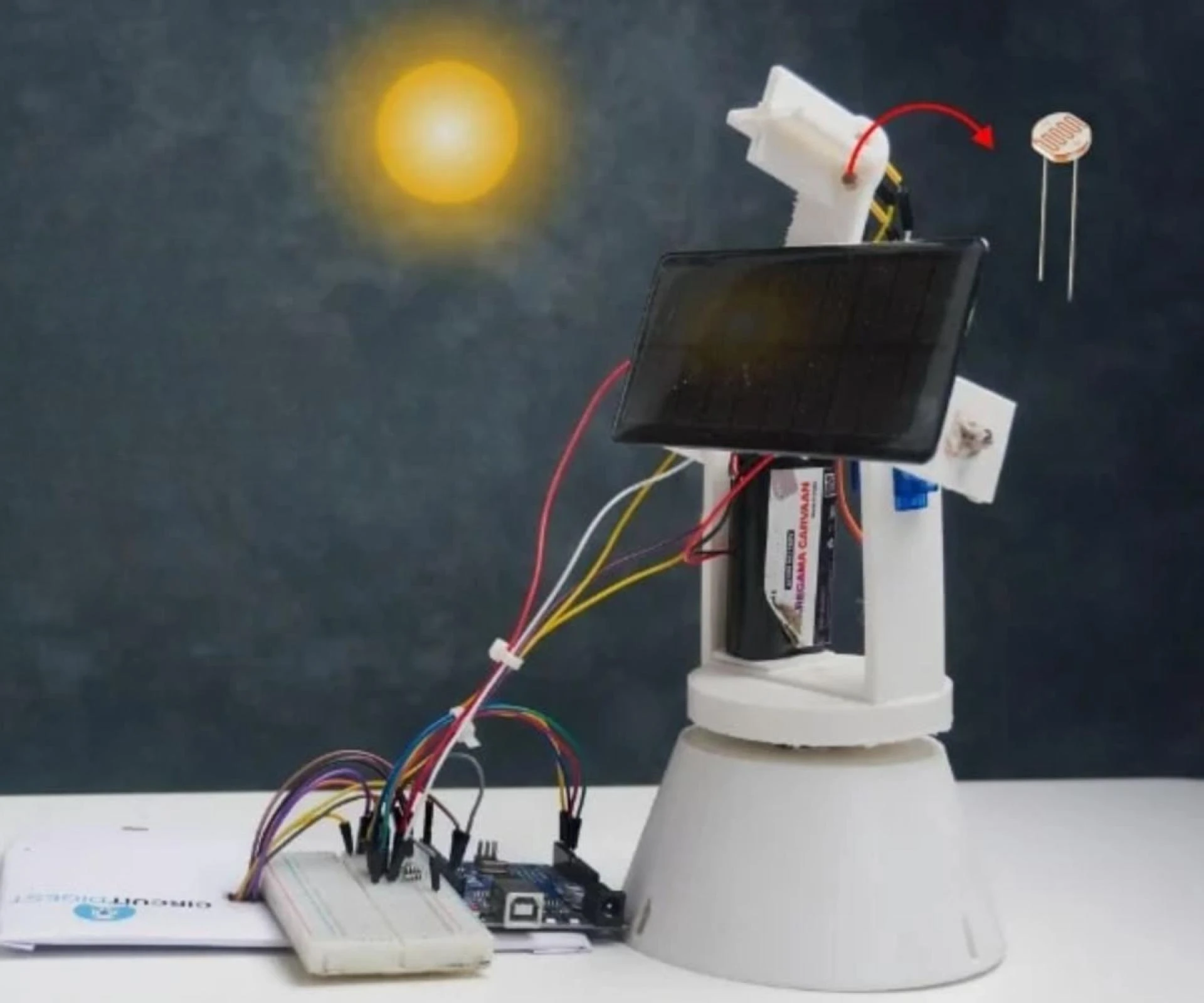

Solar panels are great, but most of the time they are not used to their full potential. A typical panel is fixed at one angle while the sun keeps moving across the sky all day. For a few hours the alignment is decent, but outside that window a lot of sunlight is simply wasted.
That was the main motivation behind this project. Instead of keeping the panel stuck in one position, the idea is to let it move and follow the sun. Not just side to side, but also up and down. That is where a dual axis solar tracker makes a big difference.
This Arduino project uses a few light sensors, and servo motors to automatically adjust the position of a solar panel so it always faces the brightest direction.
Why a Dual Axis Tracker Makes Sense
A fixed solar panel works best only when the sun is at a specific angle. As the day progresses, the sun moves horizontally from east to west and also changes its elevation. A single axis tracker can follow the sun in one direction, usually left to right, but it still loses efficiency when the sun gets higher or lower in the sky.
A dual axis tracker solves both problems. One axis handles horizontal movement, and the other controls vertical tilt. Because of this, the panel stays closer to a perpendicular angle relative to the sun for most of the day. In practical terms, this can result in 30 to 40 percent more energy compared to a fixed panel, especially during mornings and evenings.
Basic Idea Behind the System
The whole system is built around a simple feedback loop. The tracker looks at where the light is strongest, moves the panel slightly in that direction, and repeats this process again and again.
To sense sunlight, four LDRs are used. Each LDR is placed around the center of the panel so it can detect light from a specific direction. When one side receives more light than the others, the Arduino notices the difference and moves the panel toward that side using servo motors.
Nothing complicated is happening. It is just continuous comparison and small corrections.
Components Used in the Project
The main controller is an Arduino Uno. It reads the sensor values and controls the motors. Four LDR sensors are used to detect light intensity. Each LDR is paired with a resistor to form a voltage divider so the Arduino can read meaningful analog values.
Two micro servo motors are used for movement. One servo controls horizontal rotation, and the other controls vertical tilt. A small solar panel is mounted on a frame that allows it to rotate freely along both axes.
A breadboard, jumper wires, and a proper power supply complete the setup. It is important to power the servos separately because they can draw more current than the Arduino can safely provide.
How the Circuit Works
Each LDR is connected to one of the Arduino’s analog input pins. As the light intensity changes, the voltage at that pin changes as well. The Arduino constantly reads these values and stores them.
The servos are connected to digital pins. Based on the difference between LDR readings, the Arduino sends control signals to the servos to slightly adjust their angles.
The idea is not to make large movements. The panel moves in small steps, which keeps the motion smooth and avoids constant shaking.
Logic Used in the Arduino Code
The code starts by initializing two servo objects for horizontal and vertical movement. Initial angles are set so the panel starts in a neutral position.
Each LDR is read multiple times and averaged. This helps reduce noise and sudden spikes caused by shadows or small changes in light. Once the average values are calculated, the code compares top versus bottom readings and left versus right readings.
If the difference crosses a predefined tolerance, the Arduino moves the corresponding servo slightly in the direction of higher light intensity. If the difference is small, the panel stays where it is.
This loop keeps running continuously during the day.
Handling Low Light and Nighttime
At night or during very low light conditions, the LDR values drop significantly. In such cases, moving the panel makes no sense and only wastes power.
To handle this, the code checks the overall light level. If it falls below a certain threshold, the tracker enters a standby mode. The servos stop moving, and the system waits until sufficient light is available again. Once daylight returns, tracking resumes automatically.
Mechanical Assembly
The panel is mounted on a frame that allows two degrees of movement. The vertical servo is usually mounted at the base to control tilt, while the horizontal servo sits above it to control left and right rotation.
The LDRs are placed around the center of the panel with small barriers between them. These barriers help create sharper differences in light readings, which improves tracking accuracy.
All parts can be 3D printed, but that is optional. Cardboard, acrylic sheets, or PVC pipes also work as long as the structure is stable and the servos can move freely.
Real World Behavior
When the system is powered on, the panel starts adjusting itself almost immediately. If the light source moves left, the panel turns left. If the light moves upward, the panel tilts upward. The response is gradual and continuous.
Throughout the day, the panel keeps realigning itself as the sun moves. The biggest gains are usually seen during early morning and late evening hours, where fixed panels perform poorly.
Why This Project Is Useful
This project is a solid introduction to solar tracking, Arduino-based control systems, and sensor-driven automation. It shows how simple components and basic logic can result in a meaningful improvement in efficiency.
It is useful for learning, experimentation, and small-scale solar setups. With better motors, weatherproofing, and stronger frames, the same concept can be scaled for outdoor and long-term use.
Final Thoughts
This dual-axis solar tracker system using Arduino is not magic. It is just smart use of feedback and motion. By letting the panel follow the sun instead of staying fixed, a lot more energy can be harvested using the same hardware.
This Arduino-based tracker is a practical example of how small design changes can lead to noticeable gains. It also makes solar panels feel a lot less passive and a lot more intelligent, which is honestly half the fun of building it.























Sign in to leave a comment.