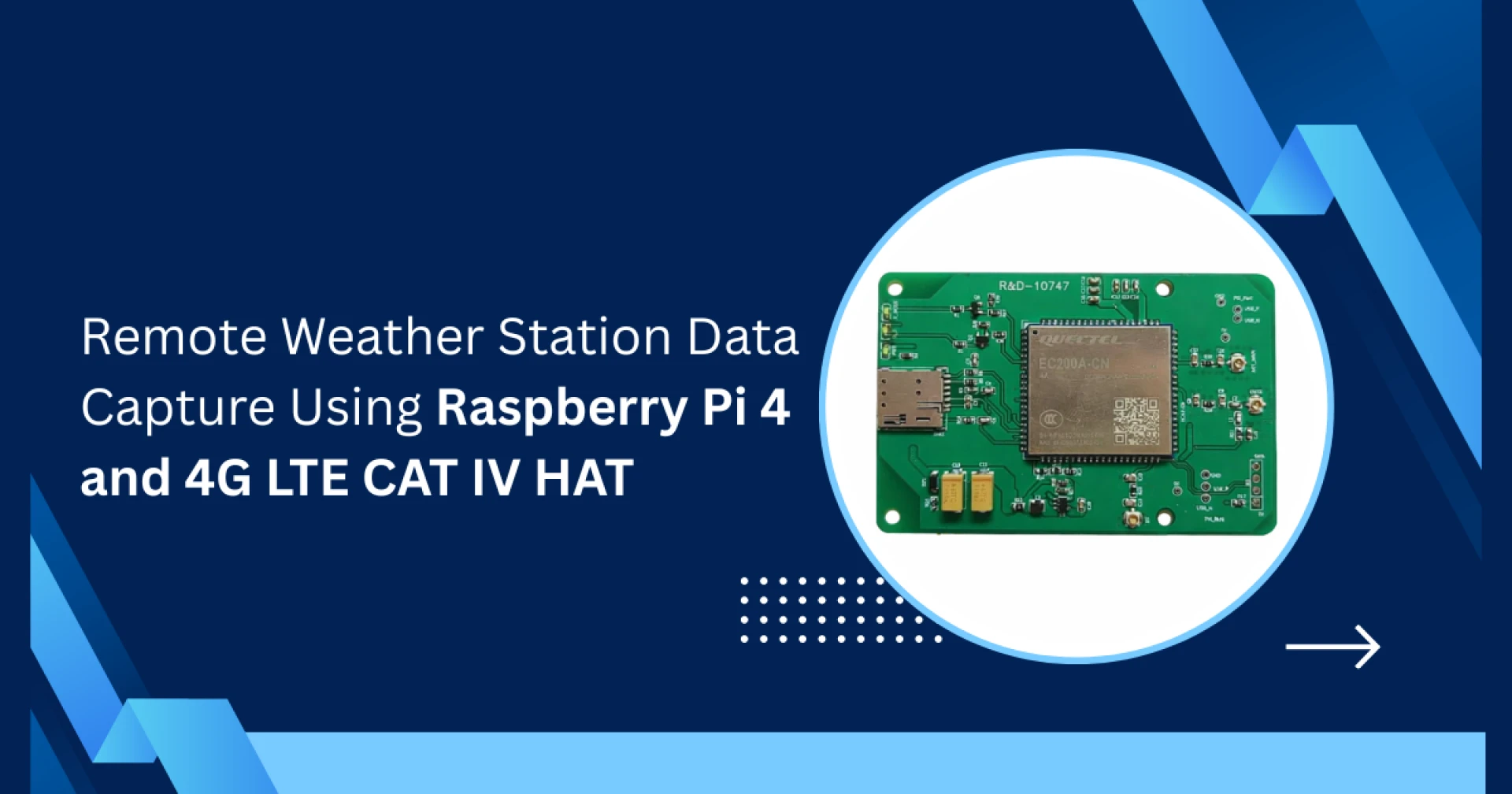

Remote weather monitoring has become essential for farming, disaster alerts, and environmental research. Hard‑wired internet often fails in off‑grid areas. Cellular networks provide a viable path for data transmission where Wi‑Fi or Ethernet cannot reach. The 4G LTE CAT IV HAT for Raspberry Pi4 and the Raspberry Pi4 CAT IV HAT form a reliable platform. This combination enables continuous collection and transmission of meteorological data to cloud servers for analysis.
This article explains what you need to build a remote weather station using the Raspberry Pi 4 and a 4G LTE cellular HAT. It covers hardware selection, software design, power planning, data transmission, security, and real‑world deployment metrics. Professionals and engineers can use these guidelines to build resilient and scalable systems.
Why the Raspberry Pi 4 Is Ideal
The Raspberry Pi 4 is ideal because it is compact, affordable, and powerful, with 4K multimedia support, versatile connectivity, GPIO for projects, low energy use, and strong community support, perfect for learning and DIY projects.
1. Powerful Hardware
The Raspberry Pi 4 has a quad-core 1.5 GHz processor and up to 8GB RAM, making it capable of multitasking, programming, and light gaming. Its GPU supports 4K video, allowing smooth media playback.
2. Excellent Connectivity
It offers USB 3.0, Gigabit Ethernet, dual-band Wi-Fi, and Bluetooth 5.0, providing fast and stable wired and wireless connections for projects and networking.
3. GPIO and Expandability
The 40-pin GPIO header allows users to connect sensors, motors, and other electronics, making it ideal for robotics, DIY projects, and home automation.
4. Multimedia Capabilities
With dual micro HDMI ports supporting 4K displays and hardware video decoding, it can handle high-definition videos efficiently, perfect for media centers and digital signage.
5. Versatility for Projects
It supports Python, C, Java, and other languages, and can be used for learning, retro gaming consoles, robotics, and small servers, making it highly versatile.
Key Components of a Remote Weather Station
A complete system includes:
1. Sensors
Sensors are the heart of a weather station. They measure environmental conditions such as temperature, humidity, wind speed, wind direction, rainfall, and atmospheric pressure. Accurate sensors ensure reliable weather data for monitoring and forecasting.
2. Data Logger
A data logger collects and stores information from all the sensors. It ensures that data can be recorded continuously and accessed later for analysis. Some data loggers can also transmit data in real-time.
3. Microcontroller or Processor
A microcontroller (like Arduino or Raspberry Pi) processes the data from sensors. It can convert raw sensor readings into usable information, trigger alerts, and manage data transmission.
4. Power Supply
Remote weather stations require a reliable power source, often solar panels with rechargeable batteries, to ensure continuous operation in areas without direct electricity.
5. Communication Module
A communication module allows the station to send data remotely. This can be via Wi-Fi, GSM/4G, satellite, or radio signals, enabling real-time monitoring from anywhere..
Selecting Weather Sensors
Accurate weather data starts with reliable sensors. Choose sensors with known performance metrics and industrial grades when possible.
1. Temperature and Humidity
Temperature and humidity measure air heat and moisture. They are recorded using sensors, providing essential data for weather prediction, climate monitoring, agriculture, and environmental studies.
2. Barometric Pressure
A barometric pressure sensor measures atmospheric pressure and converts it into electrical signals, enabling weather prediction, storm detection, and real-time environmental monitoring in weather stations.
3. Wind Speed and Direction
Wind sensors measure air movement and direction. Anemometers track speed, wind vanes track direction, providing real-time data for weather forecasting, climate monitoring, and environmental analysis..
4. Rainfall
Rainfall sensors measure precipitation using tipping buckets or electronic methods, converting it into data for weather forecasting, agriculture, flood monitoring, and climate studies.
The 4G LTE CAT IV HAT Explained
Cellular connectivity is the backbone of remote data capture. The Raspberry Pi4 CAT IV HAT integrates a 4G LTE modem with the Raspberry Pi 4. It connects directly to the Pi’s GPIO header for power and data.
This HAT supports LTE Category IV, which is significantly faster than older Category 1 modems. Typical performance includes download speeds up to 150 Mbps and upload speeds up to 50 Mbps. LTE fallback to 3G networks improves coverage in marginal areas.
Key features include:
- SIM card slot with multi‑band support.
- Status LEDs for network and signal strength.
- GPIO integration without external cables.
- Linux driver support for network interfaces.
System Architecture and Data Flow
A remote station must collect, process, store temporarily, and send data reliably. The architecture divides into distinct stages:
1. Sensor Acquisition
Sensors send readings to the Raspberry Pi through I2C, SPI, or UART.
2. Local Processing
Python scripts convert raw values to engineering units (°C, mm, m/s).
3. Local Storage
SQLite or CSV files keep backup copies for fault recovery.
4. Transmission
The 4G LTE CAT IV HAT for Raspberry Pi4 routes data to cloud servers using MQTT or HTTPS.
5. Cloud Storage and Visualization
Servers ingest data, store it in time‑series databases, and feed dashboards.
This architecture supports batch uploads when network conditions fluctuate. Batching reduces repeated connection overhead and saves cellular data.
Communication Protocols
Selecting appropriate communication protocols affects reliability and bandwidth usage:
1. MQTT: Lightweight and efficient for small telemetry packets. MQTT QoS levels ensure delivery.
2. HTTPS: Secured with TLS encryption for authenticated uploads. Reliable but slightly heavier.
3. WebSockets: Provides live data to dashboards after initial upload.
A typical station sends data every five minutes. That yields 288 transmissions per day. If each payload is ~1 KB, daily data use is ~288 KB. Monthly usage remains under 10 MB, making low‑cost data plans viable.
Hardware Assembly Guide
Follow these steps for reliable assembly:
- Install Raspberry Pi OS on the microSD card and update it.
- Mount the 4G LTE CAT IV HAT to the Pi’s GPIO header firmly.
- Insert a data‑capable SIM card into the HAT.
- Connect sensors using proper cabling and label each wire.
- Install solar panels, charge controller, and sealed battery for power.
- Place all electronics in a weatherproof enclosure with cable glands.
Ensure antennas for LTE and GPS are outside the enclosure, shielded from moisture. Proper cable strain relief prevents connector damage over time.
Software Setup and Configuration
1. Operating System and Tools
Install the Raspberry Pi OS (64‑bit). After updating packages, install Python:
sudo apt update
sudo apt upgrade -y
sudo apt install python3 python3-pip git
Install sensor libraries:
pip3 install adafruit-circuitpython-sht31 adafruit-bmp3xx
2. Modem Drivers and PPP
The 4G LTE CAT IV HAT may require modem drivers or a PPP daemon to create a network interface like wwan0. Check vendor documentation for exact steps. Store recent months locally for fault recovery. Send older entries to the cloud for long‑term storage.
Data Transmission Strategy
Data transmission strategy ensures weather station data reaches servers reliably. Sensors send data via Wi-Fi, GSM/4G, LoRa, or satellite, with encryption and error checking to maintain integrity. Efficient transmission enables real-time monitoring, reduced latency, and continuous availability for weather forecasting and analysis.
Power System Design
Remote sites rarely have grid power. Solar systems provide autonomy.
1. Solar Panel Sizing
A typical Raspberry Pi 4 setup uses ~5 W under light load. Add sensor and HAT power needs for ~8 W average.
Daily energy needed = 8 W × 24 h = 192 Wh.
With an average 5 hours of effective sun:
100 W solar panel generates ~500 Wh daily.
2. Battery Storage
A 12 V 30 Ah LiFePO4 battery stores ~360 Wh. This supports at least 1.5 days without sunlight, providing resilience during cloudy periods.
3. Charge Controller
Use an MPPT charge controller to maximize energy harvest and protect batteries.
Cellular Connectivity Planning
1. SIM Data Plan
Choose data plans with at least 1 GB monthly data and low‑cost telemetry options. Verify LTE signal strength using a smartphone before installation.
2. Antenna Placement
Antenna placement should be high, use low-loss cables, avoid metal surfaces, and maintain signal strength above –85 dBm to ensure reliable data transmission.
Security Considerations
Security in weather stations is essential to protect data from unauthorized access or tampering. Use TLS encryption for HTTPS or MQTT, implement authentication with API keys or client certificates, and consider a VPN tunnel for cloud communication. These measures ensure that all transmitted weather data remains secure, reliable, and confidential, maintaining system integrity.
Visualization and Alerting
Visualization platforms like Grafana or Kibana display metrics over time. Use a time‑series database (InfluxDB or TimescaleDB) to store incoming telemetry.
Set alerts for thresholds:
- Temperature above 40°C
- High wind speed above 20 m/s
- Rapid rainfall exceeding 10 mm/hour
Alerting via email or SMS enhances field monitoring and decision support.
Remote Maintenance and Diagnostics
Remote stations need diagnostic feedback:
- Forward logs to a central system.
- Use the Raspberry Pi4 CAT IV HAT modem status page to monitor signal strength and network status.
- Schedule automatic reboots if script failures occur.
Field technicians benefit from lightweight LCD status screens showing real‑time values and network indicators.
Real‑World Deployment Example
A farm network in rural India deployed 10 weather stations.
Each used:
- Raspberry Pi 4
- 4G LTE CAT IV HAT for Raspberry Pi4
- Standard 100 W solar panel
- 20 Ah LiFePO4 battery
Stations sampled data every 2 minutes. Farmers received rainfall and wind alerts via cloud dashboards. Monthly data usage averaged 12 MB per station. Over one season, responsive irrigation based on real data improved crop yield by 15%.
Common Challenges and Mitigation
1. Weak Cellular Signals
- Use directional antennas.
- Confirm coverage before deployment.
2. Extreme Temperatures
- Ventilate enclosures.
- Provide insulation in cold climates.
3. Water Damage
- Use IP65 or higher rated boxes.
- Seal all cable entries with gaskets.
Planning for these issues ensures higher uptime.
Performance Metrics
| Metric | Typical Value |
| Data latency | <20 seconds |
| Cellular uptime | ~98.5% |
| Power autonomy without sun | ~36 hours |
| Monthly data use | ~10–15 MB per station |
These metrics represent real field deployments under normal conditions.
Future Improvements
Future weather station improvements include local edge analytics for real-time anomaly detection, redundant power systems like wind turbines for reliability, 5G HAT support for faster data transfer, and modular designs that allow easy upgrades without major redesigns, making stations more flexible, scalable, and future-ready.
Conclusion
A remote weather station using Raspberry Pi 4 and the Raspberry Pi4 CAT IV HAT provides a cost‑effective, reliable, and scalable capture system. This setup supports real‑time monitoring without fixed internet. By combining robust hardware, efficient software, and proper power design, engineers can deliver accurate environmental data from remote sites. This solution meets the needs of farmers, researchers, and disaster response planners.

























Sign in to leave a comment.