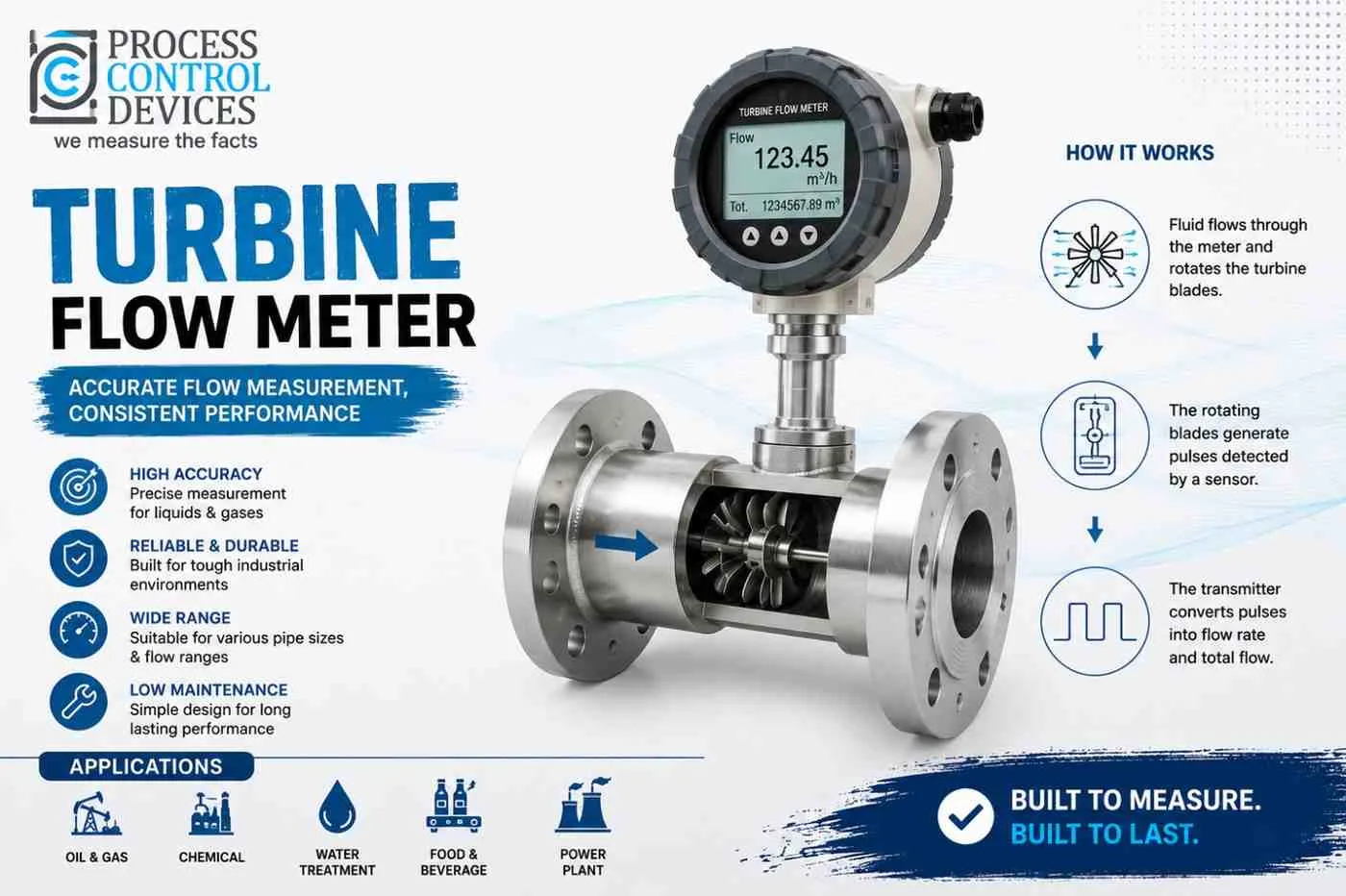

Flow measurement is at the heart of every efficient industrial process. Whether it's managing fuel consumption, monitoring chemical dosing, or controlling water distribution, accurate flow data drives better decisions. Among the various flow measurement technologies available today, the turbine meter stands out as one of the most reliable, precise, and widely adopted instruments across industries worldwide.
This article explores the working principle, construction, applications, advantages, limitations, and selection criteria of turbine meters giving engineers and instrumentation professionals a complete technical overview.
What is a Turbine Meter?
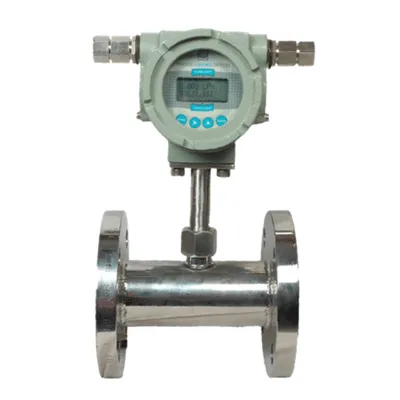
A turbine meter is a velocity-based flow measurement device that calculates volumetric flow rate by measuring the rotational speed of a rotor placed in the flow path. As fluid passes through the meter body, it imparts kinetic energy to the bladed rotor, causing it to spin at a speed directly proportional to the fluid velocity and therefore, the flow rate.
The output is typically a pulse signal, where each pulse represents a precise volume of fluid that has passed through the meter. These pulses are counted electronically to give real-time flow readings.
Working Principle
The operating principle of a turbine meter is straightforward yet highly effective:
- Fluid enters the meter through an inlet flow conditioner, which straightens the flow profile and removes turbulence.
- The conditioned fluid strikes the angled blades of the rotor, generating rotational torque.
- The rotor spins at a speed proportional to the volumetric flow rate.
- A magnetic or optical pickup sensor detects each blade passing and generates a pulse.
- The pulse frequency is converted into flow rate and totalized volume by a flow computer or transmitter.
The relationship between rotor speed and flow rate is expressed through the K-factor the number of pulses generated per unit volume. A stable, consistent K-factor across the operating range is a key indicator of a high-quality turbine meter.
Construction and Key Components
A typical turbine meter consists of the following components:
- Meter Body: Usually made from stainless steel, carbon steel, or aluminium depending on the application.
- Rotor/Turbine Wheel: Precision-machined blades set at a specific angle to maximize energy transfer from the fluid.
- Rotor Shaft and Bearings: Low-friction tungsten carbide or ceramic bearings for long service life and minimal drag.
- Flow Conditioner/Straightener: Upstream vanes that eliminate swirl and normalize the velocity profile.
- Pickup Sensor: A non-intrusive magnetic or RF sensor that detects rotor blade movement and generates pulse output.
- Transmitter/Electronics: Converts raw pulse data into engineering units and transmits via 4–20mA, HART, Modbus, or pulse signals.
Types of Turbine Meters
Axial (In-line) Turbine Meters are the most common type, where flow moves parallel to the rotor axis. Ideal for clean, low-viscosity liquids and gases in pipeline applications.
Insertion Turbine Meters are a cost-effective option for large diameter pipes. A single rotor is inserted into the pipe through a hot-tap fitting, measuring velocity at a specific point.
Tangential Turbine Meters have flow entering perpendicular to the rotor axis, often used for low flow rate applications.
Dual Rotor Turbine Meters feature two counter-rotating rotors that self-compensate for velocity profile distortions, offering higher accuracy commonly used in custody transfer applications.
Applications Across Industries
Turbine meters are deployed across a wide range of industrial sectors.
In Oil & Gas, they are used extensively for custody transfer of crude oil, refined petroleum products, natural gas, and LPG. Their high accuracy and fast response time make them ideal for fiscal metering.
In Chemical & Petrochemical plants, they provide precise measurement of solvents, acids, alcohols, and process chemicals. Stainless steel and Hastelloy construction options allow use with aggressive media.
In Water & Utilities, municipal distribution networks use turbine meters for billing and distribution monitoring, as well as cooling water and boiler feed applications.
In Food & Beverage, hygienic turbine meters with sanitary fittings measure flow of water, CO₂, edible oils, and beverages in compliance with food safety standards.
In Power Generation, steam condensate, fuel oil, and cooling water systems rely on turbine meters for process monitoring and efficiency calculations.
Advantages of Turbine Meters
- High accuracy, especially for clean, low-viscosity fluids
- Wide turndown ratio covering a broad flow range
- Fast response time for dynamic flow tracking
- Decades of field-proven performance across critical industries
- Easy integration with SCADA, DCS, and PLCs via pulse output
- Compact and lightweight compared to other high-accuracy meters
Limitations to Consider
- Viscosity Sensitivity: Performance degrades with fluids above 10–15 cSt
- Not Suitable for Dirty Fluids: Particles or fibrous materials can damage rotor bearings upstream filtration is typically required
- Straight Pipe Runs Required: Minimum 10–20 pipe diameters upstream and 5 downstream of any valves or bends
- Moving Parts: Bearings wear over time, requiring regular maintenance and calibration
- Unidirectional by Default: Bi-directional versions are available but add cost
Installation Best Practices
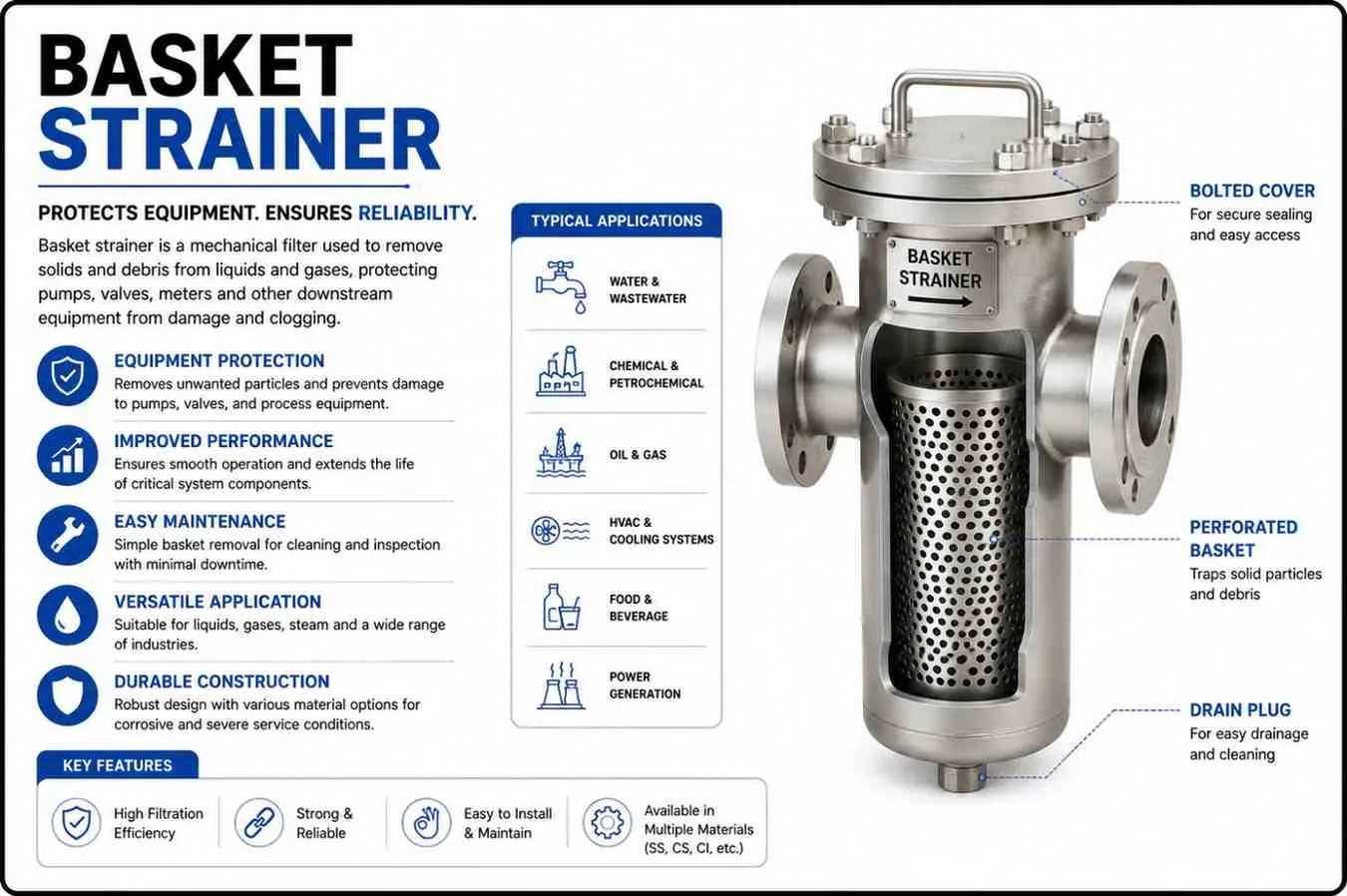
Proper installation is essential to achieving rated accuracy. Always follow manufacturer guidelines for upstream and downstream straight runs typically 10D upstream and 5D downstream. Use flow conditioners where long straight runs are unavailable. Install a strainer upstream to protect the rotor from particulate damage, and ensure sufficient back pressure downstream to prevent cavitation. For custody transfer applications, always calibrate on-site with the actual process fluid.
Selecting the Right Turbine Meter
When specifying a turbine meter, engineers should evaluate fluid type, viscosity, flow range, pressure and temperature ratings, accuracy requirements, output signal compatibility, and material compatibility with the process fluid.
Working with an experienced turbine flow meter manufacturer ensures the right meter is specified for each unique application. Companies like PCD Flowmeter offer a comprehensive range of turbine meters engineered for demanding industrial environments, backed by technical expertise and calibration support.
Conclusion
The turbine meter remains one of the most versatile and trusted instruments in industrial flow measurement. Its combination of high accuracy, wide turndown, fast response, and proven reliability makes it the preferred choice for custody transfer, process control, and fiscal metering across oil & gas, chemical, water, and power industries.
Engineers who understand the working principles, limitations, and best practices of turbine meters are better positioned to extract maximum value from this technology making it a cornerstone of modern flow measurement infrastructure.















![The Benefits of Using a CNC Touch Probe [Infographic]](https://writeupcafe.com/data/post/1677697/bfdf3e040e67936848aa232d2dfe3d03.jpg.webp)











Sign in to leave a comment.