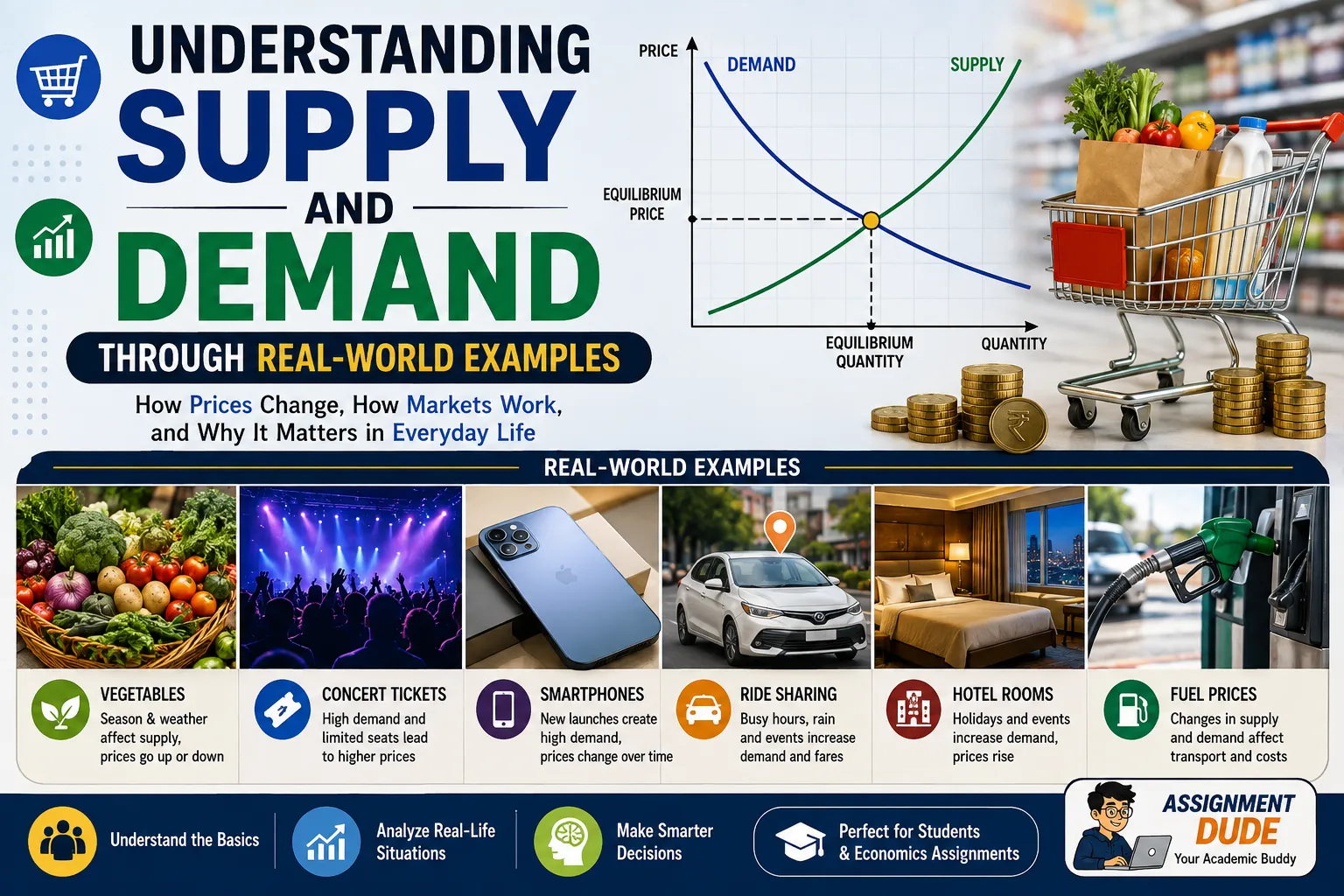

Have you ever noticed that the price of vegetables increases after heavy rain, hotel rooms become expensive during holidays or concert tickets become difficult to find when an event becomes popular? These situations may seem unrelated, but they are connected by one important economic idea.That idea is supply and demand.
Supply and demand help explain why prices change, why some products become difficult to find and why businesses sometimes offer large discounts. These concepts are among the most basic ideas in economics, but they are also among the most useful because they can be seen in everyday life.
Students often learn supply and demand through graphs and definitions in textbooks. While these methods are useful, real world examples can make the concepts much easier to understand.
Once you start paying attention, you can find examples of supply and demand in supermarkets, restaurants, transportation, housing, technology, fashion, entertainment and even in your own college life.
What Is Demand?
Demand refers to the willingness and ability of consumers to buy a product or service at a particular price.
It is important to understand that simply wanting something does not always create economic demand. A person may want an expensive smartphone but may not have enough money to purchase it.
For example, imagine that a college canteen sells cold drinks at a low price during a very hot summer day. Many students may want to buy them because they feel thirsty.
If the weather becomes cooler, fewer students may want cold drinks.
This shows how consumer needs and preferences can influence demand.
Demand can change because of several factors, including price, income, preferences, population, trends and expectations about future prices.
What Is Supply?
Supply refers to the quantity of a product or service that sellers are willing and able to provide.
Consider a small bakery that produces cakes every morning.
If customers are buying more cakes, the bakery may decide to produce more.
If customers are buying fewer cakes, the bakery may reduce production to avoid wasting ingredients.
Supply is therefore closely connected with business decisions.
Businesses consider production costs, customer demand, available resources and expected profits when deciding how much to supply.
Understanding the Law of Demand
The law of demand describes a general relationship between price and the quantity consumers want to purchase.
When the price of a product increases, consumers generally tend to purchase less of it, assuming other conditions remain similar.
When the price decreases, consumers generally tend to purchase more.
Imagine that a movie ticket costs 150 rupees. A student may be comfortable buying one ticket.
If the price suddenly increases to 500 rupees, some students may decide not to watch the movie.
However, this relationship is not an absolute rule for every situation. Consumer behavior can also depend on income, preferences, necessity and the availability of alternatives.
Understanding the Law of Supply
The law of supply describes the relationship between price and the quantity sellers are willing to provide.
When prices increase, producers may have a greater incentive to supply more because higher prices can potentially provide higher revenue.
For example, imagine farmers receive a better price for a particular vegetable. More farmers may decide to grow that vegetable in the future.
If the selling price becomes very low, farmers may reduce production or choose another crop.
Supply is therefore influenced by both market prices and the cost of producing goods.
How Supply and Demand Work Together
Supply and demand work together to influence market prices.
Imagine a local market where 100 people want to buy a particular product, but sellers only have 40 units available.
There is strong demand and limited supply.
The product may become more expensive because many customers are competing for a limited quantity.
Now imagine that sellers have 200 units available while only 50 customers want to buy them.
The market has more supply than immediate demand.
Sellers may reduce prices or offer discounts to attract customers.
This interaction helps explain many price changes that people observe every day.
Understanding Market Equilibrium
Market equilibrium is a situation where the quantity consumers want to buy is equal or close to the quantity sellers want to provide at a particular price.
Imagine a small market selling notebooks.
At one price, sellers may be willing to provide 100 notebooks while customers are willing to purchase approximately 100 notebooks.
The market is relatively balanced at that point.
If the price becomes too high, customers may purchase fewer notebooks.
If the price becomes too low, sellers may not want to provide enough notebooks.
The balance between supply and demand helps markets move toward a price at which buying and selling can take place.
Real World Example With Vegetables
Vegetable prices provide one of the easiest examples of supply and demand.
Suppose heavy rainfall damages vegetable crops in several farming areas.
The amount of vegetables reaching the market may decrease.
However, people still need vegetables for their daily meals.
Demand may remain relatively stable while supply falls.
When fewer vegetables are available but many consumers still want to purchase them, prices can rise.
Later, when weather conditions improve and farmers produce larger quantities, supply can increase.
If demand remains similar, prices may fall because more products are available.
This example shows why agricultural markets can experience noticeable price changes.
Concert Tickets and Limited Seats
Concert tickets are another clear example.
Imagine that a popular singer announces a concert in a stadium with 20,000 seats.
If hundreds of thousands of people want tickets, demand is extremely high compared with the number of seats available.
The limited number of tickets creates scarcity.
When demand is much greater than available supply, tickets can become difficult to obtain.
On the other hand, if a less popular event has many unsold seats, organizers may offer discounts to attract more customers.
The same basic economic idea can therefore work in both directions.
Smartphones and Technology
Technology markets provide another interesting example.
When a new smartphone is released with popular features, many consumers may want to purchase it.
High demand can allow manufacturers and retailers to maintain higher prices during the early stage of the product's life.
Over time, production may increase.
Competition may also become stronger.
New smartphone models may appear.
As consumers shift their attention toward newer products, demand for an older model may decrease.
Retailers may then reduce prices to encourage customers to purchase remaining stock.
This demonstrates how demand can change as consumer preferences and technology change.
Ride Services and Transportation
Transportation services can experience changes in demand throughout the day.
Imagine heavy rain during evening rush hour.
Many people may prefer to use cars or ride services instead of walking or using other forms of transportation.
Demand for available rides can increase quickly.
At the same time, the number of available drivers may be limited in the short term.
When demand rises sharply while available supply remains limited, prices can increase.
Later, when the rain stops and fewer people need rides, demand may fall.
This example shows how temporary changes in consumer needs can affect market conditions.
Hotel Rooms During Holidays
Hotels also provide a useful example.
During a normal week, a hotel may have several rooms available.
During a major festival, holiday period or large event, many more people may want accommodation in the same area.
The number of hotel rooms cannot usually increase immediately.
Therefore, demand can rise while short term supply remains limited.
Prices may increase as hotels respond to stronger demand.
During periods when fewer people travel, hotels may offer discounts to attract customers.
This is another example of supply and demand operating in everyday life.
Agricultural Products
Agriculture is strongly affected by supply conditions.
Farm production depends on weather, water availability, soil conditions, transportation and production costs.
Suppose a region experiences a serious drought.
Farmers may produce less food than expected.
The reduced supply can affect market prices, especially if consumers continue to demand the same products.
A successful harvest can create the opposite situation.
If farmers produce a large quantity of a particular crop, the increased supply may put downward pressure on prices.
Agricultural markets therefore demonstrate how natural conditions can influence supply.
Fuel and Transportation Costs
Fuel markets can also influence other parts of the economy.
Transportation companies use fuel to move people and products.
If transportation costs increase, businesses may face higher expenses when moving goods from factories to stores.
These higher costs can eventually influence the prices consumers pay for various products.
Fuel markets themselves are influenced by several factors, including supply conditions, demand and international market conditions.
This shows that supply and demand in one market can sometimes affect other markets.
Fashion Trends and Clothing
Fashion provides an excellent example of changing demand.
Imagine a particular style of clothing becomes extremely popular because of celebrities or social media.
Many consumers may suddenly want the same product.
Demand increases quickly.
Businesses may respond by increasing production and stocking more of the popular item.
However, trends can disappear just as quickly.
If customers lose interest, demand falls.
Businesses may then have excess inventory and offer discounts to encourage customers to buy the remaining products.
This demonstrates how consumer preferences can create rapid changes in demand.
Restaurants and Food Delivery
Restaurants also experience changing demand.
A restaurant may be relatively quiet on a weekday afternoon but extremely busy on a weekend evening.
During special events or holidays, demand can increase further.
However, restaurant capacity is limited.
A kitchen can prepare only a certain number of meals at a time.
There may also be limits on seating, staff and ingredients.
When customer demand becomes greater than the restaurant's short term capacity, customers may experience longer waiting times.
Restaurants respond by hiring more workers, preparing additional ingredients or adjusting their operations.
This is supply and demand in a very familiar setting.
Housing and Rent
Housing markets are another important example.
Suppose a city becomes a popular location for students and workers.
More people want to live there.
If the number of available homes does not increase at the same speed, housing demand can become greater than supply.
This can contribute to higher rents and property prices.
Over time, developers may construct more homes, increasing supply.
However, housing prices are influenced by many other factors as well, including income, interest rates, location, transportation and government policies.
Therefore, supply and demand are important but are not the only factors affecting housing markets.
What Happens When Demand Increases?
When demand increases while supply remains unchanged, prices may face upward pressure.
Consider a small shop selling umbrellas.
If unexpected heavy rain begins, many people may suddenly want umbrellas.
The shop may have only a limited number available.
Because demand has increased quickly while supply cannot immediately increase, the market may experience higher prices.
Businesses may respond by ordering more umbrellas.
Once additional products arrive, supply increases and the market may become more balanced.
What Happens When Demand Falls?
When demand falls, businesses may have difficulty selling existing products.
Imagine a store selling winter clothing near the end of winter.
As temperatures become warmer, fewer customers may want winter jackets.
The store may have unsold inventory.
To attract buyers, the business may reduce prices or offer special discounts.
This is why seasonal products often become cheaper when the season ends.
What Happens When Supply Increases?
An increase in supply means more products or services become available.
Suppose a factory develops a more efficient production method and can manufacture twice as many products using similar resources.
The market now has greater supply.
If demand remains unchanged, increased availability can put downward pressure on prices.
Consumers may benefit from greater choice and potentially lower prices.
Businesses may also benefit if the new technology reduces production costs.
What Happens When Supply Decreases?
When supply decreases while demand remains strong, prices may rise.
Imagine that a factory producing a popular product experiences a major production problem.
The number of products reaching stores decreases.
Customers may still want to buy the same product.
Limited availability can therefore create scarcity and put upward pressure on prices.
This situation can occur because of production problems, transportation disruptions, natural disasters or shortages of raw materials.
Factors That Can Change Demand
Demand can change for many reasons.
Consumer income is one factor.
When people have more disposable income, they may purchase more products and services.
Consumer preferences also matter.
A product can become popular because of a new trend.
The prices of related products can influence demand as well.
Population changes can create new demand for housing, food, transportation and other services.
Seasonal changes also matter.
Demand for cold drinks may rise during hot weather while demand for winter clothing may fall.
Advertising can also influence consumer interest.
Future expectations can affect purchasing decisions too. If consumers expect prices to rise, they may decide to purchase a product earlier.
Factors That Can Change Supply
Supply can also change because of several factors.
Production costs are important.
If raw materials become more expensive, producing a product may become more difficult or less profitable.
Technology can increase supply by making production faster or more efficient.
The number of sellers in a market can also affect total supply.
Government policies and regulations can influence production decisions.
Weather conditions can strongly affect agricultural supply.
Transportation problems can prevent products from reaching consumers.
Availability of workers and raw materials can also influence how much businesses are able to produce.
Supply and Demand Do Not Work in Isolation
It is important to remember that real markets are more complicated than simple textbook examples.
Prices can be affected by several factors at the same time.
For example, the price of a food product may increase because supply has decreased while demand has increased.
At the same time, production costs may also have risen.
Therefore, students should avoid assuming that every price increase has only one cause.
Understanding supply and demand provides a useful framework, but real economic situations often involve multiple factors.
Short Term and Long Term Effects
Supply and demand can behave differently in the short term and long term.
Suppose demand for electric vehicles suddenly increases.
Manufacturers may not be able to increase production immediately because they need factories, workers, raw materials and equipment.
In the short term, supply may remain limited.
Over several years, however, companies can expand production capacity.
New factories can be built and technology can improve.
This means supply can become more responsive over time.
Understanding this difference helps explain why markets may react differently immediately after a change compared with several years later.
Why Businesses Study Supply and Demand?
Businesses need to understand customer demand when making important decisions.
They need to decide how much to produce, how much inventory to keep and what price to charge.
If a company produces too little of a popular product, it may lose potential sales.
If it produces too much of a product that customers do not want, it may be left with unsold inventory.
Businesses therefore monitor customer behavior, market trends and competitor activity.
Understanding supply and demand helps them make better decisions about production and pricing.
Why Supply and Demand Matter to Consumers?
Consumers are also affected by these forces.
When a product becomes expensive, customers may look for alternatives.
They may wait for a discount or decide to purchase a different product.
When a product becomes cheaper, customers may buy more.
Students experience these decisions regularly.
A student may wait for an online shopping sale before buying headphones.
Another student may choose a cheaper restaurant when food prices increase.
These are everyday examples of consumers responding to changes in market conditions.
Common Misunderstandings About Supply and Demand
One common misunderstanding is that high demand always means a product is expensive.
Price also depends on supply.
A product can have high demand but remain affordable if businesses can supply a large quantity efficiently.
Another misunderstanding is that low demand means a product is bad.
Demand can fall because of seasonal changes, new technology or changing preferences.
Students should also avoid assuming that every increase in supply automatically causes businesses to lose money.
If increased supply comes from improved efficiency, a business may actually become more profitable.
Real markets require consideration of several factors.
A Simple Method for Analyzing Any Situation
Students can use a simple set of questions when analyzing a supply and demand situation.
What product or service is involved
Has demand increased or decreased
Has supply increased or decreased
What caused the change
How might consumers respond
How might businesses respond
What could happen to price
What could happen to the quantity sold
For example, suppose a heatwave increases demand for cold drinks.
Demand has increased.
If the supply remains unchanged initially, prices may face upward pressure.
Businesses may respond by increasing inventory.
This simple method can help students understand economic situations and explain them clearly in their assignments.
Students preparing economics assignments can also use resources such as assignmentdude to explore academic writing guidance and learn how to connect textbook concepts with practical examples.
Supply and Demand in Student Life
Students encounter supply and demand more often than they may realize.
A college canteen may increase the supply of popular snacks when students frequently buy them.
Used textbooks may become more expensive when many students need the same book and only a few copies are available.
Travel prices can change during holidays when more people want to travel.
Food delivery demand can increase during rainy weather.
Hostel rooms can become more expensive in areas where many students are searching for accommodation.
Even event tickets at college festivals can demonstrate the relationship between limited availability and customer demand.
Understanding these examples can make economics feel much more connected to everyday life.
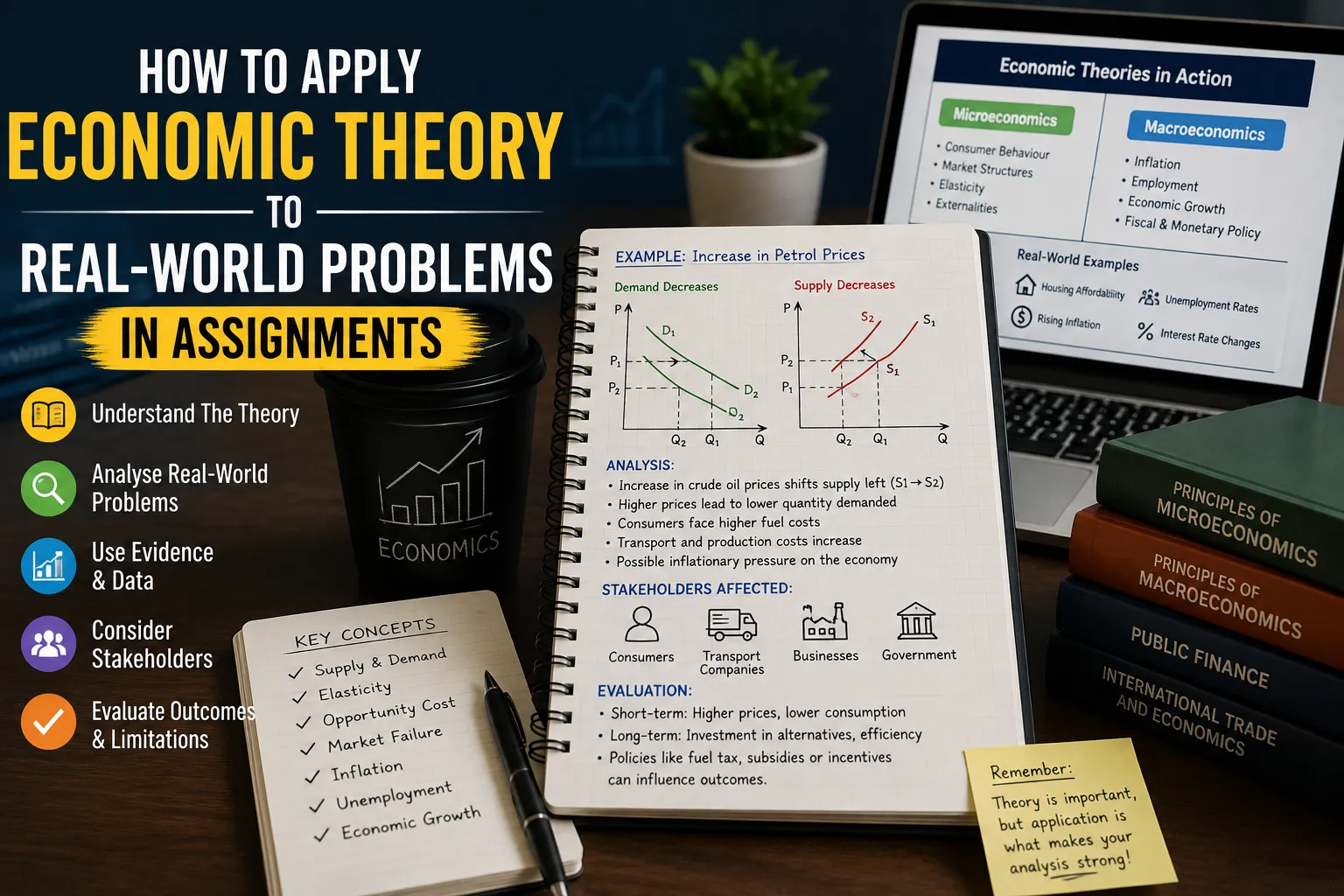
Using Real World Examples in an Economics Assignment
Real world examples can make an economics assignment more interesting and easier to understand.
Start by introducing the economic concept.
Then describe the real world situation.
Identify whether supply, demand or both have changed.
Explain what caused the change.
Discuss how the change could affect price and quantity.
Finally, connect the example back to the economic concept.
For example, when explaining demand, you can discuss how hotel prices increase during a major holiday because more people want accommodation while the number of available rooms is limited.
This approach demonstrates both theoretical knowledge and practical understanding.
Students working on economics assignments can use platforms such as assignmentdude as part of their academic preparation, especially when they want to improve the clarity and structure of their written explanations.
Quick Comparison of Supply and Demand
Supply describes the quantity sellers are willing to provide.
Demand describes the quantity consumers are willing and able to purchase.
Businesses generally influence supply through production decisions.
Consumers largely influence demand through purchasing decisions.
Supply can be affected by production costs, technology, weather and available resources.
Demand can be affected by income, preferences, trends, population and prices of related products.
When demand rises while supply remains limited, prices may increase.
When supply rises while demand remains unchanged, prices may decrease.
These relationships provide a basic framework for understanding market behavior.
Practice Situations for Students
Try identifying what is happening in each situation.
A heatwave causes more students to buy cold drinks.
A poor harvest reduces the availability of vegetables.
A new factory increases smartphone production.
A popular concert sells out within a few hours.
A fashion trend suddenly becomes unpopular.
A holiday increases demand for hotel rooms.
A transportation strike reduces the availability of certain products.
A large discount encourages more customers to purchase a product.
These situations can be analyzed using the same basic questions.
Has demand changed
Has supply changed
What caused the change
How could consumers respond
How could sellers respond
What could happen to price
Thinking through these questions is a useful way to develop economic reasoning.
Frequently Asked Questions
What is supply in economics?
Supply refers to the quantity of goods or services that sellers are willing and able to provide at different prices. Supply can be affected by production costs, technology, weather, available resources and the number of businesses operating in a market. Understanding supply helps explain why the availability of products can change over time.
What is demand in economics?
Demand refers to the willingness and ability of consumers to purchase goods or services. Demand can change because of price, income, consumer preferences, population, trends, seasonal conditions and expectations about the future. A person's desire to purchase something becomes economic demand when they also have the ability to buy it.
What is the law of demand?
The law of demand describes the general relationship between price and quantity demanded. When the price of a product increases, consumers generally tend to purchase less of it when other conditions remain similar. When the price decreases, consumers generally tend to purchase more. However, real consumer behavior can also depend on several other factors.
What is the law of supply?
The law of supply describes the general relationship between price and the quantity sellers are willing to provide. When prices increase, producers may have a stronger incentive to supply more because of potential higher revenue. When prices fall, production may become less attractive. Other factors such as production costs and technology can also influence supply.
What is market equilibrium?
Market equilibrium is a situation where the quantity consumers want to purchase is equal or close to the quantity sellers want to provide at a particular price. At this point, the market is relatively balanced. Changes in supply or demand can move the market away from this balance and create changes in price or quantity.
Why do prices increase when supply decreases?
When supply decreases while demand remains strong, fewer products are available for consumers. If many people still want to purchase the product, limited availability can create scarcity. Sellers may therefore charge higher prices. Examples include products affected by poor harvests, production problems or temporary transportation disruptions.
Why does demand affect prices?
Demand affects prices because businesses consider how strongly consumers want a product when making pricing and production decisions. When many consumers want a limited quantity of a product, prices may rise. When fewer consumers want a product and supply is plentiful, businesses may reduce prices to encourage purchases.
What are real world examples of supply and demand?
Examples can be found in vegetable markets, hotel rooms, concert tickets, smartphones, transportation, housing, restaurants, clothing and agricultural products. For example, hotel prices may increase during holidays because demand becomes stronger while the number of available rooms remains limited.
How does supply and demand affect businesses?
Businesses use supply and demand to make decisions about production, inventory and pricing. If demand increases, a business may increase production or stock more products. If demand falls, it may reduce production or offer discounts. Understanding market conditions can help businesses avoid shortages and excess inventory.
Why should students learn supply and demand?
Students should learn supply and demand because these concepts explain many everyday economic situations. They can help students understand why prices change, why products become scarce and how businesses respond to customers. These concepts are also useful for economics assignments, business studies and understanding basic market behavior.
Final Thoughts
Supply and demand may appear to be simple textbook concepts, but they influence countless decisions in everyday life.
The price of vegetables, the availability of concert tickets, hotel room prices, smartphone discounts, transportation costs and housing rents can all be connected to changing market conditions.
The key is to look at what is happening on both sides of the market.
Are consumers demanding more or less
Are sellers providing more or less
What caused the change
How might consumers react
How might businesses respond
Once you start asking these questions, economic situations become easier to understand.
Supply tells us about the availability of goods and services from sellers.
Demand tells us about the willingness and ability of consumers to purchase them.
Their interaction helps explain changes in prices and quantities across many different markets.
For students, the best way to understand these concepts is to connect theory with real life.
Look at the prices around you.
Notice when products become scarce.
Pay attention to discounts.
Observe what happens during holidays and seasonal changes.
These everyday observations can turn a difficult economics topic into something practical and understandable.
Supply and demand are not just concepts to remember for an examination. They are useful tools for understanding how markets work and why economic decisions affect the products and services people use every day.
































Sign in to leave a comment.