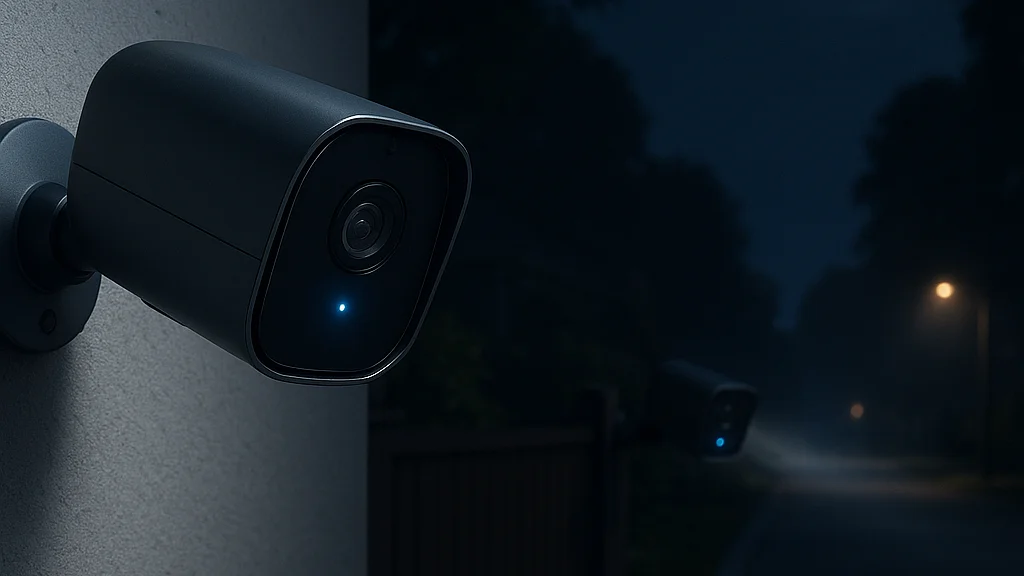

A remote worker closes her laptop in a backyard studio at dusk, glances at a phone notification, and sees the perimeter gate 2,800 feet away in crisp detail. That scene used to belong to ranches, warehouses, and utility sites with dedicated IT budgets. Now it is drifting into the mainstream for home offices, small businesses, rural properties, and distributed teams that need eyes on detached garages, workshops, barns, driveways, parking lots, and satellite storage areas. The phrase wireless security camera still makes many buyers think of a battery-powered camera on a suburban porch. But the more interesting story in 2026 is range—real range—and the networking choices that make it possible.
If you have been researching this category, you have probably seen bold distance claims splashed across product pages. Some are technically true under ideal conditions and almost useless in practice. Others point to a genuine shift in the market: cameras paired with point-to-point radios, solar power, 4G or 5G connectivity, Wi-Fi HaLow, and purpose-built long-range bridges can now be installed over half a mile away from the main building without trenching Ethernet. For remote workers, that matters more than it first appears. A secure detached workspace is only productive if it is reliably monitored, especially when it sits at the edge of a large property or in a semi-rural location with weak conventional Wi-Fi.
Silicon Valley loves to talk about distributed work as if it begins and ends with Slack threads and calendar tools. The physical layer gets less attention. Yet productivity is deeply tied to trust, visibility, and reduced friction. If you are constantly wondering whether packages are sitting exposed at a roadside gate, whether a detached office was left unlocked, or whether a storage shed near your studio has been tampered with, your focus gets shredded. As the old management line goes, what gets measured gets managed. I would tweak that for this category: what gets seen gets secured.
For readers who want a broader primer before going deep, WriteUpCafe has already covered the basics in How to Get Started With Long-Range Wireless Security Cameras and in the companion piece Wireless Security Cameras You Can Install Half a Mile Away. What follows here is the bigger picture—how these systems actually work, where the marketing gets slippery, what changed recently, and how to choose a setup that supports both security and day-to-day productivity.
“Distance claims are easy to print on a box. Reliable video over distance is an engineering problem.”
Why half-mile camera installs suddenly matter to remote work
The rise of detached workspaces is not anecdotal anymore. Hybrid and fully remote arrangements pushed many professionals to carve out office space in backyard ADUs, converted barns, guest houses, workshops, and garages. At the same time, small e-commerce operators, consultants, creators, and tradespeople started running inventory, equipment, or shipping operations from the same properties. The result is a new security map. The front door is no longer the only point that matters. The outer gate, the long driveway, the detached office, and the package drop area have become part of the workday.
That change helps explain why long-range wireless surveillance has moved beyond niche industrial use. A camera that can operate half a mile away solves a very specific productivity problem: it removes the need to physically check distant parts of a property. If you have ever interrupted a client call to investigate a vehicle at the gate or walked across acreage to verify a delivery, you know how expensive those interruptions feel. The camera is not just a security device—it is a context-switch prevention tool.
Industry data reinforces the broader direction. According to the U.S. Bureau of Labor Statistics and Census Bureau reporting trends over recent years, remote and hybrid work remain materially above pre-2020 levels, even after some corporate pullbacks. Analyst firms such as IDC and Gartner have also continued to document growth in edge devices, AI-enabled video analytics, and cloud-managed physical security. Those trends converge neatly in long-range camera deployments: more distributed work, more smart monitoring, less appetite for expensive cabling.
Another force is cost. Trenching cable over 2,640 feet can become the most expensive part of a project once labor, conduit, permits, and restoration are included. Wireless bridges often cut that dramatically, especially when line of sight is available. Add solar panels and cellular backup, and even a remote gate or field entrance becomes practical to monitor. That is why the phrase “install over half a mile away” has traction—it speaks to the economics as much as the technology.
- Detached offices: backyard studios, ADUs, converted garages, and guest houses.
- Large residential lots: long driveways, gated entrances, and outbuildings.
- Micro-business properties: inventory sheds, workshops, parking pads, and shipping areas.
- Rural work settings: farms, ranches, cabins, and remote client sites.
- Mixed-use properties: home plus business operations on the same land.
The practical takeaway is simple: the camera market is adapting to how people actually work. Not just where they sleep, but where they create, ship, store, and meet.
What “wireless” really means when the camera is half a mile away
This is where buyers can get tripped up. A long-range wireless camera is rarely a single magical device that talks directly to your home router from 2,640 feet away while streaming flawless 4K video through trees and walls. More often, the system includes multiple components: the camera itself, a network transport method, a power strategy, and storage or cloud access. Understanding those layers is the difference between a smart purchase and a frustrating weekend project.
The first model is the wireless bridge setup. Here, the camera sits near a point-to-point or point-to-multipoint radio pair that extends the local network across distance. This is common with Ubiquiti-style links and other outdoor radios used in farms, campuses, and commercial yards. The camera may be PoE-powered from a local enclosure while the bridge handles the backhaul. If there is clear line of sight, this approach can be extremely stable and can support multiple cameras.
The second model is cellular-connected cameras. These use 4G LTE or 5G rather than your property Wi-Fi. They are attractive when there is no viable network path from the main building, though they introduce monthly data costs and can be constrained by signal strength or carrier congestion. For low-traffic monitoring of gates or infrequently accessed outbuildings, cellular can be a clean answer—especially when paired with motion-triggered recording.
A third path is sub-GHz or specialized long-range wireless, including emerging Wi-Fi HaLow products in some markets. HaLow operates in lower-frequency spectrum than traditional Wi-Fi, which can improve range and penetration while sacrificing some throughput. In security use, that trade-off can make sense for efficient video delivery and sensor integration, though the ecosystem is still far smaller than standard Wi-Fi or bridge-based networking.
Power is the other half of the equation. Batteries alone are often fine for event-based clips, but a half-mile deployment usually benefits from solar charging, local AC power, or a protected PoE source. Continuous recording, night vision, onboard AI analytics, and cold-weather operation all increase power demand. A camera may be “wireless” for data while still requiring thoughtful power engineering.
- Data path: bridge radio, cellular modem, or long-range protocol.
- Power source: battery, solar, AC, or PoE from a local enclosure.
- Storage model: SD card, NVR, cloud subscription, or hybrid recording.
- Mounting environment: line of sight, weather exposure, temperature swings, and vandal risk.
- Management layer: mobile app, web dashboard, alerts, and user permissions.
If you want another angle on this distinction, WriteUpCafe’s Wireless Security Cameras You Can Install Over Half a Mile Away does a good job of framing how system design matters more than a headline spec. That is the right mindset. Range is not a single feature. It is an architecture.
“The best long-range camera is not the one with the biggest advertised number. It is the one that keeps a dependable link on your worst weather day.”
The hard limits: line of sight, bandwidth, weather, and law
Here is the less glamorous part of the story, and it is the part that saves money. Half-mile installs live or die on environmental realities. A spec sheet may mention 3,000 feet, 5,000 feet, or even farther, but those numbers often assume ideal line of sight, low interference, favorable antenna placement, and limited obstacles. A stand of trees, a metal outbuilding, a hill, or a busy RF environment can collapse performance quickly. This is why site surveys matter so much more than brand loyalty.
Line of sight is king for bridge-based systems. Even partial obstruction can degrade throughput or create intermittent drops that are maddening to diagnose. Fresnel zone clearance—the radio path around the direct line between antennas—also matters at distance, though many consumer buyers never hear the term until something fails. In plain English: a few branches in the way may be more harmful than they look.
Bandwidth needs are also widely misunderstood. A single 1080p camera with efficient compression may be manageable over modest links, especially for motion-based recording. But stack multiple cameras, add 2K or 4K resolution, enable continuous recording, and rely on cloud uploads, and the link budget changes fast. According to Axis Communications guidance and broader video surveillance best practices, frame rate, codec choice, scene complexity, and retention requirements all shape network load. That is why the most successful long-range deployments often prioritize smart placement and narrower fields of view over brute-force resolution.
Then there is weather. Rain fade is more associated with higher-frequency links, but all outdoor deployments face thermal stress, moisture ingress, wind movement, and lightning exposure. A mount that shifts slightly in a storm can misalign a directional radio enough to degrade performance. Solar-powered systems face winter daylight constraints. Batteries lose efficiency in cold conditions. Dust and insects find their way into enclosures. None of this is dramatic. All of it is real.
Privacy and legal compliance deserve equal attention. In the United States, outdoor camera laws vary by state and context, especially around audio recording. A camera pointed at your gate is one thing; a microphone capturing conversations beyond your property line can become a different issue. If your remote office handles client visits or contractor traffic, signage and policy may be wise. Security that creates legal risk is a bad bargain.
- Best-case environment: clear line of sight, stable mounting, modest bandwidth demand.
- Typical trouble spots: trees, metal siding, terrain changes, and neighboring Wi-Fi congestion.
- Overlooked costs: mounts, weatherproof boxes, surge protection, solar sizing, and data plans.
- Common compliance issue: recording audio where consent rules apply.
The broader lesson is refreshingly old-school: measure twice, mount once. Long-range camera success is won before the first alert ever hits your phone.
What changed recently in 2026—and why buyers have better options
The 2026 market is meaningfully better than it was just a few years ago, though not because one brand solved everything. Improvement has come from several overlapping advances. First, on-device AI has become more useful and less gimmicky. Person, vehicle, animal, and package detection are now common across a wider price range, reducing unnecessary clips and saving bandwidth. For a camera half a mile away, fewer false alerts are not just a convenience—they make the entire system feel trustworthy enough to integrate into your work routine.
Second, battery and solar ecosystems have matured. More vendors now offer larger solar panels, better charge controllers, and smarter sleep scheduling. That matters on remote gates and detached structures where running power is painful. Some newer systems can stay active longer under mixed weather conditions by combining event-triggered wake cycles with efficient encoding. Reports from installers and product reviewers suggest this has made off-grid monitoring viable for more small-property use cases than in the early 2020s.
Third, 5G fixed wireless and broader rural broadband expansion have created more backhaul choices. Availability is uneven, and plenty of areas still struggle, but the menu is wider. A remote worker with a detached office may now have fiber in the main house, a point-to-point bridge to the outbuilding, and cellular failover at the gate. That kind of layered setup used to feel enterprise-grade. Now it is increasingly accessible to prosumers and small-business owners.
Fourth, software has improved. Cross-device dashboards, better event timelines, and faster clip retrieval reduce the friction that used to plague camera apps. This is where the productivity angle becomes tangible. If it takes 45 seconds and three taps to verify that a courier arrived, you will stop checking. If it takes five seconds and the app reliably jumps to the event, the camera becomes part of your operational rhythm.
There is also more buyer education in the market. Articles like Install Wireless Security Cameras Over Half a Mile in 2026 and Wireless Security Cameras That Work Over Half a Mile reflect a maturing conversation. People are asking better questions: What is the backhaul? Is there line of sight? What is the winter power budget? Can the system keep recording if the internet drops? Those are the questions that produce durable installs.
According to analyst commentary from firms such as Omdia and IDC, the physical security sector continues to benefit from AI analytics, cloud management, and edge processing. Yet the most important recent development for ordinary buyers may be simpler: long-range surveillance is no longer treated as exotic. It is becoming a normal design choice for properties that double as workplaces.
How to choose the right long-range setup for a home office or small business
My favorite buying framework for this category begins with a blunt question: what decision do you need the camera to help you make? If the answer is “I need to know whether someone is at the front gate before I interrupt a meeting,” that points to a different setup than “I need evidentiary footage of a detached workshop overnight.” The first can tolerate event-based clips and cellular latency. The second may demand continuous recording, stronger illumination, and redundant storage.
Start with the site map. Measure actual distances. Note elevation changes. Identify obstacles by season, not just today—summer foliage can transform a link that looked perfect in winter. If you are connecting a detached office to the main house, ask whether a bridge can serve both security and productivity by extending network access for calls, backups, and collaboration tools. That is often the smartest budget move because one infrastructure project supports multiple outcomes.
Next, decide whether you are solving for visibility, deterrence, or evidence. A visible camera with a spotlight can deter opportunistic trespassers. A discreet camera with better dynamic range may capture plates or faces more effectively. If your workday involves deliveries, choose reliable motion zones and package or vehicle detection over headline resolution. If you store tools or inventory, prioritize retention, tamper alerts, and local recording.
Then think operationally. Who will receive alerts? How quickly can someone respond? Does the app support shared access for family members, coworkers, or property managers? Remote work has normalized asynchronous coordination, and your camera system should fit that rhythm. A good setup routes the right alerts to the right people without turning everyone into an anxious dispatcher.
- For a distant gate: cellular or solar camera, strong vehicle detection, wide dynamic range, optional spotlight.
- For a detached office: point-to-point bridge, stable power, integrated network extension, continuous recording if needed.
- For a barn or workshop: weatherproof enclosure, local storage backup, better night performance, tamper resistance.
- For a long driveway: narrower field of view, optical zoom if available, careful placement for plate visibility.
Budget realistically. The cheapest camera is rarely the cheapest system once you add mounts, solar hardware, radios, subscriptions, and troubleshooting time. I tell clients to price the install as a workflow improvement, not just a gadget purchase. If it prevents missed deliveries, cuts false alarms, and saves several interruptions a week, the return can be surprisingly fast.
As Peter Drucker famously said, “Efficiency is doing things right; effectiveness is doing the right things.” For long-range cameras, effectiveness means designing around your actual property and work habits—not around a marketing claim.
Real-world use cases where long-range cameras pay off
Consider the consultant who works from a converted studio behind the main house on a two-acre property. The driveway entrance is far enough away that doorbell cameras are irrelevant. Clients occasionally arrive early, couriers leave equipment near the gate, and service vehicles come and go during business hours. A long-range camera at the entrance, using either a bridge or cellular connection, becomes a scheduling assistant as much as a security layer. The consultant sees arrivals instantly, avoids awkward missed handoffs, and stays in flow during calls.
Another scenario is the solo e-commerce operator. Inventory sits in a detached garage 2,500 feet from the residence, and pickups happen in a separate loading area. Here, a multi-camera setup over a wireless bridge can monitor the stock room, driveway, and handoff zone while also extending usable internet to label printers and laptops in the outbuilding. That is a perfect example of security infrastructure doing double duty for productivity. One network decision supports both surveillance and daily operations.
Rural professionals are another strong fit. Architects, therapists, designers, and accountants working from country properties often have sparse lighting, long access roads, and detached offices that feel wonderfully peaceful until a package goes missing or a stranger pulls up. A half-mile-capable camera system reduces that uncertainty. The psychological benefit is easy to underestimate. Focus improves when your environment feels legible.
There is also a resilience angle. During outages or internet disruptions, local recording or cellular backup can preserve visibility into critical areas. If your detached workspace contains expensive equipment or client records, that continuity matters. According to installer best practices commonly discussed across the security industry, redundancy is often the dividing line between “nice to have” and “mission critical.”
The best systems are boring in the best possible way. They do not demand attention. They quietly remove friction from the edges of the day—verifying a delivery, confirming a visitor, checking a gate, reviewing an overnight alert, or sharing a clip with a contractor. For remote workers, that is the hidden value proposition. Security is not just about bad events. It is about preserving concentration.
“Peace of mind is productive. Every avoided interruption is time returned to meaningful work.”
What to watch next: smarter radios, better edge AI, and simpler installs
The next phase of long-range wireless cameras will probably be less about dramatic distance leaps and more about reducing complexity. Buyers do not need more grandiose box claims. They need systems that are easier to align, easier to power, easier to maintain, and easier to trust. Expect more products that bundle camera, solar, battery, and long-range connectivity into cleaner kits aimed at small properties rather than enterprise campuses.
Edge AI will keep improving, especially for filtering events before they consume bandwidth. That is a big deal for half-mile deployments where every unnecessary upload is wasteful. We are also likely to see more practical crossover between security networking and general connectivity, with bridge systems designed to support both cameras and remote office internet in one package. For anyone building a serious backyard office or rural workspace, that convergence is exciting—one install can support Zoom calls, file sync, and perimeter awareness.
Watch the lower-frequency wireless space as well. Wi-Fi HaLow has not become universal, but it remains one of the more intriguing options for longer-range, lower-power connections. Broader ecosystem support could make it more relevant for mixed sensor-and-camera deployments over the next few years. At the same time, cellular cameras will benefit if carriers continue expanding rural coverage and fixed wireless alternatives.
The practical advice for 2026 buyers is to resist both hype and cynicism. Yes, some range claims are inflated. No, the whole category is not smoke and mirrors. Properly designed systems really can monitor areas more than half a mile away, and for remote workers that can translate into tighter routines, fewer interruptions, and stronger control over the spaces where work actually happens.
If you are evaluating options now, start with the property map, define the work problem you are solving, and choose the network path before you obsess over megapixels. That order matters. A dependable 2K stream from the right location beats an unstable 4K stream every single time. Security should fade into the background and support your day—not become another side project. Or, to borrow from Maya Angelou, “Nothing will work unless you do.” In this case, the system only works if the planning does.





























Sign in to leave a comment.