
A quiet revolution is happening in the walls around us. Not in a glossy, futuristic way, but in the humble choices that decide whether a home leaks heat, traps carbon, sheds toxins, or ages gracefully for fifty years. Buildings and construction remain one of the world’s largest sources of energy-related emissions, and that reality has pushed architects, builders, manufacturers, and homeowners to ask harder questions about materials. The old checklist of price, strength, and availability is no longer enough. A smarter one now includes embodied carbon, repairability, moisture performance, indoor air quality, and what happens when a product reaches the end of its life.
That shift matters because a green home is not simply a house with solar panels and a bamboo floor. It is a system. The framing, insulation, windows, adhesives, cladding, roofing, mechanical equipment, and even finish materials interact over decades. A high-performance wall assembled with the wrong vapor profile can trap moisture. A low-carbon insulation paired with thermal bridges can underperform. A beautiful natural material shipped halfway around the world may carry a larger footprint than a less romantic local option. Good intentions help, but strategy is what turns sustainability into measurable results.
Homeowners who want a practical starting point may find it helpful to pair this guide with Green Building Materials for Smarter Eco-Friendly Homes and Inside Green Building Materials and Eco-Friendly Homes, both of which frame the broader conversation well. Here, I want to go further: beyond the basics, into the advanced decisions that separate a merely efficient home from a durable, low-impact, genuinely healthy one.
The most sustainable material is not automatically the newest one. It is the one that performs well, lasts a long time, and fits the climate, budget, and assembly around it.
That may sound simple. It rarely is. But there is something reassuring in that complexity too. Better homes are built from a series of thoughtful choices, and thoughtful choices are still available to ordinary people.
Start with whole-life carbon, not marketing labels
The biggest mistake in green material selection is treating products as isolated heroes. A recycled-content countertop can be a fine choice, but it does not outweigh a carbon-heavy structural system or an envelope that wastes energy for decades. Advanced strategy begins with whole-life carbon assessment: embodied carbon from extraction, manufacturing, transport, installation, maintenance, and end-of-life, plus the operational emissions that flow from heating, cooling, and ventilation over time.
That is why the conversation has shifted toward environmental product declarations, or EPDs. These standardized documents are not perfect, but they are far more useful than vague claims like “eco-conscious” or “planet friendly.” They allow designers to compare concrete mixes, insulation types, gypsum boards, and cladding systems with more discipline. In 2026, that level of scrutiny is becoming less niche. Lenders, developers, municipalities, and institutional buyers increasingly want evidence, not mood boards.
Industry tracking points to why this matters. A Yahoo Finance industry report on green building materials highlighted a competitive field that includes Amvic, PPG Industries, Alumasc, BASF, Binderholz, GreenPatch, and Owens Corning, reflecting how mainstream low-impact material innovation has become. Scale is arriving, and with scale comes a better chance of lower costs and more transparent product data.
Still, whole-life carbon is not just about swapping one product for another. It often rewards restraint. Renovating an existing structure can preserve a large share of embodied carbon already invested in foundations, framing, and shell components. Designing for smaller floor area reduces material demand immediately. Using modular dimensions can reduce offcuts. Choosing mechanical fasteners over permanent adhesives can improve future disassembly and reuse.
- Prioritize avoided emissions first: reuse foundations, framing, brick, or timber where safe and feasible.
- Compare assemblies, not single products: a low-carbon wall that fails moisture control is not sustainable.
- Request EPDs and third-party certifications: they are more meaningful than broad environmental claims.
- Consider service life: a product replaced every 12 years may have a larger footprint than one lasting 40.
When clients ask me what counts as “advanced,” this is often the answer: not a miracle material, but the discipline to evaluate trade-offs over the full life of the home.
Rethink the structure: timber, low-carbon concrete, and hybrid systems
Structure is where carbon stakes get serious. Conventional concrete and steel remain essential in many contexts, yet they are also among the most emissions-intensive materials in construction. That has made structural strategy one of the most consequential frontiers in eco-friendly housing. The aim is not ideological purity. It is selective substitution, material efficiency, and better engineering.
Mass timber and advanced wood systems continue to gain attention because they can store carbon while reducing reliance on more intensive structural materials. According to dw’s report on eco-friendly homes built from wooden building blocks, modular wood-based systems are improving construction speed and precision while lowering waste on site. Those benefits are especially relevant in cold climates, where controlled factory production can improve airtightness and reduce weather-related delays.
Wood, of course, is not automatically sustainable. Forestry practices, adhesives, fire design, pest exposure, and moisture management all matter. Responsibly sourced timber with clear chain-of-custody documentation is a very different proposition from poorly managed extraction. In some regions, hybrid systems make more sense: timber floors over low-carbon concrete podiums, or optimized steel elements used only where spans or loads require them.
Concrete itself is also changing. Cement substitution with supplementary cementitious materials, lower-clinker formulations, carbon mineralization approaches, and mix optimization are all moving from pilot territory into wider use. Availability remains uneven, but advanced clients now ask not just for “concrete,” but for the lowest-carbon mix that still meets structural and durability requirements. That single procurement question can have an outsized effect.
Australia’s experimental edge offers a glimpse of where things may go next. The Guardian reported on algae bricks and oyster shell walls as part of a broader wave of bio-based and waste-derived building materials. Not all of these will become mainstream in housing, and some are still early-stage. But they signal a deeper trend: structural and envelope materials are being redesigned around circularity, local waste streams, and lower embodied emissions.
Advanced green building is less about chasing a single wonder product than about using high-impact materials only where they are truly needed.
That framing leads to better homes. It also tends to produce calmer budgets, because efficiency in material use often saves money alongside carbon.
The building envelope is where performance is won or lost
If structure sets the carbon baseline, the envelope determines whether a home performs beautifully or expensively disappoints everyone. Walls, roof, slab, windows, doors, membranes, and insulation work together to control heat flow, air leakage, bulk water, vapor movement, and solar gain. Advanced strategy means designing these layers as one coordinated system, tailored to climate.
In a heating-dominated place like Calgary, where I live, continuous exterior insulation, careful air sealing, and high-performance windows can transform comfort as much as energy use. The same principle applies elsewhere, though the exact assembly changes. Hot-humid climates need different drying strategies than cold-dry ones. Marine zones demand special attention to rain screens and moisture resilience. A material that performs well in one region may become risky in another.
Cellulose, wood fiber insulation, mineral wool, and certain cork applications are receiving more attention because they can offer lower embodied carbon than conventional options while supporting strong thermal performance. Yet advanced selection goes beyond R-value. Install quality, settling risk, fire performance, moisture buffering, density, and compatibility with air and vapor control layers all matter. A wall with excellent nominal insulation can still underperform if thermal bridges remain at balconies, slab edges, rim joists, or window perimeters.
Windows deserve special seriousness. Triple glazing, insulated frames, warm-edge spacers, and climate-specific solar heat gain coefficients can dramatically reduce heating demand and interior condensation risk. But oversized glazing, especially west-facing, can create summer overheating that a green home then has to solve with more mechanical cooling. Good design is often a lesson in moderation.
- Model the assembly: use energy and hygrothermal analysis where possible, especially for unconventional wall systems.
- Target airtightness early: plan the continuous air barrier on drawings, not on site under pressure.
- Reduce thermal bridges: balconies, slab edges, and window interfaces are frequent weak points.
- Choose insulation for the assembly: compare carbon, moisture behavior, fire performance, and durability together.
- Design for passive survivability: homes should remain habitable during heat waves or outages.
For readers following newer product trends, Green Building Materials and Eco-Friendly Homes: Innovations in 2026 offers a useful companion snapshot. The larger truth, though, is wonderfully unglamorous: tape lines, flashing details, and continuity drawings can do as much for sustainability as any headline-grabbing material launch.
Healthy interiors require low-toxicity materials and moisture discipline
Eco-friendly homes are often discussed in carbon terms first, but health deserves equal billing. Indoor air can be affected by volatile organic compounds from paints, sealants, composite wood products, flooring, cabinetry, and cleaning products. Moisture problems can then amplify the harm by feeding mold growth, dust mites, and material breakdown. A home that is efficient but chemically harsh or chronically damp is not a success story.
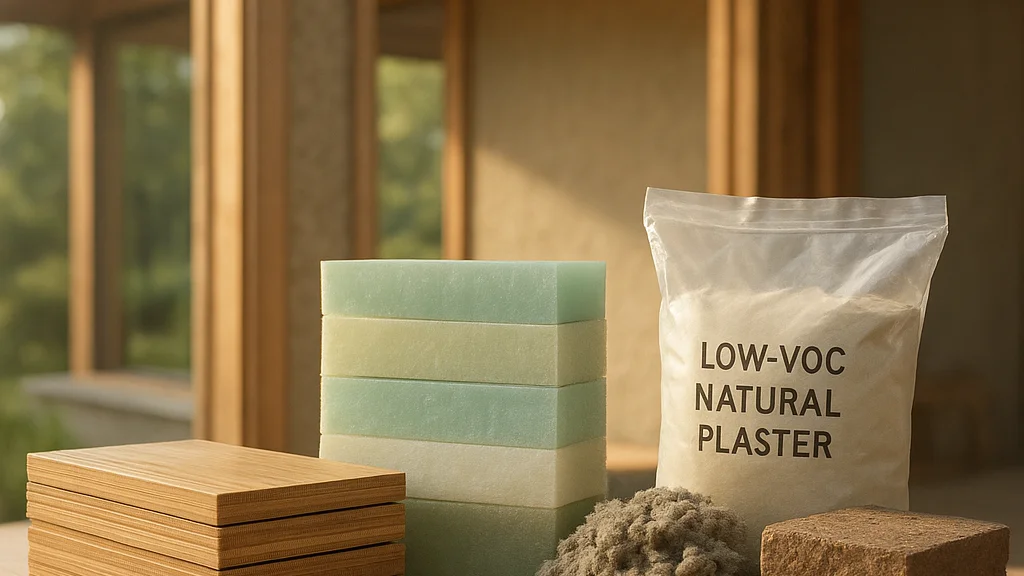
Advanced material strategy therefore looks closely at finishes and hidden components alike. Low-VOC paints are now common, but adhesives, underlayments, cabinetry cores, spray foams, and waterproofing products can still introduce problematic emissions. Formaldehyde-free or ultra-low-emitting composite products are increasingly available. So are natural plasters and lime-based finishes that help regulate humidity while avoiding some petrochemical inputs, though they require proper detailing and skilled installation.
Recent industrial developments suggest this category is expanding. The Hindu reported on a joint venture between Coromandel Chemicals and Sakarni Plaster to produce green building materials, a reminder that lower-impact interior and wall products are no longer confined to boutique suppliers. Manufacturing investment matters because healthier products only change the market when they are available at scale.
Ventilation is the other half of the health equation. As homes become more airtight, they need balanced fresh-air systems with filtration, sensible humidity control, and commissioning that verifies actual performance. Heat recovery ventilators and energy recovery ventilators are not glamorous dinner-party topics, but they quietly shape sleep quality, respiratory comfort, and resilience during smoke events. In many regions, wildfire smoke has changed the conversation entirely. Filtration and airtightness are now climate adaptation tools as much as energy tools.
- Specify low-emission finishes: paints, primers, sealants, flooring, and cabinetry should all be screened.
- Control moisture at the source: drainage planes, flashing, capillary breaks, and ventilation prevent hidden damage.
- Commission ventilation systems: poor balancing can undermine both comfort and efficiency.
- Design for maintenance: replaceable filters and accessible service zones keep healthy homes healthy.
There is a gentle but important lesson here. Sustainability is not only about saving the planet in abstract terms. It is also about making breakfast in a kitchen that does not off-gas sharply, sleeping in a room that stays dry and quiet, and raising children in air that feels clean.
Circularity is becoming a real design principle, not a slogan
For years, circular construction was discussed with a kind of hopeful vagueness. Reuse sounded admirable, but procurement systems, building codes, warranties, and demolition habits often pushed projects back toward linear consumption. That is beginning to change. In 2026, circularity is becoming more concrete through material passports, salvage marketplaces, deconstruction planning, and design-for-disassembly methods that allow parts of a home to be repaired, upgraded, or recovered instead of crushed and landfilled.
Advanced eco-home design asks a few deceptively simple questions early. Can the cladding be removed without destroying the substrate? Are mechanical systems accessible for replacement? Do interior partitions allow adaptation as family needs change? Can standard dimensions reduce waste and make future reuse easier? These choices influence both environmental impact and long-term affordability.
The economic argument is strengthening too. According to International Business Times, greener development can improve profitability when operational savings, market demand, and asset resilience are considered together. That logic extends to homes. Materials that can be repaired or selectively replaced often reduce lifecycle costs, even if their upfront price is higher.
Salvaged timber, reclaimed brick, recycled steel, remanufactured fixtures, and reused cabinetry are all viable in the right project, but advanced practice means treating them as engineered inputs rather than romantic afterthoughts. They need grading, testing, cleaning, and documentation. The same goes for recycled-content products. Recycled content is valuable, yet if a product is impossible to separate at end of life, circularity remains incomplete.
Readers wanting a broader innovation overview can also look at Exploring Green Building Materials and the Rise of Eco-Friendly Homes. What feels most promising to me is not any single trend, but the growing maturity of the conversation. We are moving from “Can we build greener?” to “How do we build greener without creating tomorrow’s waste problem?” That is a healthier question.
2026 is shaping the market through code, finance, and climate pressure
The green home conversation in 2026 is being pushed by more than personal values. Regulation, insurance, financing, and climate risk are all reshaping the economics of material choice. Extreme heat, floods, wildfire smoke, and storm events have turned resilience from a premium feature into a practical necessity. Homes that can maintain safer indoor temperatures during outages, resist moisture intrusion, and recover from disruptions faster are increasingly valued by both buyers and insurers.
Policy is part of that shift. Across multiple markets, building performance standards, embodied carbon reporting pilots, stricter energy codes, and procurement requirements are giving low-impact materials a firmer foothold. The pace varies widely by jurisdiction, but the direction is consistent. Builders who understand carbon accounting, airtightness testing, and low-emission product specification are better positioned than those waiting for old habits to remain profitable forever.
Supply chains are also maturing unevenly. Some products, such as mineral wool, high-performance windows, and low-VOC finishes, are relatively established. Others, including certain bio-based composites, algae-derived materials, and emerging low-carbon binders, are still scaling. That means advanced strategy in 2026 includes risk management: vet lead times, warranty terms, installer familiarity, and local code acceptance before committing to an innovative assembly.
There is another change worth noticing. The language of “green premium” is softening. Not disappearing, but softening. Better air sealing, optimized framing, right-sized mechanical systems, and lifecycle durability can offset some of the cost of higher-performance materials. As more manufacturers enter the market, competition may continue to narrow price gaps. The Yahoo Finance market report points to a sector that is no longer peripheral; it is crowded, competitive, and increasingly investment-backed.
By 2026, the strongest green home strategies are those that combine carbon reduction, occupant health, and climate resilience instead of treating them as separate goals.
That integrated approach is what I would watch most closely over the next few years. The homes that endure will be the ones designed for a warming, less predictable world while still feeling calm to live in on an ordinary Tuesday.
How homeowners and builders can make advanced choices without getting overwhelmed
There is a point in every renovation or new build where the spreadsheets multiply, someone mentions six unfamiliar certifications, and the whole lovely vision begins to feel like emotional admin. This is where priorities help. You do not need to perfect every material decision at once. You do need a sequence that protects the biggest wins first.
For most homes, that sequence starts with reducing demand: compact design, orientation, shading, insulation, airtightness, and high-quality windows. Next comes durable, lower-carbon structure and envelope materials suited to local climate. Then healthy interior specifications, efficient all-electric mechanical systems, and a maintenance plan that keeps performance from drifting over time. Fancy finishes should come after fundamentals, not before them.
Builders can strengthen this process by creating a repeatable green specification package rather than reinventing every project. Standardize a few proven wall assemblies. Build relationships with suppliers who can provide EPDs and emissions data. Train crews on airtightness details. Test completed homes with blower-door verification and ventilation commissioning. In practice, advanced sustainability is often a craft discipline more than a design aesthetic.
Homeowners, meanwhile, should ask direct questions:
- What is the embodied carbon impact of the main structural and insulation choices?
- How will this wall or roof assembly manage drying and moisture over time?
- Which interior products are low-emission, and who verifies that?
- Can major components be repaired or replaced without destructive demolition?
- How will the home perform during smoke events, heat waves, or outages?
Those questions tend to clarify a project quickly. They also reveal whether a team is truly conversant in green building or simply fluent in brochures. If you want another companion read, 2026 Update: Innovations in Green Building Materials and Eco-Friendly Homes adds useful context around recent product shifts.
The encouraging part is this: advanced eco-friendly homes are not reserved for experimental showpieces. They can be row houses, retrofits, laneway homes, farmhouses, and modest family builds. They ask for care, not perfection. They reward patience, good detailing, and honest math. And when they are done well, they feel less like technology demonstrations and more like what a home should have been all along: efficient, healthy, resilient, and kind to the wider world.
If you are planning one, take a breath before the next decision. Then choose the option that will still make sense ten winters from now. That kind of steadiness is its own form of sustainability, and I hope it serves you gently.


























Sign in to leave a comment.