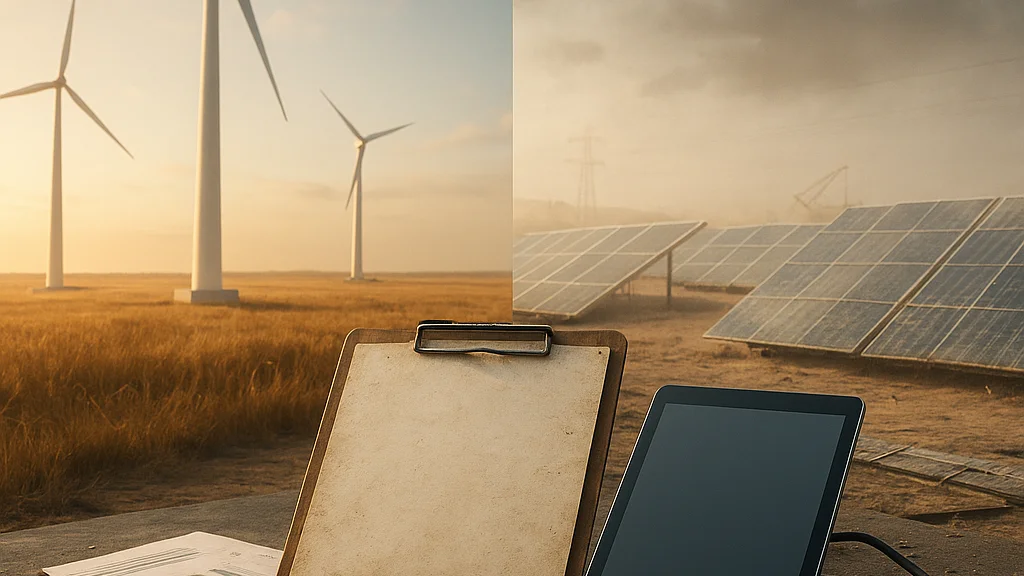

A record buildout can still hide strategic errors
From Barcelona’s tram corridors to the sun-soaked rooftops of Andalusia, the energy transition often looks clean, linear, almost architectural in its elegance. Yet global wind and solar growth is far messier than the glossy charts suggest. The headline numbers are undeniably impressive. Solar and wind have become the dominant source of new power capacity additions in many markets, and according to pv magazine International, they drove the overwhelming share of global power growth in 2025. That should be cause for celebration. It is also a reason for sharper scrutiny.
The central mistake many policymakers, investors, and even commentators make is assuming that capacity growth equals system transformation. It does not. A gigawatt announced is not a gigawatt connected. A solar park commissioned is not necessarily a solar park fully dispatched. A wind farm with excellent nameplate capacity may still underperform economically if transmission is delayed, curtailment rises, or market rules punish variable generation at the wrong hours.
This confusion between installation and integration is now one of the defining weaknesses of the clean power era. According to Ember reporting cited by CBC, wind and solar are reshaping electricity systems, but progress remains uneven and some countries are falling behind on the infrastructure needed to use that power efficiently. The same warning applies globally. Capacity is the visible sculpture, like a Gaudí facade. The hidden load-bearing structure is planning, storage, grid flexibility, permitting, workforce readiness, and market design.
“The future of electricity is wind and solar,” CBC summarized from Ember’s findings, but the future only arrives on schedule when grids, policy, and financing keep pace.
That is why discussions about growth need more precision. If the world wants to avoid expensive missteps, it must stop treating every megawatt as equally useful and every market as equally prepared. The most common mistakes are no longer about whether wind and solar can scale. They already have. The real problem is how often growth is measured badly, planned badly, and politically communicated badly.
Readers looking for the broader expansion picture may want to compare this analysis with Wind and Solar Energy Capacity Growth Worldwide in 2026, which maps the scale of current deployment. Here, the focus is narrower and tougher: where the global buildout keeps going wrong.
Mistake one: treating capacity additions as the same thing as useful generation
The most persistent analytical error is conflating installed capacity with delivered electricity. Wind and solar projects are usually announced in gigawatts, because capacity is easy to market and easy to compare across countries. But power systems run on actual generation over time, not on ribbon-cutting metrics. A country can rank high in annual solar additions and still struggle to reduce fossil generation if those additions occur in regions with weak transmission, low demand alignment, or chronic curtailment.
Politically, capacity figures are seductive. They suggest momentum. Financially, they help support narratives around scale. Operationally, however, they can obscure serious inefficiencies. According to Politifact, wind and solar remain a growing force in the global energy mix, but the distinction between total energy and electricity matters greatly. This is where public debate often gets sloppy. Many claims blend electricity shares, total energy shares, and installed capacity as if they were interchangeable. They are not.
Consider the practical consequences. If a government rewards developers solely for rapid additions, the market may prioritize projects with the fastest path to announcement rather than the highest long-term system value. That can mean oversupply in one node, underinvestment in storage, and weak incentives for hybrid projects that combine solar, batteries, and grid services.
- Installed capacity measures the maximum output a project can produce under ideal conditions.
- Generation measures the electricity actually produced over time, usually in megawatt-hours or terawatt-hours.
- Capacity factor reflects how much a plant generates relative to its maximum possible output.
- System value depends on when and where electricity is delivered, not only how much equipment is installed.
The distinction is especially important in solar-heavy markets where midday power floods the grid but evening demand remains high. Without storage, demand response, or stronger interconnection, capacity can expand while value declines at specific hours. Spain has seen this tension in its own market, where abundant solar is a strength but also a signal that flexibility must scale in parallel.
A megawatt on paper is a promise. A megawatt delivered at the right hour, in the right place, is infrastructure.
That is the first mistake in plain terms: celebrating volume while neglecting usefulness.
Mistake two: underbuilding the grid and overestimating permitting reform
Ask any serious developer what slows renewable growth and the answer is often less glamorous than turbine design or module efficiency. It is wires, substations, interconnection queues, and permits. Around the world, governments have become better at setting targets than at preparing networks to absorb those targets. The result is a paradox: clean energy can be cheap to build, but slow and expensive to connect.
This is not a secondary issue. It is structural. According to reporting carried by Yahoo News Canada and mirrored by MSN, wind and solar have overtaken gas worldwide for new growth in key metrics, but that milestone does not erase the bottlenecks between project approval and full utilization. In Europe, the United States, Latin America, India, and parts of Africa, interconnection delays have become one of the clearest barriers to turning investment appetite into delivered power.
Permitting has become a political slogan, yet real reform is harder than many ministers imply. Shortening timelines requires environmental review capacity, digitalized land records, local consultation frameworks, court resilience, and regional planning coordination. If any of those pieces are missing, “streamlining” often remains rhetorical. Local opposition can also intensify when national governments frame projects as urgent but fail to share benefits with communities.
The mistake here is twofold. First, planners underestimate the lead time for transmission. Second, they assume project-level permitting reform alone can solve system-level congestion. It cannot. A solar plant approved in twelve months still sits stranded if the transmission corridor takes six years.
- Governments announce ambitious renewable targets.
- Developers rush into high-resource zones.
- Interconnection queues lengthen as substations fill up.
- Transmission planning lags behind project pipelines.
- Curtailment risk rises and financing becomes more selective.
- Public officials blame markets, while developers blame policy design.
Barcelona offers a useful urban lesson. Mobility improvements worked best when infrastructure, regulation, and public behavior changed together. Electricity systems require the same choreography. Wind and solar growth cannot be treated as isolated generation projects. They are network projects, land-use projects, and governance projects all at once.
For readers interested in the policy side of acceleration, Expert Tips to Accelerate Wind and Solar Capacity Growth complements this discussion with a solutions-oriented lens. The point here is sharper: ignoring grid timing is one of the costliest mistakes governments continue to make.
Mistake three: copying another country’s success without local system logic
There is a recurring temptation in clean energy policy to imitate the headline winner. If China installs at extraordinary scale, others want Chinese speed. If Spain demonstrates strong solar economics, others want Spanish tariffs. If Denmark optimizes wind integration, others want Danish market outcomes. Yet energy systems are not fashion. They are shaped by geography, industrial structure, weather patterns, grid topology, capital costs, and political institutions.
This is where international comparisons often become misleading. A country with vast desert solar potential, low winter heating demand, and strong transmission corridors can rationally prioritize utility-scale photovoltaics. A country with mountainous terrain, fragmented land ownership, and weak balancing markets may need a very different sequence. Offshore wind, onshore wind, rooftop solar, utility solar, storage, hydro balancing, cross-border trade, and flexible demand all play different roles depending on local conditions.
One common mistake is importing procurement models that worked elsewhere but fail under domestic financing conditions. Another is assuming that low auction prices automatically signal a healthy market. Sometimes they signal unrealistic bids, expectations of future policy rescue, or pressure that later leads to project cancellations. Europe has already seen cases where offshore wind auctions and supply chain inflation exposed the fragility of overaggressive assumptions.
The same problem appears in developing economies where ambitious renewable targets are set without matching currency-risk mechanisms or creditworthy offtakers. On paper, the strategy looks modern. In practice, projects stall because investors cannot price political and payment risk. Capacity targets then become symbolic rather than executable.
- Resource quality differs sharply across markets.
- Grid flexibility varies even within the same region.
- Land and permitting regimes can either accelerate or freeze deployment.
- Domestic manufacturing policy may support resilience or raise short-term costs.
- Electricity demand profiles determine whether solar, wind, storage, or hybrids create the most value.
According to Reuters reporting widely cited across the sector, supply chains and trade policy have become increasingly important to deployment timing. That means policy transfer is even harder now than it was five years ago. The lesson is not that countries should avoid learning from each other. They should. The lesson is that copying outcomes without copying prerequisites creates disappointment.
A useful contrast can be found in Top 5 Wind and Solar Energy Capacity Growth Leaders. The leading countries are not simply those with ambition. They are those whose institutions, financing structures, and grid strategies align more closely with their deployment model.
Mistake four: ignoring storage, flexibility, and demand shaping until curtailment appears
For years, many power plans treated storage as a useful add-on rather than a central pillar. That assumption is now aging badly. As solar penetration rises and wind output creates larger swings across hours and seasons, flexibility is no longer optional. It is the mechanism that converts variable supply into dependable system performance.
The most common planning error is waiting too long. Governments and utilities often approve large volumes of wind and solar first, then confront curtailment, negative pricing, and evening ramp stress later. By that stage, battery procurement, market rule changes, and transmission upgrades become more urgent and more expensive. The smarter route is co-optimization from the start.
This matters especially in 2026 because the economics of batteries have improved enough in many markets to shift project design. Hybrid solar-plus-storage plants are no longer niche experiments. They are increasingly central to competitive procurement and merchant strategy. Yet some regulatory systems still classify generation, storage, and network services in rigid silos, making it harder to unlock the full value stack.
Demand flexibility remains underused as well. Industrial load shifting, smart charging for electric vehicles, thermal storage in buildings, and time-responsive tariffs can all reduce pressure on the grid. As an EV analyst, I see this point repeatedly misunderstood. Electric vehicles are often described only as additional load. In reality, managed charging can absorb midday solar, reduce curtailment, and improve renewable utilization when price signals and grid software are designed properly.
Wind and solar do not fail when the weather changes. Systems fail when planners pretend flexibility can be postponed.
Spain’s solar growth and the broader European push for electrification show why this matters. If millions of EVs charge blindly at evening peaks, they strain the system. If they charge intelligently around renewable abundance, they become part of the solution. The same logic applies to heat pumps, data centers, and industrial electrification.
According to CBC’s coverage of Ember’s analysis, the future electricity mix is increasingly shaped by wind and solar. That makes flexibility the hidden frontier. Capacity growth without flexibility planning is like building a cathedral without considering acoustics. The structure stands, but the experience does not work as intended.
Mistake five: misunderstanding community acceptance and social license
Analysts who focus only on capital flows and engineering often miss the social dimension. Wind and solar projects may be cleaner than conventional generation, but they still occupy land, alter viewsheds, require access roads, and affect local politics. One of the most damaging mistakes in global capacity growth has been treating public acceptance as a communications problem instead of a governance problem.
Communities rarely oppose projects in the abstract. They oppose being ignored, rushed, or asked to bear costs without visible benefits. This is particularly true for onshore wind, large transmission corridors, and utility-scale solar near agricultural or ecologically sensitive land. In Europe, North America, and parts of Latin America, delays increasingly emerge from legal appeals, municipal resistance, and disputes over land use rather than from technology concerns.
The industry sometimes responds with a familiar script: explain climate urgency, present technical studies, promise jobs. Those steps matter, but they are insufficient if local revenue sharing is weak, consultation begins too late, or cumulative impacts are dismissed. Social license has to be built into project economics, not appended as public relations.
There are practical ways to do this better:
- Start consultation before final siting assumptions harden.
- Offer transparent community benefit mechanisms.
- Design agrivoltaic or dual-use models where appropriate.
- Publish realistic timelines instead of overly optimistic ones.
- Coordinate transmission and generation planning to reduce repeated local disruption.
In Spain, debates around land use for renewables have shown that speed and legitimacy must travel together. The European Union’s decarbonization goals create urgency, yes, but urgency cannot erase procedural trust. If anything, it makes trust more valuable. Gaudí understood that beautiful structures still require foundations people believe in. Energy infrastructure is no different.
When developers dismiss local concerns as irrational, they often create the very delay they hoped to avoid. The global lesson is clear: community acceptance is not a soft issue. It is a deployment variable with hard consequences for timelines, financing, and political durability.
What changed recently, and what the world should watch next
The latest phase of wind and solar growth is defined less by whether deployment will continue and more by which systems can absorb it intelligently. The 2025 and 2026 data points are important because they show both success and strain. According to MSN’s coverage of the global shift, wind and solar have crossed a symbolic threshold against gas in key growth comparisons. According to pv magazine International, 2025 marked a period in which solar and wind dominated global power expansion. Those are not marginal developments. They confirm that the center of gravity in new power investment has moved.
Yet 2026 is also exposing the next layer of discipline. Investors are paying closer attention to curtailment risk, interconnection timing, and policy credibility. Governments are increasingly aware that cheap modules or turbines alone do not guarantee affordable electricity if balancing costs rise. Utilities are under pressure to modernize planning tools. Regulators are being pushed to value storage, flexible demand, and grid-enhancing technologies more accurately.
The most important indicators to watch over the next several years are not just annual additions. They include:
- Interconnection queue reform and average connection times
- Transmission build rates and substation expansion
- Battery deployment paired with renewable additions
- Curtailment levels in high-growth markets
- Auction completion rates versus cancellation rates
- Growth in managed EV charging and flexible demand programs
For readers who want a wider market narrative, Global Surge in Wind and Solar Energy Capacity Fuels Clean Power Transition provides that broader framing. My conclusion is more pointed. The era of easy optimism is over. Wind and solar have already won the argument about scalability. Now they must win the argument about system design.
If the world avoids the common mistakes outlined here, the next decade could deliver cleaner, cheaper, and more resilient electricity with remarkable speed. If it does not, the buildout will continue, but with more curtailment, more conflict, and more wasted capital than necessary. Progress is real. So is the penalty for complacency.
The clean power transition does not need less ambition. It needs better execution. That is the difference between capacity growth that photographs well and capacity growth that truly changes how the world runs.
































Sign in to leave a comment.