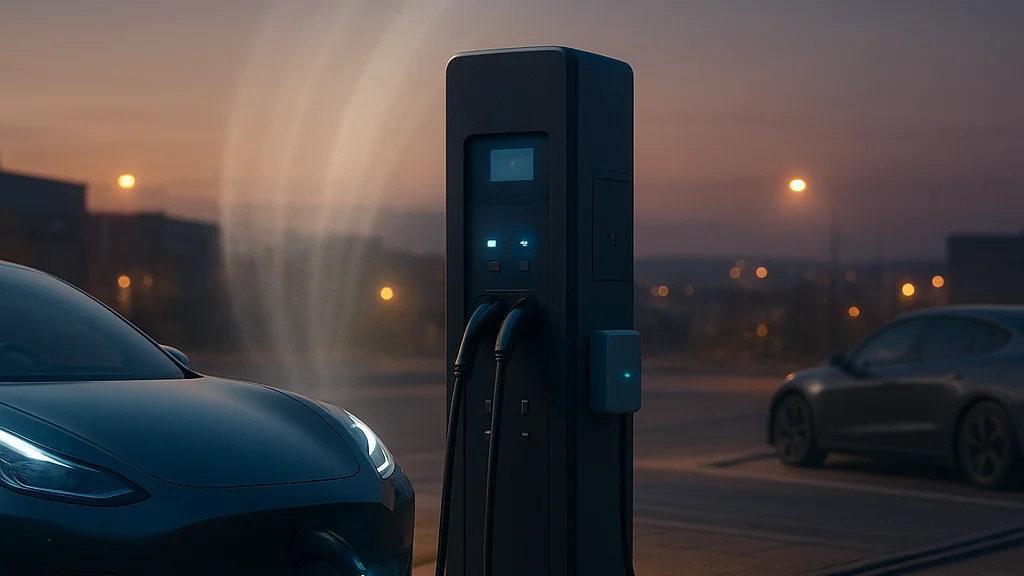

A grid-side revolution is becoming visible on ordinary streets
At a motorway service area in northern Italy, the most revealing sound is no longer the diesel idle of long-distance traffic. It is the soft click of connectors locking into place, the hum of cooling fans inside high-power cabinets, and the quiet impatience of drivers checking charging curves on their phones. That small scene captures a larger transformation: electric mobility is no longer limited by the appeal of the car alone. It now depends on whether charging is available where people live, work, shop, travel, and operate fleets.
The scale of the shift is significant. The International Energy Agency has repeatedly shown that global electric car sales have moved from niche status to mass-market relevance over the past decade, and that charging deployment must accelerate in parallel if adoption is to remain credible. Reuters and BloombergNEF have also reported in recent years that infrastructure bottlenecks, not consumer curiosity, increasingly determine the pace of market expansion in many regions. The question has changed. It is no longer simply, “Will people buy electric vehicles?” It is, “Can charging networks keep pace with vehicle growth, grid constraints, and rising expectations for reliability?”
That is why the current phase matters so much. Public policy, private capital, utilities, oil majors, charge-point operators, automakers, and property owners are now competing to shape the charging map. Some are building ultra-fast corridor networks. Others are focusing on apartment blocks, depot charging, workplace hubs, and destination charging near supermarkets or hotels. The result is a more mature and more contested market than even three years ago.
Readers who want a broader baseline can compare this moment with earlier coverage in Expanding Electric Vehicle Charging Infrastructure: Progress and Prospects and How Electric Vehicle Charging Infrastructure Is Scaling. What is different now is the intensity: infrastructure growth is no longer a supporting story to EV adoption. It is the central story.
Charging infrastructure has become the practical test of whether transport electrification can move from policy ambition to daily habit.
How the market arrived here: from pilot projects to strategic networks
The first phase of EV charging expansion was experimental. Cities installed a limited number of public AC chargers, often with municipal support, to signal environmental intent. Automakers showcased electric models, but range anxiety remained a persistent barrier, especially outside dense urban areas. Home charging did much of the early work because it was convenient and, where off-street parking existed, relatively affordable.
Then the market widened. Battery costs fell over the 2010s, vehicle ranges improved, and governments introduced stricter emissions rules, purchase incentives, low-emission zones, and industrial strategies tied to electrification. Europe pushed hard through CO2 fleet regulations. China built perhaps the most formidable EV ecosystem in the world, combining manufacturing scale with extensive charging deployment. The United States, after a slower and fragmented start, began to mobilize more substantial federal and state support for charging corridors and domestic manufacturing.
Infrastructure strategy also became more sophisticated. Early charging networks often prioritized visibility over utilization. A charger in a prominent square looked progressive, but it did not always solve real demand. More recent investment has become data-led: operators study dwell time, traffic flows, fleet routes, grid connection costs, and local housing patterns. A suburban retail park, a logistics depot, or an apartment complex may deliver more value than a symbolic charger in a civic plaza.
Technology standards have evolved at the same time. Alternating current charging remains essential for homes, workplaces, and long dwell times, but direct current fast charging now defines the competitive edge for intercity travel and high-mileage use cases. Power ratings have increased, software platforms have improved, and payment systems have become more user-friendly, though not uniformly so. Interoperability still varies by country and operator.
Another turning point came when investors understood that charging is not one business but several. Home charging hardware, public fast charging, fleet depot solutions, software management, energy services, and smart charging all follow different economics. That distinction matters because infrastructure growth looks impressive in headlines, yet profitability depends on utilization, electricity procurement, maintenance, and local regulation.
For a more focused look at the recent phase, Electric Vehicle Charging Infrastructure Growth in 2026: Trends and Insights offers a useful companion perspective. The broader lesson is clear: the market matured when charging stopped being treated as a single category and started being built as a layered ecosystem.
The real metrics behind infrastructure growth
Public debate often reduces progress to one number: how many chargers exist. That figure matters, but by itself it can mislead. A city can add hundreds of slow chargers and still leave drivers frustrated on holiday routes. A motorway can install a few ultra-fast units and transform regional confidence. Infrastructure quality is measured not only by count, but by power, uptime, location, queue management, grid resilience, and pricing transparency.
Several metrics are far more revealing than raw charger totals:
- Power mix: the share of AC versus DC fast charging determines whether a network serves overnight convenience, destination charging, or rapid long-distance travel.
- Utilization rate: underused chargers can signal poor siting, while overloaded chargers indicate unmet demand and future investment opportunities.
- Uptime and maintenance: a charger listed on a map but out of service damages trust more than an absent charger.
- Vehicle-to-charger ratio: useful when interpreted carefully, especially by region rather than national average.
- Grid connection lead times: often the hidden bottleneck delaying projects even when funding is available.
According to the Yahoo Finance report on long-term EV market growth, the broader electric vehicle market is expected to expand at a notable pace through 2034. Such forecasts are not guarantees, but they underline the infrastructure challenge: if vehicle sales continue to rise, charging deployment cannot remain linear. It must scale in clusters, with stronger grid planning and better land-use coordination.
Regional variation is equally important. China has continued to dominate global charging expansion in both public and private segments, supported by domestic manufacturing strength and integrated industrial policy. Europe has advanced steadily, but the distribution remains uneven, with leaders such as the Netherlands, Norway, Germany, and France ahead of several southern and eastern markets. In the United States, charging growth has improved, yet reliability and geographic consistency still draw criticism from drivers and analysts.
The market is also splitting into distinct competitive arenas:
- Urban residential charging for households without private driveways
- Highway fast charging for intercity mobility
- Destination charging at retail, hospitality, and leisure sites
- Workplace charging tied to employee retention and ESG strategy
- Depot charging for buses, vans, and commercial fleets
Each arena has different economics. Depot charging, for example, may lack the public visibility of a motorway hub, but it can offer predictable utilization and stronger contracts. The Yahoo Finance industry report on commercial vehicle depot charging highlights how logistics, transit, and delivery electrification is pushing demand for dedicated charging systems. This is crucial because commercial fleets often electrify faster once total cost of ownership becomes favorable and depot operations are redesigned properly.
The decisive metric is not how many plugs exist on paper, but how many drivers and fleet operators can rely on them without friction.
What changed recently: the 2026 picture is more competitive and more complex
By mid-2026, charging infrastructure growth has entered a sharper, more strategic phase. The easy story used to be simple expansion. The current story is competition over standards, speed, customer loyalty, and vertical integration. Automakers are no longer content merely to sell vehicles and leave charging to third parties. Energy companies are not satisfied with fuel retail alone. Grid operators want more say in load management. Property developers increasingly see charging as an asset rather than an amenity.
One of the most telling developments is the rise of charging as a competitive battleground among Asian manufacturers and technology groups. CarsGuide reported on how Chinese carmakers and battery companies, including BYD, CATL, and Nio, are treating charging infrastructure as a strategic frontier. This matters beyond China. It suggests that future vehicle competition may be decided not only by battery chemistry, design, or price, but by access to an integrated charging ecosystem.
Emerging markets are also moving from aspiration to implementation. In Southeast Asia, the Manila Times highlighted the Philippines as a case where charging build-out is increasingly recognized as a prerequisite for sustainable EV adoption. The point is broader than one country. Many middle-income markets no longer ask whether electrification will arrive; they ask how to avoid building a patchy network that limits confidence from the start.
Another 2026 shift is the growing seriousness of uptime and user experience. Drivers have become less tolerant of broken chargers, opaque tariffs, and app fragmentation. This is a healthy sign of market maturation. A decade ago, users accepted inconvenience because the technology felt experimental. Now they expect charging to work with the same reliability they demand from banking apps or public transport ticketing. Operators that fail on maintenance may discover that expansion alone no longer impresses investors or customers.
Policy support remains important, but subsidies are being scrutinized more carefully. Governments increasingly want measurable outputs: operational chargers, equitable geographic coverage, transparent pricing, and integration with renewable energy and grid flexibility programs. In Europe especially, the conversation has moved toward system efficiency, not just headline installation numbers.
The difficult part is not the charger, but the system around it
Installing hardware is often the most visible step and, paradoxically, not the hardest one. The deeper challenge lies in permits, transformer upgrades, land access, software interoperability, electricity pricing, and the choreography between local authorities, distribution network operators, site hosts, and service providers. A beautiful charging hub can be announced in spring and still be waiting for grid connection the following winter.
This is where the sustainability discussion becomes more mature. Charging infrastructure is not green by declaration alone. It must be integrated intelligently with the electricity system. Smart charging, load balancing, on-site solar where feasible, battery storage, and dynamic pricing can reduce peak stress and improve economics. Vehicle-to-grid and vehicle-to-building applications remain uneven in deployment, but they continue to attract attention because parked EVs represent flexible energy assets, not only transport devices.
Apartment living is one of the most underappreciated pressure points, especially in European cities with historic building stock. In Milan, Rome, Barcelona, or Paris, many residents cannot simply install a wallbox in a private garage because they do not have one. This is why curbside charging, shared residential charging, and neighborhood hubs matter so much. The challenge resembles an old Italian urban lesson: infrastructure must respect the fabric of the city. As Renaissance engineers worked within existing walls and canals, modern planners must fit electrification into streets never designed for cables, cabinets, and reserved bays.
For businesses, the equation is similarly layered. A hotel may install chargers to attract guests, but then discover demand spikes on weekends and sits idle on weekdays. A logistics operator may save fuel costs with electrified vans, yet face expensive demand charges if depot charging is not managed carefully. A manufacturer may want employee charging, but must decide whether to subsidize electricity, cap use, or integrate access with building management systems.
These operational questions explain why specialist guidance is becoming more valuable. Fleet operators, in particular, face a different decision tree from private motorists. The internal resource Selecting Electric Vehicle Charging Equipment for Fleets is useful because it reflects this practical distinction. Likewise, for property owners and businesses evaluating installation pathways, Electric Vehicle Charging Point Installation UK: A Complete Guide for Homes and Businesses shows how site-specific charging decisions quickly become technical and regulatory, not merely environmental.
Case studies from different markets show no single model wins everywhere
The most successful charging strategies are local, even when the technology is global. Norway, for example, demonstrated early that strong policy alignment, tax incentives, and dense charging deployment can normalize EV ownership quickly. The Netherlands showed the power of coordinated urban AC charging, especially in areas with limited private parking. China proved that scale, manufacturing integration, and state-backed deployment can accelerate both infrastructure and vehicle adoption at extraordinary speed.
Yet copying any one of these models wholesale is risky. Land costs, utility regulation, driver behavior, housing patterns, and political capacity vary widely. A motorway-focused strategy may work in a country with long-distance travel and detached housing, while a curbside-heavy model may be more logical in dense European cities. Depot charging can transform urban bus systems, but only when route scheduling, dwell time, and grid planning are aligned from the start.
Recent reporting from The Daily Star points to EV demand outpacing some earlier expectations in its market context, a reminder that infrastructure planning often lags real consumer behavior. When adoption surprises on the upside, queues form quickly, and public confidence can weaken just as momentum is building.
There are several recurring lessons from these case studies:
- Overbuild early on strategic corridors: adding a few extra high-power bays is cheaper than rebuilding a constrained site later.
- Prioritize reliability metrics: public trust depends on uptime more than branding.
- Match charger type to dwell time: slow charging at cinemas, rapid charging on highways, managed charging at depots.
- Plan for accessibility and payments: simple payment methods broaden use far beyond early adopters.
- Coordinate with utilities from day one: many delays are electrical, not civil.
What emerges is not a universal blueprint, but a design principle: charging infrastructure succeeds when it is treated as public-interest energy infrastructure with commercial discipline. That balance is delicate. Too much dependence on subsidy can weaken business fundamentals. Too little public coordination can create fragmented, inequitable networks.
What to watch next: profitability, equity, and the grid will decide the next chapter
The next stage of charging infrastructure growth will be shaped by three tests. The first is profitability. Investors tolerated long payback periods when the sector was visibly nascent. They are now asking tougher questions about utilization, maintenance costs, software revenue, ancillary services, and customer retention. Expect consolidation in some markets, especially among operators that expanded quickly but failed to secure strong sites or dependable uptime.
The second test is equity. Charging access remains uneven between homeowners and renters, wealthy districts and lower-income neighborhoods, large cities and rural areas. If EVs are to become a broad sustainability success rather than a premium urban convenience, public policy must support access where commercial logic alone is weak. That may include targeted grants, building-code reforms, curbside charging programs, and obligations for new developments.
The third test is the grid. Electrified transport can support decarbonization, but unmanaged charging can also intensify local network stress. The winners in this sector may not be those who install the most hardware, but those who orchestrate energy intelligently. Smart charging software, demand response, storage integration, and dynamic tariffs will become more central. Utilities, once seen as background actors, are moving toward the heart of the story.
For readers, businesses, and municipalities trying to interpret the market, a few practical conclusions stand out:
- Do not judge progress by charger counts alone; ask about power, uptime, and utilization.
- Expect fleets to become one of the strongest drivers of infrastructure investment through the late 2020s.
- Watch apartment and curbside charging closely; this is where social inclusion in electrification will be tested.
- Assume charging and energy management will converge; hardware-only strategies look increasingly incomplete.
- Prepare for regional divergence; some markets will leap ahead while others remain constrained by grids, permits, or fragmented policy.
There is a cultural lesson here as well. Europe often celebrates grand environmental targets, but the everyday success of sustainability depends on ordinary competence: permits approved, cables laid, software updated, payments accepted, chargers repaired. Venetian glass became famous not because sand was scarce elsewhere, but because craft, systems, and discipline were refined over time. EV charging infrastructure is similar. The future belongs not to the loudest announcements, but to the networks that work quietly, repeatedly, and at scale.
That is why charging infrastructure growth deserves close attention. It is not a side issue to electric mobility. It is the bridge between ambition and routine, between climate policy and the simple human need to arrive, plug in, and continue the journey with confidence.


































Sign in to leave a comment.