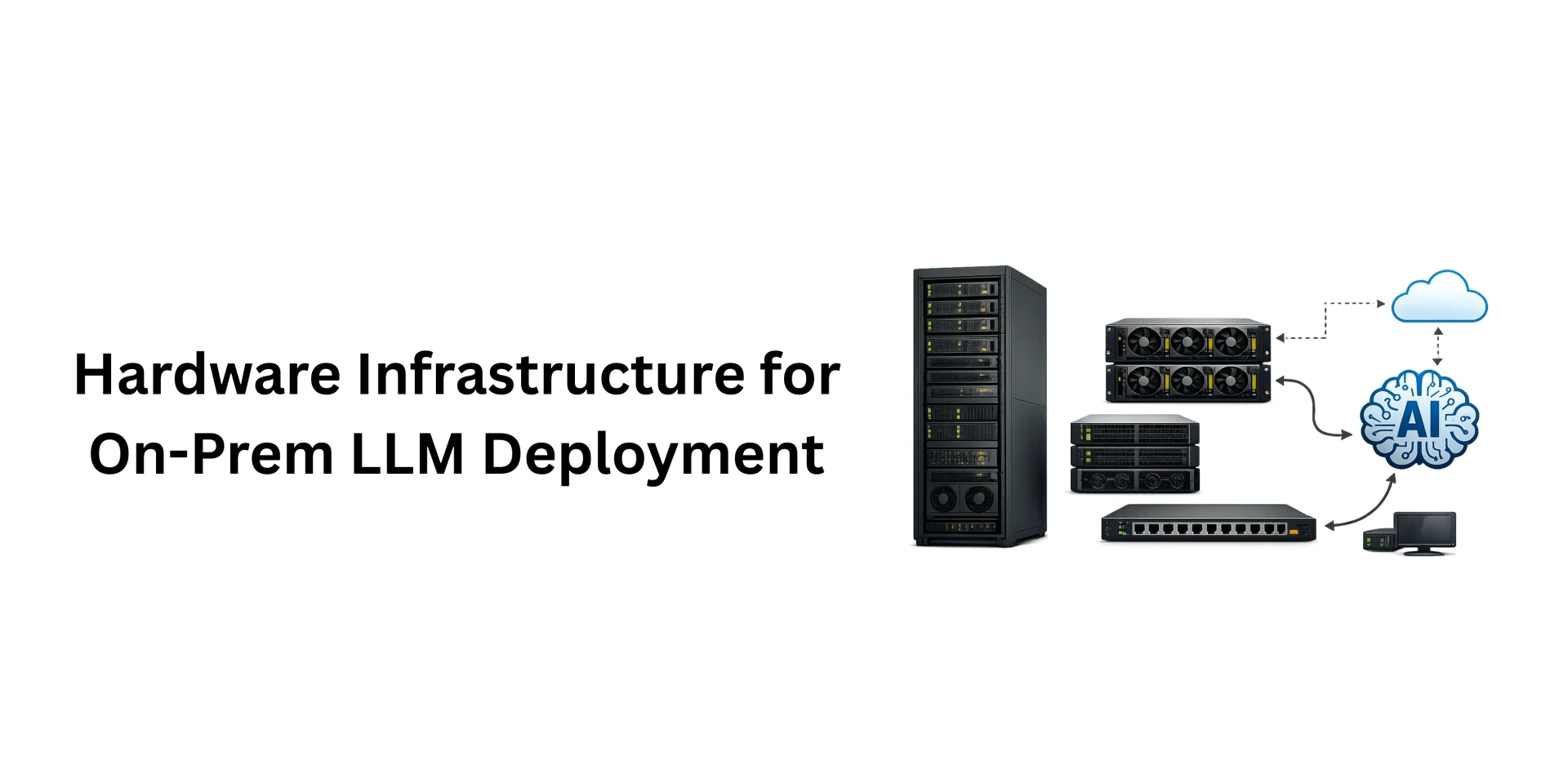

As enterprises adopt large language models (LLMs) to automate workflows, improve decision-making, and enhance customer experiences, many are choosing to keep these systems in-house. Security concerns, compliance requirements, and the need for full control are pushing organizations toward on-prem LLM deployment rather than cloud-based solutions.
There are many benefits to this strategy, but creating the appropriate hardware infrastructure is a major obligation. Although powerful, LLMs require a lot of resources. Inadequate systems can lead to decreased performance and rapidly increasing expenses.
Before making an investment in on-premises AI, CEOs and company executives must comprehend the hardware requirements.
Understanding the Significance of Hardware for On-Prem LLM Deployment
Large language models handle massive amounts of data and carry out intricate computations, in contrast to lightweight applications. It takes a lot of processing power. This infrastructure is managed by the provider in cloud settings. When on-prem LLM development, your company has to handle everything in-house.
This entails selecting networking, storage, servers, and processors that can accommodate both present demands and future expansion. Reliability, quicker processing, and a higher return on investment are all guaranteed by a solid foundation.
Simply put, the proper hardware is essential to the seamless operation of your AI.
High-Performance GPUs for Model Processing
Graphics Processing Units (GPUs) form the foundation of any LLM arrangement. These chips support parallel computations, which are essential for training and operating big models effectively.
Businesses usually employ data-center-grade GPUs with high memory and processing performance for on-premise LLM implementation. Models can respond more quickly and manage heavier workloads when many GPUs are coupled to cooperate.
Even the greatest models can become sluggish and unsuitable for everyday commercial use if there is insufficient GPU power.
Powerful CPUs and Memory
Even if GPUs do the majority of the work, CPUs are still crucial. They oversee data flow, application logic, and system operations. Robust multi-core processors contribute to the stability and responsiveness of the overall system.
RAM, or memory, is just as crucial. To load data and complete operations quickly, large models need a lot of memory. Performance can be negatively impacted by bottlenecks caused by inadequate memory.
The system's overall efficiency is ensured by balancing CPUs, RAM, and GPUs.
Scalable Storage Solutions
Datasets, model files, logs, and backups all need room for LLMs. Storage requirements can increase rapidly, particularly as businesses gather more data over time.
Fast storage devices like SSDs or NVMe discs are frequently recommended for on-prem LLM deployment. These speed up response times by enabling rapid data access. Long-term storage options can aid in the management of historical data and archives.
The optimum strategy is typically a combination of capacity and speed.
Dependable Security and Networking
AI systems frequently link to several departments and tools. Smooth communication between servers, apps, and users is ensured by robust networking. Faster outcomes are achieved by low-latency networks, particularly for real-time tasks.
Security is equally important. Sensitive data is protected by firewalls, access controls, and monitoring systems. Upholding stringent security standards fosters compliance and fosters trust because data remains inside the company.
A stable and secure environment is produced by networking and security working together.
Planning for Growth and Maintenance
Infrastructure should enable future growth in addition to meeting current demands. Systems should be built by businesses to grow with workloads. Hardware upgrades are possible with modular configurations without causing significant disruptions.
Additionally, routine upkeep and observation are required. Updating systems prevents expensive downtime and guarantees consistent performance.
Conclusion
The suitable hardware infrastructure is crucial to the fulfillment of on-prem LLM deployment. Every component, from processors and GPUs to networking and garage, is critical to dependability and overall performance.
Investing in sturdy infrastructure is more than just a technical issue for CEOs and decision-makers. It's a tactical one. AI tasks end up quicker, more secure, and more successful whilst the muse is powerful, assisting groups in remaining competitive in a marketplace that is converting quickly.

























Sign in to leave a comment.