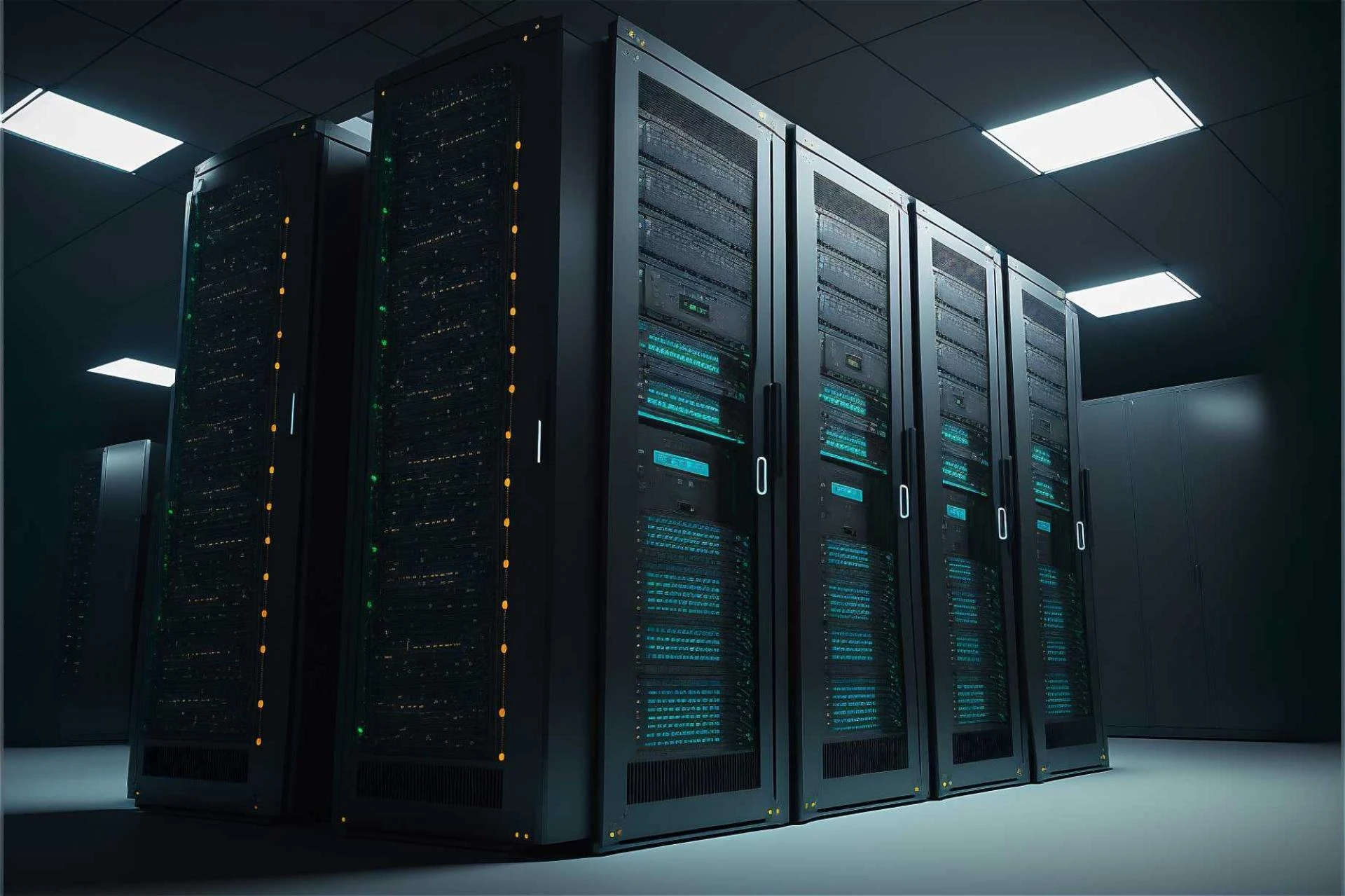

The debate between on-premises storage and cloud storage has shifted. It is no longer a binary choice. Businesses crave the agility, scalability, and ease of use associated with the public cloud, yet many still require the performance, security, and cost-predictability of on-premises hardware.
This has driven a significant evolution in storage technology. Modern NAS (Network Attached Storage) is no longer just a static box of hard drives sitting in a server room. It has transformed into a dynamic data management platform. Today's advanced NAS solutions are bridging the gap, bringing cloud-like flexibility to local data centers and empowering IT teams to manage data with unprecedented speed and efficiency.
The Evolution of NAS Storage
Traditionally, NAS storage was viewed primarily as a file server—a central repository for file sharing across a network. It was reliable but often rigid. Scaling meant buying a bigger box or manually migrating data, and management was frequently siloed.
However, the explosion of unstructured data (video, audio, IoT sensor data, and documents) forced a change. IT leaders needed on-premise infrastructure that could behave like the cloud. They needed the ability to spin up resources instantly, scale without downtime, and pay for what they use.
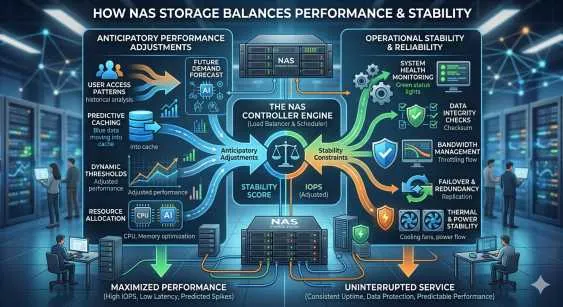
Modern NAS architecture has risen to this challenge by adopting software-defined principles. This shift, powered by advanced NAS solutions, allows organizations to keep their most critical workloads on-site—avoiding latency issues and egress fees—while enjoying an operational experience that mirrors the simplicity of the cloud.
Key Features Bringing Cloud Agility On-Prem
How exactly are these systems replicating the cloud experience? It comes down to a few critical technological advancements that define the new generation of NAS solutions.
1. Scale-Out Architecture
Legacy storage systems were often "scale-up," meaning you had a fixed controller and could only add so many drives before hitting a performance ceiling. To get more power, you had to replace the entire system (a "forklift upgrade").
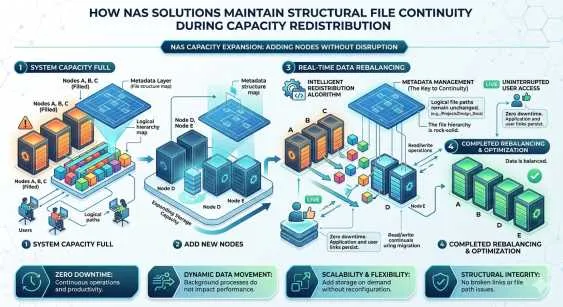
Cloud environments, by contrast, are "scale-out." You simply add more nodes to a cluster, and the system grows linearly in both capacity and performance. Modern NAS adopts this scale-out approach. When an organization needs more terabytes or higher throughput, IT administrators can simply plug in another node. The software automatically rebalances data across the cluster, requiring no downtime and no complex migrations.
2. Software-Defined Flexibility
In the cloud, hardware is abstracted away. You don't care what brand of server runs your application; you just care about the service level. On-premises NAS storage is moving in the same direction.
Software-defined storage (SDS) decouples the storage management software from the underlying hardware. This allows businesses to run advanced NAS capabilities on commodity hardware or specialized appliances, offering greater flexibility in procurement and deployment. It enables features like automated tiering, where hot data stays on fast flash media and cold data moves to cheaper, high-capacity disk drives automatically—just like cloud tiering policies.
3. Unified Storage Protocols (Including iSCSI NAS)
Agility means supporting diverse workloads without needing separate silos of infrastructure. A modern storage environment shouldn't force you to buy one system for file storage and another for block storage.
This is where multiprotocol support becomes essential. Top-tier platforms support standard file protocols (NFS, SMB) alongside block protocols. An iSCSI NAS implementation allows the storage system to handle database applications and virtual machines that typically require block-level access, all while managing standard file shares on the same physical hardware. This unification simplifies management, reduces rack space usage, and lowers power consumption.
4. API-First Management
One of the biggest draws of the public cloud is automation. Developers can provision storage via code without waiting for a storage administrator to click through a GUI.
Modern on-premises NAS systems are now built with an API-first mindset. They offer robust RESTful APIs that integrate with orchestration tools like Kubernetes, Ansible, and Terraform. This allows internal developers to provision storage resources programmatically. It turns the IT infrastructure into a private cloud, where resources are delivered as a service rather than a manual ticket request.
The Security and Cost Advantages
While agility is the headline, the underlying motivators for keeping data on-premises often revolve around security and cost control.
Data Sovereignty and Compliance
For industries like healthcare, finance, and government, data sovereignty is non-negotiable. Public clouds, despite their certifications, can introduce complexity regarding where data physically resides. On-premises NAS solutions offer absolute control. You know exactly where your data is, who accesses it, and how it is encrypted. There is no ambiguity about "shared responsibility models."
Predictable Economics
The "cloud bill shock" is a real phenomenon. While the cloud offers low barriers to entry, costs can spiral as data grows, particularly with egress fees (the cost to retrieve data). On-premises storage operates on a capital expenditure (CapEx) model, or increasingly, a subscription-based operational expenditure (OpEx) model that mimics cloud billing but with predictable monthly costs.
By keeping heavy write/read workloads local, organizations avoid the variable costs associated with high-transaction cloud workloads.
Integrating Hybrid Cloud Strategies
It is important to note that adopting on-premises agility does not mean abandoning the public cloud. In fact, the best NAS storage strategies are hybrid.
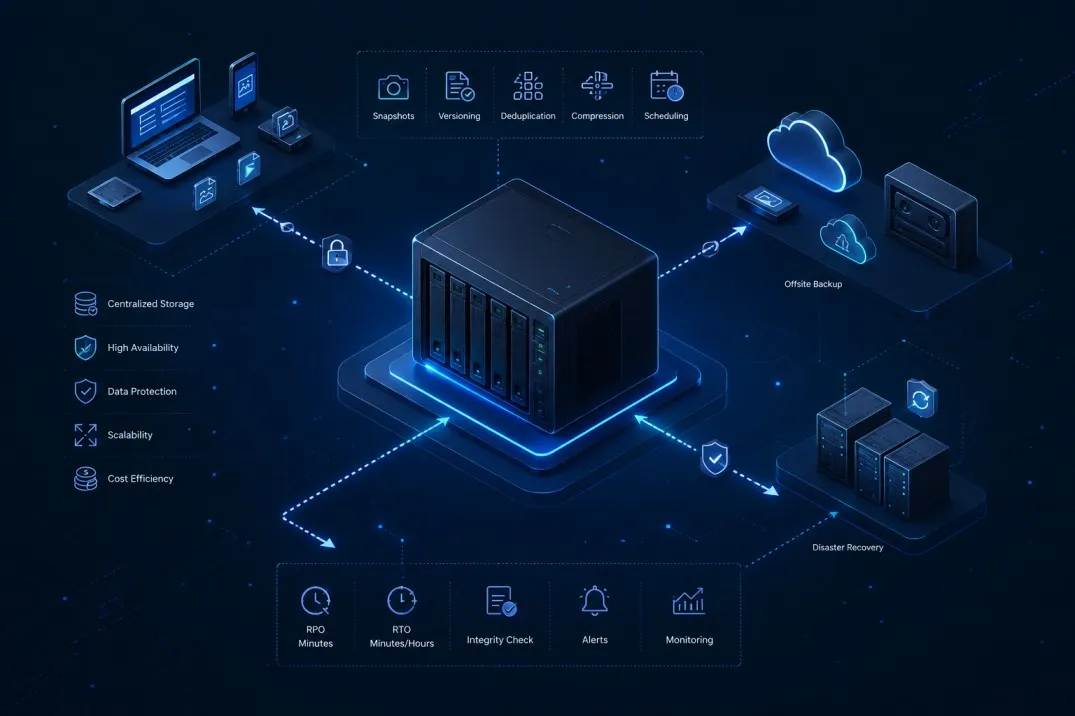
Modern NAS platforms often feature built-in cloud connectors. These allow administrators to seamlessly tier cold data to public cloud object storage (like AWS S3 or Azure Blob) for long-term retention while keeping active data on the high-performance local NAS.
Furthermore, disaster recovery becomes more efficient. Snapshots of the on-premises data can be replicated to the cloud, providing an off-site backup without the expense of maintaining a secondary physical data center.
Choosing the Right Solution for Your Enterprise
When evaluating storage options to bring agility to your data center, consider the following criteria:
- Scalability: Can the system grow non-disruptively? Look for scale-out capabilities that separate capacity from performance.
- Protocol Support: Does it support iSCSI NAS capabilities alongside NFS and SMB? Unified storage reduces complexity.
- Automation: Does the vendor provide robust APIs and plugins for your existing container and orchestration platforms?
- Cloud Integration: How easily does the system tier data to public cloud providers?
The Future of On-Premises Data
The narrative that "everything is moving to the cloud" has been replaced by a more nuanced reality: everything is moving toward a cloud operating model. In this transition, NAS storage plays an increasingly critical role by providing scalable, centralized, and flexible data management that supports hybrid and multi-cloud environments. As organizations adopt cloud-like workflows across on-premises and distributed infrastructures, NAS storage becomes essential for delivering the consistency, performance, and accessibility required in a modern cloud operating ecosystem.
Businesses realized that the location of the data matters less than the experience of managing it. By deploying modern NAS solutions that offer scale-out architecture, automation, and unified protocols, organizations can build a private cloud infrastructure that rivals the agility of the hyperscalers. This approach secures critical assets and ensures predictable costs, providing the best of both worlds.
The data center isn't dead; it just got a lot smarter.























Sign in to leave a comment.