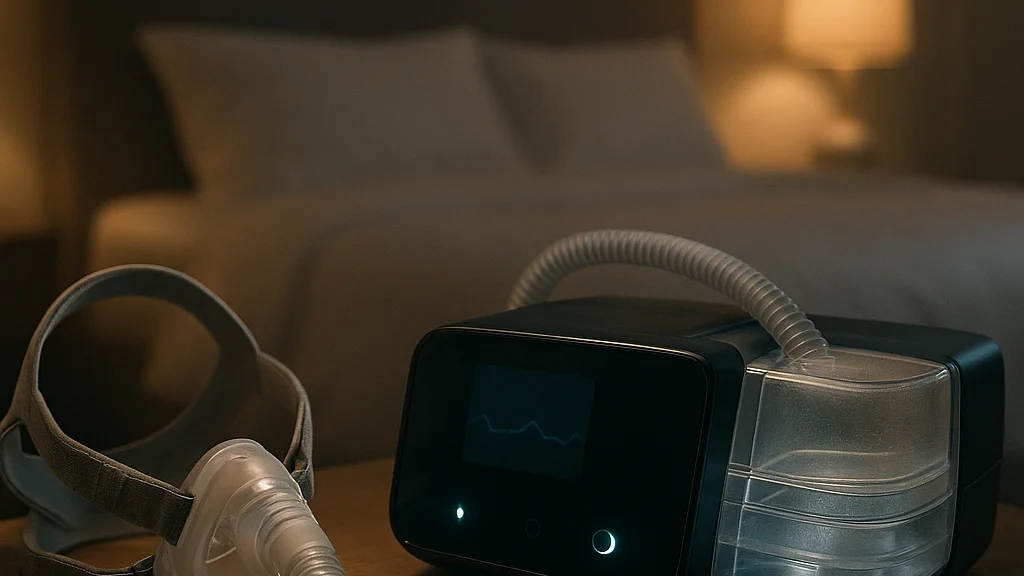

A quieter night, and a very different kind of machine
At two in the morning, a sleep lab can feel less like a clinic than a ship at sea, dim blue monitors glowing, wires trailing over sheets, the soft mechanical sigh of air moving through tubing. For decades, the emblem of sleep apnea treatment was easy to picture: a bedside CPAP unit, a mask, a hose, and the promise that pressurized air could hold the airway open until morning. It worked, often very well, but it also asked patients to make peace with noise, fit, claustrophobia, dry mouth, skin irritation, and the strange intimacy of sleeping attached to a machine.
That compact image is starting to crack. A broader technology story is unfolding, one that shifts sleep apnea care away from a single-device model and toward a layered ecosystem of diagnostics, wearables, connected sensors, implantable stimulation systems, data analytics, telemedicine, and more personalized therapy selection. As MSN reported in its coverage of new sleep apnea technology, the field is moving beyond traditional CPAP toward alternatives designed around comfort, adherence, and precision. Yale has made a similar point in its recent analysis of where the specialty is headed, arguing that the future lies not in replacing one standard with another, but in matching the right intervention to the right anatomy and the right patient behavior.
That distinction matters because sleep apnea is not a niche inconvenience. Obstructive sleep apnea, the most common form, has been associated with cardiovascular disease, daytime sleepiness, metabolic dysfunction, impaired concentration, and reduced quality of life. Untreated, it can sit in a person’s life like a low electric hum, draining mornings, sharpening blood pressure, blurring memory. Yet the old reality was blunt: many patients were diagnosed, prescribed CPAP, and then quietly fell away from treatment.
The technology story in 2026 is, at heart, an adherence story. It is also a story about design. The most promising innovations are not merely more advanced, they are more humane. They ask a simpler question than medicine sometimes does: what will people actually use, night after night, when the room is dark and nobody is watching? Readers looking for a broader primer can compare this piece with WriteUpCafe’s Technology Is Reshaping Sleep Apnea Treatment with Innovation and Precision, which sketches the same transition from a wider angle.
Sleep apnea treatment is no longer a one-machine conversation. It is becoming a precision-care conversation, where anatomy, tolerance, data, and lifestyle all shape the plan.
Why CPAP changed medicine, and why it was never enough on its own
Continuous positive airway pressure remains one of the most effective therapies ever developed for obstructive sleep apnea. When patients use it consistently, CPAP can reduce apneic events, improve oxygenation, ease daytime fatigue, and lower symptom burden quickly. That is why it still anchors clinical practice. The problem was never that CPAP failed in the abstract. The problem was that real life, unlike a protocol sheet, is messy.
Mask leaks wake people up. Pressure settings can feel intrusive. Nasal congestion turns a tolerable device into a nightly negotiation. Travel complicates routines. Partners have opinions. Patients with milder symptoms often struggle to accept a treatment that feels more burdensome than the condition itself, at least in the short term. Even among those who benefit, long-term adherence has historically been uneven, and that gap between efficacy and sustained use has shaped nearly every recent innovation in the field.
Clinicians began to recognize that “sleep apnea” was too broad a category to support a one-size-fits-all treatment pathway. Some patients have airway collapse driven largely by tongue base obstruction. Others have craniofacial structure, obesity-related narrowing, positional dependence, neuromuscular instability, or mixed contributors. A device that pneumatically splints the airway can address many of these patterns, but not always in the way a patient can comfortably live with. That opened the door to alternatives, from mandibular advancement devices to positional therapy, upper-airway surgery, and, more recently, implantable neurostimulation.
The digital turn accelerated that shift. Remote monitoring let clinicians see not only whether a patient had been prescribed therapy, but whether they were using it, for how many hours, at what leak levels, and with what residual event burden. Suddenly, treatment failure could be measured in finer grain. Telehealth follow-ups made it easier to intervene early. App-based coaching and connected devices turned adherence into an observable behavior rather than a black box.
Several forces converged:
- Better diagnostics moved more testing from labs into homes, lowering barriers to diagnosis.
- Connected devices created streams of nightly data, not isolated snapshots.
- Alternative therapies expanded choices for patients who could not tolerate CPAP.
- Consumer wearables made sleep metrics more familiar, even if not always diagnostic.
- Telemedicine shortened the distance between a rough night and a clinician response.
Seen this way, the current moment is not a rejection of CPAP. It is a correction to the older habit of treating CPAP as the entire map. For readers who want that transition explained in more practical terms, WriteUpCafe’s What You Need to Know About Technology Reshaping Sleep Apnea Treatment is a useful companion.
CPAP remains the benchmark for many patients, but the new question in sleep medicine is not “Does CPAP work?” It is “Which therapy will this patient actually sustain?”
The new toolbox: wearables, implants, oral devices, and smart diagnostics
The most important change in sleep apnea treatment is not one breakthrough gadget. It is the widening of the toolbox. In 2026, clinicians can increasingly combine home sleep testing, machine-learning-supported analysis, cloud-connected PAP platforms, custom oral appliances, positional systems, and implantable therapies in ways that would have seemed fragmented a decade ago. Now they look like the early shape of personalized sleep medicine.
Home sleep apnea testing has become central to that shift. Instead of sending every patient to an overnight lab, providers can use compact systems that measure airflow, oxygen saturation, respiratory effort, and heart rate in the patient’s own bed. That matters because diagnosis is often where the first dropout happens. A simpler test means more patients get studied, and studied sooner. It also means treatment pathways can begin earlier, with less friction and lower cost in many cases.
Then there are the devices meant to improve tolerance rather than replace core therapy. Modern PAP systems are quieter, smaller, and more connected than older generations. Heated humidification, improved mask designs, auto-adjusting pressure algorithms, and remote troubleshooting have all reduced some of the nightly annoyances that once sent machines to closets. Clinicians can now review adherence dashboards and residual event data remotely, then adjust settings without waiting for a months-later office visit.
But the more dramatic narrative sits beyond PAP. Oral appliance therapy, especially custom mandibular advancement devices fitted by trained dental sleep specialists, has gained ground for patients with mild to moderate obstructive sleep apnea or those unable to tolerate CPAP. These appliances mechanically reposition the jaw to help keep the airway open. They are not ideal for everyone, but for the right patient they can feel less like medical hardware and more like a manageable habit.
Implantable hypoglossal nerve stimulation has drawn particular attention. The idea is elegant: stimulate the nerve that controls tongue movement in a timed way during sleep, reducing airway collapse. Companies in this space have helped transform the public conversation around apnea treatment, especially for patients with moderate to severe obstructive sleep apnea who meet specific anatomical and clinical criteria and have struggled with CPAP. According to Yale’s recent reporting in Beyond CPAP: The future of sleep apnea treatment, the field is increasingly focused on selecting therapies based on the exact mechanism of obstruction, not merely the severity label attached to the diagnosis.
Several technologies now define the modern toolkit:
- Auto-titrating PAP devices that adjust pressure through the night based on breathing patterns.
- Cloud-connected adherence platforms that allow remote monitoring and coaching.
- Custom oral appliances for patients with suitable anatomy and lower tolerance for masks.
- Positional therapy systems that reduce supine sleep in position-dependent apnea.
- Hypoglossal nerve stimulation implants for carefully selected CPAP-intolerant patients.
- Advanced home sleep tests that expand access to diagnosis and follow-up.
What ties them together is not novelty for its own sake. It is the recognition that sleep apnea sits at the intersection of anatomy, behavior, and nightly routine. The best technology is the one that fits all three.
What changed recently, and what 2026 looks like on the ground
The last few years have brought a sharper focus on personalization and access. Sleep medicine in 2026 is less centered on the sleep lab as a single gatekeeper and more distributed across homes, specialty clinics, dental practices, telehealth platforms, and device ecosystems. That does not mean the lab is obsolete, especially for complex cases or when other sleep disorders are suspected. It means the center of gravity has shifted.
One major change is the maturation of remote care. During the telehealth expansion of the early 2020s, many specialties improvised. Sleep medicine has since turned improvisation into infrastructure. Device data can be reviewed remotely, mask issues can be addressed over video, and therapy adjustments can happen faster. This is especially important in a condition where the first few weeks often determine long-term adherence. A patient who struggles in silence for three weeks is far more likely to abandon therapy than one who gets a call after the third rough night.
Another shift is the rise of consumer awareness driven by wearables. Smartwatches and sleep trackers do not diagnose obstructive sleep apnea on their own, and clinicians are right to warn against overconfidence in consumer metrics. Still, they have changed behavior. People now arrive at appointments with months of sleep trend data, oxygen fluctuation alerts, snoring recordings, and a vocabulary for discussing sleep quality. That can be messy, but it also shortens the path from suspicion to formal evaluation.
There is also growing interest in combination therapy. A patient may use PAP at lower pressures after weight loss, combine positional therapy with an oral appliance, or move from failed CPAP to implant evaluation after anatomical workup. This layered approach reflects a broader medical reality: chronic conditions are often managed through systems, not single interventions.
By 2026, several themes stand out:
- Diagnosis is moving earlier, aided by home testing and consumer sleep awareness.
- Follow-up is becoming more continuous, thanks to connected platforms and telemedicine.
- Therapy matching is more nuanced, with greater attention to anatomy, severity, and patient preference.
- Alternatives to CPAP are more visible, especially oral appliances and neurostimulation.
- Adherence is treated as a design problem, not a patient moral failing.
That last point may be the most consequential. For years, nonadherence was sometimes framed as patient reluctance. The newer view is more honest. If a therapy is clinically potent but difficult to live with, the burden is partly on product design, support systems, and personalized selection. That is a healthier framework, medically and ethically.
The business and clinical stakes: who benefits, who pays, who gets left out
Whenever medicine becomes more technological, the promises arrive with shadows. Sleep apnea innovation is no exception. Better tools can improve outcomes, but they can also widen inequality if access depends on geography, insurance coverage, specialist availability, or the ability to navigate a fragmented healthcare system. The patient with a smartphone, stable insurance, and a nearby academic center is not entering the same treatment marketplace as the patient in a rural area with limited sleep specialty access.
Insurance remains one of the central pressure points. CPAP has long been embedded in reimbursement systems, coverage criteria, and durable medical equipment channels. Newer therapies, especially implantable ones, may involve more stringent eligibility requirements, documentation burdens, and preauthorization hurdles. Oral appliance therapy can be clinically appropriate yet still difficult to access depending on plan design and specialist networks. In practice, the best therapy on paper may not be the most reachable therapy in a patient’s actual life.
There are business implications too. Device makers are no longer simply selling hardware. They are building platforms, service models, data streams, and partnerships with providers. The value increasingly lies in the ecosystem: remote monitoring, software interfaces, patient engagement tools, and the ability to show that a device is not only effective in trials but sustainable in ordinary bedrooms. That changes competition. A machine is one thing. A machine plus analytics plus tele-coaching plus reimbursement support is another.
Clinically, the stakes are high because untreated sleep apnea is expensive in diffuse ways. It contributes to cardiovascular risk, workplace fatigue, motor vehicle danger, and downstream healthcare use. Better adherence and more accurate therapy matching could therefore have ripple effects beyond sleep medicine itself. Yet those benefits depend on implementation, not just invention.
The field now faces a practical checklist:
- Can primary care identify likely apnea earlier and route patients efficiently?
- Can home testing be used appropriately without missing complex sleep disorders?
- Can patients get coaching during the fragile first month of treatment?
- Can insurers adapt coverage to evidence-based alternatives beyond CPAP?
- Can clinicians avoid overtreatment driven by gadget enthusiasm rather than patient need?
The best recent reporting on this has emphasized both optimism and restraint. MSN’s overview of emerging technologies highlights the expanding menu of options, while Yale’s analysis underscores that not every patient is a candidate for every tool. That balance matters. Medicine advances not when it falls in love with devices, but when it learns where each device belongs.
For readers tracking the consumer-facing side of the trend, WriteUpCafe’s Technology Is Reshaping Sleep Apnea Treatment in 2026 and Beginners Guide to How Technology Is Reshaping Sleep Apnea Treatment in 2026 show how these changes are being framed for a broader audience, though the clinical nuance remains essential.
Innovation in sleep apnea care will be judged less by how futuristic it looks than by whether more people are diagnosed earlier, treated more comfortably, and kept in care longer.
What patients and clinicians should watch next
The next phase of sleep apnea treatment will likely be shaped by a simple but demanding ambition: making therapy feel less like an imposition and more like a tailored extension of ordinary life. That means quieter devices, smaller hardware, better interfaces, stronger predictive analytics, and more precise patient selection. It also means acknowledging that technology alone cannot solve a condition tied to weight, nasal obstruction, craniofacial structure, alcohol use, sleep position, and broader cardiometabolic health.
One area to watch is phenotyping, the effort to classify patients more precisely by underlying mechanism rather than relying only on broad severity categories such as mild, moderate, or severe. If clinicians can better identify who is likely to respond to oral appliances, positional therapy, neurostimulation, surgery, or PAP optimization, treatment could become less trial-and-error and more targeted from the start. That would reduce frustration, cost, and dropout.
Another frontier is the integration of sleep data into broader health management. Sleep apnea does not live in isolation. Patients often present with hypertension, obesity, atrial fibrillation, insulin resistance, mood symptoms, or chronic fatigue. The more sleep data can be responsibly folded into primary care and cardiometabolic management, the more likely apnea will be treated as part of whole-person medicine rather than a narrow nighttime problem.
Patients considering treatment should ask practical questions, not just technical ones:
- What type of sleep apnea do I have, and how severe is it?
- What are the realistic first-line options for my anatomy and symptoms?
- How will adherence be monitored and supported in the first month?
- If I cannot tolerate CPAP, what is the next evidence-based alternative?
- Does my insurance cover oral appliances, home testing, or implant evaluation?
Clinicians, meanwhile, should keep one eye on evidence and the other on experience. A therapy that performs beautifully in selected populations may disappoint in routine practice if onboarding is poor or eligibility is stretched. The smartest programs are building multidisciplinary pathways, where sleep physicians, respiratory therapists, dentists, ENT specialists, and primary care clinicians coordinate rather than compete.
There is something almost cinematic about this transition, the old bedside machine still humming in millions of rooms, while newer options gather at the edge of the frame. The point is not to retire CPAP by force of fashion. The point is to widen the script. Sleep apnea care is becoming more flexible, more data-rich, and, when done well, more compassionate. For patients who have spent years waking with headaches, drifting through afternoons, or abandoning treatments that never felt livable, that change may be more than technical progress. It may feel like opening a window after rain, the room clearing, the air finally easier to take in.

























Sign in to leave a comment.