
In modern industrial operations, steam systems are at the heart of energy transfer, process heating, and mechanical power generation. While superheated steam is essential in certain applications like turbines, it is often not ideal for process heating. Excessive steam temperature can reduce efficiency, damage equipment, and create instability in operations. This is where a desuperheater becomes a critical solution for optimizing steam system performance.
This comprehensive guide explores how desuperheaters work, their importance in industrial systems, and practical strategies to maximize their effectiveness.
The Role of Steam in Industrial Systems
Steam is widely used because of its ability to carry large amounts of energy. In many industries—such as chemical processing, food production, pharmaceuticals, and power generation—steam acts as a reliable and controllable heat source.
However, not all steam conditions are suitable for every application. Superheated steam, although beneficial in preventing condensation in turbines, has limitations in heat transfer processes:
- It transfers heat less efficiently compared to saturated steam
- It requires higher surface temperatures to release energy
- It can lead to uneven heating and product quality issues
- It increases thermal stress on equipment
For most heating applications, maintaining steam close to its saturation point is essential for optimal performance.
What is a Desuperheater and Why is it Important?
A desuperheater is a device designed to reduce the temperature of superheated steam by introducing a controlled amount of water into the steam flow. This process brings the steam closer to its saturation temperature without significantly affecting pressure.
Why It Matters:
- Ensures efficient heat transfer
- Maintains process consistency
- Protects downstream equipment
- Supports energy-efficient operations
By integrating a desuperheater into a steam system, industries can achieve better control over temperature-sensitive processes.
Working Principle of a Desuperheater
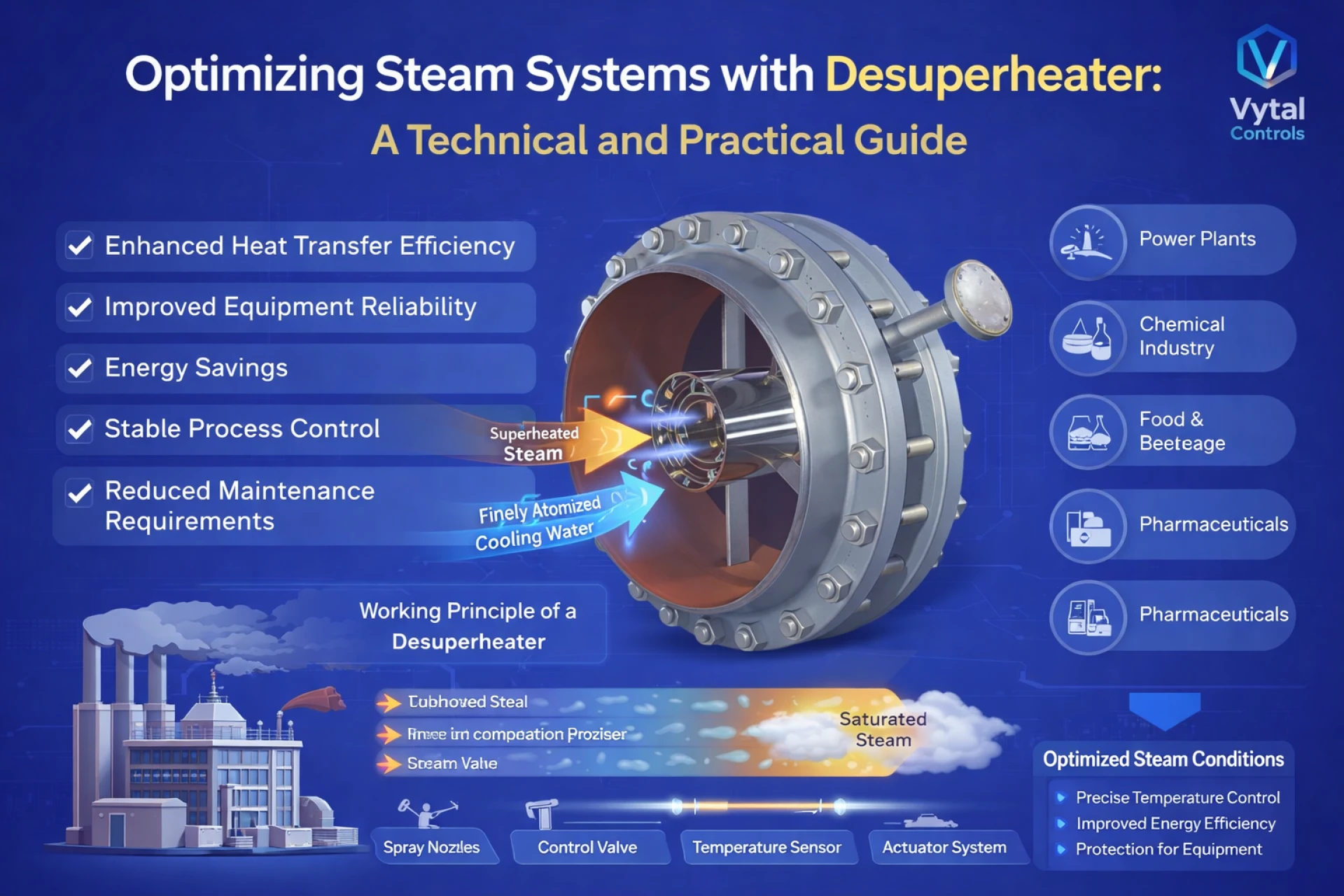
The operation of a desuperheater is based on direct contact cooling. Finely atomized water is injected into the superheated steam, where it absorbs excess thermal energy and evaporates.
Key Steps:
- Superheated steam enters the desuperheater
- Water is injected through precision nozzles
- The water droplets absorb heat and evaporate
- Steam temperature is reduced to the desired level
Critical Components:
- Spray Nozzles: Ensure fine atomization for rapid evaporation
- Control Valve: Regulates the flow of cooling water
- Temperature Sensor: Provides feedback for accurate control
- Actuator System: Adjusts water injection dynamically
Efficient mixing and complete evaporation are essential to prevent issues such as water carryover or uneven temperature distribution.
Types of Desuperheaters Used in Industry
Different applications require different desuperheater designs. Selecting the right type depends on steam conditions, load variations, and control requirements.
Spray Type Desuperheater
- Widely used across industries
- Simple design and cost-effective
- Suitable for moderate load variations
Venturi Desuperheater
- Enhanced mixing through a venturi throat
- Ideal for systems with fluctuating steam flow
Steam Atomizing Desuperheater
- Uses steam for atomization instead of pressure
- Effective in low-load or low-velocity conditions
Variable Orifice Desuperheater
- Adapts to changing operating conditions
- Provides precise temperature control
Benefits of Optimizing Steam Systems with Desuperheater
Enhanced Heat Transfer Efficiency
By converting superheated steam into saturated or near-saturated steam, a desuperheater improves the rate and efficiency of heat transfer in process equipment.
Improved Equipment Reliability
Excessive temperatures can cause thermal expansion, material fatigue, and premature failure. Proper temperature control helps extend equipment life.
Energy Savings
Optimized steam conditions reduce energy waste and improve overall system efficiency, leading to lower operational costs.
Stable Process Control
Consistent steam temperature ensures uniform heating, which is especially critical in industries like food processing and pharmaceuticals.
Reduced Maintenance Requirements
Minimizing thermal stress and preventing overheating reduces wear and tear on valves, pipelines, and heat exchangers.
Design and Selection Considerations
To maximize the performance of a desuperheater, careful design and selection are essential.
Steam Conditions
- Inlet temperature and pressure
- Required outlet temperature
- Flow rate variability
Water Quality
- Use demineralized or treated water
- Prevent scaling, corrosion, and nozzle blockage
Control System Integration
- Automated control improves accuracy
- Real-time monitoring ensures stable operation
Installation Best Practices
- Provide sufficient straight pipe length downstream
- Avoid installing near bends or fittings
- Ensure proper orientation for uniform mixing
Turndown Capability
A well-designed desuperheater should handle varying loads without compromising performance.
Common Operational Challenges
Even with proper design, certain challenges may arise during operation.
Incomplete Evaporation
Occurs when water droplets do not fully vaporize. This can be resolved by improving atomization and ensuring adequate residence time.
Temperature Instability
Fluctuations may result from poor control systems. Advanced sensors and control valves help maintain stability.
Water Carryover
Excess water can damage downstream equipment. Proper nozzle selection and placement are critical.
Scaling and Fouling
Poor water quality leads to deposits on nozzles and internal surfaces. Regular maintenance and filtration are necessary.
Industrial Applications of Desuperheater Systems
Desuperheaters are widely used across multiple industries to ensure optimal steam conditions:
- Power Plants: Turbine bypass and steam conditioning
- Chemical Industry: Process heating and reactor temperature control
- Food & Beverage: Sterilization and cooking processes
- Pharmaceuticals: Precise temperature control for sensitive products
- Pulp & Paper: Drying and processing operations
- HVAC Systems: District heating and energy management
Best Practices for Long-Term Performance
To ensure reliable and efficient operation of a desuperheater, consider the following practices:
- Conduct regular inspection of spray nozzles
- Calibrate temperature sensors periodically
- Monitor system performance using automation tools
- Maintain high water quality standards
- Implement preventive and predictive maintenance strategies
Conclusion
Optimizing steam systems with a desuperheater is essential for achieving efficient heat transfer, protecting equipment, and maintaining consistent process performance. With the right design, proper installation, and ongoing maintenance, industries can significantly enhance operational reliability and energy efficiency.
A well-engineered solution from Vytal Controls can help industries achieve precise steam temperature control, improved system efficiency, and long-term operational excellence.

























Sign in to leave a comment.