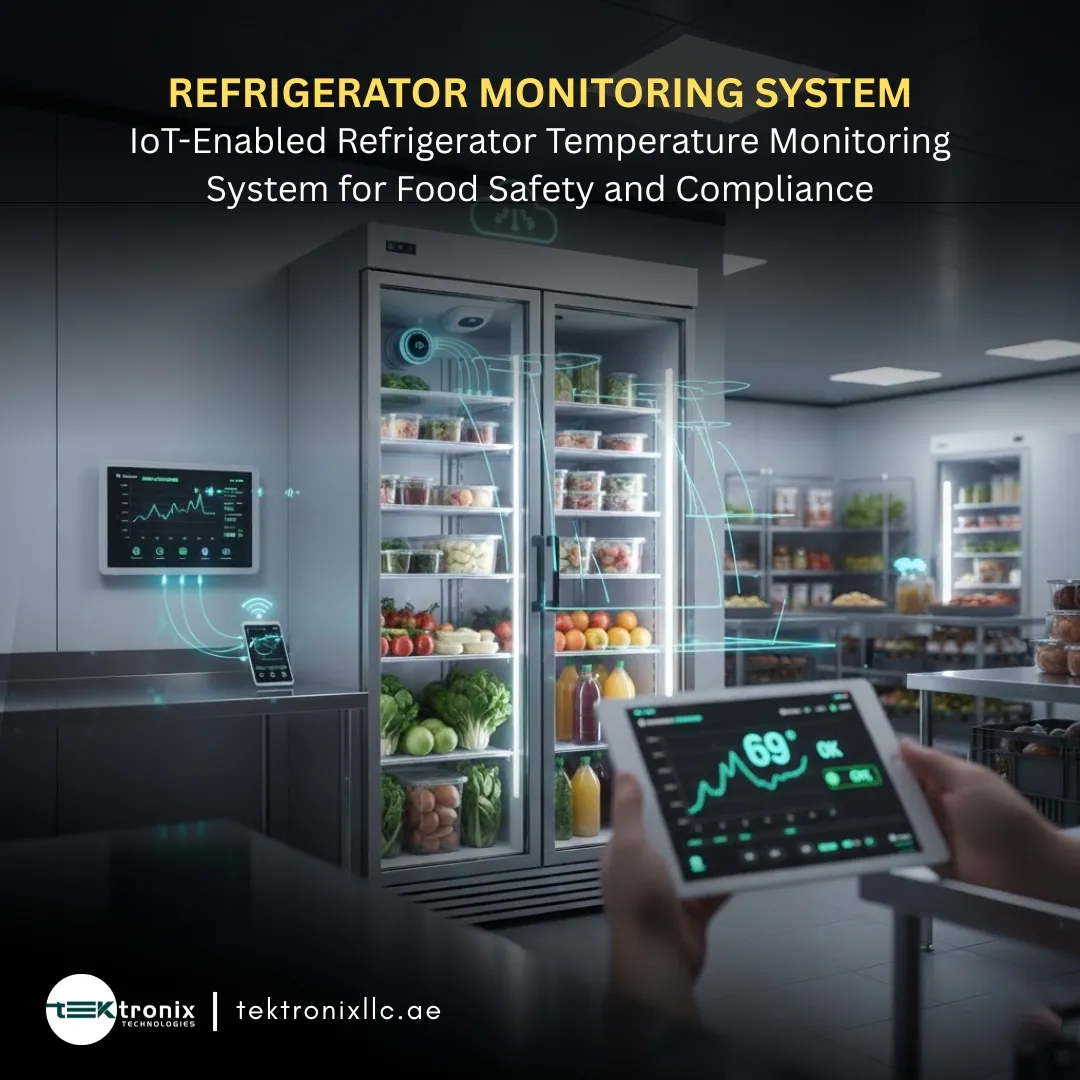

Refrigerator Monitoring is no longer a luxury in the UAE — it is a regulatory and operational imperative. From pharmaceutical cold chains to commercial food storage, every industry that depends on temperature-sensitive assets needs real-time visibility, verified compliance, and instant alerts when conditions deviate. For organisations across the Emirates, Tektronix LLC – Refrigerator & Freezer Monitoring Solutions UAE delivers comprehensive, IoT-powered systems engineered for the region's demanding climate and evolving regulatory landscape.
Why the UAE Demands Precision Cold-Chain Management
The UAE's combination of extreme ambient temperatures — regularly exceeding 45 °C outdoors — dense urban logistics networks, and strict food and pharmaceutical safety regulations creates one of the world's most challenging environments for cold-chain integrity. A single temperature excursion in a hospital pharmacy, restaurant walk-in cooler, or logistics hub can result in product spoilage, patient safety risks, multi-thousand-dirham losses, and licence revocations.
Government bodies including the UAE Food Safety Authority, Dubai Municipality, Abu Dhabi Agriculture and Food Safety Authority (ADAFSA), and the Health Authority Abu Dhabi (HAAD) mandate documented temperature records for food handlers and healthcare facilities alike. Organisations that deploy Temperature Monitoring Solutions not only protect their assets — they demonstrate the compliance readiness auditors expect.
How Modern Refrigerator Monitoring Systems Work
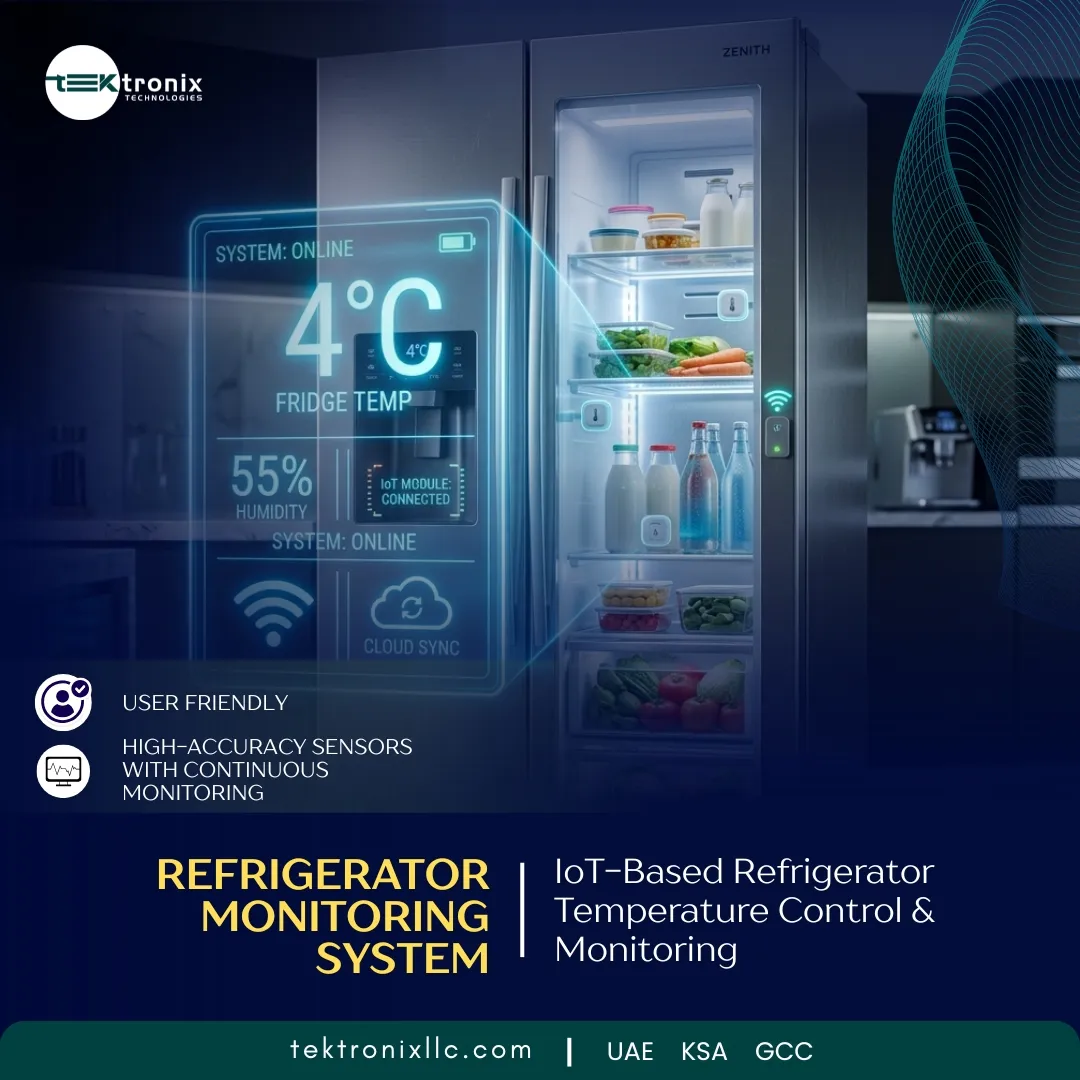
A fully integrated monitoring ecosystem combines wireless sensor hardware, secure data transmission, cloud analytics, and automated alert engines. Understanding each layer helps decision-makers specify the right system for their environment.
1. Smart Sensors: The Foundation of Cold-Chain Visibility
Smart Sensors are compact, battery-powered or wired devices placed inside refrigeration units, freezers, cold rooms, and transportation vehicles. They continuously measure temperature (and optionally humidity, door open/close status, and power supply) at configurable intervals — typically every one to five minutes. Modern sensors communicate via Wi-Fi, cellular (4G/LTE), Bluetooth Low Energy, or LoRaWAN protocols, making them deployable in facilities with or without existing network infrastructure.
In the UAE context, sensors must be rated for high-ambient-temperature operation, since plant rooms and loading docks regularly exceed 40 °C. Industrial-grade sensors with IP67 or IP68 ingress protection ratings ensure reliable operation even in harsh or wash-down environments such as commercial kitchens and seafood processing plants.
2. Remote Temperature Monitoring: Real-Time Oversight from Anywhere
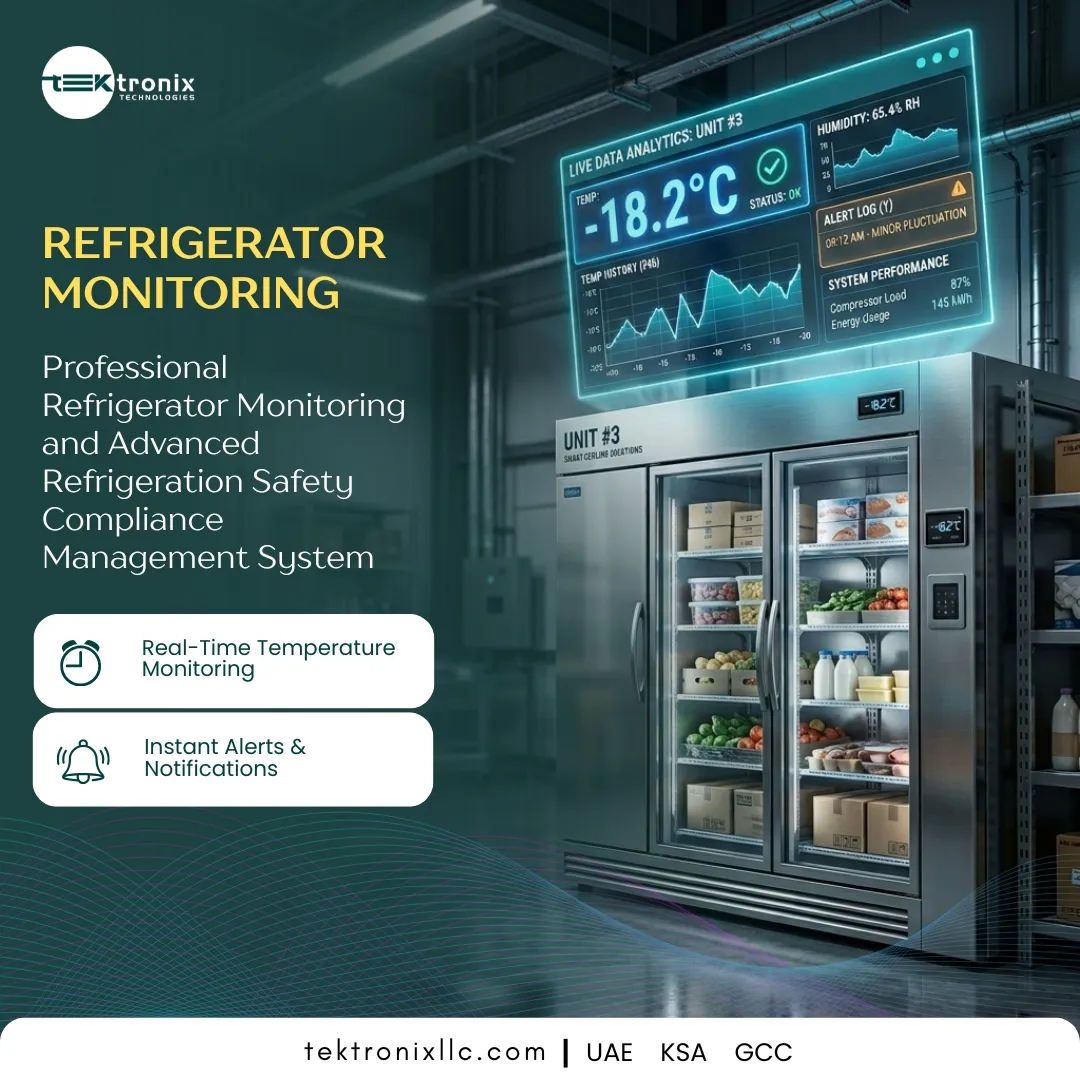
Remote Temperature Monitoring transforms passive data collection into active operational intelligence. Through a cloud-hosted dashboard accessible via desktop browser or mobile app, facility managers and quality assurance teams can view live temperature readings from every monitored asset simultaneously — regardless of whether they are on-site, across the emirate, or travelling internationally.
For multi-site operators — restaurant chains across Dubai, pharmaceutical distributors spanning Abu Dhabi and Sharjah, or hotel groups with properties throughout the UAE — centralised remote monitoring eliminates the need for manual temperature logging and provides a single pane of glass for the entire cold-chain estate.
3. Temperature Data Loggers: The Compliance Record That Protects You
Temperature Data Loggers serve a dual function: they create immutable, timestamped records for regulatory compliance and provide the forensic data needed to investigate any temperature excursion after the fact. Modern cloud-connected loggers store readings locally (ensuring no data loss during connectivity outages) and automatically sync to the cloud when connectivity is restored.
Regulatory bodies in the UAE increasingly require digital data logs with tamper-evident audit trails. Tektronix LLC's logging solutions export data in industry-standard formats (CSV, PDF reports, HACCP-compliant formats), making regulatory submissions and third-party audits straightforward and stress-free.
4. Temperature Alerts: Acting Before Loss Occurs
Temperature Alerts are the most operationally critical feature of any monitoring system. When a refrigeration unit malfunctions, a door is left ajar, or a power failure occurs, every minute of delay increases the probability of irreversible spoilage. A well-configured alert system notifies the right people — maintenance teams, quality managers, duty supervisors — via SMS, email, and push notification within seconds of a breach.
Advanced alerting logic allows operators to configure multi-tier escalation: a first alert to a duty technician, a second to the site manager if unacknowledged after ten minutes, and a third to the regional director if the excursion persists. This graduated response ensures that critical situations never fall through organisational gaps.
Sector-by-Sector Applications Across the UAE
The versatility of IoT-based cold-chain management means it serves every sector where temperature-sensitive assets are stored, processed, or transported:
- Pharmaceutical & Healthcare: Vaccines, biologics, insulin, and laboratory samples require strict 2–8 °C storage. Hospitals, clinics, and pharmacies across the UAE must provide continuous temperature evidence to regulators and accreditation bodies.
- Food & Beverage: Supermarkets, restaurants, hotels, and catering companies use monitoring to protect perishable inventory, demonstrate food safety compliance, and reduce waste — a significant cost in high-volume operations.
- Logistics & 3PL: Temperature-controlled warehouses and refrigerated vehicles require end-to-end chain-of-custody logging, particularly for pharmaceutical and fresh produce imports arriving through UAE ports.
- Hospitality: Five-star hotels and resort chains operating across Dubai, Abu Dhabi, and Sharjah protect guest safety and brand reputation by maintaining verified cold-chain records for every food storage point.
- Research & Laboratories: University and private research facilities store biological samples, reagents, and specimens that cannot tolerate temperature deviation without irreversible data loss.
- Retail: Convenience stores, petrol station forecourt chillers, and supermarket chains benefit from automated monitoring that replaces costly manual checks and documents compliance for municipal inspections.
Refrigerator Monitoring Across the UAE: A Region-Specific Perspective
Refrigerator Monitoring UAE: National Compliance Landscape
Refrigerator Monitoring UAE deployments are shaped by a layered regulatory environment that includes both federal mandates and emirate-level enforcement. The UAE's Federal Food Law (Federal Law No. 10 of 2015) and Cabinet Resolution No. 42 of 2022 on food safety set minimum standards for temperature documentation across the supply chain. Businesses that invest in automated monitoring infrastructure today are building the compliance foundation that regulators will require of all operators in the near future.
Refrigerator Monitoring Dubai: Smart City Integration
Refrigerator Monitoring Dubai is increasingly integrated with Dubai Municipality's food safety inspection systems and the Dubai Quality Mark certification programme. Food establishments seeking certification are expected to demonstrate continuous, automated temperature logging. Dubai's high density of hospitality and food service businesses — spread across Downtown, JLT, DIFC, Deira, and beyond — creates strong demand for scalable multi-site monitoring platforms that can be centrally managed without adding headcount.
Refrigerator Monitoring Abu Dhabi: Healthcare-Grade Standards
Refrigerator Monitoring Abu Dhabi requirements are particularly stringent in the healthcare and pharmaceutical sectors, governed by HAAD and the Department of Health Abu Dhabi. Medical facilities storing vaccines and blood products are subject to periodic unannounced inspections where digital temperature logs must be produced on demand. Abu Dhabi's growing life sciences ecosystem — including the cluster of pharmaceutical manufacturers on Al Raha Beach — depends on validated monitoring systems that meet WHO and GDP (Good Distribution Practice) standards.
Refrigerator Monitoring Sharjah: Industrial and Community Focus
Refrigerator Monitoring Sharjah serves a diverse economic base that includes light manufacturing, large-format retail, and a dense network of food and beverage SMEs. Sharjah's proximity to Ajman, Umm Al Quwain, and Ras Al Khaimah also positions it as a logistics corridor where cold-chain monitoring for transported goods is increasingly demanded by buyers and regulatory bodies in multiple northern emirates.
Why Tektronix LLC Is the UAE's Trusted Cold-Chain Monitoring Partner
Tektronix LLC brings over a decade of hands-on experience designing and deploying IoT-based monitoring infrastructure across the GCC. As a certified system integrator, we have successfully commissioned temperature monitoring projects for government healthcare facilities, international hotel groups, pharmaceutical distributors, and food manufacturing plants across the UAE, Saudi Arabia, and Qatar.
Our Temperature Monitoring Solutions are not off-the-shelf commodity products. Every deployment begins with a site survey, asset inventory, and regulatory requirement mapping. We then design a sensor network architecture — selecting the right hardware, communication protocol, alert logic, and reporting format — specific to each client's operational and compliance needs. Post-installation, we provide full user training, remote support, and preventive maintenance programmes to ensure continuous uptime.
Whether you need a single Temperature Data Logger for a GP clinic's vaccine refrigerator or a city-scale Remote Temperature Monitoring network spanning dozens of restaurant outlets, Tektronix LLC engineers’ solutions that scale, integrate, and perform in the UAE's unique environment.
The Broader Ecosystem: IoT, HACCP, and Cold-Chain Digitalisation
Cold-chain monitoring does not exist in isolation. It forms part of a wider digitalisation journey that includes HACCP plan automation, ERP integration, energy management systems, and predictive maintenance analytics. When Smart Sensors feed data into integrated platforms, facility managers gain not only compliance records but operational intelligence — identifying which refrigeration units are running inefficiently, which locations are most vulnerable to door-open events during shift changes, and where compressor failures are likely before they occur.
In the UAE's journey toward a fully digitised economy under UAE Vision 2031 and the National Food Security Strategy 2051, automated cold-chain infrastructure represents both a compliance requirement and a competitive differentiator. Early adopters are already realising measurable reductions in spoilage costs, energy consumption, and audit preparation time.
How to Choose the Right Refrigerator Monitoring System for Your Business
When evaluating systems, consider the following factors:
- Sensor Accuracy & Calibration: Pharmaceutical-grade applications require ±0.1 °C accuracy with annual UKAS or DAkkS-traceable calibration certificates.
- Connectivity Redundancy: Dual-communication sensors (Wi-Fi + cellular failover) ensure data continuity during network outages — critical in the UAE where uptime expectations are high.
- Alert Customisation: Granular threshold configuration per asset, per time of day, and per escalation tier prevents alarm fatigue while ensuring genuine excursions are never missed.
- Regulatory Report Generation: One-click, auto-formatted compliance reports reduce the burden of Dubai Municipality, ADAFSA, and HAAD inspections.
- Scalability: Choose a platform that can grow from five sensors to five hundred without requiring a system replacement — essential for expanding UAE businesses.
- Local Support: A UAE-based technical team that can respond on-site within hours is non-negotiable for operations where every hour of unmonitored refrigeration represents financial risk.
Conclusion
Refrigerator Monitoring is the invisible backbone of food safety, pharmaceutical integrity, and regulatory compliance across the UAE. From the healthcare corridors of Refrigerator Monitoring Abu Dhabi to the high-volume hospitality districts of Refrigerator Monitoring Dubai and the growing industrial zones of Refrigerator Monitoring Sharjah, organisations that invest in intelligent, automated Temperature Monitoring Solutions today are building resilience against spoilage loss, regulatory penalties, and reputational damage.
The convergence of Smart Sensors, cloud analytics, Remote Temperature Monitoring, Temperature Data Loggers, and real-time Temperature Alerts delivers a monitoring ecosystem that is always on, always accurate, and always audit-ready. Partner with Tektronix LLC to design a solution built for your sector, your regulatory environment, and your growth ambitions.
FAQs
1. What is Refrigerator Monitoring and why is it mandatory in the UAE?
Refrigerator Monitoring refers to the continuous, automated measurement and recording of temperature conditions inside refrigeration equipment. In the UAE, it is increasingly mandated under Federal Food Law, Dubai Municipality HACCP requirements, and HAAD healthcare facility standards. Beyond legal compliance, it protects product integrity, reduces spoilage losses, and provides the documented evidence needed to defend against liability claims in the event of a food safety incident.
2. How do Smart Sensors communicate data in facilities with poor Wi-Fi coverage?
Smart Sensors deployed by Tektronix LLC support multiple communication protocols including Wi-Fi, cellular (4G/LTE SIM), LoRaWAN, and Bluetooth gateway architectures. In facilities where Wi-Fi coverage is limited — such as basement cold rooms, loading docks, or outdoor storage areas — cellular-enabled sensors transmit data directly to the cloud via the mobile network, eliminating dependency on the facility's internal infrastructure entirely.
3. What is the difference between Remote Temperature Monitoring and a traditional data logger?
A traditional Temperature Data Logger stores reading locally on device memory, requiring manual retrieval and download — typically weekly or monthly. Remote Temperature Monitoring transmits readings to a cloud platform in real time, enabling live dashboards, instant Temperature Alerts, and continuous regulatory record-keeping without any manual intervention. For UAE businesses subject to unannounced inspections, real-time monitoring is significantly superior because compliance records are always current and accessible instantly from any device.
4. Can Tektronix LLC integrate monitoring systems with our existing ERP or food safety software?
Yes. Tektronix LLC's Refrigerator Monitoring UAE platforms are designed with open API architecture, enabling integration with leading ERP systems, HACCP management software, and quality management platforms. Data can be pushed to third-party systems automatically, eliminating manual data entry and ensuring that your quality management workflows are fed by live, accurate sensor data without duplication of effort.
5. What response time should we expect for on-site technical support in Dubai, Abu Dhabi, and Sharjah?
Tektronix LLC maintains dedicated field engineering teams across the UAE, with service coverage for Refrigerator Monitoring Dubai, Refrigerator Monitoring Abu Dhabi, and Refrigerator Monitoring Sharjah clients. Standard SLA response times for critical system faults are four hours or less during business hours, with emergency support arrangements available for healthcare and pharmaceutical clients where continuous monitoring is a patient safety requirement. Remote diagnostics are performed immediately upon alert receipt, resolving many issues before an on-site visit is necessary.
Contact Us:
+971 55 232 2390





















Sign in to leave a comment.