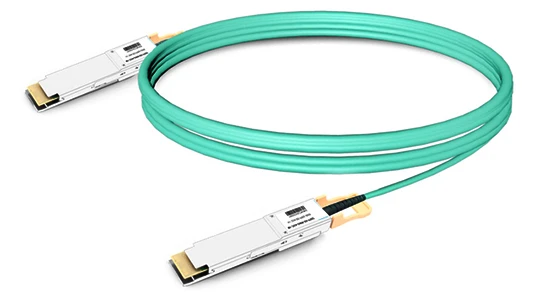

In today’s data‑driven world, the demand for higher bandwidth, lower latency, and more efficient data center interconnects continues to accelerate. To meet these demands, network architects and engineers are increasingly turning to Active Optical Cables (AOCs). Among these, the 800G AOC cable stands out as a cutting‑edge solution, delivering massive throughput in a compact, reliable form factor. This blog explores what an 800G AOC cable is, how it works, its key features, and why it’s becoming indispensable in modern high‑performance networks.
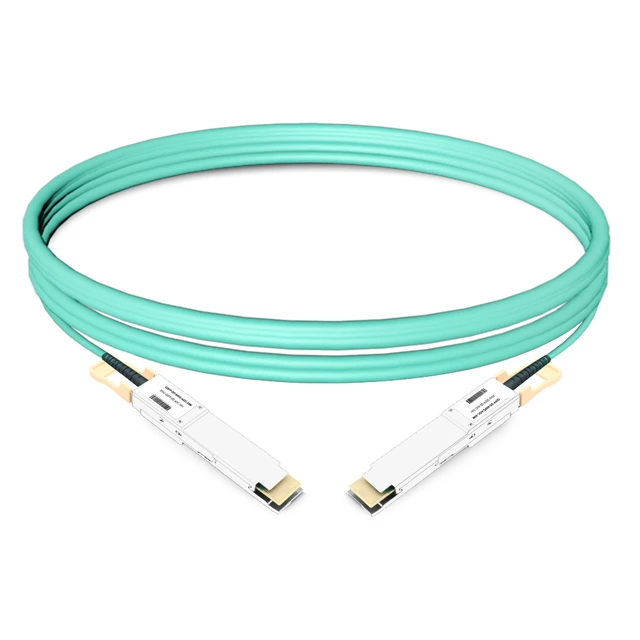
What Is an 800G AOC Cable?
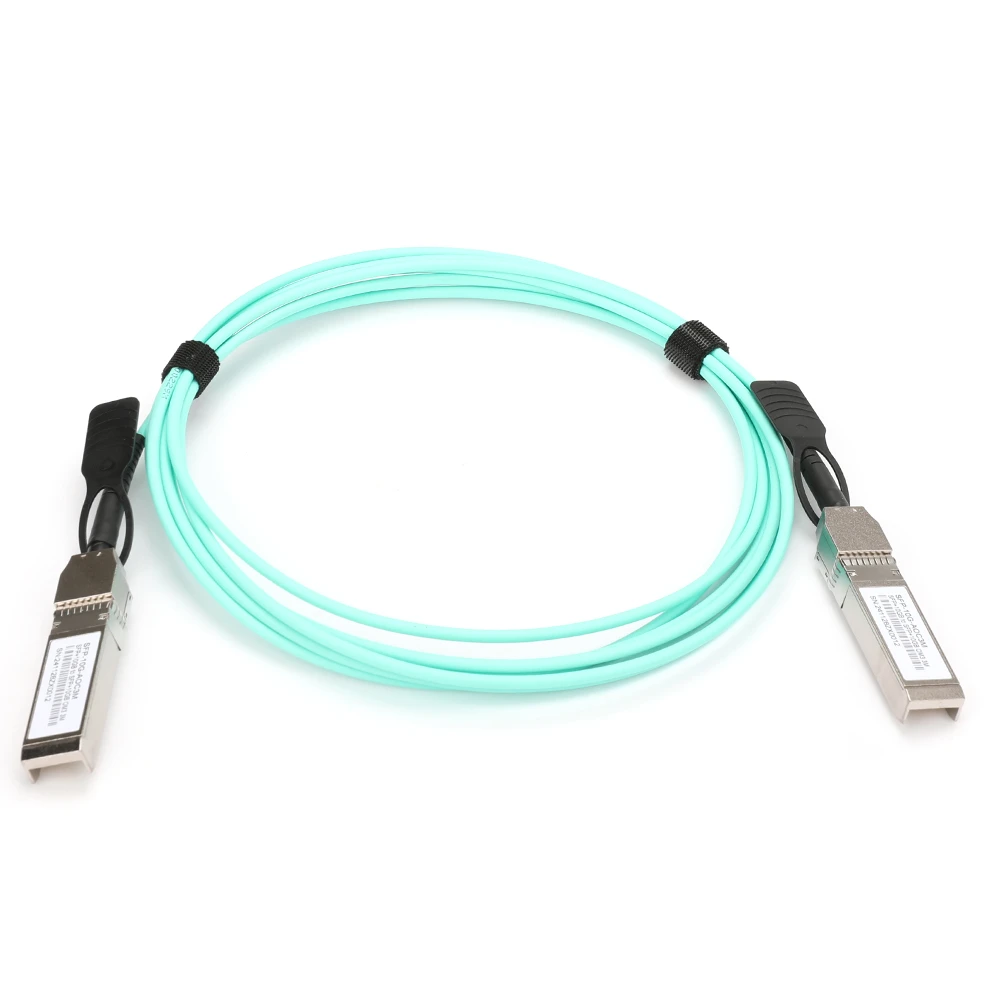
An 800G AOC cable is a factory‑terminated, fiber‑based interconnect that integrates optical transceivers with multimode or single‑mode fiber in a single assembly. Unlike traditional copper Direct‑Attached Cables (DACs), AOCs convert electrical signals to optical signals at the cable ends, allowing data to travel over fiber with minimal signal degradation and far greater reach. At 800 gigabits per second (Gbps), these cables support eight lanes of 100G (or four lanes of 200G) transmission, enabling ultra‑high‑speed links between switches, routers, storage arrays, and servers within data centers and enterprise environments.
How 800G AOC Cables Work
- Electrical‑to‑Optical Conversion
- At each end of the AOC, a small pluggable module contains a transceiver that converts incoming electrical data streams into modulated laser light pulses.
- Optical Transmission
- The light pulses travel through embedded multimode or single‑mode fiber strands. Multimode fiber is common for short‑reach (up to 100 m) applications, while single‑mode fiber extends reach beyond that, often up to 500 m or more.
- Optical‑to‑Electrical Conversion
- Upon reaching the opposite end, another optical transceiver converts the light back into electrical signals, which are then fed directly into the networking equipment’s electrical interface.
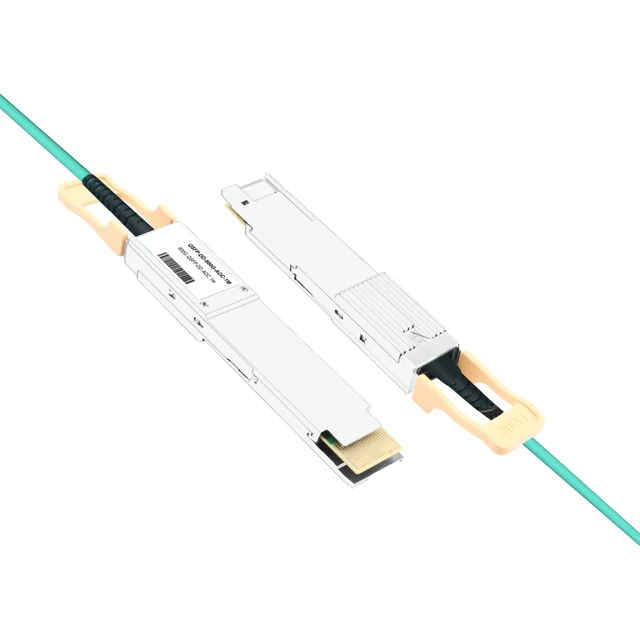
By integrating transceivers and fiber into one assembly, AOCs simplify deployment: there’s no need for separate SFP/QSFP modules and external patch cords, reducing points of failure and saving rack space.
Key Features of 800G AOC Cables
- High Bandwidth: Supports 800 Gbps aggregated throughput, suitable for next‑generation spine‑leaf architectures.
- Compact Form Factor: QSFP-DD or OSFP connector types, with an overall cable diameter typically under 5 mm, enable dense port deployment.
- Low Power Consumption: Optical transmission requires less power per bit compared to copper DACs at equivalent speeds.
- Longer Reach: Multimode variants can reach up to 100 m, while single‑mode versions extend well beyond typical data‑center interrack distances.
- Hot‑Pluggable: Like standard pluggable optics, AOCs support hot swapping without disrupting network uptime.
- EMI Immunity: Fiber‑optic designs are inherently immune to electromagnetic interference, ensuring stable signal integrity in noisy environments.
- Reduced Heat: Efficient optical transceivers generate less heat than equivalent copper solutions, easing cooling requirements.
Benefits for Data Centers and Enterprises
- Scalability
- As data centers grow, 800G AOCs allow operators to scale bandwidth without expanding physical footprint. High‑density QSFP‑type ports support hundreds of terabits in a single rack.
- Cost Efficiency
- Although initial per‑unit cost may be higher than copper DACs, total cost of ownership (TCO) benefits emerge through lower power bills, reduced cooling needs, and simplified cabling infrastructure.
- Simplified Cabling
- Factory‑terminated AOCs eliminate manual fiber‑polishing steps and reduce the risk of installation errors. There’s no need for fiber patch panels or additional transceivers.
- Future‑Proofing
- Investing in 800G‑capable infrastructure ensures readiness for emerging applications such as AI/ML clusters, high‑frequency trading platforms, and next‑generation cloud services that demand extreme throughput.
Typical Applications
- Spine‑Leaf Topologies
- High‑speed interconnects between leaf and spine switches to minimize bottlenecks in east‑west traffic flows.
- High‑Performance Computing (HPC)
- Linking GPU or FPGA clusters in research, simulation, and AI training workloads where every nanosecond of latency counts.
- Storage Area Networks (SANs)
- Connecting NVMe‑over‑Fabric appliances, all‑flash arrays, and backup nodes with ultra‑low‑latency paths.
- Telecommunications Aggregation
- Backhaul aggregation in edge and central offices, where space is at a premium and interference can be an issue.
- Data Center Inter‑Building Links
- Single‑mode AOCs can bridge adjacent buildings in campus data centers without external transceivers or patching infrastructure.
Deployment Considerations
- Compatibility
- Ensure that your switches, routers, or NICs support the specific AOC connector type (QSFP‑DD, OSFP) and speed grade (800G).
- Reach Requirements
- Choose multimode or single‑mode fiber varieties based on your maximum link distances. Multimode is cost‑effective for short runs; single‑mode addresses longer spans.
- Power Budgets
- Verify that your equipment can handle the AOC’s power consumption, typically in the range of 8 W to 10 W per cable.
- Thermal Management
- Even though AOCs run cooler than copper equivalents, high‑density port configurations may still require enhanced airflow and rack cooling strategies.
- Future Upgrades
- Plan for potential migration to 1.6 Tbps optical links or next‑generation form factors by ensuring that cabling pathways and port densities can accommodate future modules.
The Future of 800G and Beyond
As data consumption continues its exponential climb, 800G AOCs represent a stepping stone toward even higher speeds—1.6 Tbps and 3.2 Tbps interconnects are already in development. The evolution of connector standards, silicon photonics integration, and cost reductions will further cement optical cables as the backbone of tomorrow’s network fabrics.
Conclusion
The 800G AOC cable is a powerful, compact, and cost‑effective solution for achieving ultra‑high‑speed connectivity in modern data centers and enterprise networks. By combining the benefits of optical transmission with the convenience of factory‑terminated assemblies, these cables enable scalable, reliable, and energy‑efficient interconnects. Whether you’re designing a next‑generation spine‑leaf topology or linking HPC clusters, 800G AOCs are poised to deliver the performance and density that tomorrow’s applications demand.


























Sign in to leave a comment.