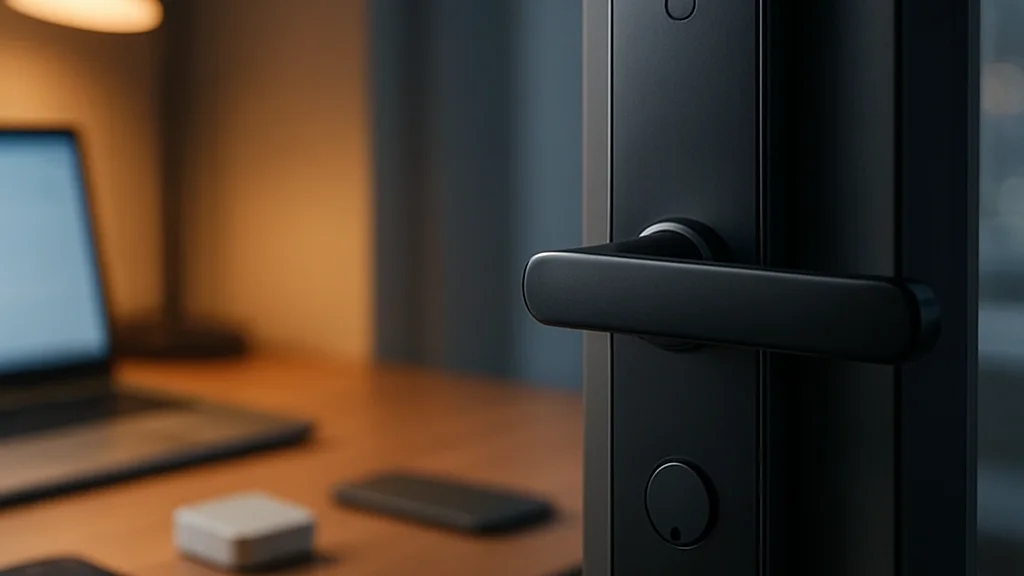

Why would a door lock matter to your workday?
You are on a client call, camera on, screen share live, brain fully locked into the moment, and then the delivery buzzer hits, the dog starts barking, and someone in the house cannot find their key. That tiny domestic interruption? It is exactly the kind of friction remote workers underestimate until it wrecks focus. This is where the Aqara Smart Lock U400 gets interesting. Not because smart locks are new. They are not. What is new is how aggressively this model pushes hands-free entry into the mainstream Apple-centric smart home, and why that matters for people whose office is now a living room, spare bedroom, or kitchen table.
The U400 arrived with a clear pitch: make access feel invisible. Support for Apple Home Key, a design built around modern deadbolt replacement, and a feature set aimed at reducing key fumbling put it in the middle of a category that has matured fast since 2023. According to 9to5Mac’s review of the Aqara U400, the lock stands out because it brings a more futuristic HomeKit experience into a price band that feels less elite than some earlier smart-entry products. The Verge also highlighted that positioning when it covered a sale on the device, emphasizing its Apple Home Key readiness and UWB support in the context of value.
That sounds like consumer-tech hype until you place it inside a remote work routine. Then it becomes practical, almost boring in the best possible way! If your productivity system depends on reducing context switching, then the front door is part of your workflow. A lock that opens quickly, reliably, and without a scramble for keys can shave off micro-disruptions all week long. I have seen remote workers obsess over keyboards, noise-canceling headphones, and desk lamps while ignoring the entry points that generate household chaos. Strange choice! The U400 makes a strong case that physical access is now part of digital productivity infrastructure.
For remote workers, the best smart home tech is not the flashiest. It is the tech that removes interruptions before they become mental residue.
That is the frame for this review: not merely whether the Aqara U400 is a good lock, but whether it earns a place in a serious remote-work setup. On that question, the answer is more nuanced than fanboy praise, but still very positive.
How the U400 fits into the smart lock race
The smart lock market in 2026 is crowded, but the crowd has split into recognizable camps. One camp chases broad compatibility and lots of unlocking methods. Another focuses on premium industrial design. A third is now racing toward frictionless entry, where the ideal user experience is that you barely think about the lock at all. Aqara wants the U400 in that third camp, and the strategy is clever.
Historically, smart locks won attention through keypad convenience, app control, and temporary access codes. Those features still matter, especially for shared households, cleaners, dog walkers, and short-term visitors. But the category’s emotional selling point has shifted. Consumers increasingly expect the lock to recognize them rather than wait for deliberate interaction. Apple Home Key accelerated that expectation by turning the iPhone or Apple Watch into a credential. Once users get used to tapping a device instead of reaching for keys, going back feels weirdly ancient, like paying cash after years of contactless cards.
Aqara’s timing also matters. The company has spent years building a reputation around value-forward smart home gear, often undercutting rivals without stripping away the features enthusiasts actually care about. In the U400, that formula meets a market where users are more educated about Matter, Thread, UWB, and ecosystem lock-in than they were even two years ago. Buyers now ask sharper questions: Will this work if I switch platforms? How fast is the unlock? What happens if my internet drops? Can I automate around it? Those are not niche concerns anymore.
PCMag UK’s 2026 smart lock roundup places the broader category in a highly competitive context, with premium and midrange brands all fighting for attention on reliability, app quality, and ecosystem support. That matters because the U400 is not entering a vacuum. It is competing against products from companies with stronger name recognition in some markets. Yet reviews from Droid Life and 9to5Mac suggest Aqara has done something hard: it has made a lock that feels less like a compromise product and more like a serious alternative.
If you want a wider product-context read before buying, WriteUpCafe has also covered the device in What You Need to Know About Aqara Smart Lock U400 and Rethinking the Aqara Smart Lock U400: Hands-Free Unlocking Perfected. Those pieces help situate the U400 inside Aqara’s broader smart-home play.
Seen from Frankfurt, where apartment entry systems and door hardware can be maddeningly inconsistent, I find the American deadbolt-centric smart lock boom fascinating. It is not just about convenience. It is about making the threshold of the home programmable. For remote workers, that threshold is now the border of the office too.
What the Aqara U400 actually gets right
The U400’s strongest feature is obvious: hands-free unlocking that feels close to the promise smart lock marketing has been making for years. Not perfect. Not magical. But close enough that it changes behavior. The combination of Apple Home Key support and modern proximity-oriented convenience means many users can stop thinking about keys as an everyday object. That is a big win, and not only because it feels cool on day one like a viral TikTok gadget demo. It remains useful on day 100, which is the real test.
According to 9to5Mac, the lock delivers a notably futuristic HomeKit experience. The Verge’s coverage of a 2026 sale specifically called out the U400 as the first Apple Home Key-ready smart lock with UWB, underscoring why the product has drawn so much attention among Apple users. UWB matters because it can improve spatial awareness and make device interactions feel more precise, though real-world performance always depends on environment, phone model, and setup. Aqara is clearly aiming for a smoother authentication experience than older Bluetooth-only routines that sometimes felt hesitant or clumsy.
Here is where the lock shines for productivity-minded households:
- Fast re-entry during work breaks: taking out trash, grabbing a package, or walking the dog no longer requires a pocket check for keys.
- Cleaner household coordination: family members, roommates, or trusted visitors can get in without derailing your concentration.
- Reduced cognitive clutter: one less recurring “don’t forget” task means fewer tiny mental interruptions.
- Automation potential: entry and exit states can tie into lights, cameras, or home/away routines depending on ecosystem setup.
The hardware itself also benefits from Aqara’s practical design instincts. Smart locks fail when they feel flimsy, overcomplicated, or visually cheap. Reviews indicate the U400 avoids that trap. Droid Life, in particular, framed it as a product capable of replacing an existing Nest smart lock in daily use, which is not a trivial endorsement. Replacement stories are often more useful than first-impression praise because they reveal whether a device can displace habits users already trust.
There is another point remote workers should care about: fallback methods. A smart lock must not become a single point of failure. Reliable physical access options, battery awareness, and local operation matter more than app gimmicks. Aqara has generally understood this balance across its product line. The U400’s appeal is not merely that it unlocks hands-free; it is that it still behaves like a serious piece of entry hardware rather than a toy attached to a deadbolt.
The smartest lock is the one that disappears into routine. If you keep noticing it, something is probably wrong.
That does not mean there are no trade-offs. Apple users are likely to get the richest experience. Cross-platform households may need to think harder about how much of the lock’s headline value they can actually use. But for the right buyer, the U400 nails the part that counts most: it turns unlocking from an action into a background process.
Where the U400 helps remote work and where it does not
Here is the part too many gadget reviews skip: productivity claims need proof through behavior, not vibes. So let us test the Aqara U400 against common remote-work pain points. If your day includes deep work blocks, back-to-back video meetings, package deliveries, childcare handoffs, or shared-home logistics, then access control has a measurable effect on focus. Every interruption carries a restart cost. Cognitive science research has long shown that task switching is expensive, even when the interruption itself looks small. A front-door problem is rarely just a front-door problem; it is a chain reaction.
The U400 helps most in these scenarios:
- Solo workers expecting deliveries: you can handle quick entry and re-entry with less friction, especially if your hands are full.
- Shared households: temporary or scheduled access reduces “can you open the door?” texts during work hours.
- Hybrid professionals: arriving home from commuting, the transition into home-office mode becomes smoother and faster.
- Service access management: cleaners, pet sitters, or maintenance visits can be managed more cleanly than hiding a key.
There is also a subtle psychological effect. When home access becomes more predictable, the home itself feels more operationally stable. That sounds abstract, but anyone who has tried to work through domestic unpredictability knows exactly what I mean. Small systems create calm. Calm protects concentration.
Still, the lock is not a universal productivity booster. If you live alone, rarely receive visitors, and already have a smooth entry routine, the gains may be modest. Likewise, if your household is not invested in Apple devices, the U400’s headline strengths may not land with full force. A smart lock can remove friction, but it cannot fix a noisy apartment, weak boundaries, or chaotic home management. It is one tool, not a miracle.
Security-conscious professionals should also think about threat models, not just convenience. Smart locks add software, radios, and account dependencies to a category once defined by mechanical simplicity. That does not automatically make them unsafe; in many cases, they can improve access management. But it does mean users should maintain firmware updates, strong account security, and sensible sharing practices. Convenience without discipline is how smart homes become messy.
For readers comparing angles, WriteUpCafe’s Aqara Smart Lock U400 Review: Best Hands-Free Entry and Aqara Smart Lock U400 Review: Hands-Free Unlocking at Its Best both explore how the lock’s convenience story translates into everyday use. My view is slightly narrower and maybe harsher: if it does not save your attention, it does not deserve desk-space conversation. The U400 mostly passes that test.
What changed recently and why 2026 matters
Smart locks in 2026 are not where they were in 2024. The conversation has shifted from “can I unlock this with my phone?” to “how native does this feel inside my ecosystem?” That is a major difference. Consumers are less impressed by raw feature counts and more sensitive to latency, reliability, and integration quality. Aqara’s U400 arrives at a moment when users expect credential-based entry to work like mobile payments: quick, familiar, and nearly invisible.
The 2026 coverage around the U400 reflects that shift. The Verge’s report on a sale may sound commerce-oriented, but editorially it pointed to something important: the lock’s combination of Apple Home Key readiness and UWB support is noteworthy enough to define its identity. That is not random marketing language. It signals that the product is being judged on how advanced its access experience feels, not merely on whether it has an app. Meanwhile, 9to5Mac’s April 2026 review framed the device as HomeKit’s futuristic lock finally arriving in practical form. For Apple-heavy households, that kind of framing matters because it positions the U400 as part of a maturing platform, not a one-off accessory.
Droid Life’s May 2026 review added another useful layer by emphasizing replacement value. When a reviewer says a new smart lock replaced an existing Nest lock, that tells us the market is no longer just adding gadgets; it is entering a phase of switching and consolidation. Users are now willing to migrate if the unlock experience is clearly better. That is a sign of category maturity.
Several broader 2026 developments shape the U400’s appeal:
- Ecosystem consolidation: buyers increasingly choose products that fit their phone, watch, and automation stack.
- Expectation of local resilience: internet-independent basics and stable local communication matter more than cloud flash.
- Security scrutiny: consumers are more alert to firmware support, credential handling, and platform trust.
- Price sensitivity: premium smart-home features must justify themselves against a softer consumer spending mood in many markets.
That last point is crucial. Smart home purchases now compete with practical budget pressures. A lock like the U400 needs to prove that it is not just a flex for tech Twitter. It has to feel like infrastructure. The good news for Aqara is that convenience tied to access control is easier to justify than, say, another decorative smart light. Entry is essential. If the experience is materially better, people notice immediately.
And yes, social media absolutely shapes this category. A product that demos well on video gains momentum fast. But unlike some overhyped home gadgets, the U400’s core trick is not spectacle. It is consistency. That gives it a better chance of lasting beyond the trend cycle.
Security, installation, and the boring details that actually matter
A lock review that ignores installation and security discipline is basically cosplay, so here comes the less glamorous part! Smart locks live or die on setup tolerance. If installation is annoying, alignment is fussy, or calibration feels unstable, user trust erodes before the first week ends. Aqara has an advantage here because it is not trying to reinvent the entire door; it is building around a familiar deadbolt-replacement model. That lowers psychological friction for buyers stepping up from traditional hardware.
Installation quality affects everything afterward. A slightly misaligned door can make even smart software look stupid. This is why some user complaints across the category are not really software complaints at all; they are door-frame problems wearing a tech disguise. Anyone considering the U400 should inspect door alignment, deadbolt travel, and strike plate condition before blaming the lock for every hiccup. Boring? Yes. Essential? Also yes.
On security, practical habits matter more than forum drama. Start with the basics:
- Use strong, unique credentials for the account tied to your smart-home ecosystem.
- Enable two-factor authentication wherever available.
- Keep firmware updated.
- Review who has access and remove stale guest permissions.
- Maintain backup entry options and monitor battery status.
Those steps sound obvious, but many households skip them. Then a smart lock gets blamed for failures caused by sloppy account hygiene. The U400 is best treated like any other security-sensitive endpoint in a connected home. If you would secure a work laptop carefully, secure the device controlling your front door with the same seriousness.
There is also an often-missed privacy angle for remote workers. Home access logs can become useful household records. They can show when cleaners arrived, whether a family member got home, or when a package pickup happened. That data can improve household coordination, but it also deserves discretion. Smart homes generate behavioral traces. Mature users treat those traces thoughtfully.
Compared with many flashy productivity products, the U400’s “boring details” are where it earns credibility. It is not enough to unlock elegantly once. It needs to perform every day, under stress, with low drama. Reviews from mainstream tech outlets suggest Aqara has taken that reliability challenge seriously, and that is exactly what this category needs.
Final verdict: who should buy the Aqara U400?
The Aqara Smart Lock U400 is not just a good smart lock. For the right household, it is a smart lock that meaningfully improves the rhythm of remote work. That distinction matters. Plenty of connected gadgets are nice to have. Fewer become part of the invisible machinery that keeps a work-from-home day running smoothly. The U400 belongs closer to that second group.
Its best audience is clear. If you are deep in Apple’s ecosystem, value low-friction entry, and want home access to stop interrupting your concentration, this lock makes a compelling case. The combination of Apple Home Key support, modern convenience, and Aqara’s value-oriented positioning gives it a strong identity in a crowded field. Reviews from 9to5Mac and Droid Life support that conclusion, while The Verge’s coverage reinforces how unusual it is to see this level of Apple-centric smart-entry ambition at a more accessible price point.
You should seriously consider the U400 if these points describe you:
- You work from home and hate being interrupted by door logistics.
- You share your home with family, roommates, or regular service visitors.
- You already use Apple devices and want native-feeling access control.
- You care more about practical reliability than luxury branding.
You may want to pause if you are platform-agnostic, have minimal household traffic, or prefer absolute mechanical simplicity over connected convenience. The U400 is strongest when integrated into a broader routine. If you will never use its ecosystem strengths, part of the value proposition disappears.
My verdict? The Aqara U400 gets unusually close to the smart-home ideal: remove a recurring annoyance so thoroughly that the user stops noticing the problem ever existed. For remote workers, that is gold. Focus is fragile. Domestic friction is sneaky. A front door that cooperates with your day instead of interrupting it is not trivial at all. It is infrastructure, and the U400 understands that better than most.
And honestly, that is why this lock stands out. Not because it is loud, but because it makes your life quieter. For a product sitting on the boundary between home and work, that is exactly the right kind of flex!

























Sign in to leave a comment.