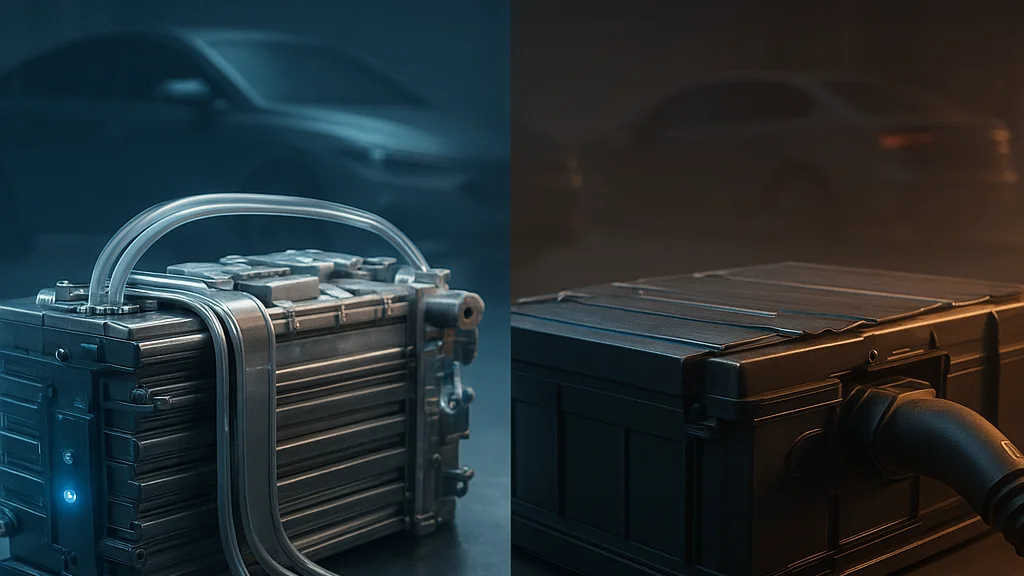

On a hot afternoon in Riyadh, the difference between hydrogen fuel cell vehicles and battery electric cars can feel less like a classroom topic and more like a practical question about time, infrastructure, and national strategy. One car promises quick refueling, almost like petrol. The other promises simpler engineering, better efficiency, and a charging network that is expanding much faster. For beginners, both can look like clean alternatives with zero tailpipe emissions. But under the skin, they are not twins. They solve transport electrification in very different ways.
Battery electric vehicles, or BEVs, store electricity directly in a battery pack and send it to electric motors. Hydrogen fuel cell vehicles, often called FCEVs, carry compressed hydrogen in tanks, then use a fuel cell to convert that hydrogen into electricity onboard. The result in both cases is electric drive, quiet performance, and no exhaust pollution from the tailpipe. Yet the energy pathway, cost structure, and infrastructure needs are very different, and those differences matter a lot for drivers, fleet operators, and policymakers across the Gulf.
For readers who want a broader companion read, WriteUpCafe has also published Complete Guide to Hydrogen Fuel Cell Vehicles vs Battery Electric in 2026 and Hydrogen Fuel Cell Vehicles vs Battery Electric: The Real EV Divide. This article takes a beginner-friendly route, but with serious analysis, because the subject is now tied to industrial policy, logistics, and energy transition plans from East Asia to the Middle East.
Saudi Vision 2030 gives this debate extra meaning. The Kingdom is investing in EV manufacturing, renewable power, and hydrogen production, while traditional energy giants such as Aramco are also studying lower-carbon fuels and new mobility chains. So the right beginner question is not only, “Which technology is better?” It is also, “Better for whom, and under what conditions?”
Battery electric and hydrogen fuel cell vehicles are not direct copies of each other. They are two different answers to the same problem: how to move people and goods with less oil burning and lower emissions.
How the two systems work, in plain language
A battery electric car is easier to understand because the energy path is shorter. You charge a battery from the grid, the battery stores electricity, and the motor uses that electricity to move the wheels. There are losses, yes, but the chain is direct. This is one reason BEVs have become the dominant form of passenger EV in most markets. Tesla helped create scale, but now the field is broad, from BYD and Hyundai to BMW, Mercedes-Benz, Lucid, Geely brands, and many others.
A hydrogen fuel cell vehicle adds more steps. Hydrogen is produced first, usually from natural gas today or from electrolysis in cleaner pathways. That hydrogen is compressed, transported, stored at a fueling station, and pumped into the vehicle. Inside the car, the fuel cell combines hydrogen with oxygen from the air to produce electricity, with water vapor as the main byproduct. The vehicle then powers an electric motor, often with a small battery buffer for efficiency and regenerative braking.
According to The Hindu’s explainer on hydrogen fuel cell technology, the basic chemistry is simple enough for school textbooks, but commercial deployment is much harder because storage, transport, and fueling systems are expensive and technically demanding. Hydrogen must usually be stored at very high pressure in road vehicles, commonly around 700 bar for passenger cars.
That complexity does not make hydrogen useless. It only means it is more sensitive to use case. For a private driver with home charging, a BEV is often the easier answer. For heavy-duty transport where downtime is costly and payload matters, hydrogen can become more attractive. This is why many automakers that once talked about hydrogen for family cars are now speaking more carefully and focusing on trucks, buses, and commercial fleets.
- BEV energy path: grid electricity, battery storage, electric motor.
- FCEV energy path: hydrogen production, compression and transport, onboard fuel cell, electric motor.
- Shared feature: both are electric-drive vehicles with zero tailpipe CO2 emissions during use.
- Main difference: BEVs store electricity directly, FCEVs make electricity onboard from hydrogen.
Why battery electric cars pulled ahead so fast
The market has already voted, at least for passenger vehicles. BEVs are far ahead in sales, model availability, charging investment, and manufacturing scale. This did not happen by accident. Battery costs fell sharply over the past decade, charging standards improved, and governments in China, Europe, and North America backed deployment with subsidies, mandates, and industrial support. Even where policy support has become less generous, the installed base and supply chain are now very large.
Hydrogen passenger cars never reached that momentum. The Toyota Mirai and Hyundai Nexo became the most visible examples, but volumes remained small. Refueling stations were limited, fuel prices were often high, and model choice was narrow. According to Reuters reporting over the past several years, and echoed by industry analysts, automakers became more selective about where hydrogen belongs. The center of gravity shifted away from mass-market passenger cars and toward heavier transport.
Efficiency is the other big reason. If renewable electricity is available, using it directly in a BEV usually moves the car farther than converting that same electricity into hydrogen, compressing it, transporting it, and then converting it back into electricity inside a fuel cell. This “well-to-wheel” disadvantage is not a small detail. It affects national energy planning, infrastructure cost, and operating economics.
That does not mean BEVs are perfect. Charging can be slow compared with liquid fueling, apartment dwellers may not have easy access to home charging, and battery weight can be a challenge for larger vehicles. But scale creates its own advantage. More BEVs on the road mean more chargers, more service knowledge, more battery factories, and more competition. That lowers prices over time, inshallah, and makes adoption easier for ordinary buyers.
For passenger cars, battery electric has become the mainstream path not because hydrogen failed scientifically, but because batteries won the race on scale, efficiency, and infrastructure.
If you want another angle on this market split, WriteUpCafe’s Expert Tips for Choosing Between Hydrogen Fuel Cell and Battery Electric Vehicles offers a useful consumer-focused comparison, while 2026 Trends in Hydrogen Fuel Cell Vehicles vs Battery Electric Cars tracks where momentum is building.
The practical comparison beginners should remember
When newcomers compare these technologies, they often focus only on range. That is understandable, but it is incomplete. The better comparison includes efficiency, refueling time, infrastructure access, cost of ownership, and intended use. A hydrogen car can refuel in a few minutes, which sounds excellent. Yet if there are only a handful of stations in your region, that convenience becomes theoretical. A BEV may take longer to recharge, but if you can charge overnight at home or at work, the time burden can feel much smaller in real life.
Range also depends on vehicle class and driving conditions. Many modern BEVs now offer ranges that are acceptable for daily driving and intercity trips, especially with fast charging networks improving. Hydrogen cars can also offer competitive range, but the station map matters more than the brochure. California, Japan, South Korea, Germany, and a few other places built some hydrogen mobility infrastructure, but coverage remains thin compared with electric charging.
Cost remains a major dividing line. Battery electric cars have become available across more price bands, though affordability is still a challenge in many markets. Hydrogen vehicles are typically expensive to build because fuel cells, carbon-fiber tanks, and low production volumes keep costs high. Hydrogen fuel itself can also be costly at the pump, depending on local subsidy and supply conditions.
- Efficiency: BEVs generally convert more of the original electricity into motion.
- Refueling or charging time: FCEVs win at the station, BEVs can win in convenience if home charging exists.
- Infrastructure: BEV charging is much more widespread globally.
- Vehicle cost: BEVs now have far more scale and model choice.
- Best fit: BEVs suit most private car users, FCEVs may suit intensive commercial duty.
There is also maintenance and system complexity. BEVs have fewer moving parts than internal combustion cars and no fuel cell stack or hydrogen storage system. Fuel cell vehicles are still electric vehicles in some respects, but they add another layer of hardware and infrastructure. For fleet managers, this means training, parts planning, and station partnerships become important.
For a beginner, one simple rule is useful: if your life revolves around predictable daily driving and charging access, battery electric is usually the easier starting point. If your operation values rapid refueling, long utilization hours, and centralized fleet fueling, hydrogen deserves a closer look.
What automakers are doing in 2026
The industry position in 2026 is clearer than it was a few years ago. Most automakers are investing heavily in BEVs for passenger cars, while treating hydrogen as a strategic option for commercial transport, industrial mobility, and selected premium or demonstration projects. That is a more disciplined approach than the broad hydrogen optimism seen earlier.
Toyota remains one of the strongest hydrogen advocates, but even Toyota has sharpened its focus. According to Just Auto, Toyota has shifted more hydrogen fuel cell attention toward commercial vehicles, where the technology may have stronger economics. This is a meaningful signal. It suggests that even a company deeply committed to hydrogen sees the heaviest opportunity in trucks, buses, and logistics operations rather than in mass passenger adoption.
That direction is reinforced by partnerships in trucking. New Atlas has described the wider push involving Toyota and support from major truck-related fuel cell efforts such as Cellcentric, the Daimler Truck and Volvo Group joint venture. The point is not that hydrogen trucks have already won. The point is that the strongest industrial logic now sits there.
BMW also continues hydrogen development, though cautiously. A recent Carsguide report discussed advances linked to the future BMW iX5 Hydrogen and a possible 2028 timeline for broader progress. The details should be read carefully, because concept announcements are not the same as mass-market rollout. Still, BMW’s persistence shows that some premium manufacturers want to keep hydrogen capability alive as a hedge against battery constraints, charging bottlenecks, or future policy shifts.
Meanwhile, BEV competition has become intense. Chinese brands continue to pressure global markets on cost and features, and legacy automakers are trying to improve software, charging speed, and battery sourcing. In pure passenger-car momentum, the center of the story remains battery electric.
Where hydrogen may make more sense than batteries
Hydrogen often loses the headline battle in passenger cars, but it can still win important niches. Heavy trucks are the clearest example. A long-haul truck carrying a very large battery may face weight penalties, charging downtime, and grid connection challenges at depots. A hydrogen fuel cell truck can potentially refuel faster and keep more payload capacity if the fueling network exists. That “if” is crucial, but in freight corridors with concentrated demand, the infrastructure challenge is less impossible than in scattered private-car use.
Buses are another candidate, especially in cities or regions that want zero tailpipe emissions but need long daily operation with limited downtime. Some transit systems have tested both battery buses and hydrogen buses. The better choice often depends on route length, climate, depot layout, and electricity connection capacity. Mining, ports, and industrial logistics can also be suitable because vehicles return to controlled bases where dedicated fueling is easier to justify.
For regions rich in gas, sun, wind, and export ambitions, hydrogen has another appeal. It is not only a vehicle fuel. It is also an industrial feedstock and potential energy carrier. Saudi Arabia, the UAE, Oman, and other Middle Eastern players are studying hydrogen because it connects transport with broader energy strategy. That does not automatically make hydrogen cars common on our roads. But it means hydrogen infrastructure could emerge first around industry, freight, and ports, then possibly spill over into mobility applications where economics work.
- Best hydrogen cases: long-haul trucking, buses, ports, mining, and centralized fleets.
- Best battery cases: private cars, urban delivery vans, ride-hailing, and daily commuting.
- Regional factor: countries building hydrogen export industries may create local mobility pilots as side benefits.
According to the MSN explainer on the future of hydrogen fuel cell vehicles, the technology still has advocates because quick refueling and long range remain attractive. That is true, but the strongest argument is no longer “hydrogen for every car.” It is “hydrogen where batteries struggle or where fleet economics can support dedicated infrastructure.”
The Middle East angle, from energy giant to mobility chain
From Riyadh, this debate looks different than it does in Oslo or California. The Gulf is not only a consumer of transport technologies, it is becoming a producer of energy transition inputs. Green hydrogen projects, blue hydrogen discussions, large solar builds, and industrial diversification all shape how policymakers think. Saudi Vision 2030 is not simply about replacing one car type with another. It is about creating new sectors, local manufacturing, and smarter use of energy resources.
That is where companies like Aramco remain important, even when the public conversation is focused on batteries. Traditional energy giants understand molecules, logistics, and large infrastructure. They can influence hydrogen economics, especially in production and transport. At the same time, battery electric mobility is moving fast in urban passenger transport, and that creates pressure for charging networks, grid upgrades, and local assembly ambitions.
The beginner should understand one subtle point. A country may support both technologies without contradiction. Battery EVs can serve city drivers and private households. Hydrogen can target heavy transport, industrial fleets, and export-linked ecosystems. This dual-track strategy is more realistic for the Middle East than copying a single model from Europe or the United States.
There are still hard questions. Can green hydrogen become cheap enough for mobility? Will hydrogen stations achieve enough utilization to justify investment? Can hot-climate charging systems and battery durability continue improving for Gulf conditions? Those questions are open, but they are now being asked inside a much broader industrial plan, not as isolated car-market curiosities.
For the Middle East, the hydrogen versus battery debate is not only about consumer choice. It is about how transport fits into a larger energy and industrial transition.
What beginners should watch before choosing a side
Newcomers often want a final verdict, one winner for all situations. The market does not work that neatly. What matters is matching technology to need. If you are a private buyer, ask practical questions first. Can you charge at home? Is there reliable public charging on your routes? What is the real purchase price after incentives or financing? How strong is after-sales support? In most cases today, the battery electric answer will look stronger because the ecosystem is simply more mature.
If you are evaluating fleet strategy, the checklist changes. You need to calculate vehicle utilization, depot energy access, downtime cost, route predictability, and fuel supply contracts. In some operations, especially where trucks run hard and continuously, hydrogen may become competitive. In others, depot-charged battery fleets will be cheaper and easier.
By 2026, the most important recent change is not a dramatic hydrogen breakthrough in passenger cars. It is the clearer segmentation of the market. Batteries are consolidating leadership in light-duty vehicles. Hydrogen is searching for durable footholds in heavy-duty and industrial use. That clarity is healthy. It removes some confusion and helps investors spend more wisely.
For readers who want one final comparative resource, WriteUpCafe’s Hydrogen Fuel Cell Vehicles vs Battery Electric: A 2026 Comparative Analysis expands on cost and market trends in a more side-by-side format.
My own conclusion is simple. For beginners, start by seeing both as electric mobility branches, not enemies. Then ask where the energy comes from, how the vehicle is refueled, and whether infrastructure exists where you live or operate. For most passenger drivers, battery electric is the practical path today. For freight and selected commercial sectors, hydrogen still has a serious case. The future may not belong to one technology alone. It may belong to a smarter division of labor, and that would be a very Gulf-style solution, pragmatic, diversified, and built around real economic strengths, inshallah.




























Sign in to leave a comment.