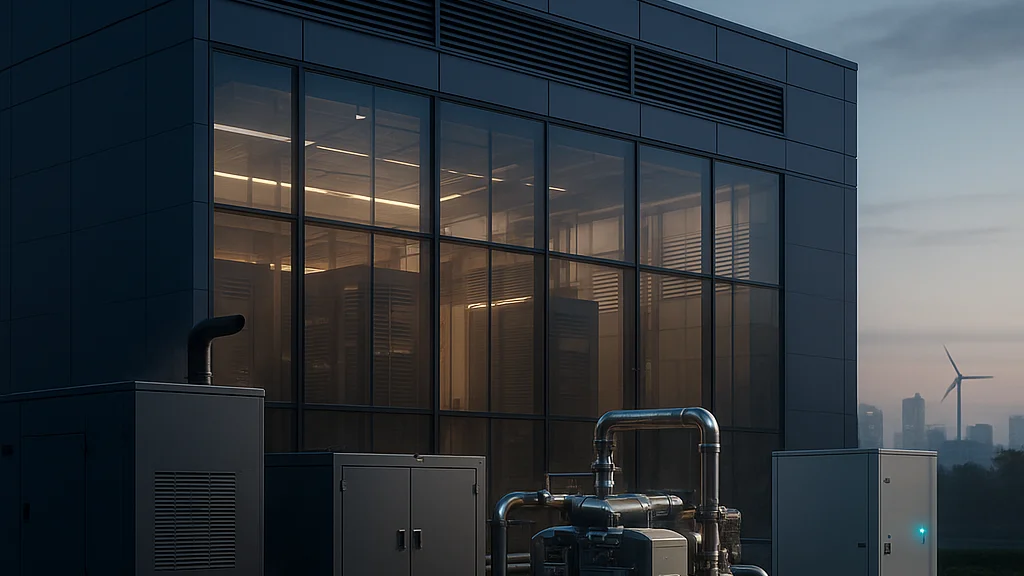

A clean-tech story with a fossil-fuel engine
The image is jarring because it cuts against a decade of tech-sector storytelling. A company that has spent years presenting itself as a climate leader is now tied to a data center whose future power supply depends on a very large gas plant. That tension is not cosmetic. It sits at the center of one of the most consequential energy questions of the AI era: what happens when the world’s appetite for cloud computing, chips, and generative AI grows faster than clean electricity can be built?
Reports over the past year have made the contradiction harder to ignore. According to the Houston Chronicle report republished on MSN, data centers are helping drive a power plant boom in Texas, and the emissions implications could be substantial. That matters well beyond one facility. Texas has become a proving ground for what the next generation of digital infrastructure may look like when utilities, grid operators, and hyperscalers all face the same blunt reality: demand is arriving now, while transmission lines, storage, geothermal, advanced nuclear, and long-duration clean resources are arriving more slowly.
For readers trying to understand the specifics of this debate, WriteUpCafe has already tracked the core controversy in Google-Funded Data Center and the Massive Gas Plant Behind It and the sharper policy critique in Google-Funded Data Center Raises Hard Questions on Gas Power. The larger question now is not whether this is awkward for sustainability branding. It is whether gas-backed data centers represent a short bridge to a cleaner grid, or the beginning of a more carbon-intensive digital economy than many people expected.
When a company buys more computing power than the grid can supply with low-carbon electricity, the shortage does not stay theoretical. It shows up as new combustion turbines, pipeline demand, and higher system emissions.
That is why this story belongs in green-tech coverage, not just business pages. The future of sustainable living increasingly runs through invisible infrastructure: substations, gas interconnects, transmission queues, water permits, and power purchase agreements. If AI is going to shape everyday life, then the energy system beneath AI deserves the same scrutiny as the software on top.
How the industry arrived at this contradiction
For most of the 2010s, the broad direction of travel seemed clear. Major cloud companies signed massive renewable energy deals, improved data center efficiency, and argued that digitalization could help decarbonize the wider economy. There was truth in that. Hyperscale operators became some of the biggest corporate buyers of wind and solar power in the world. Google, Microsoft, Amazon, and Meta all helped create demand for cleaner generation at a scale that would have been hard to imagine twenty years earlier.
Yet two developments changed the tempo. First, the easiest efficiency gains were never going to fully offset explosive growth in computing demand. Second, the AI buildout that accelerated after 2022 created a new class of data center load. Training and running advanced models requires dense clusters of power-hungry chips, more cooling equipment, more backup systems, and often a more rigid expectation of round-the-clock uptime. A search query and a large AI inference task are not the same thing electrically.
Grid planners have been warning about this mismatch. Interconnection queues across the United States remain clogged. Transmission projects can take years to permit and build. Utility-scale solar and wind are still expanding, but they are not always co-located with new data center campuses, and they do not by themselves solve the challenge of matching hourly demand. Batteries have grown quickly, especially in Texas and California, but most are still designed for shorter-duration balancing rather than multi-day reliability coverage.
That is the opening gas developers have moved into. In practice, the pitch is simple: if a hyperscaler wants certainty, speed, and dispatchable power, combined-cycle gas or gas peaker capacity remains one of the fastest bankable options in many U.S. markets. It is not clean, but it is familiar to investors, utilities, and regulators. That is one reason the argument has become so emotionally loaded. The issue is not whether renewable energy works. The issue is whether the institutions around electricity can build enough clean, firm, and flexible supply quickly enough to keep up with AI.
A more nuanced reading is emerging in climate and infrastructure circles. The problem is not one company behaving badly in isolation. The problem is a system that rewards immediate load growth while making cleaner alternatives slower to permit and harder to finance. Readers who want a more detailed framing of that paradox may find useful context in Google’s 2026 Data Center Powered by a Massive Gas Plant: A Sustainable Paradox, which captures how sustainability claims can collide with physical grid limits.
- Corporate clean-energy procurement expanded rapidly in the 2010s and early 2020s.
- AI workloads increased electricity demand faster than many forecasts anticipated.
- Transmission and interconnection bottlenecks slowed the arrival of new clean supply.
- Gas generation remained one of the quickest dispatchable options available at scale.
Why data centers are suddenly reshaping power markets
Data centers used to be large but manageable loads in most regional planning models. That is changing. A single modern campus can require hundreds of megawatts, and the largest proposed developments can stretch into the gigawatt range when fully built out. To put that in plain language, one project can begin to resemble the electricity demand of a mid-sized city. Utilities do not absorb that kind of change casually.
Texas has become the most visible example because it combines rapid population growth, an energy-only market structure, abundant land, strong solar and wind resources, and a business-friendly environment for industrial development. It also has a grid, ERCOT, that has experienced both impressive renewable growth and very public reliability stress. According to the Houston Chronicle report on MSN, the rush of data center demand is contributing to interest in new gas-fired generation, with potentially significant emissions consequences if those plants are built and run at scale.
The economics matter. A hyperscaler or colocation operator values uptime intensely. If renewable contracts cannot guarantee local hourly supply, and if transmission congestion makes imported power uncertain or expensive, the perceived value of on-site or dedicated thermal generation rises. That does not mean every new data center will be directly powered by a gas plant. It does mean that large loads increase pressure for more firm generation somewhere on the system, especially where reserve margins are tightening.
Another force is timing. Investors want projects online quickly. AI demand forecasts are influencing capital expenditure decisions now, not after a decade of grid modernization. Gas plants, though not instant, often fit within a development timeline that markets understand. Advanced nuclear remains promising but commercially limited. Enhanced geothermal has momentum but is still early. Long-duration storage is improving, yet deployment is not broad enough to anchor every large industrial load. The result is a market signal that often points back to gas.
The sustainability problem is not merely that a gas plant emits carbon. It is that long-lived gas infrastructure can lock in planning assumptions, fuel contracts, and political constituencies that outlast the emergency it was built to solve.
This is where green-tech analysis has to stay honest. There is a difference between using gas as a temporary reliability patch and building a durable operating model around fossil-backed digital growth. If the second path wins, the climate math becomes much harder. If the first path is real, then companies need to show credible milestones for reducing gas dependence over time, not simply offsetting it on paper.
- Large AI data centers can demand hundreds of megawatts each.
- Utilities must plan generation, transmission, cooling water, and backup around that load.
- Where clean resources lag, gas becomes the default reliability option.
- Once built, gas assets can influence emissions and investment patterns for years.
The emissions question is bigger than one facility
A gas plant attached directly or indirectly to a major data center raises two environmental questions at once. The first is straightforward: how much carbon dioxide and methane-related climate impact will the facility add compared with a cleaner supply mix? The second is more subtle: what other investments will be delayed, displaced, or deprioritized because gas solved the immediate problem?
Natural gas still emits less carbon dioxide at the smokestack than coal, but that comparison can be misleading in this context. Hyperscalers are not choosing between coal and gas for new capacity. They are choosing among combinations of solar, wind, batteries, demand management, transmission, geothermal, nuclear, and gas. The relevant benchmark is not the dirtiest option from the past. It is the cleanest feasible portfolio that could be built on a realistic timeline.
Methane leakage also complicates the picture. Climate scientists and energy analysts have long argued that upstream methane emissions can materially worsen the footprint of gas-fired electricity. The exact leakage rates vary by basin, measurement method, and enforcement regime, but the principle is well established: gas is cleaner than coal only up to a point, and poor methane control narrows that advantage. For a company with public decarbonization goals, that should matter a great deal.
Then there is water. Thermal plants can require substantial water use depending on technology and cooling systems, while data centers themselves already face scrutiny for cooling demand in water-stressed regions. A gas-backed data center may therefore concentrate multiple environmental pressures in one place: air emissions, water consumption, local pollution concerns, pipeline dependence, and land-use conflict. Those burdens are not distributed evenly. They are felt by host communities first.
That is why a narrow carbon-accounting defense does not fully settle the issue. Companies may point to renewable energy purchases elsewhere, annual matching claims, or broader portfolio decarbonization. Those tools can be meaningful, but they do not erase local combustion if a project’s real-time operation depends on fossil generation. Readers who want to avoid simplistic interpretations may appreciate Common Mistakes When Reading Google’s Gas-Powered Data Center, which helps separate branding language from underlying infrastructure realities.
- Direct impact: combustion emissions from gas-fired electricity generation.
- Indirect impact: methane leakage across production and transport.
- System impact: delayed investment in cleaner firm resources and transmission.
- Local impact: water use, air quality concerns, and community burden.
What changed in 2026
By mid-2026, the conversation has shifted from speculative concern to infrastructure triage. Utilities, regulators, and tech companies are no longer debating whether AI will alter load forecasts. They are debating how severe the strain will be, and who pays for the upgrades. Across North America, utilities have revised demand expectations upward, often citing data centers as a major driver. That has sharpened the politics around new generation far beyond Texas.
One notable change is tone. A few years ago, public messaging from large technology companies leaned heavily on broad clean-energy commitments and long-term carbon-free ambitions. In 2026, that language is still present, but it now coexists with a more pragmatic emphasis on reliability, grid partnerships, and firm capacity. The rhetorical center of gravity has moved. The industry is admitting, sometimes reluctantly, that hourly carbon-free power remains harder to secure at scale than annual renewable matching.
Another change is the policy response. State officials in several markets have become more explicit about attracting data center investment while preserving reliability. That can cut both ways. It may accelerate transmission, storage, and renewable deployment. It may also make approval of gas plants easier if policymakers fear losing jobs and tax revenue to rival states. The same urgency that can speed up clean infrastructure can also speed up fossil infrastructure.
Technology pathways have matured somewhat in 2026, but not enough to erase the gap. Battery deployment continues to expand. Advanced geothermal companies are drawing more investor interest. Small modular reactor discussions remain active, though commercial timelines are still uncertain. Demand flexibility, including curtailment agreements for some computing tasks, is receiving more attention. Yet none of these options has scaled quickly enough to make the gas question disappear.
That leaves companies like Google in a delicate position. Their purchasing power and engineering talent give them unusual leverage to push grids toward cleaner solutions. At the same time, their AI roadmaps create immediate demand that local systems may meet with fossil generation. The future will hinge on whether hyperscalers use their influence to accelerate genuinely cleaner firm power, or settle into a pattern where gas becomes the quiet enabler of digital expansion.
Can a gas-backed data center still fit inside a climate strategy?
The fairest answer is that it depends on what happens next. A single gas-linked project does not automatically invalidate every climate commitment a company has made. But it does raise the burden of proof. If a company claims this is a transitional measure, observers should ask transitional toward what, by when, and under what enforceable milestones.
A credible pathway would include several elements. First, transparent disclosure of expected electricity demand, emissions implications, and operating assumptions. Second, a timetable for replacing or materially reducing gas dependence with cleaner firm resources. Third, aggressive procurement of local and regional clean power rather than relying only on distant credits or annual balancing. Fourth, investment in grid-enabling assets such as transmission support, storage, and flexible demand management. Fifth, community accountability around air quality, water use, and land impacts.
There are practical options. Some AI workloads can be shifted in time or geography more than companies initially admit, especially non-latency-sensitive training tasks. Better siting decisions can place future campuses closer to surplus clean generation or stronger transmission hubs. Advanced cooling technologies can reduce water stress. More sophisticated hourly matching can improve the integrity of clean-power claims. None of these steps is effortless, but all are more serious than treating offsets or annual renewable purchases as a complete answer.
The uncomfortable truth is that sustainable technology now requires a more mature definition of sustainability. It is no longer enough to ask whether a company funds renewable projects somewhere in its portfolio. We need to ask whether the physical infrastructure serving its most energy-intensive operations is moving the grid toward a lower-carbon future or away from it. That is a harder, more adult question. It is also the right one.
A climate strategy that depends on fossil reliability today may still be defensible, but only if it clearly shrinks that dependence tomorrow. Otherwise, transition language becomes a holding pattern.
For households, communities, and policymakers who care about sustainable living, this can feel abstract. It is not. The electricity system that powers AI competes with factories, homes, electric vehicles, heat pumps, and public infrastructure for the same grid resources. When one sector locks in new fossil generation, everyone inherits the consequences.
What to watch next
The future of this story will be decided less by headlines than by permits, contracts, and interconnection studies. Watch whether the associated gas infrastructure is framed as temporary peaking support, baseload replacement, or long-term dedicated supply. Those distinctions matter enormously for emissions. Also watch whether companies disclose hourly carbon intensity and real operational dependence, rather than relying on annual sustainability summaries that smooth over local realities.
Transmission progress is another key signal. If regions that attract hyperscale data centers can rapidly expand high-voltage lines and connect more clean generation, gas may remain a bridge rather than a destination. If transmission delays persist, expect more pressure for on-site engines, dedicated gas plants, or utility-backed thermal additions. Market design will matter too. Capacity payments, reliability rules, and interconnection reform can all tilt decisions toward or away from cleaner alternatives.
Investors should pay attention to stranded-asset risk. A gas plant built for today’s data center boom could face pressure later from carbon rules, methane scrutiny, water constraints, or cheaper clean firm technologies. Communities should watch local permitting closely, especially around emissions monitoring and water use. Journalists should ask a simple but powerful question whenever a new AI campus is announced: what powers it hour by hour, not just on an annual spreadsheet?
There is still room for optimism, and I say that gently, not naively. The same urgency that is reviving gas can also force overdue grid modernization. Hyperscalers have money, influence, and technical sophistication. If they direct those assets toward clean firm power, flexible computing, and transmission buildout, they could help solve a problem they are currently making worse. If they do not, the digital future may arrive with a heavier carbon shadow than the public was led to expect.
The sustainable path is not impossible. It is simply more demanding than the branding version. It asks companies to align their fastest-growing businesses with the physical limits of the grid, and then help expand those limits cleanly. That is difficult work. It is also the only version of progress that will age well. Be gentle with yourself while following stories like this; the details are dense, but the stakes are deeply human.





























Sign in to leave a comment.