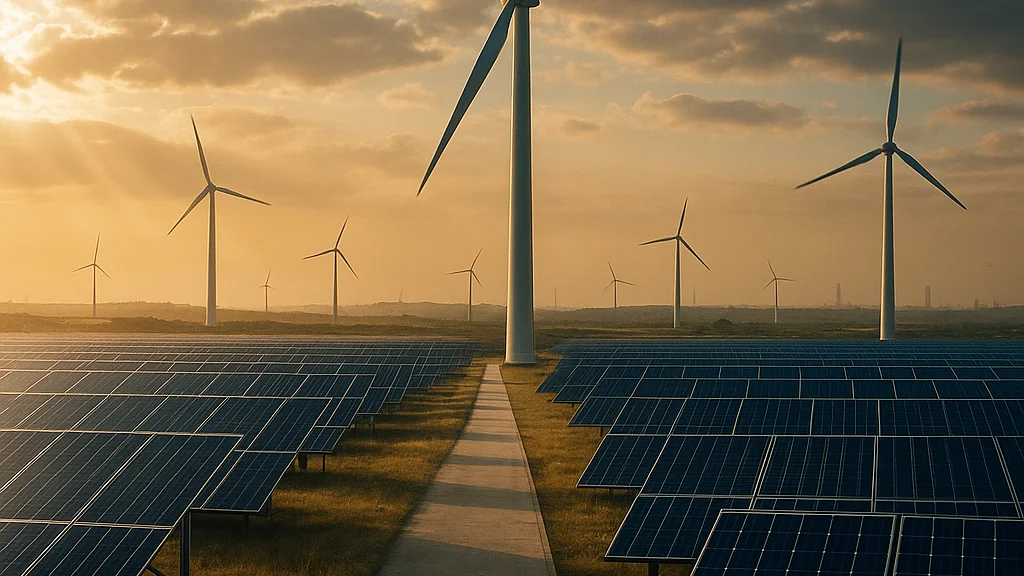

A power shift that is now visible from space
Stand on the edge of Barcelona’s port at dawn and the energy transition no longer feels abstract. Ferries arrive under cleaner grid conditions than they did a decade ago. Rooftops across Spain glitter with photovoltaic modules. Inland, wind farms turn above dry summer fields. This is not a local curiosity. It is the visible edge of a global buildout that has become one of the defining industrial stories of the century.
The most important fact is brutally simple: wind and solar are no longer niche additions to power systems. They are now central to capacity growth worldwide. According to pv magazine International’s report on global power growth in 2025, solar and wind dominated net additions to electricity generation capacity last year, confirming a trend that had been building for years but has now reached structural scale.
That matters for more than climate targets. Electricity demand is rising because of air conditioning, data centers, industrial electrification, heat pumps, and electric vehicles. Every serious forecast now treats clean power expansion as an economic necessity, not merely an environmental preference. The International Energy Agency and other major institutions have repeatedly argued that the pace of renewable deployment will shape inflation, industrial competitiveness, and energy security through the 2030s.
Readers who want a broader primer can compare this analysis with WriteUpCafe’s Beginner’s Guide to Wind and Solar Energy Capacity Growth, but the headline for 2026 is sharper: the world has moved from asking whether wind and solar can scale to asking whether grids, storage, permitting systems, and supply chains can keep up.
“The transition is no longer constrained by technology alone. It is constrained by speed, coordination, and infrastructure.”
That distinction is crucial. Turbines and panels are proven. The real contest now is over transmission lines, market design, financing costs, local acceptance, and industrial policy. Capacity growth worldwide is accelerating, but the shape of that growth varies sharply by region. China is moving at extraordinary scale. India is accelerating. Europe is balancing climate ambition with grid bottlenecks. The United States remains powerful but politically uneven. Emerging markets are the next major battleground.
How the world got here: from expensive alternatives to system anchors
Fifteen years ago, wind and solar were often discussed as supplements to conventional generation. Their critics focused on intermittency, land use, and cost. Some of those concerns remain valid, especially around grid integration and permitting. Yet the economics changed faster than many incumbents expected.
Solar module costs fell dramatically over the 2010s as manufacturing scaled, especially in Asia. Wind turbines became larger, more efficient, and better suited to lower-wind sites. Competitive auctions spread across Europe, Latin America, the Middle East, India, and parts of Africa. Capital markets became more comfortable with renewable projects as operating histories improved. By the early 2020s, in many markets, new wind and solar were the cheapest sources of new electricity generation on a levelized cost basis.
The energy crisis following Russia’s invasion of Ukraine added a second force: energy security. Governments that once framed renewables mainly as decarbonization tools began treating them as strategic assets. A widely cited report carried by Yahoo News Canada on wind and solar overtaking gas worldwide for the first time captured the symbolic importance of that shift. The point was not that fossil fuels disappeared. They did not. The point was that electricity systems had crossed a threshold where variable renewables were no longer peripheral.
Europe offers a particularly revealing example. Spain’s solar expansion, backed by strong irradiation, auction design, and corporate power purchase agreements, has become a reference point for the continent. In Catalonia, debates now focus less on whether renewables should expand and more on how quickly projects can move through planning and how communities can share benefits. The conversation has matured.
Three historical drivers explain the present moment:
- Technology learning curves: lower module, inverter, and turbine costs expanded the number of viable markets.
- Policy frameworks: feed-in tariffs gave way to auctions, tax credits, contracts for difference, and industrial subsidies.
- Strategic urgency: climate commitments, volatile gas prices, and geopolitical risk pushed governments to accelerate deployment.
That is why today’s capacity growth is not a temporary burst. It is the result of compounding industrial, political, and financial momentum. As climate scientist Johan Rockström has argued in public forums, the decisive decade is not only about setting targets; it is about physically building the systems that can replace high-emissions infrastructure at scale.
The numbers behind the boom, and what they really mean
Capacity growth is often reported in gigawatts, but gigawatts alone can mislead. A gigawatt of solar does not produce the same annual electricity output as a gigawatt of offshore wind, hydropower, or nuclear because capacity factors differ. Even so, capacity additions remain the clearest measure of industrial momentum, and on that front wind and solar are dominating.
According to pv magazine International, solar and wind accounted for the overwhelming majority of global power capacity growth in 2025. Solar remained the largest contributor by far, reflecting falling equipment prices and rapid construction timelines. Wind additions were more uneven, with stronger onshore performance than offshore in some markets due to supply chain pressure, inflation, and permitting delays. Yet wind still represented a major pillar of new clean power.
Several data points help explain the scale of change:
- Solar is winning on speed. Utility-scale solar parks can often move from financing to operation faster than large thermal plants or offshore wind farms.
- Wind remains critical for diversity. In many regions, wind output complements solar by producing more strongly in evenings, winters, or shoulder seasons.
- Storage is becoming the multiplier. Batteries are increasingly paired with solar to raise system value and reduce curtailment.
- Grid investment is lagging generation growth. This is now one of the biggest structural risks to continued acceleration.
There is another nuance that deserves attention. Installed capacity growth does not automatically translate into fossil generation decline. In fast-growing economies, clean power is often meeting new demand rather than displacing existing thermal output immediately. That is still significant. Every unit of new demand met by renewables reduces the need for future fossil lock-in.
Politifact recently highlighted a common misunderstanding in public debate: wind and solar still account for a smaller share of total global energy than they do of global electricity, because “energy” includes transport, heat, and industrial fuels. Its fact-check on the topic is useful for separating rhetoric from arithmetic, and readers can review it here: Politifact’s analysis of wind and solar’s share of global energy.
“Capacity growth is not the same as complete system transformation, but it is the clearest sign of where investment confidence has moved.”
This is why the distinction between electricity and total energy matters. Power is the beachhead. Once grids get cleaner, electric vehicles, electric heating, and some industrial processes become much more powerful decarbonization tools. That link is especially important in the EV sector. Every additional solar farm or wind project improves the emissions profile of each electric kilometer driven.
For readers tracking the broader trend line, WriteUpCafe’s Global Surge in Wind and Solar Energy Capacity Fuels Clean Power Transition offers a useful companion perspective on how this buildout is feeding wider energy system change.
Regional leaders and the uneven geography of expansion
Global growth looks smooth in charts. On the ground, it is anything but smooth. The transition is profoundly regional, shaped by land, financing, manufacturing, weather, policy, and politics.
China remains the central story. It has built renewable manufacturing dominance and continues to install wind and solar at volumes unmatched by any other country. Its scale is so large that global annual totals increasingly depend on Chinese deployment decisions. The country’s challenge is no longer whether it can build capacity, but whether transmission, market reform, and storage can absorb it efficiently across provinces.
India is the next giant to watch. The country’s electricity demand is rising quickly, and solar sits at the center of its expansion plans. An OilPrice.com report on India’s solar growth outlook pointed to expectations of roughly 22% annual growth through 2035. Even if actual deployment fluctuates, the direction is unmistakable. India sees solar not only as a climate instrument but also as a development and energy sovereignty strategy.
Europe is more complex. It has world-class policy ambition, a strong offshore wind pipeline, and increasingly mature corporate clean power markets. Yet it also faces slower permitting, community opposition in some areas, and transmission constraints. Spain, by contrast, has become one of Europe’s standout solar markets, helped by exceptional natural resources and a business environment that has attracted utility and industrial buyers. As someone who watches Iberian markets closely, I see Spain as a reminder that the European transition can move fast when solar economics, grid planning, and political will align.
Türkiye has also become a notable case. According to Anadolu Agency’s reporting on Türkiye’s renewable growth, wind and solar investments are strengthening energy security while supporting climate and emissions goals. That framing matters. In many middle-income economies, clean energy succeeds fastest when presented as a resilience and import-reduction strategy, not only as an emissions story.
Across regions, four patterns keep repeating:
- Markets with clear auction schedules and stable grid rules attract capital faster.
- Countries with domestic manufacturing ambitions are using subsidies and trade tools more aggressively.
- Transmission bottlenecks are delaying projects even where generation economics are attractive.
- Hybrid projects combining solar, wind, and storage are becoming more common.
No single model fits all. A dense, service-oriented European economy does not build like a fast-growing South Asian one. But the direction is shared: wind and solar are moving from marginal additions to the backbone of incremental power growth.
What changed recently in 2026
By mid-2026, the conversation has become more sophisticated. The question is no longer whether renewables can win annual capacity races. They already are. The sharper issue is whether the world can convert record project pipelines into stable, affordable, dispatchable clean electricity systems.
One recent shift is the normalization of solar-plus-storage. In several markets, developers now bid projects with batteries as a standard feature rather than an optional upgrade. That changes the value proposition. Solar is no longer only a midday generation source; when paired with storage, it becomes a tool for evening peak management and grid services. This is particularly relevant for electric vehicle charging clusters, logistics depots, and urban distribution networks.
A second change is political. Governments are increasingly tying renewable deployment to industrial policy. The European Union’s response to global subsidy competition, the United States’ tax-credit framework, and Asia’s manufacturing strategies all point in the same direction: clean energy is now treated as an industrial base issue. Panels, inverters, transformers, cables, and batteries have become strategic goods.
A third development is more sobering. Offshore wind, once seen as an unstoppable premium segment, has faced cost inflation, auction mispricing, and supply chain pressure in multiple markets. That does not mean offshore wind is failing. It means the sector is maturing under harsher financial conditions, with developers demanding more realistic contract structures. Onshore wind and solar have generally adapted faster because their project cycles are shorter and capital intensity is lower.
Meanwhile, curtailment has become a bigger theme in high-growth regions. When solar floods the grid at midday and transmission is inadequate, some output is wasted. This is not evidence that renewables have gone too far. It is evidence that system planning has lagged deployment. More flexible demand, stronger interconnections, batteries, pumped hydro, and smarter market signals are the obvious responses.
WriteUpCafe’s Wind and Solar Energy Capacity Growth Worldwide in 2026 tracks some of these near-term developments, but the broader takeaway is this: 2026 is the year the transition’s center of gravity shifted from generation technology to system integration.
As climate scientist Katharine Hayhoe often emphasizes in public communication, the energy transition is not one silver bullet. It is a portfolio. Wind, solar, storage, transmission, efficiency, and electrification all reinforce one another. Remove one pillar, and the whole structure weakens.
Why this matters for electric vehicles, cities, and industry
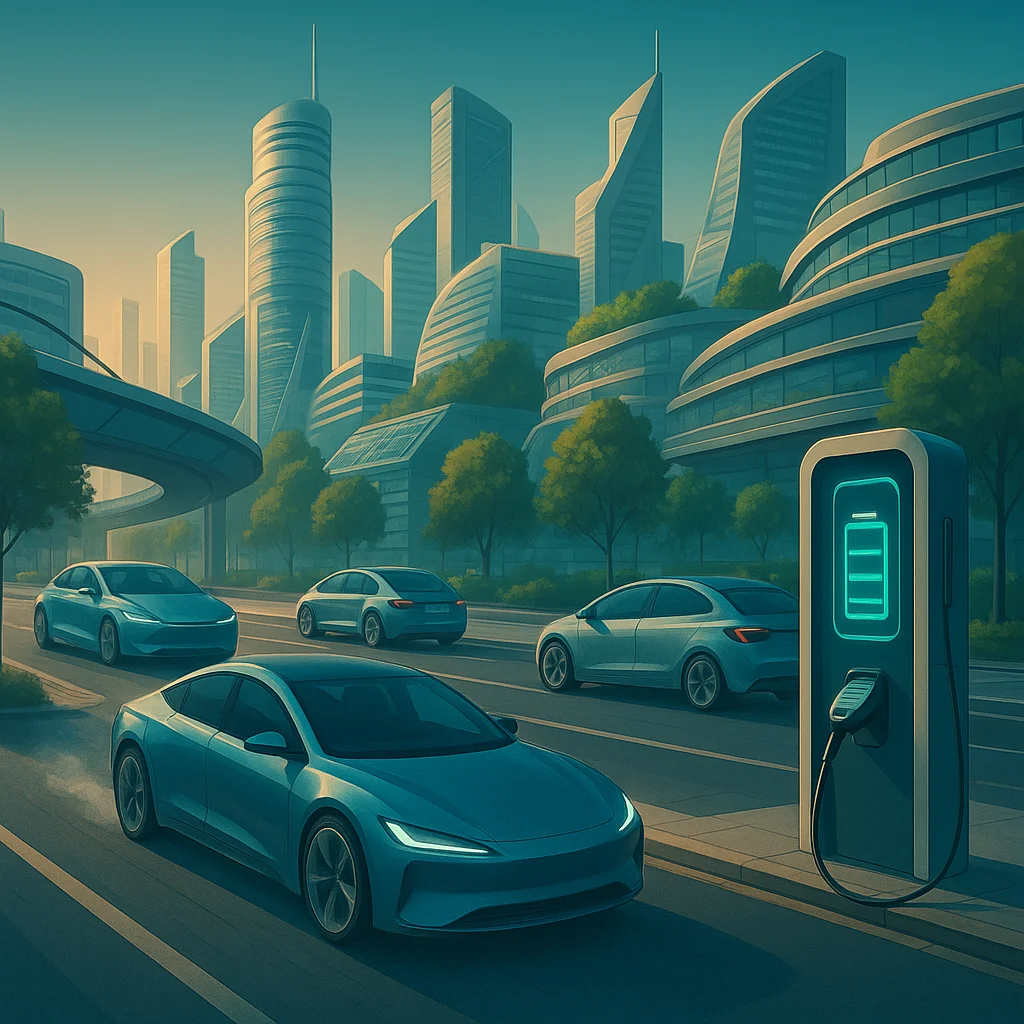
Wind and solar capacity growth is often discussed as if it were isolated from transport. It is not. The economics of electric vehicles improve as grids get cleaner and more abundant. Fleet operators care about charging costs. Cities care about air quality. Manufacturers care about power price stability. Clean electricity sits underneath all three.
Consider urban mobility. Barcelona has spent years expanding low-emission zones, transit electrification, and distributed energy thinking. The city cannot rely on architecture alone, however beautiful Gaudí’s skyline may be. It needs electrons. More renewable generation across Spain and the wider European market helps stabilize the long-run case for EV buses, delivery vans, and private charging infrastructure. Clean mobility is downstream from clean power.
Industry is also changing its behavior. Large companies increasingly sign long-term power purchase agreements with solar and wind developers to hedge power prices and meet emissions commitments. Data centers, green hydrogen projects, and advanced manufacturing plants are reshaping demand maps. In several jurisdictions, access to low-cost renewable electricity is becoming a site-selection advantage.
The practical effects can be summarized clearly:
- Lower operating costs for EV charging: abundant midday solar can reduce charging costs for workplaces, depots, and smart home charging.
- Cleaner transport emissions: the climate benefit of EV adoption rises as grid carbon intensity falls.
- Industrial competitiveness: manufacturers with access to cheap clean power can protect margins and meet customer procurement standards.
- Energy security: domestic wind and solar reduce exposure to imported fuel volatility.
This is why investors increasingly evaluate clean energy and electrified transport as one ecosystem. A battery factory without reliable low-cost power faces a competitiveness problem. An EV boom without grid upgrades risks congestion and price spikes. A renewable surge without flexible demand leaves value on the table.
For businesses and policymakers looking for execution ideas rather than broad theory, WriteUpCafe’s Expert Tips to Accelerate Wind and Solar Capacity Growth is a useful operational companion.
“The real victory is not installing a turbine or a panel. It is building a power system where clean electricity becomes the default fuel for transport, buildings, and industry.”
That is the wider significance of capacity growth. It changes what becomes possible elsewhere in the economy.
The obstacles no serious analysis can ignore
Optimism is justified, but complacency would be a mistake. The clean power boom has exposed a set of constraints that are now impossible to dismiss.
Permitting remains painfully slow in many democracies. Projects that are economically viable can still spend years in administrative limbo. Environmental review is necessary, but fragmented procedures and weak staffing can turn due process into paralysis.
Transmission is even more critical. New generation often rises in sunny or windy regions far from demand centers. Without high-voltage lines and better interconnection, cheap renewable electricity cannot reach consumers consistently. This is one of the least glamorous parts of the transition, yet it may be the most important.
Supply chains are another pressure point. Solar has benefited from massive manufacturing scale, but concentration creates vulnerability. Wind developers, especially offshore, have struggled with turbine economics, vessel availability, and specialized component costs. Batteries help solve variability, but they bring their own mineral and manufacturing dependencies.
Financing costs also matter more than many headlines admit. Renewable projects are capital-intensive up front. Higher interest rates can damage project economics even when operating costs are low. That is one reason policy certainty is so valuable: it lowers perceived risk and, by extension, the cost of capital.
Finally, there is the social dimension. Communities want affordable power and climate action, but they also want fair land use, biodiversity protection, and local benefit sharing. The best projects increasingly include community investment mechanisms, agrivoltaics, local tax revenue, or co-ownership structures. Public trust cannot be treated as an afterthought.
None of these barriers are fatal. All of them are manageable. But they require political craftsmanship, not slogans. The next stage of global capacity growth will belong to the countries that can solve these bottlenecks with speed and legitimacy.
What to watch next as the buildout enters a harder phase
The next few years will not be defined simply by how many more gigawatts are installed, though that still matters. They will be defined by whether those gigawatts are integrated into a more flexible, resilient, lower-cost system.
First, watch grid modernization. Advanced forecasting, dynamic pricing, better interconnections, and digital grid management will determine whether renewable-heavy systems operate smoothly. This is where utilities, regulators, and software providers become as important as turbine and panel manufacturers.
Second, monitor storage economics. If battery costs continue to improve and duration expands, solar’s value profile will strengthen dramatically. Short-duration batteries are already changing peak management. Longer-duration storage could reshape seasonal balancing in selected markets.
Third, follow electrification demand. The more transport, heating, and industry shift onto the grid, the more valuable rapid renewable deployment becomes. Electric vehicles are especially important because flexible charging can absorb surplus solar and support grid balancing if incentives are designed intelligently.
Fourth, pay attention to emerging markets finance. Many countries with excellent solar and wind resources still face high borrowing costs. If multilateral lenders, development banks, and blended finance structures reduce those costs, global capacity growth could accelerate well beyond current expectations.
My own view is hopeful but disciplined. The world has already proved it can mass-produce clean generation. The harder task now is orchestration. Europe must build wires faster. India must sustain execution at scale. China must continue reforming grid integration. Middle-income economies must secure affordable capital. Cities from Barcelona to Bengaluru must align mobility, buildings, and power planning.
If that happens, wind and solar will do more than grow. They will become the organizing logic of 21st-century electricity systems. And once that logic is established, electric mobility, cleaner industry, and more resilient cities follow much more naturally.
The age of pilot projects is over. The age of systems building has begun.
































Sign in to leave a comment.