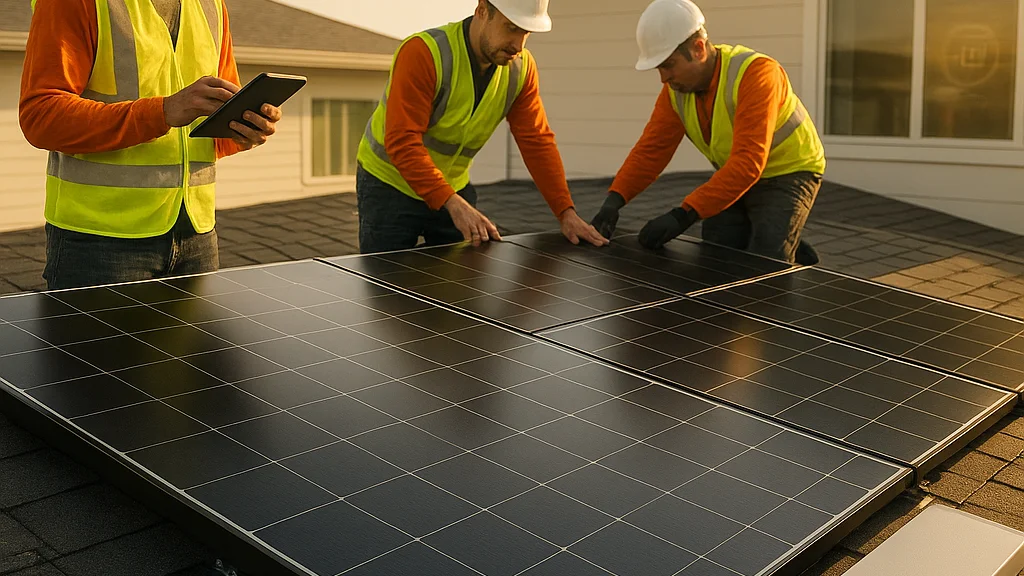

On a bright winter afternoon in Calgary, solar can feel almost counterintuitive. Snow on the fence, a cold wind moving across the yard, and yet a rooftop array still quietly producing electricity. That image captures why home solar has moved from niche enthusiasm to serious household planning. The modern question is no longer whether solar works in a few famously sunny places. It is whether your roof, budget, utility rules, and long-term plans make a system worth installing.
For homeowners, the appeal is practical before it is ideological. Electricity prices have risen in many markets, grid reliability has become a more personal concern, and the equipment itself has become more familiar. Panels are more efficient than they were a decade ago, battery options have broadened, and financing has become easier to compare. At the same time, the wrong installation can lock a family into disappointing output, awkward roof work, or a payback period that never really settles into comfort.
This guide is designed to slow the process down in the best way. If you are at the very beginning, the Beginner’s Guide to Solar Panel Installation at Home offers a useful starting frame. If you already know the basics and want a broader checklist, What You Need to Know About Solar Panel Installation: A Home Guide pairs well with the deeper analysis here.
A good solar purchase is not just about buying panels. It is about matching a home’s physical reality, utility structure, and future energy habits to a system that performs well for 20 years or more.
That is the heart of it. A home solar project sits at the intersection of construction, finance, and daily life. Done carefully, it can reduce bills and lower household emissions. Done casually, it can become an expensive lesson in assumptions.
Start with the roof, not the brochure
The first serious step in any solar panel installation home guide is a roof assessment. Homeowners often begin with panel brands or savings claims, but installers begin with geometry. Roof orientation, pitch, age, structural condition, and shading determine whether the rest of the conversation is exciting or constrained. A south-facing roof in the Northern Hemisphere is often ideal, but east-west roofs can still be productive. Steepness matters less than many people think; severe shade matters much more.
CNET’s reporting on shade and solar performance is especially useful here because it addresses a common homeowner blind spot: trees, chimneys, dormers, neighboring buildings, and even seasonal sun angles can materially reduce output. Shade on one section of an array does not always ruin the whole project, particularly with module-level power electronics such as microinverters or optimizers, but it changes the production math. A system that looks good on a generic online calculator may perform very differently once a site visit captures real obstructions.
Roof age is another quiet deal-breaker. If your shingles are near the end of life, installing solar first usually creates extra cost later because the array may need to be removed and reinstalled for reroofing. That can erase part of the expected savings. Structural load also deserves attention. Panels, racking, and snow loads add weight, and local building rules may require engineering review before permits are approved.
There are a few practical questions worth asking before you request quotes:
- How old is the roof covering, and when is replacement likely?
- Which roof planes receive the longest unobstructed sun exposure?
- Are there vent stacks, skylights, or chimneys that limit layout options?
- Will nearby trees grow enough over the next five to ten years to increase shade?
- Does the attic or framing show any moisture or structural concerns?
These details sound unglamorous, but they shape everything from panel count to labor cost. A careful installer should measure, model, and explain those constraints in plain language. If the proposal skips that step, treat the savings estimate gently.
How to size a home solar system without fooling yourself
System sizing is where many homeowners either overspend or undershoot. The instinct to cover “100% of the bill” is understandable, but it is not always the smartest target. Utilities compensate exported electricity differently depending on local net metering, feed-in tariff, or avoided-cost rules. In some places, excess production is credited generously. In others, exported power is worth much less than the electricity you buy from the grid. That changes the economics of system size dramatically.
The cleanest way to start is with your last 12 months of electricity consumption, measured in kilowatt-hours. Look for seasonal swings. A home with electric heating, central air, a hot tub, or an EV charger may have very uneven usage. Then think forward, not backward. Will you add a heat pump, induction range, or electric vehicle in the next few years? A solar array sized only for current use may feel too small quickly.
Most residential systems in North America often fall somewhere in the mid-single-digit to low-double-digit kilowatt range, but that broad range is not a recommendation. A compact, efficient home with gas heating may need far less than a larger all-electric property. According to industry reporting and installer disclosures, panel wattages commonly available to homeowners have moved higher over time, which means fewer panels may produce the same capacity compared with older systems. That can help on roofs with limited space.
The right size is the one that aligns with your utility policy, your roof’s production profile, and the home you expect to live in five years from now, not just the bill you paid last month.
When comparing proposals, ask installers to show the assumptions under the headline numbers. You want to see estimated annual production, degradation assumptions, utility rate assumptions, and whether the model includes realistic losses from temperature, inverter conversion, and shading. A responsible quote should make room for uncertainty rather than pretending every sunny hour behaves perfectly.
- Gather 12 months of electric bills and total annual kWh usage.
- List likely future loads such as EV charging, electric water heating, or heat pumps.
- Review local compensation rules for exported solar power.
- Compare system size against roof space and expected annual production, not just panel count.
- Stress-test payback estimates against modest utility-rate changes and realistic panel degradation.
If you want a complementary roundup of planning angles and homeowner questions, Solar Panel Installation Home Guide: Everything You Need to Know provides a helpful companion read.
Understanding the real costs: equipment, labor, financing, and payback
Solar pricing can look deceptively simple in advertisements. A company may quote a cost per watt, a monthly payment, or a “free installation” tied to a financing structure. Those are not the same thing. The installed price of a home system usually includes panels, inverters, racking, wiring, permitting, design, labor, inspections, and often monitoring software. Batteries, main electrical panel upgrades, roof work, trenching, and consumption monitoring may be extra.
One reason homeowners get confused is that the market mixes cash pricing, loans, leases, and power purchase agreements. Cash purchases usually provide the clearest long-term economics because you avoid financing charges and keep direct ownership benefits. Loans can still make sense, especially where incentives are strong and electric rates are high, but the annual percentage rate, dealer fees, and term length matter enormously. Leases and PPAs reduce upfront cost but can complicate resale and limit the share of savings that stays with the homeowner.
Electrek’s guide to Tesla solar pricing is useful not because every homeowner should choose Tesla, but because it illustrates how system pricing discussions often separate hardware from broader project realities. The sticker number rarely tells the whole story. Likewise, BGR’s overview of what to know before installing solar panels highlights a truth seasoned buyers learn quickly: installer quality and contract clarity are just as important as nominal equipment cost.
When you evaluate payback, include these variables:
- Upfront cost after incentives: tax credits, rebates, or local subsidies can materially reduce net cost.
- Utility rate structure: time-of-use pricing may increase the value of pairing solar with a battery.
- Annual production: conservative estimates are healthier than rosy ones.
- Maintenance and insurance: usually modest, but not zero.
- Opportunity cost: cash tied up in solar is cash not used elsewhere.
A healthy quote comparison should include at least three installers. Ask each one for a cash price, financed price, warranty summary, production estimate, and a line item for any electrical upgrades. If one proposal is dramatically cheaper, look for what has been omitted. Sometimes the missing piece is not obvious until permit or interconnection stage, when the homeowner is already emotionally committed.
Choosing an installer: credentials, warranties, and contract traps
The installer you choose may matter more than the panel brand on the roof. Modules from established manufacturers often perform within relatively predictable ranges, but installation quality varies widely. Flashing details, wire management, roof penetrations, conduit routing, labeling, panel layout, and post-install support all depend on the company and crew. A well-designed system can be undermined by rushed workmanship or aggressive sales culture.
The Independent’s review of Heatable’s solar installation service is a reminder that homeowners increasingly compare installers not only on cost, but on responsiveness, equipment options, and project management. That trend makes sense. Solar is not a shelf product. It is a home improvement project with permitting, utility approvals, inspections, and long-tail customer service needs.
Ask prospective installers for license details, proof of insurance, examples of recent local installs, and the brands they use for panels, inverters, and mounting systems. Clarify who actually performs the work. Some companies sell the job and subcontract the installation. Subcontracting is not automatically bad, but it should be disclosed, and responsibility for warranty claims must be unmistakably clear.
Warranties deserve a slower read than most people give them. There are usually three categories: product warranty for the panels, performance warranty on output over time, and workmanship warranty from the installer. Inverter warranties may differ from panel warranties, and battery warranties often include throughput or cycle limitations. A 25-year panel performance warranty sounds comforting, but if the installer’s workmanship coverage is only a few years and the company disappears, the practical value changes.
Before signing, review these contract points carefully:
- Who owns the permits, utility paperwork, and inspection scheduling?
- What happens if the roof needs repair after design approval?
- Are production guarantees included, and how are they measured?
- What are the cancellation terms and deposit rules?
- Who monitors the system and responds if output drops unexpectedly?
If a sales representative avoids specifics, pushes same-day signatures, or relies on inflated utility inflation assumptions to make the numbers work, pause. Gentle caution can save a lot of heartache later.
Batteries, backup power, and whether storage belongs in your plan
Battery storage is often the most emotionally charged part of a home solar decision. The promise is deeply appealing: store daytime solar production, use it after sunset, and keep some household circuits running during outages. Yet batteries still add significant cost, and their value depends heavily on local conditions. In areas with stable grids and favorable net metering, a battery may extend payback rather than improve it. In places with frequent outages, demand charges, or time-of-use pricing, storage can become far more compelling.
Homeowners should separate three ideas that are often blended in marketing. First, solar panels alone usually do not provide backup power during a grid outage unless paired with appropriate battery and control equipment. Second, not every battery system is designed to run an entire house. Many are configured to support a critical-load panel covering essentials such as refrigeration, lighting, internet, and selected outlets. Third, backup duration depends on battery size, load management, weather, and whether the solar array can continue recharging during an outage.
This is where lifestyle matters. A household working from home, storing medication that needs refrigeration, or living in a wildfire-prone or storm-prone region may value resilience beyond simple payback. Another family may prefer to keep costs lower and add storage later if prices improve or utility rules change. Both choices can be sensible.
There is also a growing conversation around smaller-scale solar formats. The MSN piece on balcony solar panels reflects how urban residents and renters are exploring modular options where full rooftop systems are not feasible. Those setups are not direct substitutes for a traditional home array, especially in markets with strict electrical rules, but they signal a broader shift: distributed solar is becoming more flexible in form, not just more common.
For detached homeowners, the battery question should be framed around priorities:
- Do you want bill savings, outage protection, or both?
- How often does your grid fail, and for how long?
- Are your utility rates time-sensitive enough to reward evening discharge?
- Would a generator solve your resilience needs at lower cost?
- Can your household realistically reduce loads during an outage?
Storage can be wonderful. It is just not automatically necessary. That distinction matters.
What has changed recently, and what homeowners should watch in 2026
By 2026, the home solar conversation is more mature than it was even a few years ago. Several shifts stand out. First, consumers are asking harder questions about financing and promised savings. That is healthy. The industry’s rapid growth brought innovation, but it also attracted uneven sales practices. Homeowners are increasingly aware that low monthly payment claims can obscure total repayment cost or depend on incentives being claimed in a specific way.
Second, electrification is reshaping system design. A home that adds a heat pump, electric water heater, induction cooking, and an EV charger may see electricity demand rise substantially even as fossil fuel use falls. Solar is therefore being planned less as a niche add-on and more as part of a household energy platform. That includes panel upgrades, smart load controls, EV charging strategy, and sometimes batteries. The result is a more integrated project, but also a more complex one.
Third, equipment expectations have changed. Homeowners now commonly ask about app-based monitoring, panel-level visibility, battery compatibility, and black-start or backup features. They want cleaner aesthetics too. All-black panels, hidden conduit where possible, and better roof layouts are part of the sales conversation. This may sound cosmetic, but visual acceptance often determines whether a family feels good about the purchase years later.
There is also more regional nuance in 2026. Local utility policies and permitting timelines can still make or break project value. In some jurisdictions, interconnection remains slow. In others, subsidy structures are reshaping demand quickly. Hyperlocal guidance can therefore be more useful than generic national advice. For readers interested in how subsidy and savings calculations can differ by city and policy environment, this WriteUpCafe guide focused on Lucknow shows how location-specific planning changes the equation.
In 2026, the smartest solar buyers are not the fastest buyers. They are the ones who understand their utility rules, verify installer claims, and plan for how their homes will use electricity over the next decade.
That may be the biggest recent change of all: solar has become ordinary enough that the best decisions are less about enthusiasm and more about disciplined homework.
A practical roadmap from first quote to switched-on system
If you are ready to move from research to action, the process becomes much less intimidating when broken into stages. The first stage is information gathering: bills, roof age, future appliance plans, and local utility rules. The second is proposal comparison. The third is contract review and site verification. Then come permits, utility interconnection, installation, inspection, and permission to operate. The timeline can be surprisingly uneven. Physical installation may take only a few days, while paperwork can stretch much longer.
Here is a grounded sequence that tends to serve homeowners well:
- Collect 12 months of bills and note any upcoming changes in electric use.
- Confirm roof condition and whether reroofing should happen first.
- Request at least three detailed proposals with production estimates and equipment lists.
- Compare cash and financed costs separately.
- Read warranty terms and ask who handles post-install service.
- Verify permits, inspections, and utility interconnection responsibilities in writing.
- Review the final design for panel placement, conduit routing, and inverter location.
- After activation, monitor production monthly and keep all documentation.
Once the system is live, do not assume your job is over forever. Monitoring matters. A good app or portal should show whether production is behaving roughly as expected. Sudden drops can signal inverter issues, tripped breakers, communication failures, or unexpected shade growth. Light maintenance, such as keeping nearby foliage in check and visually inspecting for obvious debris or damage, is usually enough for most households. Professional cleaning is not always necessary, but local dust, pollen, smoke residue, or low-slope roof conditions can change that.
The gentlest truth about solar is that there is no universal perfect setup. There is only a well-matched one. A modest system on a sound roof with honest assumptions can be a better investment than a larger, flashier install sold on optimism alone. Take your time. Ask one more question than feels polite. Read the contract on a quiet evening, maybe after dinner, when the house is settled and your mind is clear. Your future self will thank you for that patience.
And if the process feels a little technical, that is all right. Most worthwhile home projects do at first. Step by step, it becomes legible. Be kind to yourself while you sort it out.



































Sign in to leave a comment.