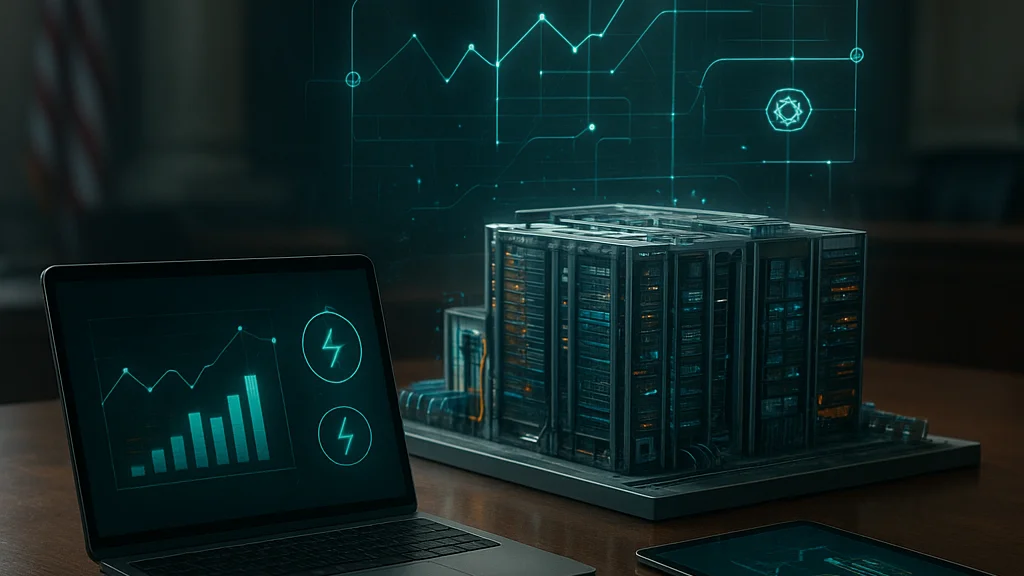

A row of windowless buildings can look strangely quiet from the road. No smokestacks, no assembly lines, no visible crowds. Yet behind those walls, racks of servers can draw as much electricity as a small city. That gap between appearance and reality is exactly why U.S. senators have pressed federal agencies to get a clearer picture of how much power data centers actually consume. The issue is no longer niche. It sits at the intersection of artificial intelligence, grid reliability, industrial policy, water use, and climate targets.
Recent reporting has sharpened the urgency. Wired reported that the federal government is moving to ask data centers directly about their electricity use, reflecting concern that policymakers have been planning around incomplete information. Meanwhile, PBS NewsHour documented how state clean-energy plans are being strained by a wave of new data center development. Those two threads are connected: if the country cannot measure the load accurately, it cannot plan generation, transmission, storage, or emissions reductions with confidence.
For readers trying to make sense of the political fight, the technical jargon can obscure the real question. Senators are not merely asking for a spreadsheet. They are asking whether public officials, utilities, and communities are flying blind while one of the fastest-growing sources of electricity demand expands at breakneck speed. That concern has been explored from several angles in WriteUpCafe’s Rethinking Senators’ Demand to Know How Much Energy Data Centers Use and Senators Demand Transparency on Data Center Energy Use Amid Sustainability Push. The deeper question now is practical: what should industry, regulators, investors, and communities do with this demand for transparency?
The central policy problem is simple: when electricity demand from data centers is underestimated, every downstream decision on grids, rates, emissions, and water can be wrong.
The best expert advice starts there. Measure first, standardize second, compare apples to apples, and do not confuse corporate sustainability claims with systemwide impacts. Once those principles are clear, the debate becomes much easier to evaluate.
Why senators are asking now, not later
The timing is not accidental. Since late 2022, generative AI has shifted data center demand from a steady enterprise-computing story into a national infrastructure story. Training and running advanced AI models requires dense clusters of graphics processing units and specialized accelerators that can consume enormous amounts of electricity and shed large amounts of heat. Hyperscale operators were already expanding before the AI boom, but the economics of AI inference and training have accelerated land purchases, utility interconnection requests, and long-term power procurement.
Lawmakers have also watched utilities revise load forecasts upward. Across several U.S. regions, data centers have become a leading source of new demand, sometimes overshadowing electric vehicles or building electrification. According to Reuters and other major outlets that have tracked utility filings, planners in states such as Virginia, Texas, Georgia, and Arizona have had to revisit assumptions about future capacity needs. The concern in Congress is that federal energy statistics have not kept pace with this shift. If policymakers still rely on outdated models or broad commercial-building categories, they may miss the true scale and concentration of demand.
That concern is reflected in reporting from TechRepublic, which described the expansion of a federal energy-reporting pilot tied to mandatory data center energy disclosure efforts. The significance of that move is easy to understate. A pilot is not just administrative housekeeping. It is often the precursor to a more durable reporting framework that can support legislation, rate cases, transmission approvals, and environmental review.
There is also a political reason for urgency. Communities increasingly ask whether the economic benefits of data centers match their infrastructure costs. A facility may create construction jobs and tax revenue, but it can also require new substations, transmission upgrades, backup generation, and water-intensive cooling systems. When senators demand better numbers, they are responding to a widening trust gap.
- AI growth has increased server density and power intensity.
- Utility forecasts in major markets have moved sharply higher.
- State climate plans are harder to meet when large new loads arrive quickly.
- Local communities want clearer disclosure on grid and water impacts.
The practical takeaway is that the political pressure is rooted in physical infrastructure, not abstract ideology. The grid has to balance in real time, regardless of how incomplete the data may be.
The measurement problem: why nobody seems to agree on the numbers
One reason this debate feels confusing is that several different questions are often blended together. How much electricity does a single facility draw at peak? How much does it use over a year? How much of that load is constant, and how much is flexible? Does the number include cooling, battery charging, and on-site support systems? Are we counting only colocation and hyperscale sites, or also edge facilities and enterprise server campuses? These distinctions matter because a headline figure can be technically true and still misleading for planners.
Experts generally advise focusing on a few comparable metrics. The first is annual electricity consumption, usually measured in megawatt-hours or terawatt-hours. The second is peak demand in megawatts, which matters for generation and transmission planning. The third is power usage effectiveness, or PUE, which compares total facility energy to IT equipment energy. A lower PUE can indicate a more efficient building, but it does not necessarily mean the total load is small. A huge, efficient facility can still overwhelm local infrastructure.
Reporting gaps make the challenge worse. An MSN report on Texas captured the uncertainty bluntly: many proposed projects have announced capacity ambitions, but no one can say with confidence how much power all of them will ultimately use. Some projects are built in phases. Others secure land and interconnection rights before final equipment plans are set. Some reserve more capacity than they immediately need. Utilities therefore face a planning puzzle: they must prepare for large loads that may arrive late, arrive early, or never fully materialize.
A data center’s announced size is not the same thing as its actual annual electricity use. Capacity reservations, phased construction, utilization rates, and cooling design can produce very different outcomes.
Another complication is confidentiality. Large operators often treat detailed load data as commercially sensitive. They may argue that granular disclosures reveal strategic information about customer demand, AI deployment, or future expansion. Senators pushing for transparency are effectively challenging that norm, arguing that when private demand has public consequences, some disclosure becomes a matter of public interest.
The strongest expert tip here is methodological: insist on standardized reporting categories. Without them, comparisons across states and companies become little more than educated guesswork.
- Separate connected load from actual energy consumed.
- Report both peak demand and annual usage.
- Disclose PUE, cooling method, and backup power design.
- Identify whether the site supports AI training, inference, cloud hosting, or colocation.
- Clarify whether renewable procurement is hourly matched, annual matched, or based on offsets.
Those details turn a political slogan about transparency into a usable planning tool.
What the data center boom means for climate goals and local grids
The clean-energy implications are not theoretical. PBS reported that states are struggling to stay on track with climate goals as data center demand rises. The core tension is straightforward. A state may be adding solar, wind, and batteries, but if electricity demand jumps faster than clean generation, fossil-fuel generation can remain on the system longer or run more often. That does not mean data centers are uniquely to blame for emissions growth in every market, but it does mean they can materially alter the pace of decarbonization.
Virginia remains the most cited example because Northern Virginia hosts the world’s largest concentration of data centers. Yet the issue has spread well beyond one corridor. Texas has seen aggressive development tied to land availability and market structure. Georgia has attracted major projects through tax incentives and utility access. Arizona has become a magnet for facilities despite water concerns, partly because of land and logistics advantages. Oregon and other Pacific Northwest markets face a different challenge: uncertainty about future demand can complicate long-range resource planning even before projects are fully built.
Oregon Public Broadcasting reported in April 2026 that data center uncertainty is making grid planning difficult, a point that energy economists have stressed for years. Utilities do not simply need more electrons in the abstract. They need the right combination of generation, reserves, transmission capacity, and flexibility at the right time. A 24/7 industrial load with limited curtailment potential is much harder to integrate than a load that can shift or scale back during system stress.
For sustainability-minded readers, one expert tip stands out: ask whether a project is adding clean capacity in a way that aligns with when it consumes power. Annual renewable energy matching can make a corporate report look strong while leaving a grid heavily dependent on gas during evening peaks or seasonal shortfalls. More sophisticated buyers are moving toward hourly matching, firm clean power contracts, geothermal, advanced nuclear discussions, long-duration storage, and demand-response arrangements. Those strategies are still evolving, but they reflect a more honest attempt to reduce systemwide emissions rather than just improve branding.
That distinction matters because the public debate has matured. The question is no longer whether data centers can buy renewable credits. It is whether their growth is compatible with credible decarbonization pathways.
Current developments in 2026 that changed the conversation
By mid-2026, the policy conversation has become more concrete than it was even a year earlier. Federal reporting efforts have advanced, state regulators have become more aggressive in scrutinizing large-load interconnections, and utilities have started to separate speculative demand from contracted demand more carefully. This is a major shift. For years, data center growth was often treated as a local economic-development win first and a system-planning issue second. That order has reversed in many jurisdictions.
One catalyst has been the widening gap between announced AI ambitions and available power infrastructure. Companies can order chips and sign leases faster than transmission lines can be permitted or gas turbines can be delivered. As a result, some projects have had to rethink timelines, phase deployments, or consider on-site generation options. Industry analysts have also noted a rise in discussions around behind-the-meter generation, microgrids, and hybrid designs that combine grid supply with batteries or dedicated generation. Those solutions may ease bottlenecks, but they raise fresh questions about emissions accounting, local air quality, and cost allocation.
Another 2026 development is that regulators have become more focused on who pays for grid upgrades triggered by very large customers. Residential and small-business ratepayers do not want to subsidize infrastructure built primarily for hyperscale campuses. Consumer advocates increasingly argue for tariff designs that assign costs more directly to the loads creating them, especially when those loads are concentrated and rapidly growing. Senators demanding better energy-use data are, in effect, supporting that rate-design debate because transparent usage data helps determine fair cost recovery.
WriteUpCafe’s Senators Demand Transparency on Data Center Energy Use in 2026 highlighted how this issue has evolved from a transparency request into a broader governance challenge. That framing is useful. Once reliable reporting exists, the next questions follow quickly: Which facilities are flexible during emergencies? Which are tied to new clean generation? Which require major transmission upgrades? Which rely heavily on water-intensive cooling in stressed regions?
The expert lesson for 2026 is that transparency is no longer the finish line. It is the entry ticket to more difficult debates about allocation, accountability, and infrastructure sequencing.
Expert tips for evaluating claims from operators, utilities, and politicians
When a company says its new data center will be sustainable, readers should ask a more disciplined set of questions than public-relations materials usually invite. The first is whether the claim refers to the building, the electricity supply, or the company’s broader corporate portfolio. A highly efficient building can still run on a carbon-intensive grid. A company can also claim renewable coverage on an annual basis while drawing heavily from fossil-backed power during critical hours. Precision matters.
The second question is about scale. A project described as a 100-megawatt campus may sound straightforward, but experts know that actual build-out can be staged and utilization can vary. Conversely, a smaller-sounding site can still have outsized local effects if it is in a constrained grid zone. Look for specifics on contracted load, in-service dates, cooling technology, and whether backup generators are for emergencies only or part of a broader operational strategy.
The third question concerns water. Electricity gets most of the headlines, but many high-performance data centers also consume significant water for cooling, depending on design and climate. Water use is especially contentious in drought-prone regions. If a company touts energy efficiency while saying little about water intensity, the sustainability picture is incomplete.
Here are the most useful expert filters:
- Do not accept one metric alone. PUE, renewable matching, and annual energy use each tell only part of the story.
- Check the geography. A green procurement deal in one region may not reduce stress on the local grid serving the facility.
- Ask about timing. Hourly demand patterns matter more than annual averages for reliability and emissions.
- Look for cost allocation details. Who pays for substations, transmission, and reserve capacity?
- Examine flexibility. Can the site curtail noncritical workloads during grid emergencies?
Politicians deserve the same scrutiny. Some frame every data center as a jobs bonanza; others frame every project as an environmental threat. Reality is more conditional. The smartest policy approach rewards transparent, efficient, grid-supportive projects and subjects opaque or infrastructure-heavy proposals to tougher review.
Good data center policy is not anti-tech. It is pro-disclosure, pro-grid realism, and pro-accountability about who bears the costs of rapid digital expansion.
That distinction is essential for a serious sustainability conversation. The goal is not to stop computing. It is to align digital growth with physical limits and public obligations.
What communities, investors, and sustainability professionals should watch next
The next phase of this story will turn on a handful of measurable signals. First, watch whether federal energy reporting becomes routine, standardized, and detailed enough to support state planning. If disclosures remain partial or inconsistent, senators may push for stronger statutory authority. Second, monitor how utilities classify data center demand in integrated resource plans. A growing number are expected to distinguish between speculative pipeline demand and legally binding commitments, which would improve planning discipline.
Third, pay attention to contract innovation. The most credible large buyers are likely to move beyond broad renewable claims toward cleaner hourly matching, firm low-carbon supply, and flexible load arrangements. If those models spread, data centers could become more manageable from a grid perspective. If they do not, the sector may face tougher siting battles and more public opposition.
Investors should also watch the economics of delay. Power availability is becoming a competitive differentiator. A company with land, chips, and capital but no reliable electricity pathway may find its expansion plans stalled. That reality could shift investment toward regions with stronger transmission prospects, more transparent utility processes, or abundant clean firm power. It may also elevate the value of retrofits, efficiency upgrades, and workload optimization inside existing facilities, where megawatts saved can be as valuable as megawatts procured.
For local officials and residents, the practical advice is straightforward:
- Request public disclosure of projected peak load, annual energy use, and water demand.
- Ask utilities whether grid upgrades are customer-funded or socialized.
- Press developers on cooling technology, backup generation, and emissions implications.
- Seek clarity on community benefits, including tax revenue, jobs, and infrastructure offsets.
- Compare short-term incentives with long-term constraints on land, power, and water.
Senators demanding to know how much energy data centers use are asking a question that sounds narrow but is actually foundational. The answer will shape electricity prices, transmission build-out, decarbonization timelines, and the social license of the AI economy. The most useful expert perspective is neither alarmist nor complacent. It is empirical. Count the load accurately. Publish the assumptions. Distinguish efficiency from total impact. Then make decisions that reflect the real footprint of digital infrastructure, not the imagined one.
If that sounds basic, it is. But in infrastructure policy, basics decide everything. What gets measured gets planned. What gets planned gets built. And what gets built determines whether the digital future can coexist with a credible clean-energy future.

































Sign in to leave a comment.